


AI Agent Tools: Comparison of 15+ Platforms

An AI agent reads context, picks a tool, acts, and checks the result before choosing the next step. That loop separates an agent from a chatbot. Agents work as co-pilots: they research, draft, and execute, and a person approves anything consequential.
The 15 tools below cover four categories: coding agents, enterprise agent platforms, customer service and conversational agents, and agent development and automation frameworks.
AI coding agents
Tool | Best fit | Key limitation |
|---|---|---|
Claude Code | Terminal work, hard architectural problems | Federal procurement status unsettled2 |
OpenAI Codex | Parallel cloud-delegated tasks | Default model changes often, so benchmarks go stale |
Cursor | Fast iteration inside a full IDE | Ownership moved to SpaceX in August 20263 |
GitHub Copilot | Teams standardized on GitHub and VS Code | Depth per agent trails dedicated tools |
Kiro | AWS teams that want specs before code | Arrives as a forced migration from Amazon Q Developer |
Claude Code Anthropic’s terminal-based coding agent, which reads a repository, edits files, runs tests, and iterates on failures. Its Code Review feature dispatches parallel agents across a pull request, verifies findings to filter false positives, and posts inline comments ranked by severity without approving the PR itself.1
OpenAI Codex OpenAI’s coding agent, available through a CLI, a desktop app, IDE integrations, and ChatGPT. The CLI is open source, connects to MCP servers, and can import existing setup and past sessions from Claude Code and Cursor.2
Cursor An AI code editor built on VS Code that runs local and cloud agents side by side. It ships its own Composer models alongside third-party ones, plus plugins, MCP servers, hooks, skills, and iOS remote control for cloud agents.3
GitHub Copilot A multi-agent development environment spanning the CLI, VS Code, and JetBrains IDEs. Its CLI delegates to four specialized agents that run in parallel, Explore, Task, Plan, and Code-review, and compresses conversation history automatically at 95% of the token limit.4
Kiro (AWS) A spec-driven IDE and CLI that inverts the usual order of work. A plain-language request becomes a structured specification, a design document, and sequenced tasks before any code is written, with hooks and custom subagents running against that plan.
Enterprise agent platforms
OpenAI Frontier An end-to-end platform for building and managing agents, including agents built outside OpenAI. Each agent receives its own identity scoped to the access a task requires, with monitoring and detailed logs, and a shared context layer connecting CRMs, data warehouses, and internal applications.
Microsoft Agent 365 A control plane that governs agents whether they were built in Copilot Studio, bought from a vendor, or installed on a user’s device. It extends Microsoft Entra network controls to those agents, restricting which destinations they can reach and filtering risky file movement.
Gemini Enterprise Agent Platform Google’s successor to Vertex AI, covering model selection, agent building, orchestration, and governance in one console. More than 200 models are available through Model Garden, alongside managed MCP servers with Apigee bridging existing APIs to agents.
IBM watsonx Orchestrate An orchestration layer aimed at regulated industries. Its Agentic Control Plane adds a governance dashboard, a security control center, and observability traces that show how context changes as work moves across a workflow.
Creatio AI Studio The agent layer of Creatio’s CRM and workflow platform, running alongside Business Studio for no-code applications and AI Twin for personal agents built by end users. It offers two designers: a Prompt Agent Designer for natural-language agents and a Workflow Agent Designer for deterministic multistep processes. Governance covers policy enforcement, approval checkpoints, execution monitoring, and consumption tracking per agent, model, and action. Agents connect through REST and MCP and run over web chat, messaging, SMS, voice, and video. Prebuilt agents ship for sales, marketing, and service, plus industry sets for banking (onboarding, loan preparation, loan servicing, referral, renewal, retention) and manufacturing field visits.
Customer service and conversational agents
Salesforce Agentforce Customer service and sales agents that run directly against Salesforce records, spanning Agentforce Sales, Agentforce Service, and Agentforce Analytics on a shared platform. Salesforce measures output in Agentic Work Units, tasks an agent completed, rather than seats or sessions.
OpenAI Presence A voice and chat agent product where each deployment is scoped to a single job, such as resolving a billing issue or an IT service request. The company sets the policies, approved actions, and escalation rules; Codex then proposes updates from production sessions that teams test against the live version before rollout.
Tidio Lyro An SMB chat agent built on Claude. It answers from operator-supplied content, such as FAQ entries, help articles, and scraped site pages, rather than open-ended generation, and routes questions it cannot resolve to a human agent.
Agent development and automation frameworks
Teams use these products to build agents rather than buy them.
LangGraph A low-level orchestration runtime that models agent workflows as graphs with an explicit state schema. With a checkpoint configured, a run can be saved and resumed at any point, which makes multi-day approval processes and background jobs practical.
CrewAI A Python framework where each agent takes a role, a goal, and a backstory, then collaborates through a crew orchestrator. It supports MCP for tool access, A2A for delegation between agents, and checkpointing that replays or forks a run from a chosen step.
n8n A workflow automation platform with dedicated AI agent nodes. Its MCP client and server nodes let a workflow both call external tools and act as a tool that other agents call, and the Community Edition self-hosts with no execution limit.
What Is an AI Agent?
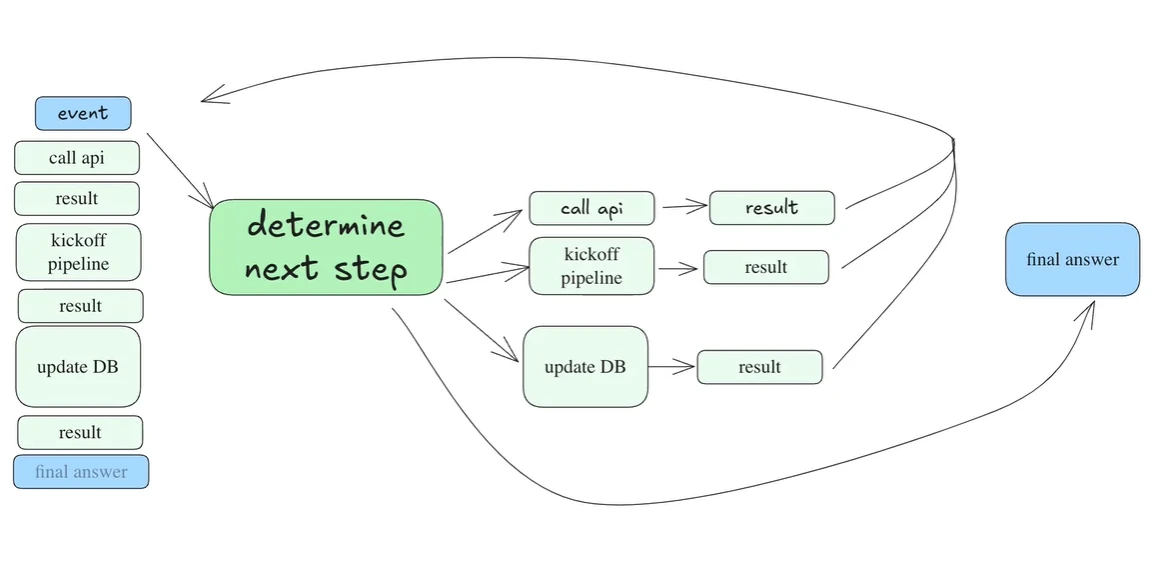
An AI agent loops. That is the core difference from a chatbot. A chatbot answers. An agent plans a step, calls a tool, reads the result, and decides what to do next until the task ends or a limit stops it.
Source: GitHub5
No single definition holds across the industry. Traditional AI defines an agent as a system that perceives an environment and acts on it. Some analyst firms reserve the term for systems operating independently across long horizons. Others apply it to prescriptive workflows with a model in the middle.
The 12-factor agents project proposes engineering principles for building reliable LLM-powered applications, including structured tool calls, explicit context management, execution state, human handoffs, and explicit control flow.6
Two properties matter more than the label. First, whether the agent takes actions with real consequences. Second, whether a person reviews those actions before they land.
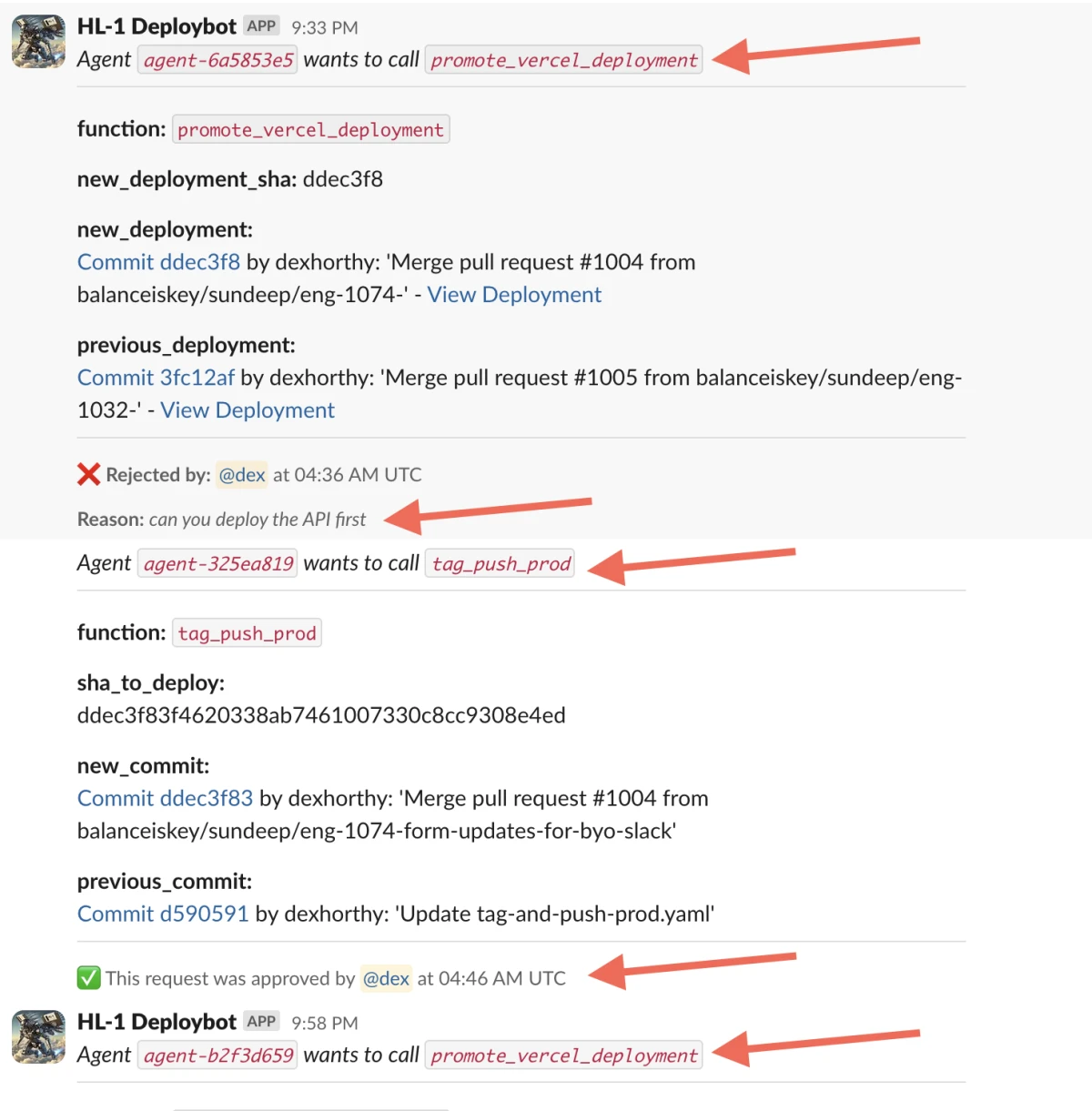
Here is a real-world example and conversation of an open source software agent managing deployments at Humanlayer:7
Source: GitHub 7
Capabilities of agentic AI systems
Adapted from: Cobus Greyling8
Read more: AI agent builders, large action models (LAMs), and agentic AI in cybersecurity.
How to choose
Autonomy vs. Control
The first decision is how far independence should extend.
Co-pilot agents such as Cursor and Claude Code keep a person at the decision point. They research and execute, then wait for approval before taking any irreversible action. Workflow platforms such as n8n follow predefined paths with limited real-time decision-making, which is predictable and breaks on unexpected input. Rule-based systems respond to triggers with no contextual understanding.
Full autonomy creates more problems than it solves without extensive guardrails in place first.
Reliability vs. accuracy
Benchmark accuracy answers one question: how often does an agent finish the task? Deployment raises three more. Does it behave the same way twice? Does it hold up when conditions shift? Does it recognize when it is wrong?
A Princeton team measured all four dimensions across 15 models on GAIA and τ-bench, covering model releases from early 2024 to mid-2026 and running each task repeatedly rather than once. Their headline finding: roughly 24 months of accuracy gains produced minimal reliability gains. Accuracy climbed steadily; reliability trailed well behind it on both benchmarks. The authors describe the pattern as an industry-wide plateau rather than a weakness at one vendor, since all frontier providers cluster together.9
Two specifics matter for procurement:
- Outcome consistency stays low across every model tested. An agent that can solve a task frequently fails to solve it on every run. A refund agent that approves a claim on three runs out of five and denies it on the other two produces liability, not savings.
- Prompt robustness varies widely between models. Agents absorb genuine infrastructure failures such as API timeouts better than they absorb a rephrased instruction. “I want to cancel my subscription” and “please end my plan” can produce different outcomes.
A practical pre-purchase test: run the same task five times, rephrase the instruction, inject a tool failure, and compare. A single benchmark run answers none of these questions.
Integration depth
Two open standards now sit under most agent deployments, and they solve different problems.
MCP connects an agent to tools. Anthropic donated the Model Context Protocol to the Linux Foundation’s Agentic AI Foundation in December 2025, placing it under the same independent governance model as Kubernetes and Node.js.10
MCP shipped its largest revision on July 28, 2026. The 2026-07-28 specification retires the initialize handshake and the session header, turning MCP from a stateful bidirectional protocol into a stateless request/response one. Each request carries its own protocol version, client identity, and capabilities, so any request can land on any server instance behind a plain load balancer.
Four changes matter in production:
- Header-based routing. Method and tool names travel in the
Mcp-MethodandMcp-NameHTTP headers, so gateways and rate limiters route without parsing request bodies. - Cacheable list results. Responses from
tools/listand related calls carry cache hints and a deterministic order, which keeps upstream prompt caches stable across reconnects. - Authorization hardening. Authorization servers return an issuer parameter per RFC 9207, and clients must validate it before redeeming a code, closing an authorization-server mix-up hole. Dynamic Client Registration is deprecated in favor of Client ID Metadata Documents.
- A twelve-month deprecation floor. Roots, Sampling, Logging, and the legacy HTTP+SSE transport keep working for at least a year.
MCP maintainers report close to half a billion monthly downloads across the Tier 1 SDKs, with the TypeScript and Python SDKs each past one billion total downloads.11
A2A connects agents to each other. Google released the Agent2Agent protocol in April 2025 and donated it to the Linux Foundation two months later. At the one-year mark in April 2026, the Linux Foundation reported more than 150 supporting organizations, integration across Google, Microsoft, and AWS platforms, and production deployments in supply chain, financial services, insurance, and IT operations. The 1.0 specification added signed Agent Cards for cryptographic identity verification.12
The two standards report progress differently, and the difference is worth naming. MCP publishes download volume and a public server registry. A2A publishes supporter counts and platform integrations without usage metrics. In an evaluation, “supported by” is a weaker signal than “running in production at.”
Security, identity, and compliance
Security certifications describe the platform. Agent identity describes what one agent can reach, and that is where recent work has concentrated.
OWASP published the Top 10 for Agentic Applications on December 9, 2025, with identifiers ASI01 through ASI10. The list treats an agent as a principal with goals, tools, memory, and inter-agent protocols, each a distinct attack surface. Goal hijacking sits at the top: an attacker plants instructions in a document, an email, or a calendar invite that the agent later reads as context and executes.13
Vendor products have converged on a similar answer. OpenAI Frontier assigns each agent a defined identity with scoped permissions. Microsoft Agent 365 extends Entra network controls to agents on endpoint devices. The shared pattern treats an agent the way an identity team treats a service account.
The working checklist for a production agent is short: a distinct identity, permissions scoped to a single job, an audit trail, and a kill switch that halts execution mid-run.
Regulation. Compliance dates shifted twice during 2026, and coverage has been inconsistent. Two things became enforceable in the EU on August 2, 2026: the Article 50 transparency obligations and the European Commission’s enforcement powers over general-purpose AI models.
Article 50 is narrower than the shorthand suggests. It places a disclosure duty on providers of systems that interact directly with people, with a carve-out where the AI nature of the interaction is obvious to a reasonably well-informed person, plus further exemptions in areas such as law enforcement. Separately, it places a machine-readable marking duty on providers of generative systems, and a disclosure duty on deployers publishing synthetic content. Penalties reach €15 million or 3% of worldwide annual turnover, whichever is higher.
The high-risk obligations did not arrive on that date. The Digital Omnibus on AI moved Annex III standalone systems to December 2, 2027, and Annex I systems embedded in products to August 2, 2028.14
For an agent deployment reaching EU users, the near-term work is scoping rather than conformity assessment: identifying which agent surfaces fall inside the disclosure and marking duties, and which sit outside them. Blanket labelling is neither required nor sufficient.
Cost and pricing model
Direct costs cover model API calls, tool execution, and infrastructure for self-hosted systems. Hidden costs are less visible:
- Context window usage accumulates across multi-turn sessions.
- Failed attempts are billed, including the retries.
- Debugging and prompt refinement consume engineering time.
- Governance and security infrastructure carry their own line items.
- Teams need training to work with agents.
Leading organizations treat agent cost as an architectural constraint rather than a line item to review after deployment. Common optimizations: route simple queries to smaller models, cache repeated context, set circuit breakers that stop runaway agents, monitor token usage per task, and batch requests when latency permits.
Pricing structure is moving alongside pricing level. A seat license assumes one login equals one unit of productive work. That assumption breaks when an agent works independently of any user, and vendors have started saying so publicly: Sierra co-founder Clay Bavor made the point to CNBC in July 2026.15
Three structures are in market:
- Per-seat or per-agent-instance, a flat monthly fee per unit.
- Consumption, billed per task started, per API call, or per voice minute.
- Outcome, billed per resolved ticket, booked meeting, or collected invoice, with no charge on escalations.
A fourth structure is emerging at the platform level: an unlimited plan with a flat platform fee and no cap on users, agents, or workflows, with AI model consumption as the remaining variable. Creatio introduced this model in May 2026; the platform fee is fixed, while model usage is tracked through credits.16 The practical question for a buyer is the same as with consumption pricing: what does one agent run cost, and who controls the model choice that drives it.
Hybrid pricing, a base platform fee plus a usage or outcome tier, has become the common structure, because it gives buyers a predictable floor and vendors a share of the upside.
The contract risk sits in a single word. “Resolution” needs a written definition in the agreement, or the vendor supplies one. A conversation that ends without escalation is not the same as a customer problem that was solved, and the gap between those two readings is the whole invoice.
 Add as preferred source
The Governance Problem Nobody Solved Yet
Governance tooling is beginning to catch up. Several concrete solutions shipped:
- Cisco AI Agent Monitor for Splunk Observability Cloud real-time tracking of agent workflow quality, cost per run, and behavioral anomalies, entering public testing. 17
- OpenAI Frontier each agent is assigned a defined identity with explicit permissions, audit trails, and guardrails, modeled on how companies manage human employee access.18
- Agentic AI Foundation (AAIF), OpenAI, Anthropic, and Block co-founded a Linux Foundation-backed consortium in December 2025 to establish open, vendor-neutral governance standards for agentic AI. AWS, Google, Microsoft, Bloomberg, and Cloudflare joined as Platinum members. Anthropic donated MCP to the foundation, ensuring it remains an open industry standard rather than a proprietary protocol.19
- Creatio AI Studio a governance dashboard showing execution history, success rates, policy violations, and consumption per agent, with admin-defined PII and PCI controls and human-approval steps placed inside agent workflows.
What works and what does not
Works today
Coding assistance with a human reviewer. A common pattern pairs a fast IDE agent with a slower reasoning agent: the first for iteration, the second for architectural decisions. The agent runs tests and iterates on failures. A person reviews before merge.
High-volume repetitive support. Agents resolve routine inquiries at rates vendors publish and buyers should verify against their own content quality. Response latency improves regardless of resolution rate, because an instant partial answer beats a next-day reply.
Research synthesis with citations. Agents scan new publications, extract relevant sections, and maintain reference lists. The output needs checking, and the time saved is still material.
Governed agent inventories. The newest products in this category solve counting and permissions rather than capability. That is a real problem in organizations where agents arrive from several teams at once.
Does not work yet
Fully autonomous production deployment. Agents that ship code or move money without approval remain too risky for most organizations. The reliability research explains why: consistency has barely improved across two years of capability gains. Bounded systems with recoverable failures are the exception.
Complex customer situations. Agents fall apart when empathy, judgment, or unstated context is required.
Multi-stakeholder decisions. Agents cannot read organizational politics or negotiate around unspoken constraints.
Novel strategy. Agents optimize within given parameters. They do not question the parameters.
Multi-agent failure containment. When agents consume each other’s output, one error becomes an accepted premise downstream. The reliability literature flags error propagation across agents as an open research problem, while enterprises ship multi-agent architectures anyway.
Further reading
Cite this research
Pick the format that matches where you're publishing. Pasting the link version into your CMS preserves the backlink.
@misc{dilmegani2026,
  author = {Dilmegani, Cem and Arslan, Ezgi},
  title  = {{AI Agent Tools: Comparison of 15+ Platforms}},
  year   = {2026},
  month  = sep,
  howpublished    = {\url{https://aimultiple.com/ai-agent-tools}},
  note   = {AIMultiple. Retrieved September 11, 2026}
}Results and timestamps of 20 data points. Download the summary data shown in this article's charts and tables as a ZIP file containing 5 CSV files.
Want the granular data behind it? Join Premium
Changelog
12 updatesAdded a Reliability vs. Accuracy section citing a Princeton study on agent benchmarks.
Removed the list of example agentic AI platforms and tools from the introduction section.
Updated the data for Cursor, Claude Code, GitHub Copilot, and Kiro in the Coding Agents section.
Added OpenAI Frontier and Kiro (AWS) to the list of popular agentic platforms.
Added Creatio to the list of popular agentic-style platforms and tools.
Reference Links
Cem's work at AIMultiple has been cited by leading global publications including Business Insider, Forbes, Morning Brew, and Washington Post, global firms like Deloitte and HPE, NGOs like World Economic Forum, and supranational organizations like European Commission. [1], [2], [3], [4], [5]
Throughout his career, Cem served as a tech consultant, tech buyer and tech entrepreneur. He advised enterprises on their technology decisions at McKinsey & Company and Altman Solon for more than a decade. He also published a McKinsey report on digitalization.
He led technology strategy and procurement of a telco while reporting to the CEO. He has also led commercial growth of deep tech company Hypatos that reached a 7 digit annual recurring revenue and a 9 digit valuation from 0 within 2 years. Cem's work in Hypatos was covered by leading technology publications like TechCrunch and Business Insider.
Cem regularly speaks at international technology conferences. He graduated from Bogazici University as a computer engineer and holds an MBA from Columbia Business School.






Be the first to comment
Your email address will not be published. All fields are required. Comments are left in their original language.