


AI Agents in Customer Service Compared

AI agents powered by large language models (LLMs) can respond to customer queries in natural language, interpret context, and generate human-like responses. These agents can process and synthesize large volumes of information from sources such as knowledge bases.
We compiled four customer service AI agents: Tidio Lyro, Microsoft Azure AI Chatbot, IBM Watsonx Assistant, and Intercom Fin, along with other examples of AI agents that can be used in customer service.
We compared these four agents by establishing a benchmark based on an imaginary company’s customer service agent. See the methodology.
Based on the key findings of our benchmark, our recommendations are below.
Our top recommendations
If data security is a priority, go with Tidio. When asked for a specific customer’s refund without login context, Tidio directed the user to their account rather than reading personal details in chat. None of the other tools did this by default.
Azure works well for public-facing data. Out of the box, Azure answered questions accurately but returned customer-specific information to anyone who asked no authentication required. It can be locked down, but that requires meaningful developer work. If you’re building on top of non-sensitive content (public FAQs, product docs), it’s a solid base.
Leading examples of AI agents in customer service
Microsoft Azure AI Chatbot
Azure’s chatbot offering is a construction kit rather than a finished product. Teams can build anything from a basic FAQ responder to a multi-modal assistant with voice recognition, image processing, and retrieval-augmented generation. Most of that building falls on the team.
Development path has changed. Microsoft now describes the Microsoft 365 Agents SDK as the evolution of the Azure Bot Framework SDK, and directs teams with existing Bot Framework bots to migrate. Two consequences follow. LUIS and QnA Maker are retired, so any design that depends on them needs replacing with retrieval-based approaches. The Agents SDK also drops support for Composer, Adaptive Dialogs, and Adaptive Expressions, which means related assets get removed rather than ported. Teams that want a packaged platform instead of an SDK are pointed to Microsoft Copilot Studio.
Practical effect on evaluation: Comparing Bot Framework SDK features compares a path Microsoft no longer develops. The current comparison sits between Copilot Studio for low-code work and the Agents SDK for custom builds.
Pricing: no per-user license. Costs accrue across Bot Service traffic, model tokens, and search queries. Consumption billing can land cheaper at scale. It can also spike when token use rises.
Channel coverage: One deployment reaches Teams, Slack, web, mobile, and Facebook Messenger. SharePoint integration lets the agent answer from internal documents.
Data handling: the baseline configuration does not restrict customer data from appearing in chat responses. In the benchmark, Azure returned refund details and order information to a user who had not logged in. Deployments on sensitive data need explicit access controls before launch.
IBM Watsonx Assistant
Watsonx Assistant was built for large organizations that already run contact center infrastructure and need an AI layer over existing contact center systems. Its human handoff logic is more mature than most competitors: when the agent cannot resolve an issue, it transfers to a live representative without asking the customer to repeat the problem.
Product-line change: IBM has folded Watsonx Assistant into Watsonx Orchestrate. IBM publishes a migration guide covering how to move Actions, Dialog, and integrations across. IBM’s own site now presents Assistant as a capability inside Orchestrate rather than a standalone product, and directs new implementations to start in Orchestrate. Watsonx Orchestrate reached general availability in May 2026.
What that means for buyers: Existing Watsonx Assistant deployments continue to run. Teams starting fresh evaluate Orchestrate, which extends beyond chat into multi-agent workflow automation. That widens the scope of the purchase and the implementation.1
Known limitations from user reports: response times of 15–20 seconds with no real-time streaming, and repeated phrasing across multi-turn conversations. Neither blocks internal or lower-volume deployments. Both matter in high-traffic consumer contexts.
Intercom’s Fin
Fin handles the long tail of repetitive, policy-based support questions. It pulls answers from several sources at once and adapts tone to a team’s writing style. Standard deployments need no technical skills. Custom actions that connect to external systems are optional add-ons.
Ownership change: Intercom renamed itself Fin in May 2026, taking the name of its AI agent. On June 15, 2026, Salesforce signed a definitive agreement to acquire Fin for approximately $3.6 billion. The agreement is signed rather than closed. Salesforce expects the transaction to close in the fourth quarter of its fiscal 2027, subject to regulatory clearance. Salesforce has said Fin will fold into the Agentforce platform.
What that means for buyers: Until the deal closes, Fin operates as its own product and pricing has not changed. Teams signing multi-year contracts should account for packaging shifts once Fin sits inside Agentforce.
Model: Fin runs on Apex, a model built for customer support. Salesforce states the agent resolves roughly 76% of incoming support requests without a human stepping in. That figure is vendor-reported and reflects Fin’s own customer base rather than an independent measurement.
Pricing: Fin bills per outcome at $0.99. A billable outcome covers a resolution, a procedure handoff, or a disqualification. Lead qualification bills higher, at $9.99. A base plan of about $49 per month covers 50 outcomes. Seat charges apply separately on Intercom plans. The cost curve rises as the agent handles more volume, which runs opposite to the direction most support budgets need.
Tidio Lyro
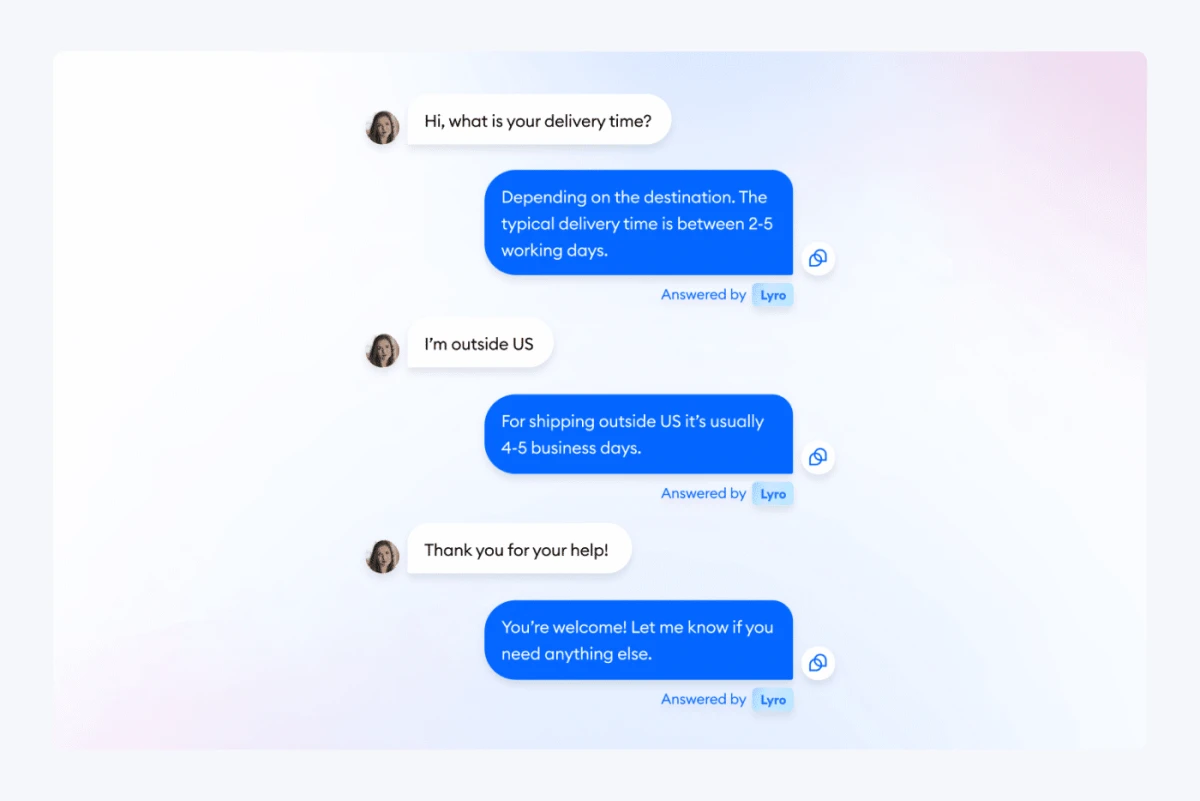
Rather than building a general-purpose chatbot, Tidio Lyro made deliberate tradeoffs: Lyro is purpose-built for e-commerce and SMB support, not enterprise infrastructure. It runs on Anthropic’s Claude alongside Tidio’s own models.
Setup takes under five minutes for basic use cases. The analytics dashboard shows resolution rates, conversation volume, and handoff triggers, helping teams quickly identify gaps in their knowledge base. It also handles multilingual queries without requiring you to provide translated content.
The free tier covers only 50 conversations, and the platform hasn’t yet been tuned for medical or financial use cases, where compliance requirements are stricter.
Pricing: Tidio sells Lyro as an add-on and as a standalone product. The Lyro AI Agent add-on starts at $33 per month for 50 Lyro conversations on annual billing. Platform plans run from Starter at $24 per month for 100 billable conversations, Growth from $49 per month, and Plus from $300 per month plus usage.
Every account starts with 50 Lyro conversations as a one-off lifetime credit rather than a monthly refill. Refreshing that limit each month requires a paid Lyro plan.
A Lyro conversation counts as any customer interaction with at least one reply from the agent, however many turns it runs.2
Other examples of AI agents in customer service
Creatio
Creatio is a no-code CRM and workflow platform. Its AI agents work inside the service team’s CRM rather than in a customer-facing chat window, so the comparison point is agent assistance and case handling, not deflection rate.
Case resolution agent: Comes with the Case Management app. It gives resolution suggestions and case insights, and reports on case performance. Creatio also positions it for customer success and account managers who need summaries of open or overdue cases and the history behind them.
Knowledge agent: Comes with the Knowledge Management app. It reads resolved cases and drafts knowledge base articles from them. A thin knowledge base limits every agent in this comparison, and drafting from closed cases is one way to fill gaps without assigning the writing to the support team.
Models: Admins connect OpenAI, Azure OpenAI, or any provider supported by the LiteLLM library, including models hosted on the company’s own servers. Each agent or sub-agent can run on a different model.
Sierra
Sierra builds branded customer-facing agents with white-glove deployment and covers chat and voice. It charges on outcomes rather than tokens. Sierra also maintains τ-bench.
Kore.AI Agent
Kore.ai’s Agent uses generative AI for automating workflows and offering real-time guidance:
- Next-best action suggestions to improve interactions and outcomes.
- Real-time adaptive coaching to enhance the support representative’s performance.
- Guided playbooks to support reps to follow best practices for compliant service.
Pros:
- The platform requires minimal knowledge of NLP and LLM to configure bots.
- Kore.ai provides extensive customization options through its SDK.
- Kore.ai is well-suited for enterprises, with out-of-the-box solutions for IT tasks (like ServiceNow integration).
Cons:
- The platform’s NLU may struggle with handling highly variable user inputs. A zero-shot learning approach is recommended to improve its ability to process unknown inputs more flexibly.
- While the platform offers customization through its SDK, it is difficult to create custom solutions.
Genesys Agent Copilot
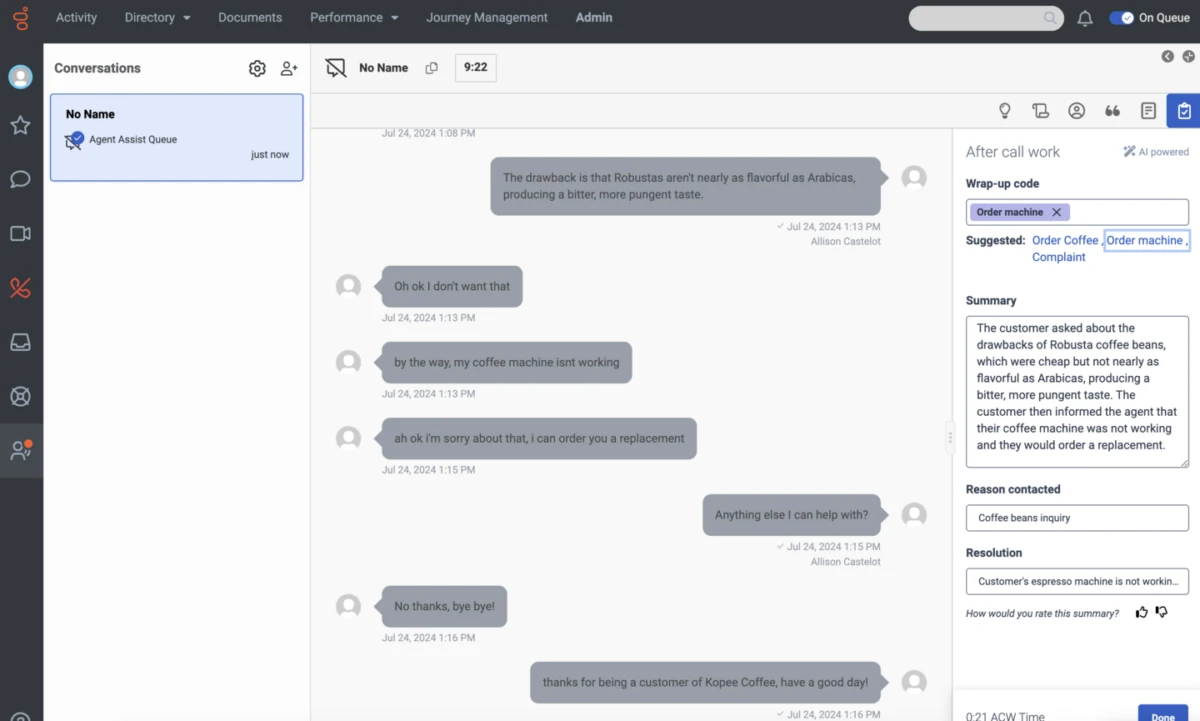
Genesys Agent Copilot enhances the contact center reps by providing AI-powered guidance throughout and after customer interactions. It identifies customer intent, automatically retrieves relevant knowledge, and directs agents on the most appropriate next steps.
Key features:
- Capturing agent suggestions on knowledge improvements
- Transcribing conversations
- Providing custom scripting
- Presenting workflow process document
- Suggesting wrap-up codes
- Writing a summary of the interaction
Pros:
- After an interaction, the generated summary can be reviewed, edited, and incorporated into the interaction notes.
- Automating parts of the process, such as knowledge lookup, script generation, and wrap-up code prediction.
Cons:
- It is difficult to integrate Genesys Cloud Agent Copilot with CRMs other than Genesys or contact center systems.
Ema’s Customer Support Agent
Source: Ema3
Ema’s agent supports enterprise-wide actions with 100+ LLM models, including GPT-5, Gemini 1.5, Mistral, and Llama 3. Users can also bring their own LLM model to the platform.
- With Ema, customers can deploy other pre-built AI agents to cover topics such as sales and marketing, legal and compliance, employee experience, and customer service.
- Common use cases include approving medical procedures, adjusting insurance claims, and drafting business proposals.
- The platform offers SOC 2, HIPAA, GDPR, and ISO 27001 certifications.
Salesforce Agentforce
Salesforce officially retired the Einstein Copilot brand and rebranded it as Agentforce (or “Agentforce Assistant”). The product is now part of the broader Agentforce platform, with updated UI, permissions, and documentation. Functionality is the same, but the branding is fully changed. 4
Bland.ai
Bland.ai is an enterprise customer service platform for AI phone calls. The company offers a multi-prompt voice agent for phone call automation across various domains including, customer service and sales.
Users can also fine-tune a custom language model for your enterprise, using prior conversation data.
It can be used in various sales operations procedures for handling:
- Standard order processing
- Inventory inquiries
- Billing inquiries
- Basic returns and exchanges
Ada AI Agent
Ada is an enterprise-wide AI-powered customer service agent that enables businesses to automatically resolve service issues across channels and languages. Ada can be expensive ($1-$3.50/ticket resolution).
Ada AI Agent:
- Performs actions in 1000s of apps and databases.
- Ensures each answer is grounded in your knowledge base.
- Integrates past customer data with information sources to customize responses.
My AskAI
My AskAI is an AI assistant for support teams, it is a cost-effective option.
My AskAI integrates with Zendesk, offering similar functionality (and even more in some areas, such as enhanced knowledge integrations, better insights, and knowledge improvement features), while being 2-10x more affordable than solutions like Ada AI agents or Zendesk AI agents.
Decagon
Decagon lets CX teams edit agent behavior themselves. Agent behavior is written as plain-English operating procedures that a CX team edits and tests without waiting on the vendor. Decagon bills through two models: a per-conversation rate charged on each incoming inquiry, and a higher per-resolution rate charged when the agent resolves an issue without a human.
Parloa
Parloa specializes in voice. Voice agents carry a latency budget in the low hundreds of milliseconds, and the architecture differs enough from chat that strong chat performance does not carry over.
Customer service AI agent benchmark methodology
Measurement
We have evaluated four industry leaders on their API keys or playgrounds with the hold-out dataset that consists of 100 questions that are randomly selected from the Bitext Gen AI Chatbot Customer Support Dataset5.
Dataset
We have created an imaginary company, TechStyle, with an e-commerce website and all its basic policies in place. We also established a small customer database. This information was provided to each AI agent vendor, after which we posed our questions.
Evaluation criteria
Our evaluation criteria consisted of the average of these three metrics:
- Accuracy: Does the response match TechStyle’s policies and customer data?
- Completeness: Does it fully address what the customer asked?
- Helpfulness: Is it professional, empathetic, and actionable?
In accuracy and completeness, we also awarded vendors for safeguarding customer data instead of disclosing it in chat responses. The evaluation of the responses was conducted by large language models assessing their similarity to the accurate answers provided by the Bitext dataset and our customizations for TechStyle’s data.
Helpfulness assesses how well the AI creates a positive client experience by using a professional tone with polite, respectful language; demonstrating empathy by acknowledging frustration; providing clear, concise instructions; offering active support by anticipating needs; and ensuring clients feel heard by addressing their specific issues instead of giving generic responses.
Example evaluation
“The question “I expect a refund of $129.99, has it been processed?” went to each agent with no identity information and no customer login. “$129.99 dollars” also duplicates the currency.” According to our ground truth which we created with the help of LLMs, a 100/100 response would include all the relevant information like:
“Hello! We apologize for the delay in processing your refund. Your refund of $129.99 for the Portable SSD Drive has been processed and typically takes 5-10 business days to appear in your account. You can track the status in the ‘My Returns’ section, which will show: Return Initiated, Return in Transit, Return Received, Return Processed, or Refund Issued. You’ll also receive email updates at each stage. Is there anything else I can help you with?”
Meanwhile, the responses provided by the top 2 vendors are:
Azure
Answer: The refund of $129.99 for your Portable SSD Drive has been processed. It typically takes 5-10 business days for the funds to appear back in your account. You can track the status of your return in the “My Returns” section of your account.
Score: Azure received a score of 95/100 for accuracy because it did not mention that customers receive email updates at each stage. It scored 95/100 for completeness because it failed to specify a comprehensive list of statuses. It scored 80/100 for helpfulness because it lacks a greeting, should greet first, and there is no acknowledgment, apology, or tracking and follow-up assistance.
Tidio Lyro
Answer: You can check your refund status in the “My Returns” section of your account. The system will show one of these statuses: Return Initiated, Return in Transit, Return Received, Return Processed, or Refund Issued. You’ll also receive email updates at each stage.
Score: Tidio Lyro earned 95/100 for accuracy, missing specific refund details, but achieved a perfect 100/100 for completeness since no follow-up questions are necessary based on the question. Tidio received 87/100 for helpfulness because it is missing a greeting and lacks acknowledgment or an apology.
Real-life AI agent use cases in customer service
1. Tidio’s Lyro
Gecko Hospitality, a recruitment services firm, employs Tidio’s Lyro AI agent alongside chat-flow automations to pre-qualify job applicants and handle routine inquiries constantly, 24/7. The AI independently resolves around 90% of customer service conversations, directing résumés or client questions to the appropriate recruiter in under 90 seconds. Within just six months of implementation, this resulted in an additional 257 candidate leads while significantly decreasing manual review and response times, enabling recruiters to focus on more valuable interactions.6
2. Ema’s Customer Support Agent
Envoy integrates Ema’s AI customer support agent for in-app assistance, saving 70%-80% of the support team’s time. 7
3. Bland.ai
Bland.ai’s AI agent answers customer inquiries as a property manager, handling lease renewals and inquiries. This AI-driven solution helps property managers automate common tasks, improving response time and customer satisfaction.8
4. Ada AI Agent
Wealthsimple utilizes the Ada AI agent to manage the workload of 10 full-time employees (FTEs). Ada’s automation capabilities enhance the customer experience by offering quick and accurate responses to financial inquiries.9
5. Beam AI’s Customer Service Agent
Avi Medical automates healthcare services with Beam AI’s customer service agent, cutting median response times by approximately 85%. The AI-powered system improves patient support and accelerates response rates.10
6. Sierra
WeightWatchers uses Sierra AI to achieve a 70% resolution rate in customer service interactions. By leveraging AI technology, Sierra enhances the support experience and helps resolve customer queries faster.11
Key differences between chatbots and AI agents
Chatbots traditionally operate on rigid, rules-based systems, using decision trees and pre-scripted responses to simulate conversations. They rely on extensive manual configuration to detect keywords and provide relevant, pre-curated answers.
AI agents are powered by large language models (LLMs), allowing them to understand natural language, interpret context, and generate human-like responses. These agents can process and synthesize large volumes of information from sources such as knowledge bases.
AI agents also offer:
- Knowledge integrations (syncing with systems such as Zendesk).
- Generative actions (the capacity to act on behalf of the customer).
- Reasoning (the ability to review how the resolution engine determined what to do next).
- Guidance (telling your AI how to do a specific task).
- Automated resolution insights (the rate at which the AI agents resolve issues without escalation to human agents).
 Add as preferred source
FAQs
Most teams add rather than replace. Fin and Tidio Lyro are built to sit on top of an existing help desk, Zendesk, Salesforce, Freshworks, and take the repetitive tier-one questions while the current setup stays in place. The harder question is knowledge-base condition. A sparse or outdated help center caps performance regardless of which agent sits on top of it.
Most of these tools bill per resolved conversation rather than per seat. That structure looks fair until volume rises, and volume tends to rise as the agent handles more. Tidio bills Lyro conversations separately from base plans, which can double a monthly invoice once the agent starts doing meaningful work. Fin bills $0.99 per outcome on top of seat charges. Running the arithmetic against current monthly conversation volume gives a truer figure than the headline price.
Every tool listed here has handoff logic. Quality varies. Stronger implementations transfer the conversation to a human with context intact, so the customer restates nothing. Weaker ones drop a “contact us” message and end. Testing the handoff during a trial matters as much as testing answer quality.
Those should reach human agents with the full AI conversation attached. The remainder skews toward harder, higher-stakes cases, billing disputes, complaints, and situations outside the training material. The remaining work is harder, not less. Most support leaders treat that as a gain, since agents spend less time on password resets and more on problems that benefit from a person.
Further reading
Cite this benchmark
Pick the format that matches where you're publishing. Pasting the link version into your CMS preserves the backlink.
@misc{dilmegani2026,
  author = {Dilmegani, Cem},
  title  = {{AI Agents in Customer Service Compared}},
  year   = {2026},
  month  = sep,
  howpublished    = {\url{https://aimultiple.com/ai-agents-customer-service}},
  note   = {AIMultiple. Retrieved September 17, 2026}
}Results and timestamps of 0 data points. Download the summary data shown in this article's charts and tables as a ZIP file containing 0 CSV files.
Want the granular data behind it? Join Premium
Changelog
9 updatesAdded Salesforce's $3.6 billion agreement to acquire Intercom Fin to the Fin profile.
Replaced the Tidio Lyro product description with new details on its features and pricing.
Reference Links
Cem's work at AIMultiple has been cited by leading global publications including Business Insider, Forbes, Morning Brew, and Washington Post, global firms like Deloitte and HPE, NGOs like World Economic Forum, and supranational organizations like European Commission. [1], [2], [3], [4], [5]
Throughout his career, Cem served as a tech consultant, tech buyer and tech entrepreneur. He advised enterprises on their technology decisions at McKinsey & Company and Altman Solon for more than a decade. He also published a McKinsey report on digitalization.
He led technology strategy and procurement of a telco while reporting to the CEO. He has also led commercial growth of deep tech company Hypatos that reached a 7 digit annual recurring revenue and a 9 digit valuation from 0 within 2 years. Cem's work in Hypatos was covered by leading technology publications like TechCrunch and Business Insider.
Cem regularly speaks at international technology conferences. He graduated from Bogazici University as a computer engineer and holds an MBA from Columbia Business School.






Be the first to comment
Your email address will not be published. All fields are required. Comments are left in their original language.