


Top 10 Voice Recognition Tool & Applications

If you’ve used virtual assistants like Alexa, Cortana, or Siri, you’re likely familiar with speech recognition and conversational AI. This technology enables users to interact with devices through verbal commands by converting spoken queries into machine-readable text.
Explore the top 10 uses of voice recognition technology in voice search, customer service, healthcare, and other areas.
Top 10 voice recognition tools
Tool | Starting price | Free trial / free tier | Features | Use cases |
|---|---|---|---|---|
Apple Dictation | Free (built into Apple devices) | Free | Quick everyday voice typing on Mac/iOS | Speech-to-text |
AssemblyAI | Pay-as-you-go: $0.45 /hour | $50 in free credits | Developer API with built-in audio intelligence | Speech-to-text, customer service & voice agents |
Deepgram | Pay-as-you-go: Nova-3 ~$0.0043/minutes batch | $200 in free credits | Developer API for real-time voice apps/agents | Voice search, speech-to-text, customer service & call centers |
Descript | $16/month | Free plan with 60 media minutes/month | Podcast/video production (transcript-as-editor) | Speech-to-text & multimodal audio/video |
Dragon (Professional/Anywhere) | $700 one-time (Professional, Windows); Anywhere $14.99/month | ✕ | Daily dictation in specialized vocabularies | Healthcare & legal |
Google Voice Typing / Gboard | Free | Free | Free voice typing in the Google ecosystem | Voice search/assistant, speech-to-text & smart home |
Otter.ai | $9/month | Free plan with 300 min/month | Real-time meeting notes and team collaboration | Speech-to-text & lecture notes |
Rev | $25/month | Free plan with 45 AI transcription minutes/month | Near-perfect transcripts of recorded files | Speech-to-text & legal depositions |
Sonix | $10/audio hour pay-as-you-go, or $22/user/month | 30 minutes free trial | High-volume, multilingual transcription for teams | Speech-to-text & legal transcription |
Wispr Flow | $12/month | Free plan with 2,000 words/week | System-wide dictation for solo knowledge workers | Speech-to-text & hands-free computing |
1. Voice search
Voice search allows users to interact with devices by speaking instead of typing. When you speak a command, the system uses speech recognition to convert your voice into text, applies natural language processing to understand your intent, and then returns relevant results, either displayed on a screen or spoken back to you by a digital assistant
Real-life example: Speech-to-Retrieval (S2R)
Speech-to-Retrieval (S2R) is a voice search technique developed by Google Research that bypasses the traditional speech-to-text transcription step.
Instead of converting spoken queries into text and then searching, S2R uses a dual-encoder model that maps the raw audio directly into a semantic vector representation and matches it against document representations in the same space.
This approach focuses on understanding what information the user is seeking rather than what exact words were spoken, reducing errors caused by imperfect speech recognition and improving search relevance and reliability.1
Watch the video below to learn the Speech-to-Retrieval process:
Real-life example: OpenAI
OpenAI has released a new suite of audio models that significantly improve how machines understand and generate voice.
These models include advanced speech-to-text systems (like gpt-4o-transcribe and gpt-4o-mini-transcribe) that deliver higher accuracy across accents, noisy environments, and varied speech patterns, as well as text-to-speech models that can produce more expressive, customizable audio responses.
Developers can build more natural and reliable voice-enabled applications and agents directly through OpenAI’s tools. The release also adds integrations (e.g., with the Agents SDK) to make creating voice experiences easier.2
2. Speech-to-text
Voice recognition enables hands-free computing across various applications, including writing emails, creating documents in Google Docs, generating automatic closed captions (such as on YouTube), providing automatic translations, and sending texts.
Real-life example: Microsoft Azure
Microsoft Azure’s real-time speech-to-text feature leverages call center agent support, captioning, voice-enabled interactive response systems, and live meeting transcriptions.
See the speech-to-text benchmark to find out which product to choose.
3. Voice commands to smart home devices
Smart home devices utilize voice recognition technology to automate household tasks, such as turning on lights, boiling water, adjusting thermostats, and more. Some voice recognition applications also offer additional features, such as advanced voice commands or expanded language support, enhancing their functionality and user experience.
Real-life example: Amazon Alexa+
Amazon has introduced Alexa+, rebuilt with generative artificial intelligence to make interactions more natural, useful, and capable.
Alexa+ leverages advanced large language models to better understand conversational speech and context, enabling it to engage in richer dialogue, remember user preferences, and help accomplish tasks across services and devices, such as managing smart homes, making reservations, organizing schedules, and answering complex questions.3
4. Voice biometrics for security
Similar to how your smartphone allows you to unlock it with your fingerprints, vocal biometrics uses a person’s speech to authenticate them. Users might be required to say their name aloud during log-ins rather than typing a password.
Alternatively, speech biometrics can be used in Fintech to authorize transactions and verify that they are genuine and authorized by the account owner. Besides, speech biometrics can restrict access to authorized personnel in healthcare, where maintaining patient confidentiality is of utmost importance.
Real-life example: HSBC
HSBC used speech recognition systems to identify clients by their voices, enabling secure account access without PINs or traditional passwords. This technology analyzes distinctive vocal traits, such as pitch, tone, and speech patterns, to generate a unique “voiceprint” for each individual. 4
5. Customer service
By leveraging automatic speech recognition (ASR) and natural language processing, voice recognition technology enables customers to make requests such as “check my balance” and be automatically routed or assisted, often without the need for a human agent.
Real-life example: Amazon Lex
Amazon Lex is a fully managed conversational AI service from Amazon Web Services (AWS) that allows developers to deploy voice and text-based chatbots and virtual assistants.
It supports integration with AWS Lambda and other AWS services, multi-platform deployment (e.g., contact centers, web/mobile apps, messaging services), visual conversation building, analytics, context, and multi-turn dialog management.
Lex also provides generative AI enhancements via large language models to improve intent classification, slot resolution, and automated responses.
A recent update adds a neural ASR model for English that delivers improved speech recognition accuracy across accents and conversational styles, making voice bots more reliable and reducing the need for users to repeat themselves.5
6. Automotive
In-car speech recognition systems are now standard in most modern vehicles. The most significant benefit of car speech recognition is that it enables the driver to keep their eyes on the road and hands on the wheel. Use cases include initiating phone calls, selecting radio stations, setting up directions, and playing music.
Real-life example: Tesla
Tesla developed voice bots that allow users to manage climate, entertainment, and navigation via voice commands such as “Set temperature to 72 degrees” or “Navigate to [destination].”6
7. Education and academia
Speech recognition can create an equitable learning platform for children with no/low sight.
Real-life example: Duolingo
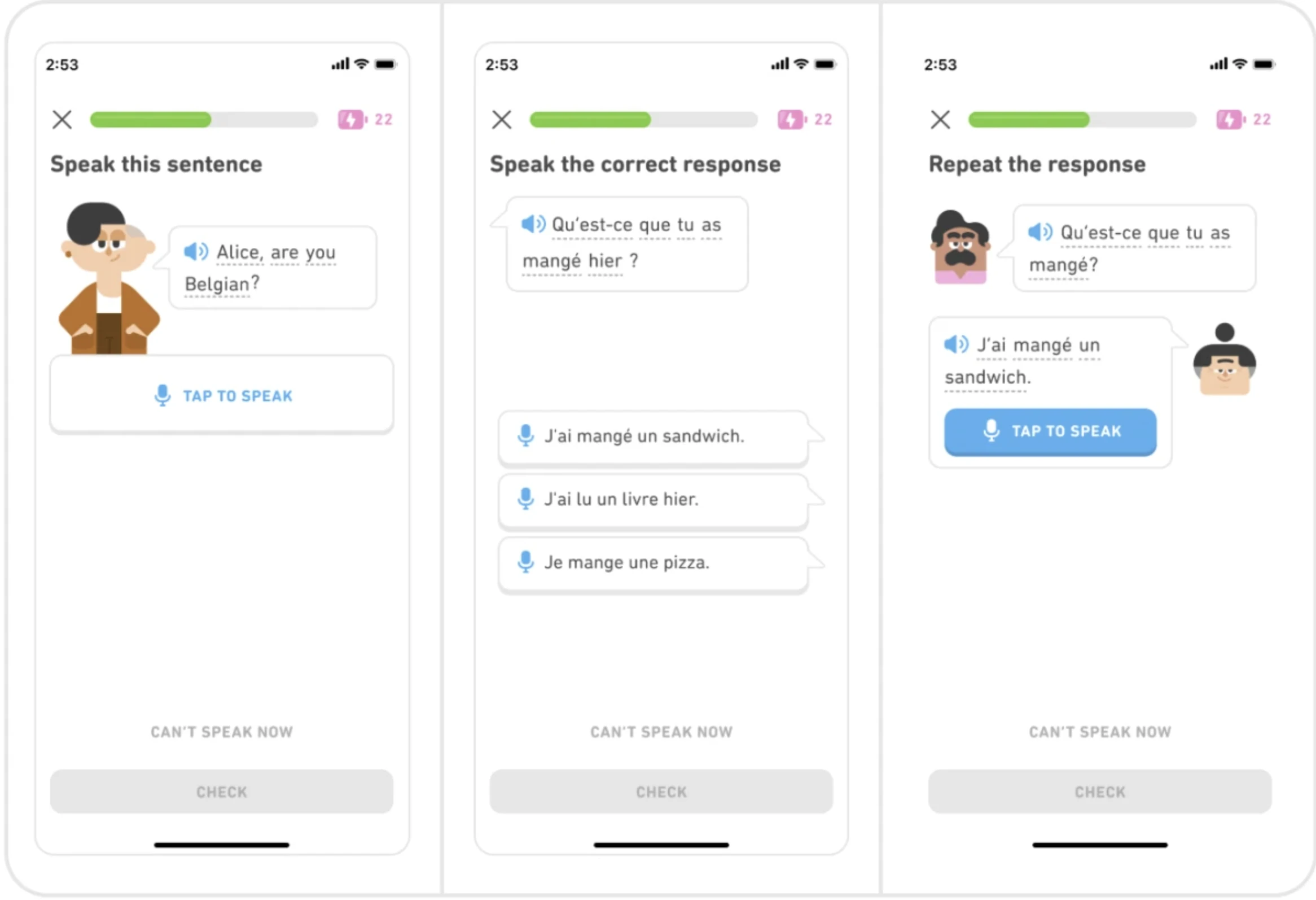
Duolingo integrates speaking practice throughout its language courses to help learners build real conversational ability right from the start.
Users encounter speaking exercises from their first lesson, such as repeating words, saying translations aloud, and engaging in short dialogues, and can tap the microphone to speak answers instead of typing them.
There are dedicated speaking-only practice sessions to refine pronunciation and build confidence, specialized activities for new writing systems, and, for Duolingo Max subscribers, interactive conversation tools like video calls and role-plays with characters to practice speaking in supportive, realistic scenarios.
Figure 1: An example from Duolingo speaking lessons.7
 Add as preferred source
8. Healthcare
MD note-taking
Patient diagnosis notes are transcribed using medical transcription (MD) software powered by speech recognition.
It has been noted that taking notes is one of the most time-consuming activities for physicians, detracting from their ability to see patients. With speech recognition technology, doctors can reduce the average appointment duration and, in turn, accommodate more patients in their schedules.
Real-life example: Abridge AI
Abridge AI is an AI-powered medical scribe used at Johns Hopkins Medicine to automate clinical documentation during patient visits. The tool uses ambient listening to capture doctor–patient conversations, applies natural language processing to transcribe them, and then uses generative AI to produce structured draft clinical notes.
Clinicians can record encounters using mobile devices or integrated systems; afterward, the AI-generated notes are entered into electronic health records. Importantly, doctors must review and finalize these notes before they become part of the official patient record.
By filtering out irrelevant conversation and focusing on medically important details, Abridge reduces documentation workload and allows clinicians to spend more time focusing on patient care.8
Diagnosis
Depression speech recognition technology analyzes a patient’s voice to detect the presence or absence of depression undertones through words such as “unhappy,” “overwhelmed,” “bored,” “feeling void,” etc.9
Real-life example: ElevenLabs
ElevenLabs provides AI-powered conversational agents with voice and text interactions to handle tasks across the patient and provider experience.
These agents can answer inquiries, automate intake, triage patient needs, schedule and manage appointments, support follow-ups, handle billing, and assist with prescription and workflow tasks.
The platform is built for enterprise-grade security and compliance (including HIPAA, GDPR, SOC 2, and zero-retention options) with full audit trails and governance, and supports real-time analytics to monitor performance.
By automating routine communication and administrative workflows, these agents aim to improve access to care, reduce administrative load, and enhance patient and operational outcomes.
9. Legal tech
Legal chatbots have grown in popularity because of their ease of use and broad applicability. Speech-enabled legal tech can expand the use cases to:
- Court reporting (Realtime Speech Writing)
- eDiscovery (Legal discovery)
- Automated transcripts in depositions and interrogations
- Using NLP to review legal documents to determine if they meet regulatory criteria.
Audio transcription technology is widely used in legal settings to convert recorded depositions, interrogations, and court proceedings into accurate written records.
Real-life example: Prevail
Real-time, accurate draft transcripts of depositions and arbitrations are produced using AI-assisted transcription systems, such as those employed by Prevail, and are subsequently refined by human transcriptionists. 10
10. Multimodal voice experiences
Voice recognition is increasingly integrated with computer vision and other sensory inputs to enhance interactive experiences.
- Voice and visual search: Users can direct a camera at items while articulating their search. Smart displays respond to both verbal commands and hand gestures simultaneously.
- Contextual voice assistance: Devices leverage visual context to interpret voice commands more effectively (e.g., by recognizing “turn off that light” when the user is focusing on a specific fixture).
Real-life example: Omind
Omind’s platform includes a centralized knowledge hub that combines documents, product images, video tutorials, and chat logs into a searchable repository.
Its omnichannel delivery engine enables transitions across IVR, mobile applications, web chat, and in-store kiosks while maintaining context and session history.
The platform also provides visual and voice analytics to measure engagement and resolution performance, along with pre-built UI components, such as carousels, image overlays, and video players, that integrate into voice workflows with limited coding requirements.11
FAQs
Speech recognition converts spoken words into text, while voice recognition software identifies the speaker based on unique speech patterns and vocal characteristics. Modern speech-to-text software combines both technologies to achieve transcription accuracy while distinguishing between different voices through speaker diarization.
Today’s speech-to-text technology achieves over 95% transcription accuracy under ideal conditions; however, background noise and audio input quality can impact performance. Professional dictation software, similar to that used for phone calls and audio transcription, can accurately transcribe multiple speakers and handle various languages, making it valuable for business applications and note-taking.
Yes, modern recognition software supports multiple languages simultaneously, and many platforms offer integration across mobile devices and desktop systems. Most solutions include voice control features that respond to a few commands in different languages, and many providers offer free credits or a free plan to test multilingual capabilities.
Speech recognition technology helps business operations through interactive voice response systems, audio transcription of meetings, and dictation software for document creation. These features save time by converting human speech directly into text file formats, eliminating the need for manual typing and enabling hands-free productivity through voice access and text commands on various devices, including Windows systems.
Cite this research
Pick the format that matches where you're publishing. Pasting the link version into your CMS preserves the backlink.
@misc{dilmegani2026,
  author = {Dilmegani, Cem},
  title  = {{Top 10 Voice Recognition Tool & Applications}},
  year   = {2026},
  month  = jul,
  howpublished    = {\url{https://aimultiple.com/voice-recognition-applications}},
  note   = {AIMultiple. Retrieved July 2, 2026}
}Results and timestamps of 10 data points. Download the summary data shown in this article's charts and tables as a ZIP file containing one CSV file.
Want the granular data behind it? Join Premium
Changelog
5 updatesAdded Abridge AI to the Real-life example in the Healthcare section.
Removed the "Further reading" section.
Reference Links
Cem's work at AIMultiple has been cited by leading global publications including Business Insider, Forbes, Morning Brew, and Washington Post, global firms like Deloitte and HPE, NGOs like World Economic Forum, and supranational organizations like European Commission. [1], [2], [3], [4], [5]
Throughout his career, Cem served as a tech consultant, tech buyer and tech entrepreneur. He advised enterprises on their technology decisions at McKinsey & Company and Altman Solon for more than a decade. He also published a McKinsey report on digitalization.
He led technology strategy and procurement of a telco while reporting to the CEO. He has also led commercial growth of deep tech company Hypatos that reached a 7 digit annual recurring revenue and a 9 digit valuation from 0 within 2 years. Cem's work in Hypatos was covered by leading technology publications like TechCrunch and Business Insider.
Cem regularly speaks at international technology conferences. He graduated from Bogazici University as a computer engineer and holds an MBA from Columbia Business School.





Comments 1
Share Your Thoughts
Your email address will not be published. All fields are required. Comments are left in their original language.
Voice recognition tools are really helpful! As an alternative, I can recommend Audext. It works quite fast, and it has many useful features such as an in-built editor, text timings tracking, voice recognition in noise, etc.