


Top Open Source UEBA Tools & Commercial Alternatives

At their core, UEBA solutions identify patterns in data, whether from real-time streams or historical datasets.
- Commercial UEBA tools such as ManageEngine Log360 keep their proprietary ML models closed. Having access to these models allows analysts to extract relevant patterns from data and refine anomaly-detection processes.
- Open-source UEBA tools give users full access to these models, enabling them to replicate pattern extraction for more targeted anomaly detection.
Open source UEBA tools
After reviewing the documentation for each open-source UEBA framework and tool, I selected the leading open-source behavior analytics technologies that provide standard SIEM-like capabilities, alerting, support for the MITRE ATT&CK threat intelligence framework, and API-based ingestion from data sources.
Based on whether they offer built-in UEBA features, I split them into:
- Core UEBA tools: OpenUBA and Graylog
- Complementary UEBA tools: Wazuh
Core UEBA tools: OpenUBA and Graylog
Core UEBA tools provide a repository of ready-to-use models, machine learning, and behavioral profiling models to identify and analyze anomalous user and entity behaviors. These tools collect logs from various sources, store them in databases, and integrate with the Elastic Stack (Elasticsearch, Kibana, Logstash) for further processing and analysis.
Graylog collects logs from various servers using third-party agents (e.g., Filebeat) and can configure these logs with its lightweight Graylog Sidecar agent from a central location. Once logs are ingested, ML-based anomaly detection is available through the Graylog interface.
OpenUBA ingests logs from servers and third-party log ingestion agents. Once logs are ingested, they can be analyzed for abnormal behaviors using built-in ML or behavioral profiling models. It integrates with TensorFlow, Keras, Scikit-Learn, and Elasticsearch for visualization and analytics. The project is in early development (pre-alpha).
Complementary UEBA tools: Wazuh
Complementary UEBA tools use monitoring and data analytics to detect user and entity anomalies. By integrating big data technologies like Apache Spark with engines such as Elasticsearch, they enable centralized log analysis and anomaly detection.
Wazuh monitors telemetry data, including metrics, logs, and traces. You can monitor servers directly or use AWS to monitor cloud services, with results visualized in the Wazuh Dashboard.
Compare free and open source UEBA tools
Agent-based log ingestion
Tool | Built-in agent-based log ingestion | Best for |
|---|---|---|
OpenUBA | ✕ | Security analysts, data scientists |
Graylog | ✕ | Small-to-medium organizations needing SIEM |
wazuh | ✓ | Enterprises needing XDR + SIEM |
Apache-Metron | ✓ | Large organizations needing a scalable SIEM |
HELK | ✕ | Small-to-medium organizations needing custom threat hunting |
Apache-Spot | ✕ | Enterprises focusing on network security |
✕: Requires third-party agent integrations.
Built-in agent-based log ingestion allows a platform to collect log data directly from endpoints, servers, or devices using its own agents, without third-party tools, for centralized analysis and monitoring.
Pre-defined response actions and custom playbook patterns
The listed tools offer SOAR integrations (via API/custom integrations) to trigger workflows like sending alerts, creating tickets, or responding to incidents based on detected anomalies. Graylog and Wazuh provide pre-defined response actions, enabling workflow automation without the need for SOAR integrations.
- Pre-defined response actions trigger automatically based on log data, enabling proactive threat detection and actions like alerting, blocking IPs, or quarantining systems.
- Custom playbook patterns allow security operators to trigger tailored responses, such as alerting teams or blocking access, when suspicious behavior is detected.
Security maintenance
Enterprise security maintenance helps log collection by ensuring that security measures are actively enforced, monitored, and updated by:
- Centralized control and oversight
- Consistent logging configurations
- Regular updates and patches to log collection tools prevent vulnerabilities from being exploited
Out-of-the-box integrations
OpenUBA
OpenUBA is a SIEM-agnostic UEBA framework for security analytics. It operates independently of your SIEM and pulls data directly from data stores.
OpenUBA uses Spark and Elasticsearch to process and ingest data from multiple sources at scale. It includes a Model Library/Registry similar to Docker Hub, letting developers and security analysts search a model repository and share their models with the community.
Key features:
- Visual rule builder: Analysts wire registered models together with logical operators on an interactive canvas to build detection rules without code. Rules are serialized as versioned JSON, making them auditable and reproducible.1
- Community Model Hub: A model marketplace on openuba.org hosts ready-to-use anomaly-detection models contributed by the core team and the community.
- Ingests logs from servers and third-party log ingestion agents
- Analyzing ingested data for abnormal behaviors using built-in ML or behavioral profiling models
- Integrates with TensorFlow, Keras, Scikit-Learn, and Elasticsearch for visualization and analytics
Graylog
Graylog combines SIEM, UEBA, and anomaly detection in its platform. Graylog Server includes:
- The Graylog application, which accepts logs from various sources and stores them
- Elasticsearch database
- MongoDB for configuration data (user accounts, saved searches, etc.)
The solution includes over 50 pre-built security scenarios based on the MITRE ATT&CK framework and real-world adversarial examples.2
Graylog integrates with Office 365, Azure, GCP, AWS, Okta, Palo Alto Networks, F5, CrowdStrike, and Salesforce.
Wazuh
Wazuh is a unified XDR and SIEM platform for on-premises, virtualized, containerized, and cloud environments. An endpoint security agent deployed on monitored systems collects and analyzes data, forwarding it to a central management server.
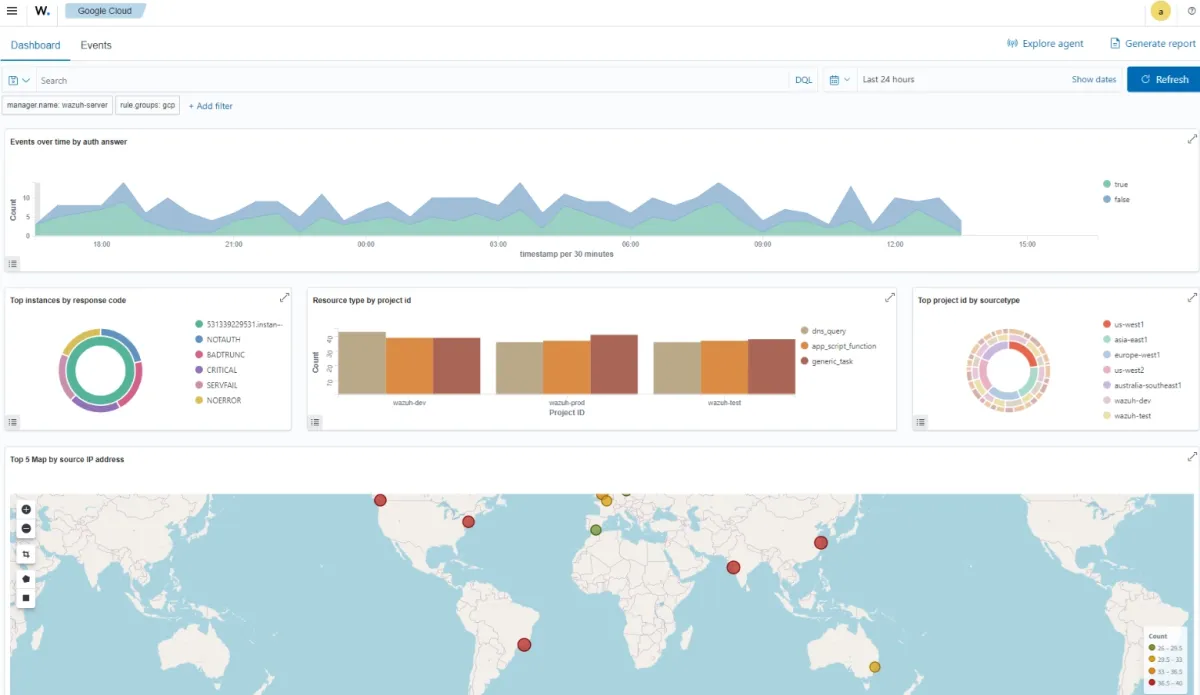
Visualizing Google Cloud events on the Wazuh dashboard:
Source: Wazuh3
Key features:
- Intrusion detection: Detects malware and hidden files using a signature-based approach to analyze log data for indicators of compromise.
- Log data analysis: Reads operating system and application logs and forwards them to a central manager for rule-based analysis.
- File integrity monitoring: Monitors file systems for changes in content, permissions, ownership, and attributes. Tracks user and application actions for PCI DSS compliance.
- Incident response: Blocks threats and runs system queries to identify indicators of compromise.
- MCP/AI integration (2026): Multiple open-source MCP servers now integrate with Wazuh, Claude, ChatGPT, and other AI assistants, enabling natural-language security queries “show me critical vulnerabilities on my web servers” without writing API calls. The most complete implementation supports Wazuh 4.8.0–4.14.4.4
 Add as preferred source
Commercial UEBA tools
Commercial UEBA tools offer out-of-the-box capabilities for user behavior analytics that can be integrated into existing environments without extensive customization.
Leading commercial vendors:
- ManageEngine Log360: Combines SIEM log ingestion with behavioral analytics.
- Exabeam: A behavioral analytics platform with UEBA, now also covering AI agent behavior (January 2026). Best for large, complex environments.
- IBM Security QRadar: Provides UBA with risk profiling, giving deeper context for threat detection.
- Teramind: Combines UEBA with DLP, with a focus on data leakage prevention and employee monitoring.
Open source UEBA tools vs commercial UEBA tools
Commercial providers typically start with one or more open-source technologies, pattern recognition, and database updates for new anomaly patterns, and then add proprietary automation and preconfigured detection models on top.
1. Pre-configured anomaly detection models: Commercial tools provide these out of the box. Open-source tools generally require users to build and configure their own, though Graylog (paid tiers) and Wazuh offer some predefined capabilities.
2. Automated response workflows: Commercial tools trigger predefined actions directly. Open-source tools typically require SOAR integrations or custom scripts, though Wazuh and Graylog (paid) include some pre-defined actions.
3. Pattern recognition automation: Commercial tools automate this with sophisticated ML models. Open-source tools require more manual configuration and custom model building.
4. Data loss prevention (DLP): Commercial tools include DLP with device, location, and network context. Open-source tools need additional tools or integrations to add this.
5. Compliance reporting: Commercial tools include built-in reporting for GDPR, HIPAA, PCI-DSS, and SOX. Open-source tools require custom development or third-party add-ons.
6. Third-party integrations: Commercial tools include pre-built connectors to SIEM, SOAR, and antivirus platforms. Open-source tools integrate via custom API connections.
FAQs
UEBA detects unusual behavior by analyzing deviations from normal patterns. For example, if a user who doesn’t typically download files suddenly starts downloading large amounts, UEBA flags it as an anomaly. It can also monitor machine behavior, such as detecting a surge in server access requests from a company device.
Organizations use UEBA tools because traditional security solutions, like firewalls and intrusion detection systems, are no longer sufficient to protect against modern threats. UEBA tools help by detecting anomalous user and entity behaviors that could indicate security breaches, such as insider threats or credential-based attacks, which are often missed by conventional defenses. These tools provide a more proactive approach to threat detection, especially for advanced persistent threats (APTs) and sophisticated attack methods.
Further reading
Cite this research
Pick the format that matches where you're publishing. Pasting the link version into your CMS preserves the backlink.
@misc{dilmegani2026,
  author = {Dilmegani, Cem and Sezer, Sena},
  title  = {{Top Open Source UEBA Tools & Commercial Alternatives}},
  year   = {2026},
  month  = mar,
  howpublished    = {\url{https://aimultiple.com/open-source-ueba}},
  note   = {AIMultiple. Retrieved March 26, 2026}
}Results and timestamps of 24 data points. Download the summary data shown in this article's charts and tables as a ZIP file containing 4 CSV files.
Want the granular data behind it? Join Premium
Changelog
10 updatesRemoved Apache-Metron, HELK, and Apache-Spot from the "Open source UEBA tools" section.
Reference Links
Cem's work at AIMultiple has been cited by leading global publications including Business Insider, Forbes, Morning Brew, and Washington Post, global firms like Deloitte and HPE, NGOs like World Economic Forum, and supranational organizations like European Commission. [1], [2], [3], [4], [5]
Throughout his career, Cem served as a tech consultant, tech buyer and tech entrepreneur. He advised enterprises on their technology decisions at McKinsey & Company and Altman Solon for more than a decade. He also published a McKinsey report on digitalization.
He led technology strategy and procurement of a telco while reporting to the CEO. He has also led commercial growth of deep tech company Hypatos that reached a 7 digit annual recurring revenue and a 9 digit valuation from 0 within 2 years. Cem's work in Hypatos was covered by leading technology publications like TechCrunch and Business Insider.
Cem regularly speaks at international technology conferences. He graduated from Bogazici University as a computer engineer and holds an MBA from Columbia Business School.







Be the first to comment
Your email address will not be published. All fields are required. Comments are left in their original language.