


Top 12 RPA Software & Their Features

Based on our experience with RPA software during our RPA benchmark as well as external market presence metrics like number of reviews and employees, we selected the leading and emerging RPA providers. Below is a summary of the availability of on-premises deployment and built-in process mining features across the top 12 RPA software solutions.
Product | On-Premise Deployment | Built-in Process Mining |
|---|---|---|
UiPath | ✓ | ✓ |
Automation Anywhere 360 | ✓ | ✓ |
Microsoft Power Automate | ✕ | ✓ |
SS&C Blue Prism | ✓ | ✓ |
IBM Robotic Process Automation | ✓ | ✕ |
Fortra Automate | ✓ | ✕ |
Tungsten Automation | ✓ | ✕ |
AssistEdge | ✓ | ✓ |
SAP Build Process Automation | ✕ | ✕ |
AutomationEdge | ✓ | ✕ |
Built-in process mining: Analyzes employee desktop activity or system logs to automatically map processes and identify bottlenecks, recommending the best candidates for automation.
On-premise deployment: provides on-premise infrastructure.
Details on top RPA vendors
UiPath Business Automation Platform
UiPath offers a comprehensive platform with Studio (for developers), Orchestrator (for deployment and management), and Robots (for execution). UiPath provides:
- Strong AI and machine learning capabilities
- Extensive library of pre-built components and activities
- Supports both attended and unattended automation
- Robust community and marketplace for shared components
- Easy-to-use interface.
In February 2026, UiPath announced the acquisition of WorkFusion, adding purpose-built AI agents for financial crime compliance to its platform.1
Automation Anywhere
Automation Anywhere runs in the cloud by default. It groups its features around a few named modules:
- IQ Bot reads unstructured documents like invoices and forms.
- Bot Insight gives analytics on how bots are performing.
- Agentic Process Automation (APA) lets AI agents handle steps that need judgment, not rules.
- PRE-based reasoning is the vendor’s framing for how its agents plan and execute work.
The cloud-first setup means most teams do not need to manage their own bot servers.2
SS&C Blue Prism
Blue Prism focused on back-office RPA. It is most often picked when audit trails and centralized control matter more than fast citizen-developer adoption.
IBM Robotic Process Automation
IBM robotic process automation is often chosen by companies using other IBM solutions. It leverages IBM’s Watson AI capabilities for intelligent automation.
Fortra Automate
Fortra Automate (formerly HelpSystems Automate) targets small and mid-sized teams that want RPA without a long ramp-up. It fits teams that want to start with a few processes and scale gradually rather than build a large bot factory.
AssistEdge
AssistEdge is the RPA platform from EdgeVerve. It is most often chosen by enterprises that work with Infosys or want a platform tested at a large-scale BPM.
Argos Labs
Argos Labs is a low-code Python automation platform. It is less well-known compared to some other major players, but it is gaining traction in specific sectors.
For example, Argos Labs automated the manual validation and input of sales data from GEOPAL to the CRM system for a utility provider in Northern Ireland. This eliminated manual entry errors and significantly accelerated the sales-CRM process.
BotCity
BotCity gives developers a Python framework and an orchestrator (BotCity Maestro) instead of a low-code drag-and-drop builder. Bots are written as Python scripts. It fits teams with developers on staff. Business users who want drag-and-drop will struggle here.
What are the key features of RPA tools?
The right RPA tool for a specific process in a specific industry depends on the capabilities of the tool. Robotic process automation bots from all robotic process automation companies can be categorized by the functionality they provide in these 3 dimensions:
- Programming options: Either code-based (developers write scripts) or low-code/no-code (built through a visual UI).
- Cognitive / AI capabilities: How much the bot can reason about its inputs, not solely follow rules. This ranges from simple rule-based bots to AI agents that handle exceptions and unstructured data.
- Usage: Attended bots work alongside a person (the person triggers them). Unattended bots run independently on a server or on a schedule. Hybrid bots combine both, handing off between human and bot mid-process.
What are the types of RPA tools?
With more than 50 players in the market, it is hard to identify the best RPA solution. The best solution for your company depends on your specific requirements.
RPA bots are software robots that complete specific automatable activities. There are 4 types of robotic process automation tools on the market.
- Even before RPA software, enterprises were using automation tools. Employees were automating simple processes with Excel automation, macros, and simple hacks. These solutions were not scalable or sustainable, but they increased the productivity of individual employees.
- First-generation RPA tools were programmable bots that required specific inputs.
- Cognitive or intelligent automation bots augment programmable bots with advanced functionality like Natural Language Processing, image recognition or machine learning. These bots have augmented capabilities in interacting with unstructured data and can be effective in decision-making. To achieve this functionality, solution providers bring together services from several companies such as NLP API providers and RPA providers.
- Self-learning tools are now shipping in production from major vendors. Instead of following fixed rules, these bots set goals, plan steps, call other tools, and adjust based on feedback. UiPath, Automation Anywhere, Microsoft, and SAP all market agentic features as part of their core platforms. Most enterprises use them alongside rule-based RPA rather than replacing it.3
How to choose the best RPA technology for your company?
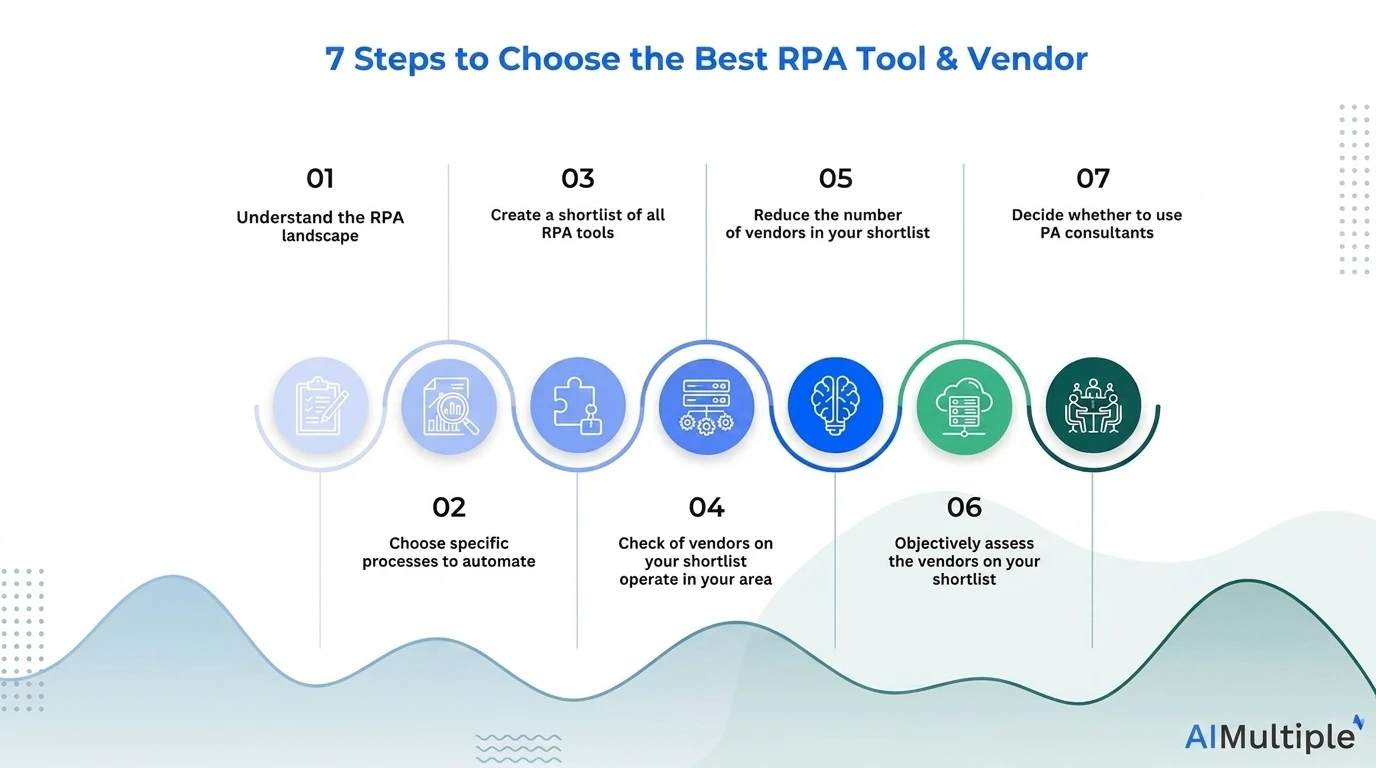
The global RPA market size is expected to reach $64 billion by 2032, thanks to more businesses selecting and leveraging RPA software. See the key steps for RPA adoption:
1. Understand the robotic process automation vendor landscape
No RPA tool is the best one for every industry or process. This view was also shared by RPA consultants during our interviews.
These are the main types of RPA vendors:
Established technology providers
Companies like Pegasystems or Kofax (Tungsten Automation now) were launched in 1980s and 1990s to provide solutions that support various digitization needs of companies.
For example, Kofax established itself as a digital transformation vendor offering services like document digitization and e-signatures. Using their relationships with companies, process knowledge and understanding of change management in companies, they launched RPA products.
1st wave RPA focused vendors
Founded in the 2000s, these vendors are focused on providing RPA solutions and have reached significant scale. Initially, they provided and later perfected programmable bot solutions. Currently, they are focused on improving advanced capabilities of their bots, offering cognitive automation capabilities, and a marketplace to extend the capabilities of their solutions. Some examples in this group are:
- Blue Prism works with numerous Fortune 500 customers
- UiPath, founded in 2005, works for 6 of Fortune 10, 8 of world’s top 20 financial services organizations
2nd wave RPA focused vendors
Founded in 2010s, these vendors are focused on providing latest generation RPA solutions like cognitive or intelligent automation. To achieve higher levels of automation, they focused on specific industries. For example, Workfusion, founded in 2010 is focused on the financial services industry.
Upcoming RPA vendors specialized in innovative RPA solutions
Recently, scope of RPA has grown significantly as we covered in our section on different types of RPA. As a result, specialized RPA companies are on the rise. As we covered in our future of RPA article, we see these as the areas of focus for new RPA companies:
- No code RPA: Companies develop RPA solutions that do not require coding. This facilitates and speeds up RPA development. However, the distinction between no code and low code RPA tools is not a clear one, most RPA solutions allow developers to embed code.
- RPA for MSPs: RPA focused on Managed Service Providers (MSPs) needs. MSPs are called System Integrators (SIs), technology service providers or consultants. These tools provide pricing that is in-line with these companies’ needs. They offer affordable prices at scale or at individual bot levels so these service providers can provide a cost-effective RPA-as-a-Service offering to their customers.
- Agentic Process Automation (APA): AI-native agentic process automation platforms replace rigid RPA scripts with autonomous LLM-driven planners. Some examples include:
- Stacks: An agentic platform for enterprise finance that automates reconciliations, journal entries, and month-end close workflows.
- Chia (Ramco Systems): An enterprise-grade conversational AI agent platform for customer experience teams, designed to automate multi-step support workflows with no-code agent building.
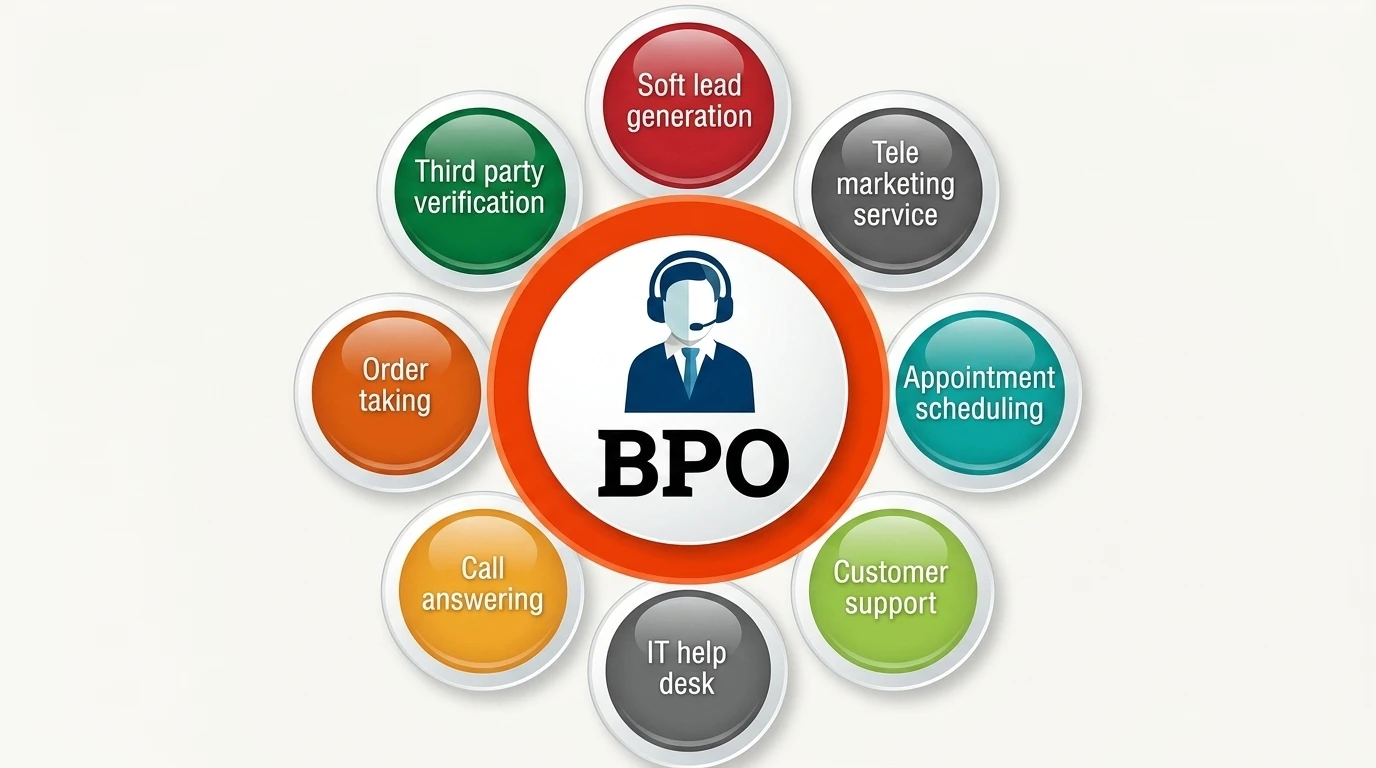
Business Process Outsourcing (BPO) providers
Source: Global Data Management4
Companies like Infosys from India run numerous processes for large companies. It is logical that these companies are striving to automate the processes they took over from other companies. As a result, they have accumulated significant expertise in RPA.
Most of these companies do not have their own RPA solutions; however, they formed partnerships with RPA solution providers and offer turn-key solutions to companies. This model allows companies to focus on business while BPO provider automates the process so it is an interesting alternative for companies that have issues managing day-to-day business with their current headcount.
BPOs can leverage RPA solutions in-house to provide cost-effective outsourcing for automatable processes. They manage the automation while also addressing any edge cases that might disrupt bot operations. This model allows companies to avoid the complexities of automation, making it a hassle-free solution for business process outsourcing.
Now that you know the industry landscape, it is time to prepare your short list of vendors.
2. Pick a process to automate that will clarify your needs.
To identify the important RPA selection criteria for your business, it would be good to understand what good candidate processes are for RPA automation at your company. There are advantages offered to users in different areas, such as the use of RPA in utilities and RPA in finance.
Process mining is an emerging technology that can help businesses identify the best processes to automate. By using real-time data like event logs, process mining reflects the business processes’ actual performance and detects bottlenecks.
For example, in a process mining case study, Caverion, a building and industrial systems company, leveraged process mining to enhance its invoicing processes and accelerate them by 50%.
If you do not have the bandwidth to pick the right processes, there are numerous companies, including system integrators and the Big 4, offering RPA consulting services.
Now that you know the processes to be automated, you can understand which attributes of RPA vendors are more relevant to your business. For example, you should consider automating part of your candidate processes with RPA to see how easy the RPA tool is to use.
3. Get the list of all RPA tools to prepare your shortlist within minutes
Prioritize vendors your company works with, especially if you’re in a Fortune 500. Established relationships with technology or BPO providers for RPA services can expedite purchases. Buying multiple services from a vendor also gives procurement more leverage to negotiate better prices.
If you are feeling lazy, query the list below against your procurement database. You could also use the list of vendors below, but that list may not be as up-to-date as the one on our platform. Now, you have the beginning of a short list of vendors.
You can finalize your shortlist after adding leading vendors with whom your company has no relationship yet. Our list above and database allows you to make those additions. Instead of trying to compare vendors by looking at a marketing employee’s fancy adjectives, we offer you real and up-to-date data.
You can compare established companies and startups on objective metrics using this list. By ranking the most suitable vendors based on your own insights, you will never be fooled with subjective rankings and choose what is best for your company.
We get the question “What’s the best RPA software?” from companies after they go through the list. It is unfortunately impossible to say that without understanding your company’s automation needs in detail, and this guide helps you do that.
4. Check if vendors in your shortlist are operating in your area
RPA vendors are expanding their geographic coverage rapidly. It’s easy to find testimonials from Japan to Africa on leading vendors’ websites.4 And even if they do not have an office in your country, they are probably serving it from a regional office or serving it via their partners like Big 4.
However, if you are considering a large RPA roll-out, it is still good to check if the vendors you selected are offering their services in your country. Having access to their experts can reduce implementation time and improve the success of your RPA project.
5. Reduce the number of vendors on your shortlist
Now that you have your short list of vendors and your partially filled list of criteria, it is time to start communicating with vendors. Before talking to vendors, we recommend going to their profiles on our website to understand a bit more about who they work with and how they describe their services.
After meeting with vendors and evaluating them across these criteria, you will be ready to choose your vendor.
6. Use a checklist to help you fairly and clearly assess RPA vendors.
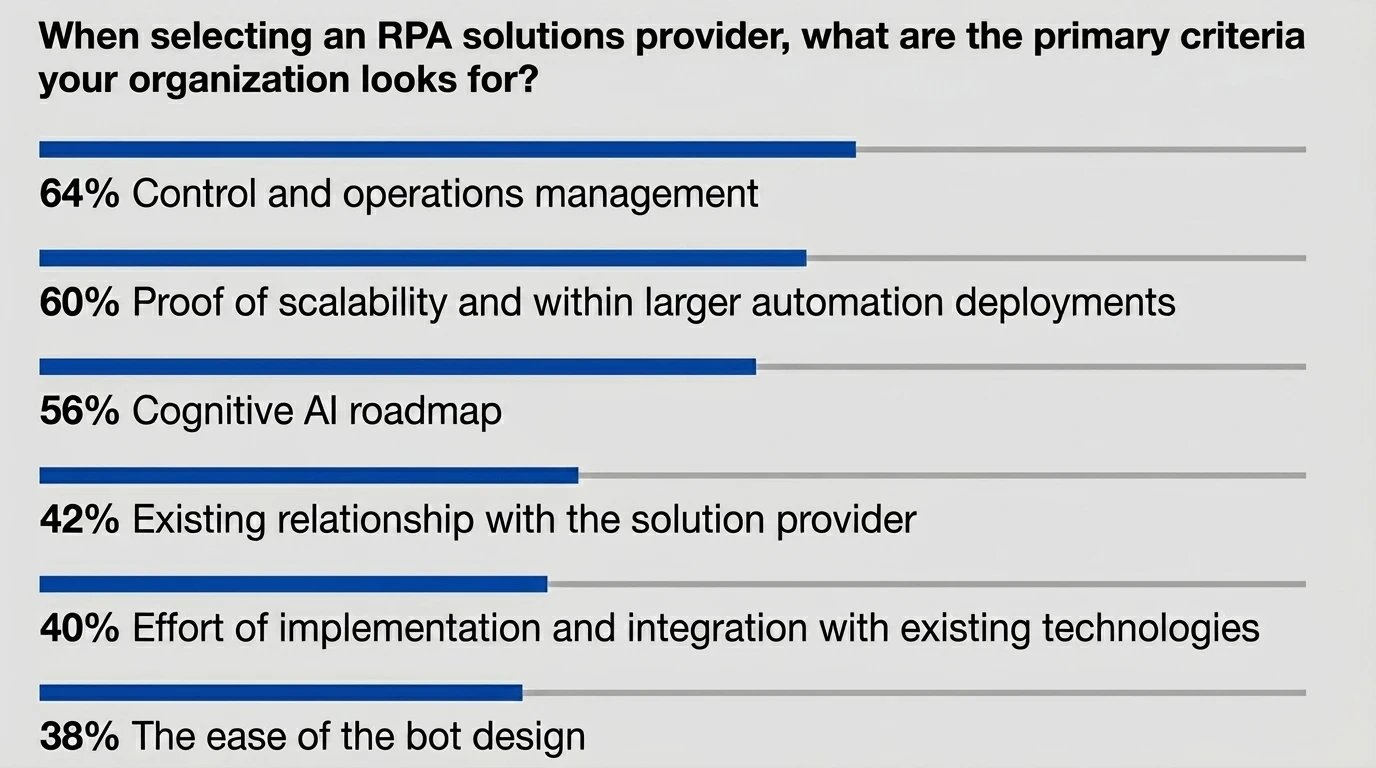
There are plenty of sources on criteria for choosing RPA providers. For example, the list above from Forrester is based on 105 answers by managers listing their primary criteria for selecting an RPA solutions provider. We created the full list of criteria and categorized them to make the list more manageable.
- Total cost of ownership, which includes the initial setup cost of the RPA system, ongoing vendor license fees, and maintenance costs.
- Initial setup cost: Initial setup costs can also be negligible if in-house process experts can train bots. However, if in-house resources are better utilized elsewhere, business consulting companies like Accenture and Infosys can augment your workforce and speed up implementation.
- Ongoing vendor license fees: Vendors like UiPath offer free editions. However, these vendors offer their rule-based bots for free. Cognitive bots that learn by watching employees are a premium product and can be priced per bot or per process. Since different vendors use different pricing models, you need to estimate the total vendor license fee you will pay.
- Maintenance cost: As inputs and systems change, your bots will require maintenance. When you roll out bots, your teams will need to set up the alerts needed to identify bot issues. As those alerts arise, your teams will be fixing bot configurations to maintain bots. This is not a directly measurable financial cost; however, it will distract your employees. An easy-to-maintain solution will make your employees happier and more productive.
- Ease of programming and control:
- Ease of automation: A user-friendly solution easy enough to be used by your team can help them implement RPA in new areas and increase both efficiency and employee satisfaction. Easier-to-use solutions will also require less training and allow your new hires to get up to speed faster.
- In-person or virtual training options: The quality of available training is also an important factor here. Great text or video tutorials and availability of hands-on training can help employees become quickly proficient in RPA solutions. Some leading RPA solutions providers offer community versions of their products. To support RPA development by their community, they offer free courses, training material and community forums helps users support one another.
- Ease of control: Once your process is automated, you will need to make adjustments to how it is running. For example, you may need to stop bots during systems maintenance and add bots when process volume increases. Different providers offer different levels of automation and granularity of control. That’s why it is good to use the bot orchestrator before the purchase.
- Ease of use depends on bot development options, such as the availability of a Graphical User Interface (GUI) for drag and drop bot building and macro recording. Additionally, new vendors are pushing for completely code free RPA solutions that are simpler/easier to implement.
- You can’t know ease of use without using the product. Once you reduce your shortlist to 2 or 3 vendors, pick the simplest use case that you really need to automate, sit down with vendor personnel for an hour, and automate that process on a demo environment.
- Ease of use (from an end-user perspective): Attended RPA or RDA (Robotic Desktop Automation) bots are triggered by end-users, such as call center agents. Therefore, the ease of use of bots from an end-user perspective is important for these bots. The most important feature we noticed in this case is concurrency, which enables an end user to work alongside a bot. Without this feature, bots that need to take long periods of processing time are not feasible to use in attended RPA.
- Technical criteria need to be evaluated by the company’s technology team. RPA software needs to comply with the technology guidelines of the company in terms of:
- Minimum system requirements in terms of software and hardware
- Security
- Integrations
- Screen scraping capabilities
- Cognitive or intelligent automation capabilities
- Compliance with the company’s product roadmap
- Vendor experience: Ideally, it is best to work with a vendor that served a company similar to yours both in terms of size and industry. This may not be easy to find, but it would be easier to work with a vendor that understands the needs and processes of your business. Such experience can drastically improve speed of implementation by reducing the work required to implement RPA software.
- Vendor support: While some companies will require quite some hand-holding, others have technically competent, eager-to-learn staff who can program RPA bots themselves. Based on the needs of your company you need to consider the level of support you will require from your RPA vendor. For a company that requires a lot of support, working with a BPO provider may be a good solution.
- Existing vendor relationship: It is faster to get started with a provider that is familiar with your company
7. Deciding whether to turn to RPA consultants
RPA consultants assist companies in implementing RPA solutions. If your team lacks the expertise or time for deployment, consider partnering with RPA consultants. Discussions with RPA vendors suggest that experienced consultants can significantly speed up project rollouts, making them valuable even if your team is capable.
 Add as preferred source
Tips to turn your next automation project into a success story
There are also alternatives to RPA, such as system upgrades. If RPA costs are approaching system upgrade costs, you could upgrade your underlying systems and automate the tasks rather than using RPA bots. With either an upgrade of your legacy systems or a flexible RPA solution, you will end up with an optimized, automated operation that can carry your business forward.
Automation provides an opportunity to rethink the entire process from customer to service delivery. Unnecessary steps can be eliminated, and non-compliant or legacy activities can be improved.
For example, removing fields from customer forms can improve the user experience and reduce the amount of work to automate.
Cite this research
Pick the format that matches where you're publishing. Pasting the link version into your CMS preserves the backlink.
@misc{dilmegani2026,
  author = {Dilmegani, Cem and Arslan, Ezgi},
  title  = {{Top 12 RPA Software & Their Features}},
  year   = {2026},
  month  = may,
  howpublished    = {\url{https://aimultiple.com/rpa-software}},
  note   = {AIMultiple. Retrieved May 7, 2026}
}Results and timestamps of 24 data points. Download the summary data shown in this article's charts and tables as a ZIP file containing 2 CSV files.
Want the granular data behind it? Join Premium
Reference Links
Cem's work at AIMultiple has been cited by leading global publications including Business Insider, Forbes, Morning Brew, and Washington Post, global firms like Deloitte and HPE, NGOs like World Economic Forum, and supranational organizations like European Commission. [1], [2], [3], [4], [5]
Throughout his career, Cem served as a tech consultant, tech buyer and tech entrepreneur. He advised enterprises on their technology decisions at McKinsey & Company and Altman Solon for more than a decade. He also published a McKinsey report on digitalization.
He led technology strategy and procurement of a telco while reporting to the CEO. He has also led commercial growth of deep tech company Hypatos that reached a 7 digit annual recurring revenue and a 9 digit valuation from 0 within 2 years. Cem's work in Hypatos was covered by leading technology publications like TechCrunch and Business Insider.
Cem regularly speaks at international technology conferences. He graduated from Bogazici University as a computer engineer and holds an MBA from Columbia Business School.



Be the first to comment
Your email address will not be published. All fields are required. Comments are left in their original language.