


Network Monitoring Service Pricing Comparison

Network monitoring service pricing is shaped by several factors: how many devices you’re monitoring, what protocols and integrations you need, and whether you’re deploying on-premises or in the cloud. The five services below use different billing units, sensors, hosts, resources, or technicians, which makes direct price comparisons harder than they look.
Top Network Monitoring Services Pricing Comparison
* When the solution is used to manage the max number of prices allowed by the package. These prices can be considered the minimum prices.
** Paessler PRTG uses a pricing model based on the number of aspects or sensors monitored. One device requires approximately 5–10 sensors (aspects). 1
***Datadog pricing is per host, with different tiers for basic to advanced features. A “host” refers to any physical or virtual operating system instance that is being monitored. You can consider it as a device.2
**** A technician refers to a user who has access to the Atera platform to manage IT operations. The pricing is based on the number of technicians, not on the number of devices.3
****LogicMonitor charges based on specific resources. A resource is not strictly equivalent to a device. Instead, it refers to any unique infrastructure component that is monitored.1
Top Network Monitoring Services Features
Affordability Comparison:
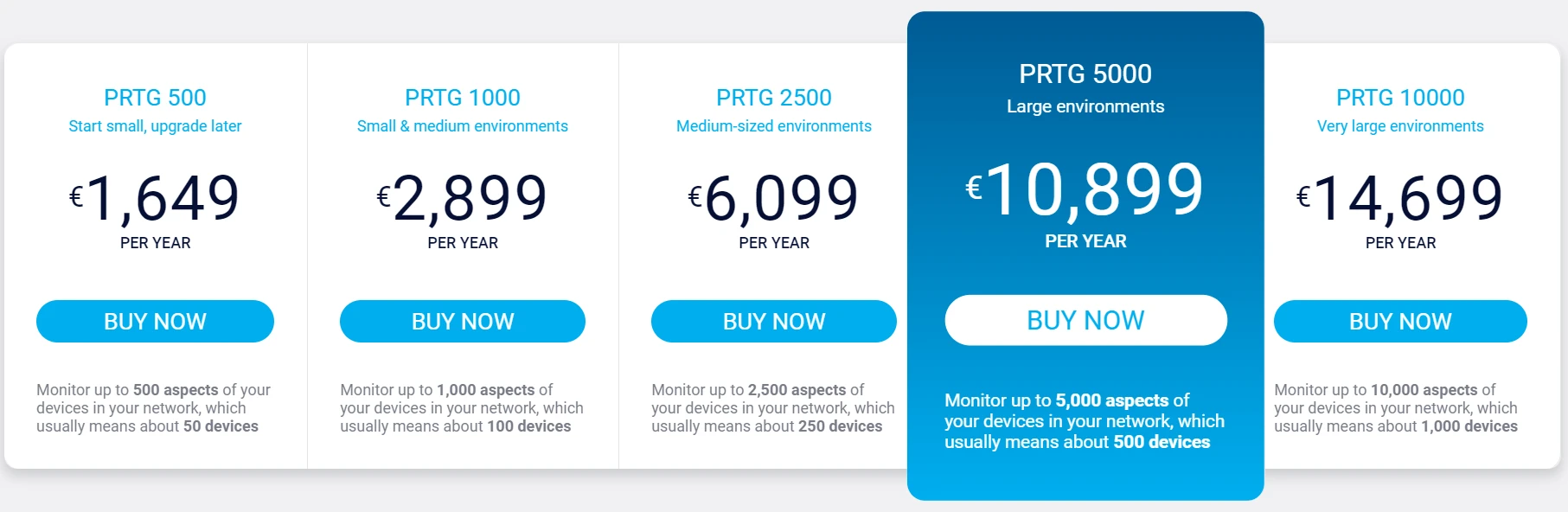
- Small networks (up to 50 devices): WhatsUp Gold’s Business plan covers up to 50 devices and is the lowest entry point for this group, though official pricing is not published on the vendor’s website and may have changed since our last retrieval. PRTG 500, which covers roughly 50–100 devices depending on sensor usage, starts at €1,649/year.
- Mid-sized networks: PRTG’s tiered model becomes cost-effective as device counts increase. PRTG 1000 is priced at €2,899/year (~$3,200 at current exchange rates) for up to 1,000 sensors, roughly 100–200 devices.
- Enterprise environments: LogicMonitor’s $16/resource/month model and Datadog’s $23/host/month Enterprise plan both scale with infrastructure size. For organizations using Datadog across multiple product areas (APM, logs, synthetics), the total cost is substantially higher than the per-host base price suggests.
Paessler PRTG
Paessler PRTG Network Monitor runs on-premises on a Windows server and monitors network devices, servers, virtual environments, applications, and cloud services from a single installation. Pricing is based on the number of sensors, and all plans include the same feature set. The only difference between tiers is capacity. All licenses are sold as 3-year subscriptions billed annually.
Paessler PRTG pricing depends on:
- PRTG 500: $1,726/year (up to 500 sensors)
- PRTG 1000: $3,049/year (up to 1,000 sensors)
- PRTG 2500: $6,401/year (up to 2,500 sensors)
- PRTG 5000: $11,441/year (up to 5,000 sensors)
- PRTG 10000: $15,435/year (up to 10,000 sensors)
If you have an existing PRTG Network Monitor subscription and need more sensors, you can upgrade to a larger license. There are two scenarios:
- New Subscription Period: The upgrade takes effect when the new subscription starts, with no change to your license key.
- Mid-Term Upgrade: The upgrade takes effect immediately, and a new subscription period commences. You’ll receive a discount for unused days from your previous plan, and your license key remains unchanged.
Paessler published MSP-specific guidance and a formal MSP Program, offering multi-tenant monitoring architecture and commercial terms designed for service providers managing multiple client environments under a single PRTG deployment. 4
LogicMonitor
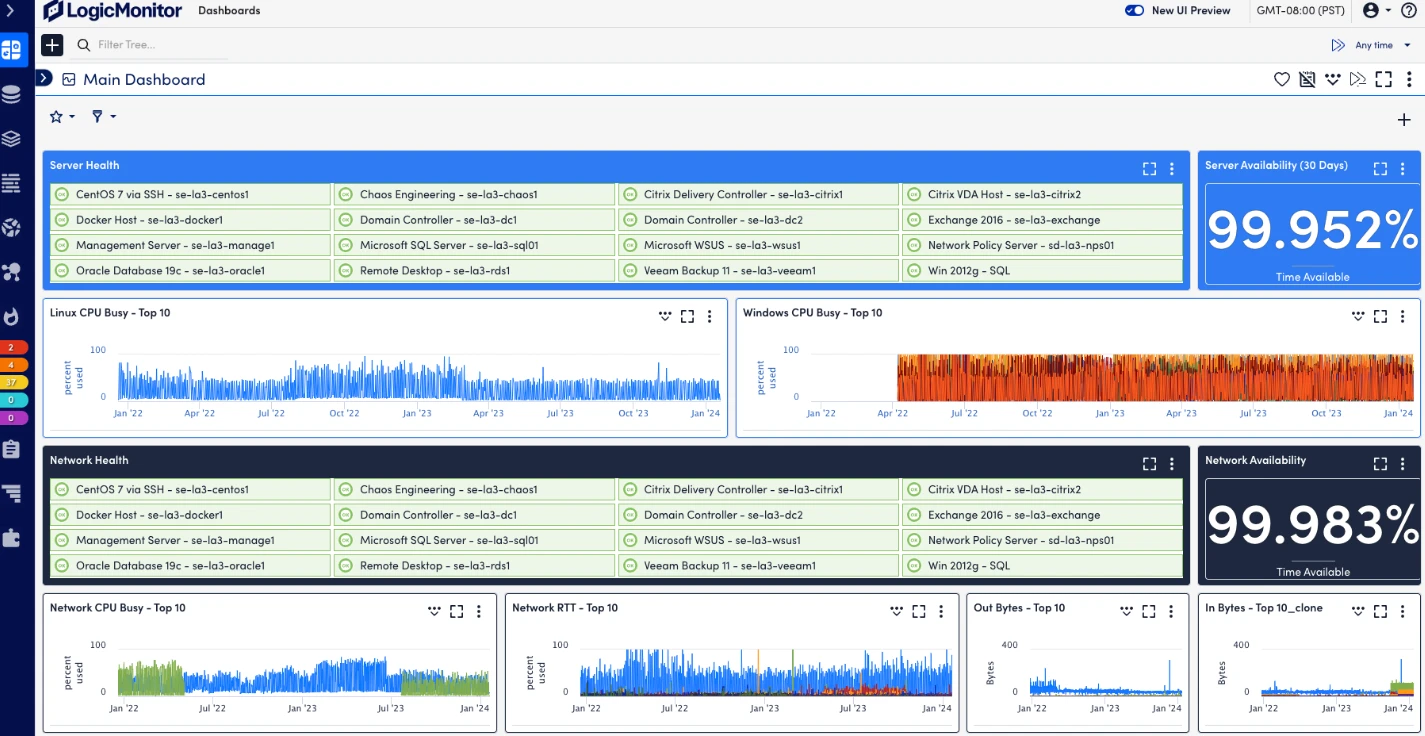
LogicMonitor is a cloud-hosted monitoring platform covering networks, servers, cloud infrastructure, and containers. It bills per resource rather than per device meaning a server with multiple monitored components counts as one resource, while a Kubernetes cluster may count as many.
They announced a new platform pricing model that replaces the product-by-product, per-resource structure. Pricing uses a single “Hybrid Unit” billing metric across three packages Essentials, Advanced, and Signaturecovering all resource types (on-prem, cloud, wireless, containers) under one license. 5
There are three tiers: Essentials at $16/hybrid unit/month for faster troubleshooting and infrastructure modernization,
Advanced at $27/hybrid unit/month for enterprise-grade hybrid infrastructure, and Signature + Edwin AI at $53/hybrid unit/month, which bundles LogicMonitor’s AI-powered operations tool directly into the package.
All prices are starting monthly list prices billed annually, with volume discounts available. GovCloud availability is planned.6
Atera
Atera is an RMM and PSA platform aimed at IT departments and managed service providers. Unlike the other tools here, it charges per technician rather than per device. One technician license covers unlimited endpoints. The pricing below is for IT departments; MSP-track pricing differs.
Atera offers four pricing plans:
- Professional: $156/month (billed annually). Includes remote management, monitoring, access, patch management, and more.
- Expert: $198/month (billed annually). Adds unlimited Splashtop sessions, AnyDesk access, chat, and extended audit logs.
- Master: $230/month (billed annually). Includes custom reports, longer audit log retention, and data recovery.
- Enterprise: Custom pricing. Includes enterprise-grade services like SSO, private repositories, and premium support.
Datadog
Datadog is a cloud-based observability platform that monitors infrastructure, applications, and logs across distributed environments. The base infrastructure plans listed below are the starting point; most production deployments add APM, log management, or other modules at separate per-unit costs.
- Free: $0/month, includes core features with 1-day metric retention and up to 5 hosts.
- Pro: $15/month per host (billed annually), includes 750+ integrations, out-of-the-box dashboards, and 15-month metric retention.
- Enterprise: $23/month per host (billed annually), adds machine learning-based alerts and live processes.
- DevSecOps Pro: $22/month per host, includes security features like continuous scanning and compliance frameworks.
- DevSecOps Enterprise: $34/month per host, includes advanced security features.
Datadog’s expansion into LLM and AI agent monitoring (with the Google ADK integration) represents a trend of network monitoring vendors extending into AI observability. Buyers are beginning to evaluate whether their network monitoring tool can also monitor AI workloads, making this a relevant differentiator to cover in pricing comparisons. 7
 Add as preferred source
Progress WhatsUp Gold
WhatsUp Gold is an on-premises network monitoring tool that covers devices, servers, applications, and cloud infrastructure. It uses device-based licensing for its core editions.
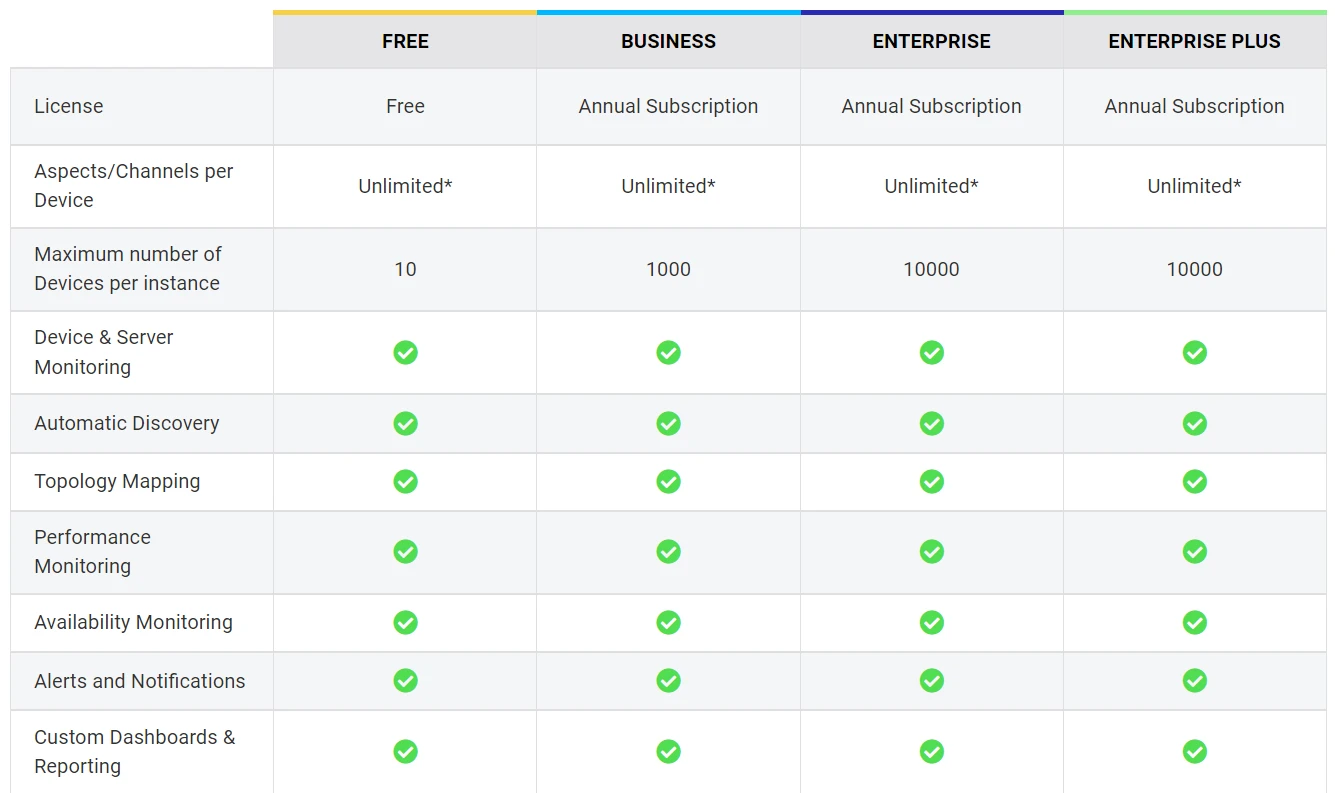
- Free Edition: $0, allows monitoring of up to 10 devices.
- Business: $899/year for monitoring up to 50 devices, scalable to 1,000 devices.
- Enterprise: $1,499/year for 50 devices, tailored for businesses monitoring over 1,000 devices.
- Enterprise Plus: $2,199/year for 50 devices, includes all additional add-ons.
For more on network monitoring
Cite this research
Pick the format that matches where you're publishing. Pasting the link version into your CMS preserves the backlink.
@misc{dilmegani2026,
  author = {Dilmegani, Cem},
  title  = {{Network Monitoring Service Pricing Comparison}},
  year   = {2026},
  month  = jul,
  howpublished    = {\url{https://aimultiple.com/network-monitoring-service-pricing}},
  note   = {AIMultiple. Retrieved July 16, 2026}
}Results and timestamps of 11 data points. Download the summary data shown in this article's charts and tables as a ZIP file containing 2 CSV files.
Want the granular data behind it? Join Premium
Changelog
4 updatesRemoved the Frequently Asked Questions section.
Updated the description of network monitoring service pricing factors.
Reference Links
Cem's work at AIMultiple has been cited by leading global publications including Business Insider, Forbes, Morning Brew, and Washington Post, global firms like Deloitte and HPE, NGOs like World Economic Forum, and supranational organizations like European Commission. [1], [2], [3], [4], [5]
Throughout his career, Cem served as a tech consultant, tech buyer and tech entrepreneur. He advised enterprises on their technology decisions at McKinsey & Company and Altman Solon for more than a decade. He also published a McKinsey report on digitalization.
He led technology strategy and procurement of a telco while reporting to the CEO. He has also led commercial growth of deep tech company Hypatos that reached a 7 digit annual recurring revenue and a 9 digit valuation from 0 within 2 years. Cem's work in Hypatos was covered by leading technology publications like TechCrunch and Business Insider.
Cem regularly speaks at international technology conferences. He graduated from Bogazici University as a computer engineer and holds an MBA from Columbia Business School.







Be the first to comment
Your email address will not be published. All fields are required. Comments are left in their original language.