


Top 18 Process KPIs to Monitor Process Performance

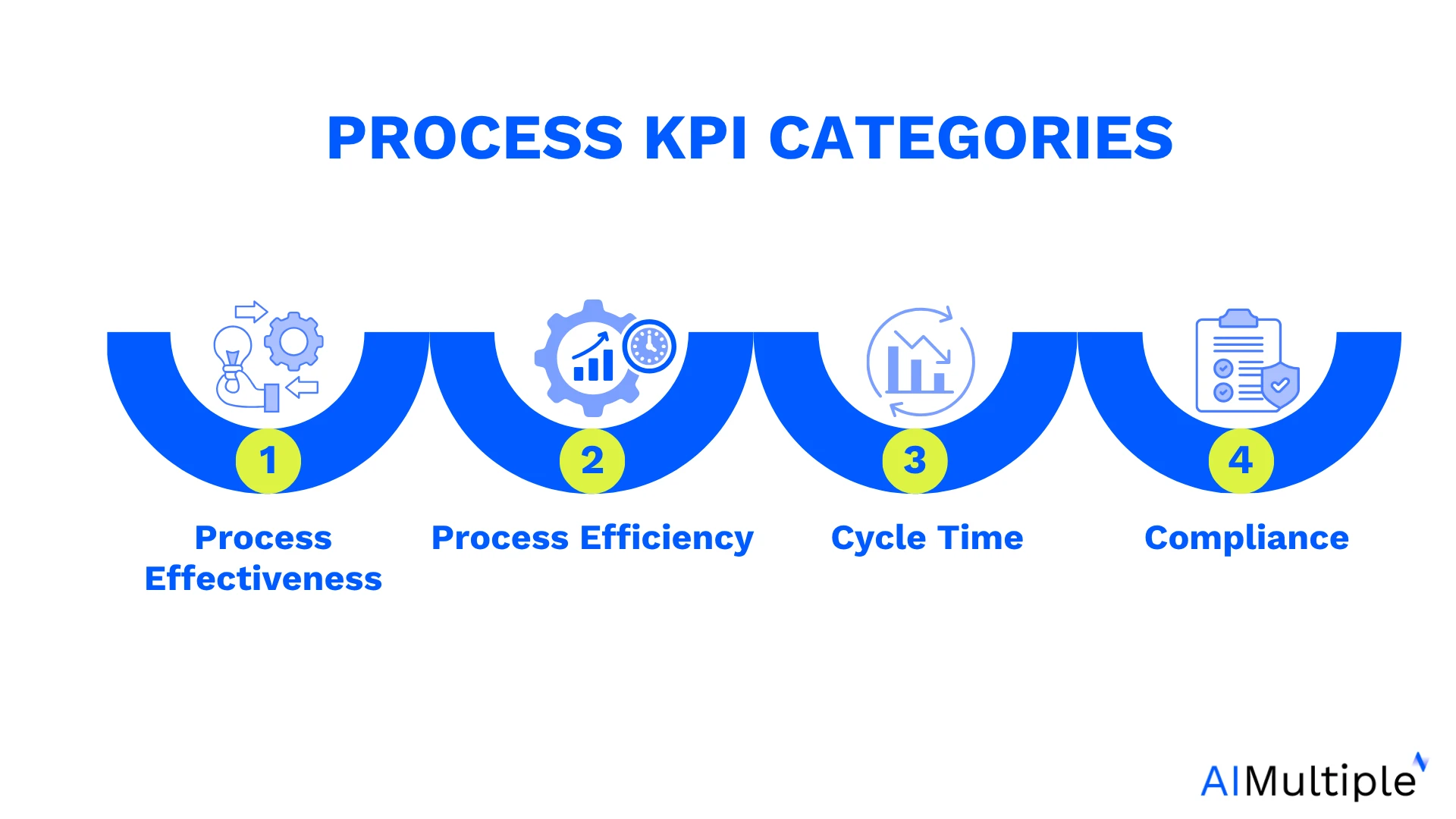
Process KPIs (key performance indicators) help assess process effectiveness, efficiency, cycle time and compliance in an organization. To show which of these metrics matter most in practice, we reviewed 52 process mining case studies and recorded the KPIs mentioned in the cases, noting whether the case reported an actual result or aimed at that KPI.
The chart below shows the 10 most mentioned process KPIs:
We counted a case study once for each KPI it mentions, so one case can appear under several KPIs. KPI mentions are counted as:
- Reported: The case study states an actual result for that KPI, such as a percentage or a before and after figure.
- Targeted: The case study aims at that KPI, but gives no result, so we do not know if it was achieved.
Which process KPI categories appear most?
The chart shows how many KPI mentions from the 52 case studies fall into each of the four categories (effectiveness, efficiency, cycle time and compliance), and how many came with a reported result:
The three buttons show the same data in different ways:
- Total mentions: all KPI mentions in that category, reported and targeted together.
- Reported results: The mentions with an actual result.
- Evidence rate (%): reported results divided by total mentions, so a higher rate means more of the claims in that category are backed by a result.
Check out KPI distribution methodology.
Process effectiveness
Process effectiveness is the delivery of a qualified service or product in a way that it satisfies the customers.
Some examples for process effectiveness KPIs include:
- Quality: The output (service or product) meets the client standards, internal QA and budget.
- Error rate: The number of units, products or service that failed during the entire process cycle.
- Customer satisfaction: How well the process meets the customer’s expectations. This KPI is related to another KPI:
- Value: A measure of customer perception regarding the worth of a product or service.
- Conversion rate: The number of prospects that company interacts and convinces to become customers (in a commercial process).
- Competitiveness: It is the market share compared to competitors which is a strategic measure for market positioning.
- Profitability: It refers to relationship between revenue and costs, beneficial to assess financial outcomes linked to process performance.
For instance, in a manufacturing process:
- Percentage of non-conforming units produced
- The level of customer satisfaction (for the final product).
Process mining automatically calculates throughput rates, conversion rates, and bottlenecks during process analysis. The results can be compared to the strategy, business process model, or ideal process model using conformance check.
Real-life example
In a process mining case study, Von Ardenne, a leading German equipment supplier, integrated a process mining software to elevate operational effectiveness. Thorough analysis, Supplier company aligned with some of the key performance indicators (KPIs) such as:
- Efficient delivery by increasing delivery reliability
- Error rate reduction
- Cost reduction by improving planning and analytics
- Improved customer satisfaction by tracking workflow for customer lifetime value.
Process efficiency
Process efficiency measures resource utilization rates, employee skill-application ratios, and the proportion of non-value-added activities relative to total process time. Some operational efficiency KPIs examples are:
- Cost: The expenses spent on the necessary resources to complete the process, including workers’ salaries.
- Resource efficiency: The metrics compares the total value of the final process against the consumed resources considering environmental impact
- Return on investment: The amount of profit required to justify the investment on a particular campaign or process.
- Takt time: Time to complete one unit before starting another which helps evaluating the consistency in unit production.
Process mining can identify which specific activities consume the most wait time.
Process cycle time
Process cycle time measures the duration from task initiation to completion, typically calculated as the average across multiple instances. The cycle time KPIs include:
- Total lead time/Throughput time: The time from the start until the end of the process, including each step the process contains
- Value-added time: It is the time that is spent completing a single task
- Turnaround time: The turnaround time refers to the time it takes to complete a customer’s request from order to delivery
Logistics firms prioritize turnaround time reduction to improve customer satisfaction scores. For manufacturers, throughput time assesses the entire production pipeline from raw materials to finished goods. They evaluate all the waiting time for materials, machinery downtime or delays occurring at any stage that might prolong the throughput time.
Process mining predicts delays before they impact delivery schedules.
Process compliance
Internal process compliance provides insights into possible causes for non-conforming processes compared to standard operating procedures and best practices, while external compliance ensures tracking and complying with relevant government regulations and policies. As a result, process compliance protects organizations from fines and helps mitigate the risks such as regulatory penalties in the financial sector.
Some KPIs used for compliance:
- Risk mitigation timeframe: It is to measure the time between the risk that occurs after the change implemented and the discovery of that risk
- Mean time to issue resolution: It is the time that takes to solve an issue after it’s identified
- ESG performance: Environmental, social and governance reporting shows the non-financial impact and compliance level with standard procedures and rules in the regions the firm operates through several metrics.
- Capacity: It is the maximum production capability under optimal conditions. This KPI helps measure production potential alongside throughput time.
These KPIs enable executive boards to demonstrate compliance to auditors using timestamped process logs.
Compliance is a key use case for process mining, as it maps entire processes and detects compliance issues through discovery and conformance checks. Process mining tools perform automated root cause analysis to identify specific workflow stages generating non-compliant outputs.
Real-life example
For example, a logistics company leveraged process mining and detected around 70% compliance risks in its credit and collections management process.1
Process KPIs & process mining
Process mining tools can help track relevant process performance metrics by deriving quantitative process performance metrics from system data.
With process mining, users can:
- Compare the discovered process to the ideal model and determine its effectiveness.
- Identify resource and time waste to improve efficiency.
- Predict potential problems like delays that can negatively impact process performance.
- Improve process flow and reduce cycle time.
- Ensure compliance by identifying deviations from regulations and standards.
- Pinpoint responsible teams or stages for non-compliant outputs, enabling corrective actions with root-cause analysis.
AI capabilities for Process KPI tracking
- User-friendly workflow automation:Natural language workflow interfaces enable business users to define automations using plain-language prompts, removing the need for developers to write code.
- Autonomous AI agents: Organizations piloting autonomous AI agents report a ~65% reduction in routine approvals requiring human intervention, as AI handles straightforward decisions.2
- Predictive analytics: Predictive process analysis can reduce process cycle times by 20–30% by identifying bottlenecks before they occur.2
- Generative AI: Generative AI is applied to process mining to automatically map process variants and flag anomalies with confidence scores.
 Add as preferred source
Process KPI methodology
We used the case studies and use cases listed in our process mining use cases article, 50 in total, plus 2 examples from the article, giving 52 cases. For each case we read the full entry, and marked every KPI it addressed:
- Reported: the case states an actual result for that KPI, such as “35 minutes to 5 minutes” or “67% fewer duplicate payments.”
- Targeted: the case names or clearly implies the KPI in its description or summary, but reports no result.
We then mapped each KPI to one of the four categories, counted how often each appeared, and calculated the evidence rate per category. A case can address several KPIs, so 52 cases produced 141 KPI mentions.
What are the process performance indicators and examples?
Process Performance Indicators (PPIs) measure the efficiency and health of a workflow. While high-level KPIs focus on overall business goals, PPIs look closely at the mechanics of how work gets done, focusing on inputs, step durations, and outputs. Process indicators fall into two categories:
- Leading indicators (Predictive): They track active steps to forecast future performance and flag issues early.
- Average response/cycle time
- Raw material input quality
- Task duration.
- Lagging Indicators (Historical): They measure the final results of a completed workflow to see if goals were met.
- Total sales generated
- Customer or employee satisfaction scores
- Final output/defect rates
What are 5 of the most common KPIs?
KPIs can differ by business, but five commonly used ones include:
- Revenue growth: Measures the increase in a company’s sales over a period.
- Revenue per client: Assesses the rate at which income is generated from each customer.
- Profit margin: Indicates the amount of profit a company makes relative to its total revenue.
- Client retention rate: Tracks the percentage of clients that stay with the company.
- Customer satisfaction: Gauges how pleased customers are with the company’s products or services. These KPIs are essential for assessing overall business performance and guiding strategy.
Further reading
Feel free to read process improvement articles:
- SAP Process Orchestration: Top Solutions, Features, Integrations
- Top Process Mining Real-Life Use Cases & Applications
Cite this research
Pick the format that matches where you're publishing. Pasting the link version into your CMS preserves the backlink.
@misc{simsek2026,
  author = {Şimşek, Hazal},
  title  = {{Top 18 Process KPIs to Monitor Process Performance}},
  year   = {2026},
  month  = aug,
  howpublished    = {\url{https://aimultiple.com/process-kpis}},
  note   = {AIMultiple. Retrieved August 20, 2026}
}Results and timestamps of 92 data points. Download the summary data shown in this article's charts and tables as a ZIP file containing 4 CSV files and a README.
Want the granular data behind it? Join Premium
Changelog
12 updatesAdded a chart of the 10 most mentioned process KPIs from 52 case studies
Added Process KPI methodology section explaining case study evidence scoring.
Added AI capabilities for Process KPI tracking to the article.
Reference Links

Be the first to comment
Your email address will not be published. All fields are required. Comments are left in their original language.