


8 Network Monitoring Use Cases with Real-Life Examples

Network monitoring is one of those things that IT teams notice when it is missing. When it works well, problems get caught before users know anything is wrong. When it is absent, a minor connectivity issue can quietly escalate into a major outage.
See our examples below to show how organizations are actually putting these tools to work across performance, security, compliance, capacity planning, and more.
Core Network Monitoring Use Cases
1. Agentic Network Operations
Traditional network monitoring alerts humans to problems. Agentic systems go further, they detect, investigate the root cause, and initiate remediation without waiting for a ticket to be opened.
In practical deployments, this means an agent can detect an anomalous traffic spike, correlate it against topology data and recent configuration changes, determine it is not a security event but a misconfigured QoS policy, push a corrected configuration, verify the fix, and close the incident all faster than the time it takes a human to read the initial alert.
Gartner’s 2026 report on the future of NetOps describes a three-stage progression: response-focused AI (chatbots and simple alerting), task-focused AI (AI assistants that recommend actions), and goal-focused AI (autonomous agents that act).
Most enterprises are currently in the first or second stage. The third stage is operationally available now through platforms like Cisco ThousandEyes AI Canvas, Dynatrace Intelligence, and LogicMonitor Edwin AI, but requires a mature event intelligence infrastructure to deploy safely. 1
Case Study:
Deutsche Telekom deployed what it calls the “RAN Guardian Agent,” an autonomous system that monitors mobile network performance, assists with troubleshooting, and optimizes configurations in real time across its radio access network.
The agent ingests live telemetry, detects exceptional situations, and applies fixes without waiting for human intervention. Deutsche Telekom announced this in November 2025, and it became a reference case in McKinsey’s April 2026 report on agentic infrastructure. 2
A broader McKinsey analysis of enterprise IT service desk deployments found that embedding agents across network monitoring and incident management workflows resulted in up to 80% of requests being automated and 50% of service agent capacity redeployed to higher-value tasks, with customer satisfaction holding at 4.8/5.
The same report notes that observability, ITSM, and infrastructure operations together account for 45–75% of total infrastructure labor spend, making this the highest-ROI area for agentic AI deployment in IT. 2
2. Performance monitoring and uptime
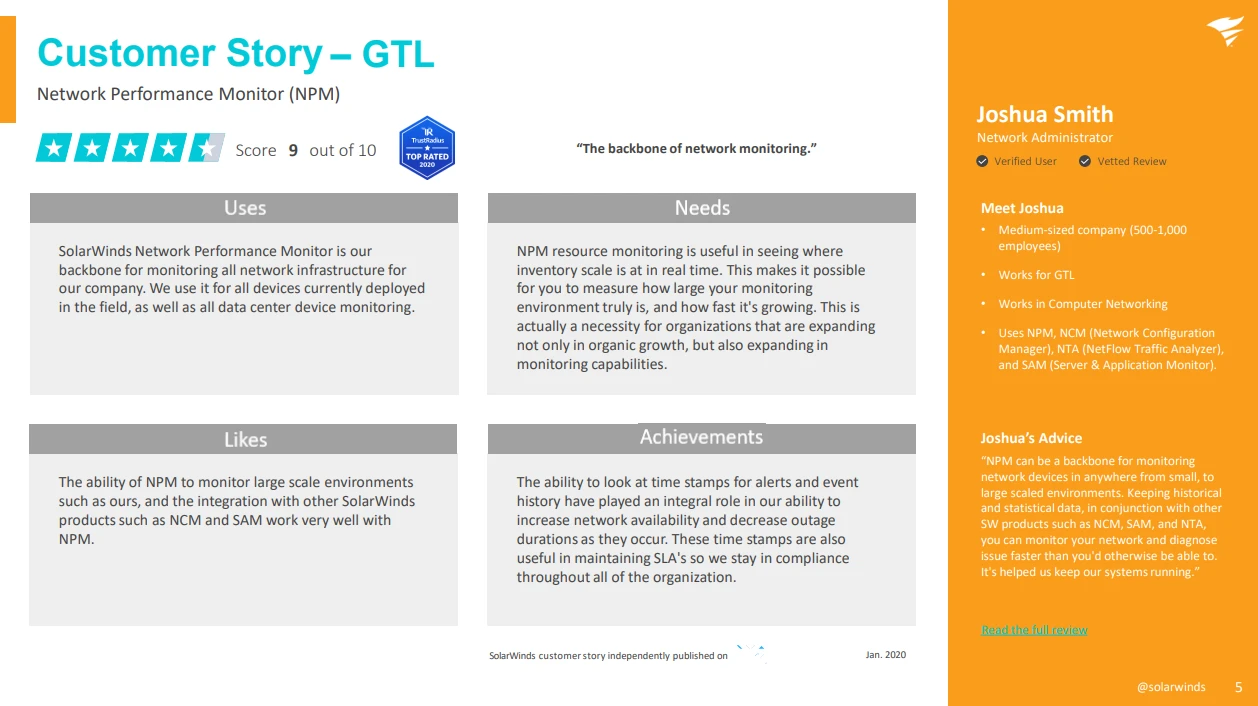
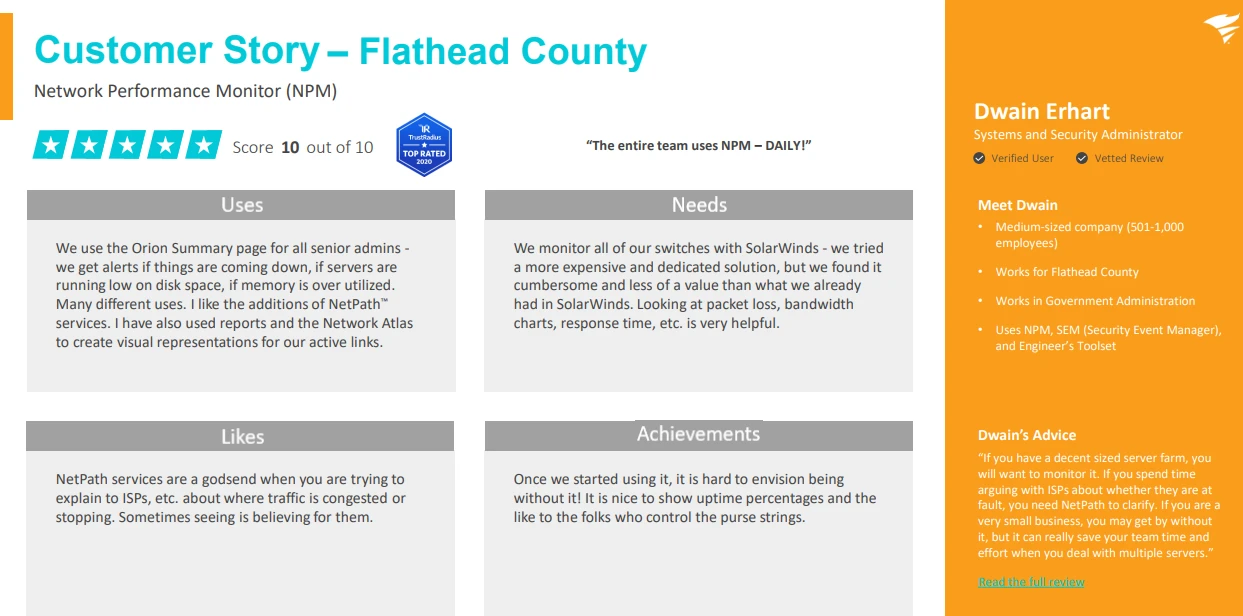
Network monitoring gives IT teams real-time visibility into server health, link availability, and device status, the baseline needed to catch degradation before it becomes downtime.
This reflects a common pattern in public sector and mid-market organizations: the monitoring data is as useful in budget conversations as it is in incident response.
3. Security Threat Detection
Most breaches leave traces in network traffic well before anyone notices something is wrong. The problem is that those traces are invisible without a baseline. You can’t detect unusual behavior in traffic you’ve never characterized as normal.
According to Verizon’s 2025 Data Breach Investigations Report, 88% of breaches involved stolen credentials.3 Attackers use valid accounts to move laterally, which means anomalous traffic patterns a user account accessing systems it’s never touched, or a server making outbound connections at unusual hours are often the early signal available.
The security monitoring picture in 2026 has shifted from detection to autonomous response. Where earlier tools flagged anomalies for human review, agentic security systems now isolate compromised endpoints, block source IPs, and trigger containment workflows without waiting for analyst intervention. Telecom operators report a 25–29% improvement in MTTR (mean time to repair) when agentic tools handle the initial response cycle, with human analysts retained for complex and ambiguous cases. 4
4. Compliance and Audit
Regulatory frameworks require organizations to prove they monitor and log network access. Network monitoring tools generate the audit trails that regulators and assessors need to see.
Real example: The Equifax breach is the clearest illustration of what happens when monitoring fails. Attackers entered through an unpatched Apache Struts vulnerability in May 2017 and stayed undetected for 76 days. The reason the breach went undetected for that long: an SSL inspection certificate had expired 19 months earlier, and nobody had noticed. With SSL inspection disabled, the network monitoring tools couldn’t see the encrypted traffic the attackers were using to exfiltrate data. When the certificate was finally renewed in July 2017, monitoring resumed and immediately detected the unauthorized data flows.5
The legal aftermath involved two separate proceedings. First, the FTC, CFPB, and 50 U.S. states and territories (48 states plus DC and Puerto Rico) settled with Equifax for at least $575 million, potentially up to $700 million, depending on consumer claim volume.6 Separately, a consumer class action concluded in a $1.5 billion settlement that required Equifax to spend at least $1 billion over five years overhauling its security infrastructure.7
The breach exposed 147 million names and dates of birth and 145.5 million Social Security numbers. The root failure, an expired certificate that no one caught for 19 months, is exactly what continuous certificate monitoring and network visibility tooling is designed to prevent.
5. Troubleshooting and Diagnostics
Finding the source of a network problem without monitoring is guesswork. You know something is broken, but not where or why. With visibility into traffic flows and device behavior, diagnoses that once took hours can be completed in minutes.
Real example: Isothermic, a Quebec-based manufacturer of windows and doors with over 250 employees across factories and retail locations, had Microsoft Teams crashing and VoIP calls dropping across sites. The new IT Director found no visibility into the network structure across locations and no data to work from. The managed service provider had no way to identify the source of the problems without it.
After deploying Obkio monitoring agents at each location, the diagnosis came quickly: the head office was running on a residential coaxial connection that dropped under load. Armed with traffic data rather than hunches, the team made the internal case to upgrade to fiber, which resolved the connectivity issues. The monitoring also identified Wi-Fi dead zones in conference rooms that had been causing intermittent problems nobody could previously pinpoint.
6. Capacity planning and bandwidth optimization
Growing organizations tend to outpace their infrastructure gradually; traffic increases incrementally, new services get added, and then peak load reveals the gap. Monitoring gives IT teams the usage data to see that trajectory early and make a case for investment before performance degrades.
It also prevents unnecessary spending. The actual bottleneck is often not what it appears to be.
Real example: Compuquip, a managed security services provider, ran into a recurring pattern: clients were convinced they needed urgent bandwidth upgrades, and ISPs were ready to sell them one. But the actual bottleneck was rarely what anyone assumed. After adding PRTG to its monitoring stack, Compuquip could pull up granular traffic data in minutes rather than spending hours disputing performance claims with internet providers.
Jorge Azcuy, Director of Technical Services, put it directly: “PRTG lets us see the traffic and accurately determine whether the bandwidth is truly maxed out. Why spend four or more hours on the phone with your ISP when you can look at the PRTG data and make a decision in less than 15 minutes?” Beyond avoiding unnecessary upgrades, the team used PRTG traffic analysis to identify the lowest-bandwidth hours of the day and schedule backups and other data-intensive jobs during those windows, keeping the network clear during business hours without changing any infrastructure.8
7. Quality of service (QoS) and SLA compliance
QoS management means prioritizing traffic so that critical applications get the bandwidth and latency they need, even when the network is under load. In practice, this often comes down to SLA enforcement: proving that committed performance levels are being met and catching violations before they become contractual problems.
Real example: A medical device company supplying EKG analysis software to hospitals operates under a 20-minute SLA on analysis results. The company uses Intermapper to monitor the queue of EKG tests waiting for processing in real time.
When a network issue causes the queue to grow, IT gets an alert before the hospital does. The monitoring distinguishes between a problem on the local network and a failure on an upstream connection the kind of distinction that determines whether the response is an internal fix or an ISP call. The key feature is the custom probe capability: not all medical and industrial devices use standard SNMP, so generic monitoring tools miss them entirely.9
8. Tool consolidation and observability
Most organizations don’t run one monitoring tool; they run several. One for infrastructure, one for applications, one for cloud, one for security. Each covers a different layer. None of them talk to each other. The result is that engineers spend more time correlating dashboards than resolving incidents.
Real example: Pine Labs, a merchant payment platform processing transactions across thousands of retail locations, spent years building network visibility from six different open-source and third-party tools. Managing the tools had become a job in itself, and the combined picture they produced was fragmented enough that the team was partially blind.
After consolidating onto SolarWinds Observability Self-Hosted as a single platform, Pine Labs eliminated tool sprawl, reduced operating costs, and improved MTTR by 15–20% immediately. The infrastructure architect, Somil Goyal, projected continued improvement: “In the longer run, we can reduce MTTD and MTTR up to 40 to 50%.”10
The consolidation payoff is not just cost. Every additional tool adds alert fatigue, requires its own maintenance window, and creates a data silo. When an incident spans multiple layers, a network bottleneck causing an application timeout, and a user-facing error, seeing all three in one place cuts resolution time more than any individual tool improvement can.
FAQs
Network monitoring tools provide real-time insights into network traffic, bandwidth utilization, and device performance. By analyzing this data, organizations can identify areas of congestion, optimize network configurations, and allocate resources efficiently to enhance overall performance.
Network monitoring use cases employ advanced threat detection algorithms and anomaly detection techniques to identify suspicious activities, malware infections, and unauthorized access attempts. By continuously monitoring network traffic and behavior, organizations can detect security threats early and respond promptly to prevent data breaches and cyber attacks.
Network monitoring tools are crucial in ensuring compliance with regulatory requirements by tracking data flows, monitoring access controls, and logging user activities. By maintaining audit trails, organizations can demonstrate compliance during regulatory audits and inspections, as highlighted in network monitoring use cases.
When considering network monitoring use cases, these tools provide valuable insights into network usage patterns, traffic trends, and performance metrics, enabling organizations to forecast future capacity requirements accurately. By proactively planning for increased demand, organizations can avoid network congestion, optimize resource allocation, and ensure seamless scalability.
For more on network monitoring
Cite this research
Pick the format that matches where you're publishing. Pasting the link version into your CMS preserves the backlink.
@misc{dilmegani2026,
  author = {Dilmegani, Cem and Ermut, Sıla},
  title  = {{8 Network Monitoring Use Cases with Real-Life Examples}},
  year   = {2026},
  month  = jun,
  howpublished    = {\url{https://aimultiple.com/network-monitoring-use-cases}},
  note   = {AIMultiple. Retrieved June 26, 2026}
}
Changelog
4 updatesAdded an Agentic Network Operations section on autonomous incident response.
Added case studies for American University's NDR deployment and a medical device company using Intermapper.
Replaced Case Study 1 in the Network Monitoring Use Cases section.
Reference Links
Cem's work at AIMultiple has been cited by leading global publications including Business Insider, Forbes, Morning Brew, and Washington Post, global firms like Deloitte and HPE, NGOs like World Economic Forum, and supranational organizations like European Commission. [1], [2], [3], [4], [5]
Throughout his career, Cem served as a tech consultant, tech buyer and tech entrepreneur. He advised enterprises on their technology decisions at McKinsey & Company and Altman Solon for more than a decade. He also published a McKinsey report on digitalization.
He led technology strategy and procurement of a telco while reporting to the CEO. He has also led commercial growth of deep tech company Hypatos that reached a 7 digit annual recurring revenue and a 9 digit valuation from 0 within 2 years. Cem's work in Hypatos was covered by leading technology publications like TechCrunch and Business Insider.
Cem regularly speaks at international technology conferences. He graduated from Bogazici University as a computer engineer and holds an MBA from Columbia Business School.

She previously worked as a recruiter in project management and consulting firms. Sıla holds a Master of Science degree in Social Psychology and a Bachelor of Arts degree in International Relations.






Be the first to comment
Your email address will not be published. All fields are required. Comments are left in their original language.