

Top 14 Intrusion Detection and Prevention Tools in 2026

At its core, intrusion detection and prevention systems (IDPS) monitor networks for threats, alert administrators, and prevent potential attacks. We previously explained real-life use cases of AI IPS solutions.
We listed the best commercial IDS/IPS and open source alternatives based on their categories, detection types, and pricing:
Commercial IDS/IPS
These vendors provide a security package with enterprise-grade automation, ready-made dashboards, and out-of-the-box integration, along with an annual subscription.
System | IDS/IPS types* | Detection type | Free version |
|---|---|---|---|
IPS, network-based | Broad threat detection | ❌ | |
IDS, IPS, network-based | Broad threat detection | ❌ $1,500+/year | |
IDS, IPS, network-based | Broad threat detection | ❌ $9,500+/year | |
IPS, network-based | Broad threat detection | ❌ | |
IDS, IPS, network-based | Broad threat detection | Free: Anomaly-based HIDS Paid: NIDS | |
IDS, IPS, network-based, cloud-based | Broad threat detection | ❌ |
Open source IDS/IPS alternatives
Detection types marked with “broad threat detection” offer a combination of signature-based, anomaly-based, behavior-based, and threat intelligence-based detection.
IDS/IPS types
IDPS can be categorized into 2 main types:
- Intrusion detection systems (IDS): An intrusion detection system monitors network activity and analyzes system and host state for suspicious traffic.
- Intrusion prevention systems (IPS): An intrusion prevention system not only monitors network traffic but also prevents it by taking immediate action, such as blocking anomalous traffic before the attack reaches its target.
Furthermore, IDPS can provide “network-based” and “host-based” protection:
- A network-based tool monitors the entire network traffic and automatically takes actions like blocking traffic to prevent attacks.
- A host-based tool only operates on individual hosts or devices to protect them from attacks.
>Commercial IDS/IPS explained
Cisco Secure IPS
Cisco Secure IPS detects and blocks malware and malicious network activities. The platform has evolved significantly since its SourceFire (Snort) acquisition, with Cisco now integrating machine learning directly into its Firepower NGIPS engine to detect and classify threats in encrypted traffic without requiring decryption.
Why we like it:
Cisco’s firewalls are part of a broad ecosystem, making Cisco Secure IPS suitable for organizations already invested in Cisco infrastructure.
The Encrypted Visibility Engine (EVE) uses machine learning to identify client applications and processes in TLS- and QUIC-encrypted traffic by fingerprinting the ClientHello message without decrypting the connection. The engine draws on a database of over 10,000 known client process fingerprints trained across 35 billion connections.1
Cisco Talos threat intelligence integration provides continuous, real-time signature updates security intelligence feeds refresh by default every two hours, ensuring protection against newly disclosed CVEs without manual intervention.
What can be improved:
CISA issued an emergency directive in late 2025 requiring immediate patching of Cisco ASA and Firepower devices after identifying active exploitation of CVE-2025-20333 (remote code execution) and CVE-2025-20362 (privilege escalation) both of which persisted through reboots and upgrades. Organizations running unpatched Firepower devices should treat this as urgent. 2
Check Point Quantum IPS
Check Point Software Technologies specializes in cybersecurity for governments and enterprises. Its Quantum IPS provides signature and behavioral protections integrated directly into Check Point’s Next-Generation Firewall platform, with multi-gigabit throughput and a low false positive rate.
Why we like it:
- Customization and integrated threat prevention are key strengths of Check Point Quantum Intrusion Prevention System:
- Network administrators can execute detailed IPS policies to control how deeply packets are inspected, including bypassing deep packet inspection for trusted flows to preserve performance.
- Integration with Check Point’s broader ThreatCloud intelligence, continuously updated from millions of sensors worldwide, enables rapid identification of zero-day and emerging threats.
- The solution provides clear descriptions and controls for configuring granular threat prevention policies across different profiles, network segments, and host interactions.
What can be improved:
- Enabling threat prevention, especially IPS, can decrease performance. File copying between hosts was measurably slowed until IPS was disabled in some tested configurations.
- Some security features, such as source and destination scope, are hidden by default, requiring administrators to explicitly configure visibility into which specific traffic is inspected.
Palo Alto Networks
Palo Alto Networks’ Intrusion Prevention Systems (IPS) leverage signature-based, anomaly-based, and policy-based methods, delivered as part of the Advanced Threat Protection service within its Next-Generation Firewall platform. Palo Alto framed IPS as part of a broader platform strategy with AI-driven defenses positioned as the primary response to an environment where autonomous AI agents outnumber human employees by 82 to 1 inside enterprise networks. 3
Why we like it:
- Palo Alto Networks’ IPS benefits from its Next-Generation Firewall architecture, which classifies all traffic, including encrypted traffic, by application, function, user, and content before applying threat prevention policies. This makes it a strong choice to actively block threats with full context.
- Compared to products like Cisco Secure IPS and Fortinet FortiGuard IPS, Palo Alto is considerably more customizable. Administrators can explore deep intrusion analysis dashboards and respond to threats at a granular level.
- Unit 42 threat research integration means IPS signatures benefit from one of the largest dedicated threat intelligence teams in the industry.
What can be improved:
- Palo Alto Networks is more complex to learn and administer compared to alternatives, and the total cost of ownership is high, particularly for organizations that require multiple add-on services to achieve full protection coverage.
Fortinet FortiGuard IPS
Fortinet’s FortiGuard IPS Service integrates deep packet inspection and virtual patching within its IPS framework. The signature database is updated frequently by FortiGuard Labs as of March 2026. FortiGuard Labs is publishing multiple new and modified IPS signatures weekly, covering newly disclosed CVEs across commercial software, network devices, and web applications.4
Why we like it:
- FortiGate IPS integrates seamlessly with other Fortinet security features: firewalls, anti-virus, anti-malware, and SIEM through the Fortinet Security Fabric, giving administrators a single management plane.
- The solution provides signature-based protection with frequent updates and a demonstrably lower false-positive rate than anomaly-based competitors. User-friendly reports and tight SIEM integration make it practical for day-to-day operations.
- Virtual patching allows organizations to protect vulnerable systems against known exploits, even before vendor patches are applied, and is particularly valuable in environments with extended maintenance windows.
What can be improved:
- Deep packet inspection can reduce throughput in high-traffic environments or specific configurations. Organizations running inspection at 10 Gbps+ should size their FortiGate hardware with IPS headroom in mind.
- Some firewall models enter a power-saving mode that can disrupt performance. Dashboard customization is limited; removing certain interface elements is not possible without firmware-level changes.
Splunk
Splunk is a network intrusion detector and IPS traffic analyzer that employs AI-powered anomaly detection rules. Splunk also features automated behaviors for intrusion remediation to secure and monitor IT environments. In 2026, Cisco’s acquisition of Splunk has deepened integration between Splunk Enterprise Security and Cisco’s broader security portfolio, including ThousandEyes for network path context and Cisco AI Defense for agentic AI threat detection, making it a more complete SOC platform than it was as a standalone product.
Why we like it:
Splunk is effective for aggregating log data and provides three unique capabilities for log analysis:
- The ability to load CSV files containing master data (e.g., accounts) and use them as lookups to provide context for your data.
- Schemaless searches allow mixing and matching data across sources to explore trends without defining schemas in advance.
- A Regex wizard lets analysts set text-extraction patterns using a point-and-click interface, reducing dependence on scripting expertise.
What can be improved:
- Administrators require elevated file system access that can create security concerns in tightly controlled environments.
- Customizing the Splunk app interface, particularly CSS and JavaScript, is difficult, limiting the ability to adapt dashboards and app layouts to organizational requirements.
Zscaler Cloud IPS
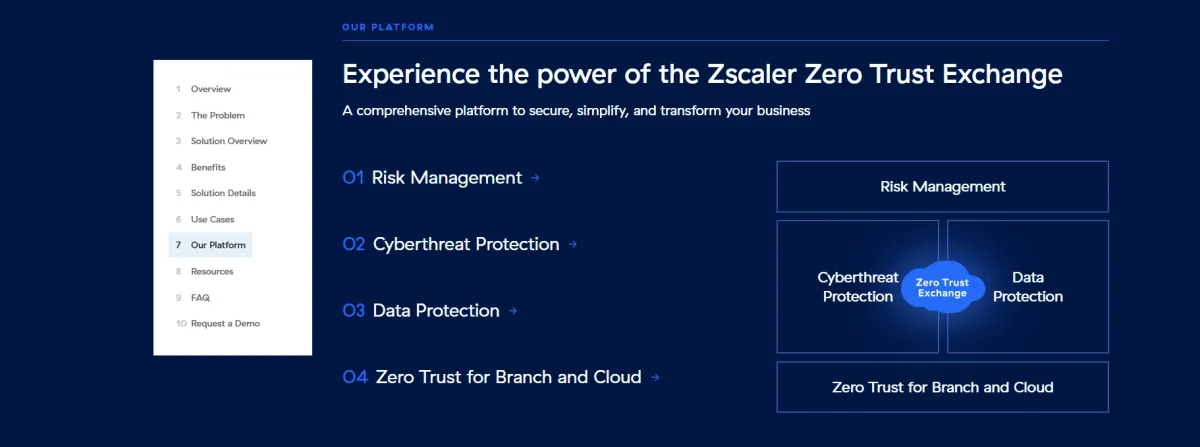
Zscaler Cloud IPS is a strong choice for cloud-first organizations, providing broad threat detection and seamless integration with other cloud security tools. It operates as part of Zscaler’s Zero Trust Exchange inspecting all traffic, including SSL/TLS, without requiring hardware appliances at branch locations.
Why we like it:
- Broad threat detection encompasses malware, phishing, command-and-control communication, and advanced persistent threats (APTs), all inspected in-line across all ports and protocols.
- Zscaler Cloud IPS is purpose-built for environments using Zscaler Private Access (ZPA) and Zscaler Internet Access (ZIA), making it a natural fit for organizations that have already committed to the Zscaler security platform.
- Signature updates are applied centrally to the cloud fabric, meaning all users receive updated protection simultaneously, unlike on-premises appliances that depend on scheduled update jobs.
What can be improved:
- Customization options are limited compared to traditional IDS/IPS systems like Snort or Suricata. Organizations with specific detection-engineering requirements may find the rule-customization surface too narrow.
- For organizations not yet fully cloud-native, migrating to a cloud-based IPS model requires rearchitecting traffic flows and may introduce complexity during the transition for sites with direct internet breakout.
>Open source IDS/IPS alternatives explained
OSSEC
OSSEC is a host-based IPS platform that offers intrusion detection, log monitoring, and security information and event management (SIEM) as an open-source package.
The solution offers three versions:
- Free: The free version includes hundreds of open-source security rules covering common attack patterns and log-based anomalies.
- OSSEC+: This version costs $55 per endpoint per year and includes additional rules, threat intelligence integration, and add-ons.
- Atomic OSSEC: This version combines advanced OSSEC rules with ModSecurity web application firewall rules into a single extended detection and response (XDR) solution, suitable for organizations that need application-layer coverage alongside host monitoring.
Why we like it:
OSSEC effectively monitors and processes log data at scale, making it one of the most capable open-source solutions for host-based threat detection.
Users can draw on OSSEC’s open-source rule library to access predefined threat intelligence rule sets for free. OSSEC’s technical community remains active on GitHub, enabling access to ongoing community-maintained rule updates and configuration guidance.
What needs improvement:
While technically a HIDS, OSSEC provides several system monitoring features typically associated with NIDS, but it is not a comprehensive solution for detecting network-level malware or ransomware.
Implementing OSSEC in an enterprise environment can be challenging with its built-in client/server model. A more effective approach is to run each installation as a standalone instance managed by configuration tools (Ansible, Puppet), then centralize logs via ELK or Splunk.
Quadrant Information Security Sagan
Sagan is a log analysis engine that bridges the gap between SIEM and IDS. At its core, Sagan is conceptually similar to Suricata and Snort but operates on log data rather than live network traffic.
Why we like it:
- Sagan’s rule syntax is identical to that of Snort and Suricata, meaning teams already familiar with those tools can write and maintain Sagan rules without learning a new language and can correlate log-based alerts with network-based IDS/IPS detections within the same rule framework.
- Sagan’s client-tracking feature notifies analysts when hosts start or stop logging, confirming that expected data sources are active, useful for detecting silent failures or tampering.
- Sagan supports threshold-based alerting that fires only after specific conditions are met, reducing alert fatigue in environments with noisy log sources.
What needs improvement:
The syntax for log scanning rules has a steep learning curve, particularly for analysts transitioning from traditional SIEM platforms.
Hillstone S-Series
Hillstone’s Network Intrusion Prevention System (NIPS) is designed for data center and enterprise network environments to identify, analyze, and mitigate sophisticated threats. It offers an extensive database of attack signatures, a cloud-powered sandbox for dynamic threat analysis, and support for both passive (IDS) and active (IPS) deployment modes.
Why we like it:
- Hillstone’s firewalls integrate seamlessly with leading products of Juniper, Checkpoint, and Palo Alto in terms of security features.
- Hillstone firewalls and UTM devices offer Layer 2 (data link layer) and Layer 3 (network layer) blocking options, which provide flexibility and enhanced control over network traffic.
- Hillstone S-Series seamlessly integrates with Active Directory (AD) for user-based web filtering is a useful feature, allowing businesses to set policies based on user groups across several devices.
What needs improvement:
- While basic web filtering and AD group integration are possible, setting up and managing complex rules can be cumbersome on some UTM devices, potentially leading to a more difficult configuration process compared to other solutions.
- Hillstone is relatively unknown compared to major players like Palo Alto or Fortinet, and there’s a lack of user-generated content online.
Snort
Snort 3 is a network-based intrusion detection and prevention system (IDS/IPS) that analyzes network traffic in real-time and records data packets. It detects potentially malicious behavior using a rule-based language combining anomaly, protocol, and signature inspection. Snort is maintained by Cisco, and its rule format has become the de facto standard for network IDS/IPS, meaning rules written for Snort are compatible with Suricata and many commercial platforms.
Modes of operation:
Sniffer mode: Captures and displays network packets in real time.
Packet logger mode: Records packets to disk for offline analysis and forensics.
Network intrusion detection system (NIDS) mode: Analyzes live network traffic and fires alerts using predefined rules.
Why we like it:
- Snort effectively detects network scans, buffer overflows, and denial-of-service (DoS) attacks by analyzing packet data against a set of predefined rules.
- In addition to detection, Snort can also be configured to take action against detected threats, such as blocking malicious traffic.
- Snort monitors several forms of traffic using a versatile rule-based language. These rules can be tailored to include certain protocols, IP addresses, and patterns indicating risky behavior.
What needs improvement:
- Running Snort in an inline configuration (as an IPS) can introduce latency or disrupt network traffic if not configured correctly.
Suricata
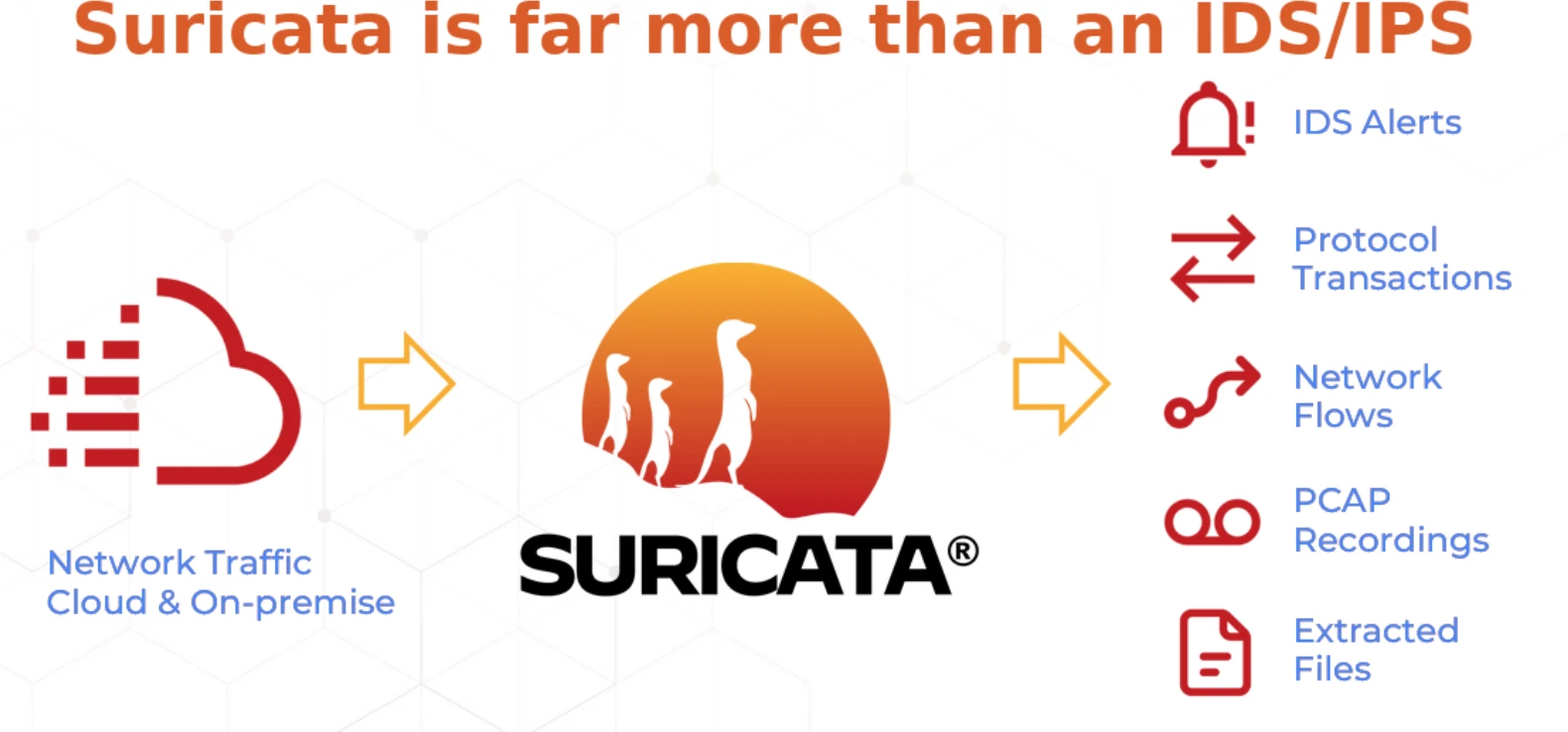
Suricata is an open-source detection IDS and IPS engine. It was created by the Open Information Security Foundation (OSIF) and is a free tool utilized by both small and large businesses.
The system detects and prevents risks through the use of a rule set and signature language. Suricata works on Windows, Mac, Unix, and Linux.
It also supports additional features like network security monitoring (NSM).
Why we like it:
- Suricata can inspect network traffic at Layer 7 (application layer), which helps detect complex attacks, such as SQL injection or malware, even within encrypted traffic (if decryption is configured).
- It can be used both as an IDS (detecting threats) and as an IPS (actively blocking threats).
- Suricata supports several protocols (HTTP, DNS, SMTP, FTP, etc.).
What needs improvement:
- Suricata is resource-heavy, especially when deployed in high-traffic environments. It requires substantial CPU, memory, and network bandwidth.
- Suricata provides a basic level of protection, but to achieve threat detection (like detection of zero-day exploits or advanced malware) additional rules or paid rule sets might be needed.
Fail2Ban
Fail2Ban is a good fit for basic log file-based protection, with freemium features.
Why we like it:
- Simple and effective for defending against brute-force attacks, especially for SSH, FTP, and web applications.
- Lightweight and easy to deploy, making it ideal for smaller environments or personal use.
What needs improvement:
- Relies solely on IP addresses, and does not perform hostname lookups unless configured to do so.
- Fail2Ban must use its strictest settings to provide any protection from distributed brute-force attacks, since it identifies intruders by their IP address.
AIDE
Best for file integrity monitoring in host-based environments, but lacks network detection and real-time alerts.
Why we like it:
- Can be easily configured to monitor specific files, directories, or file attributes (like permissions or ownership), allowing fine-tuned security monitoring.
- Can be used on various Linux distributions.
What needs improvement:
- Relies on local files and databases for integrity checking, making it vulnerable if those files are compromised.
- No built-in dashboard.
Kismet
Kismet is a wireless packet sniffer and IDS useful for detecting unauthorized wireless access. It is compatible with a wide range of wireless interfaces and supports Linux, macOS, and Raspberry Pi.
Why we like it:
- Effective in detecting access points, unauthorized connections, and wireless sniffing.
- It can operate in passive mode, meaning it can monitor networks without actively interacting with them, reducing the risk of detection by potential attackers.
What needs improvement:
- Kismet is a wireless IDS/IPS tool and is not suitable for monitoring wired networks.
- Lacks features like automated response mechanisms or the ability to conduct deep packet inspection (DPI), seen in more complete IDS/IPS solutions like Snort.
How IPS differs from IDS in protecting networks
Intrusion prevention systems (IPS) and intrusion detection systems (IDS) both play crucial roles in network security, yet they function differently.
Intrusion prevention systems actively identify threats and respond by permitting, blocking, or adjusting network traffic based on the threats they detect. In contrast, intrusion detection systems monitor network activity and inbound and outbound traffic for policy breaches, generating alerts and recording data about potential threats, but IDS tools do not intervene to counter those threats.
IPS operates directly within the network’s traffic stream, allowing it to examine and alter data in transit. IDS is not positioned in the immediate path of network traffic; instead, it analyzes copies of network packets, making it faster and less disruptive but also passive.
An intrusion prevention system actively enforces security policies by autonomously implementing rules that determine which network traffic is allowed and which is blocked. An intrusion detection system does not directly enforce these policies but notifies administrators of policy breaches, leaving the response decision to a human or a downstream SOAR tool.
IDS technology can be faster and easier to deploy precisely because it does not intercept packets. IDS can be connected anywhere a packet copy is available, making it suitable for monitoring critical systems that must run continuously, such as industrial control systems or high-availability databases.
IDPS and AI
Traditional signature-based detection is no longer sufficient as a primary defense layer against AI-generated threats, deepfake-based identity attacks, and data poisoning of AI models, which represent attack classes that signature databases cannot cover. Palo Alto Networks explicitly framed 2026 as the year where AI-driven defenses “tip the scale” in defenders’ favor, with autonomous agents handling initial alert triage and threat blocking at machine speed.3
The practical consequence for buyers: standalone IDPS products are increasingly being absorbed into broader platforms: NGFW, XDR, NDR, and SASE where IPS is one feature layer among many rather than a dedicated appliance category. Organizations evaluating IDS/IPS in 2026 should assess the platform into which IPS detection is embedded, not the IPS capability in isolation.
IDPS can be categorized into four main types:
- Network-based intrusion prevention system (NIPS): Monitors and protects all network traffic from malicious activities, automatically taking action against suspicious traffic in-line.
- Network behavior analysis (NBA): Focuses on analyzing traffic patterns for unusual behavior, particularly for signs of DDoS attacks, lateral movement, or policy violations that don’t match known signatures.
- Host intrusion prevention system (HIPS): Relies on software agents running on individual endpoints to identify and block malicious activity at the host level.
- Wireless intrusion prevention system (WIPS): Monitors, detects, and prevents unauthorized access over wireless networks, identifying rogue access points and unauthorized client connections.
IDPS detection types
Signature-based detection creates fingerprints for patterns found in known malicious traffic and files, enabling fast, low-false-positive detection of known threats.
Anomaly-based detection evaluates traffic against established baselines to identify data points that deviate from normal behavior, enabling detection of novel threats but also leading to higher false-positive rates.
Behavior-based detection identifies suspicious activity through behavioral analysis, for example, detecting when a user attempts to access systems outside their normal scope, regardless of whether specific signatures match.
Threat intelligence-based detection integrates external data feeds containing indicators of compromise (IoCs), enabling teams to block known malicious IPs, domains, and file hashes proactively before attacks execute.
Key security software to use with IPS tools
Network security audit tools: Identify threats, vulnerabilities, and malicious activity to help organizations mitigate cyber attacks and maintain compliance.
NCCM software: Monitors and documents network device configurations to detect unauthorized changes that may indicate compromise.
Network security policy management solutions (NSPM): Protect network infrastructure using firewalls and security policies against a broad threat surface.
 Add as preferred source
Further reading
Cite this research
Pick the format that matches where you're publishing. Pasting the link version into your CMS preserves the backlink.
@misc{dilmegani2026,
  author = {Dilmegani, Cem and Sezer, Sena},
  title  = {{Top 14 Intrusion Detection and Prevention Tools in 2026}},
  year   = {2026},
  month  = mar,
  howpublished    = {\url{https://aimultiple.com/ips-tools}},
  note   = {AIMultiple. Retrieved March 24, 2026}
}Results and timestamps of 14 data points. Download the data used in this article as a ZIP file containing 2 CSV files.
Reference Links
Cem's work at AIMultiple has been cited by leading global publications including Business Insider, Forbes, Morning Brew, and Washington Post, global firms like Deloitte and HPE, NGOs like World Economic Forum, and supranational organizations like European Commission. [1], [2], [3], [4], [5]
Throughout his career, Cem served as a tech consultant, tech buyer and tech entrepreneur. He advised enterprises on their technology decisions at McKinsey & Company and Altman Solon for more than a decade. He also published a McKinsey report on digitalization.
He led technology strategy and procurement of a telco while reporting to the CEO. He has also led commercial growth of deep tech company Hypatos that reached a 7 digit annual recurring revenue and a 9 digit valuation from 0 within 2 years. Cem's work in Hypatos was covered by leading technology publications like TechCrunch and Business Insider.
Cem regularly speaks at international technology conferences. He graduated from Bogazici University as a computer engineer and holds an MBA from Columbia Business School.











Be the first to comment
Your email address will not be published. All fields are required. Comments are left in their original language.