


CRM Pricing & Features Compared: See $/Seat Prices

Comparing CRM costs shouldn’t require a calculator and three spreadsheets. We analyzed pricing across 12 major platforms to show what companies actually pay once you factor in the extras nobody mentions up front.
Most vendors hide real costs behind “contact us” buttons and tiered packages filled with features you won’t use. Here’s what we found.
The Three Price Bands
- Entry-level: $5–25/user/month: You get a contact database, a basic pipeline board, and email sync with Outlook or Gmail. Everything’s manual no automation. Mobile apps let you look up phone numbers and add notes but you can’t run your business from them. Customization is limited to maybe 10–15 fields.
- Mid-range: $50–150/user/month: This is where the system starts doing work for you. New leads route automatically to the right rep. Sales managers get forecasting dashboards that actually mean something. You can run separate pipelines for enterprise deals and SMB deals simultaneously. Email tracking shows who opened what.
- Premium: $150+/user/month: Vendors lean hard on AI at this tier. The system predicts which deals will close based on historical patterns sometimes accurately, sometimes not. You can rebuild the interface to match exactly how your company sells. Analytics start connecting things like “deals with three decision-makers take 40% longer to close.” Connecting it to accounting software is possible but takes real work.
Major CRM Platforms
*Average ratings on G2, Trustradius & Capterra
Note: We sorted vendors by the number of reviews in descending order, except for our subscribers at the top.
**These prices are relevant when paid annually. Monthly billing options are also available for a higher price.
- AI is now a separate line item and it adds up fast. Salesforce embedded Agentforce across its AI lineup with two pricing models: Flex Credits at $500 per 100,000 credits (roughly $0.10 per AI action), or $2 per conversation. Standard add-ons run $125/user/month for unmetered AI access. In March 2026, Salesforce moved to include Agentforce in its SMB Starter and Pro Suites at no extra charge absorbing the cost into the seat price rather than metering it separately.1 If you’re on Enterprise, expect AI to cost more on top of your license.
- HubSpot renamed Operations Hub to Data Hub (March 2026), bringing data unification and quality tools under a clearer label. The platform now runs six hubs on top of its Smart CRM: Marketing, Sales, Service, Content, Data, and Commerce.2
- The CRM market hit $80 billion in 2026 and is tracking toward $130 billion by 2030, driven by AI integration and companies consolidating from multiple point tools onto single platforms.3
The Costs Nobody Mentions
- Data migration: $2,000–$15,000. Moving your old data isn’t copy-paste. Someone has to map every field, clean duplicates, and fix the import errors that will definitely happen.
- Training: 4–8 hours per person for basics, double that for power users. Outside trainers charge $150–$300/hour. Internal YouTube-based onboarding is cheaper but slower.
- Integrations: $500–$5,000+ for each connection to your existing tools. “Seamless integration” in marketing materials translates to custom work in practice.
- Storage overages: $10–$50/GB/month once you exceed the included storage. Proposals, contracts, and attachments add up faster than most people expect.
- Support tiers: Email with 48-hour response times is standard on lower plans. If you need someone to pick up the phone, that usually requires upgrading.
What Actually Drives the Price
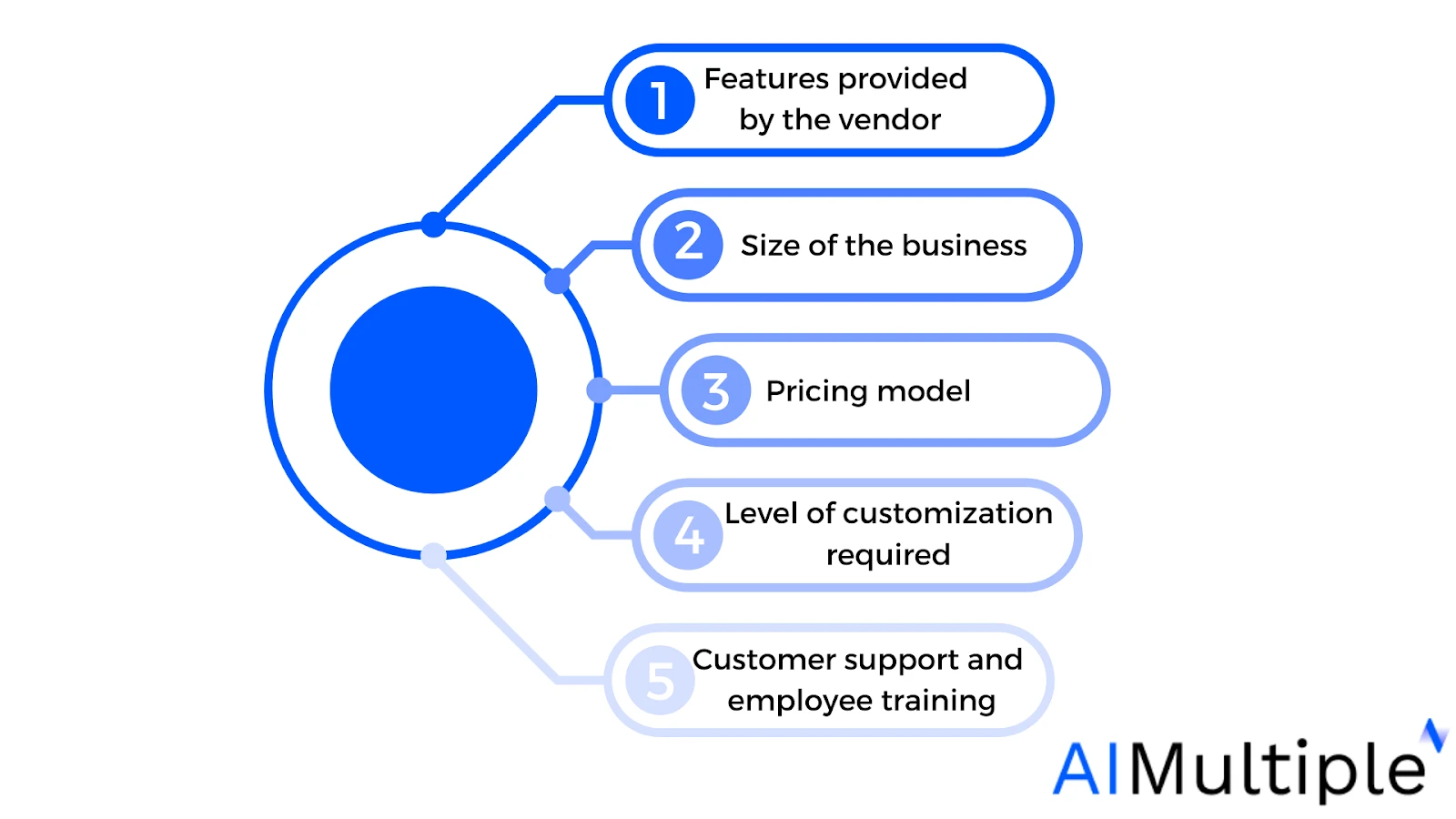
- Features that actually matter are multiple pipeline configurations, custom calculation fields, territory management, meaningful revenue forecasting, and real workflow automation. Every vendor has task management and email tracking at any price point; those aren’t what drive the cost up.
- Your company size changes the math. Ten users pay list price. Fifty gives you room to negotiate, especially at year-end. Two hundred and you’re in custom pricing territory. Larger companies also need things smaller ones don’t compliance tracking, approval chains, audit logs and those features consistently push prices up.
- Monthly vs. annual billing. Monthly gives you an exit if things go wrong but costs 10–20% more over the year. Annual locks you in with savings just make sure you’ve tested the system properly during the trial period. For enterprise deals, push to get dedicated support, custom training, and priority feature requests included in the contract rather than negotiating just on the discount percentage.
 Add as preferred source
Further Reading
Cite this research
Pick the format that matches where you're publishing. Pasting the link version into your CMS preserves the backlink.
@misc{ermut2026,
  author = {Ermut, Sıla},
  title  = {{CRM Pricing & Features Compared: See $/Seat Prices}},
  year   = {2026},
  month  = aug,
  howpublished    = {\url{https://aimultiple.com/crm-pricing}},
  note   = {AIMultiple. Retrieved August 20, 2026}
}Results and timestamps of 12 data points. Download the summary data shown in this article's charts and tables as a ZIP file containing one CSV file.
Want the granular data behind it? Join Premium
Changelog
5 updatesAdded a section on AI add-on pricing, covering Salesforce Agentforce rates and HubSpot's Data Hub rename.
Expanded the CRM pricing tiers with 'Who this works for' subsections.
Reference Links
She previously worked as a recruiter in project management and consulting firms. Sıla holds a Master of Science degree in Social Psychology and a Bachelor of Arts degree in International Relations.



Be the first to comment
Your email address will not be published. All fields are required. Comments are left in their original language.