


Top Agentic CRM Platforms

Customer relationship management tools are getting smarter. Instead of just storing data, agentic CRM platforms can plan tasks, execute workflows, and adjust strategies autonomously. Think of them as CRM systems with built-in intelligence that actually do the work instead of waiting for users to click buttons.
Platform | User Rating | Starting Price | Free Tier | Free Trial | Employee Size |
|---|---|---|---|---|---|
4.7 based on 327 reviews | $25/user/month | ✕ | ✓ (14 days, unlimited users) | 836 | |
Salesforce Agentforce 360 | 4.1 based on 68 reviews | $25/user/month (Einstein) $125/user/month (Agentforce) | ✕ | ✓ (30 days) | 7 |
HubSpot | 4.4 based on 5,506 reviews | Free (basic), $50/month premium | ✓ | ✕ | 16 |
Microsoft Dynamics 365 | 4.4 based on 5,506 reviews | Custom pricing | ✕ | ✓ (30 days) | 244,900 |
Zoho CRM | 4.2 based on 9,351 reviews | $14/user/month | ✕ | ✓ (15 days) | 23,544 |
Freshworks | 4.6 based on - reviews | Free trial, then paid | ✕ | ✓ (21 days) | 24 |
Copper CRM | 4.2 based on 9,351 reviews | Subscription-based | ✕ | ✓ (14 days) | 250 |
Pipedrive | 4.3 based on 5,777 reviews | $14.90/user/month | ✕ | ✓ (14 days) | 960 |
ActiveCampaign | 4.4 based on 17,433 reviews | $49/user/month (3-user min) | ✕ | ✓ (14 days) | 845 |
How We Selected These Platforms
We focused on platforms that actually work in real businesses and have proven results. Our criteria included:
We checked for:
- Independent task execution (not just automation that follows rigid rules)
- Integration with existing business tools
- Multi-agent coordination (when multiple AI agents need to work together)
- Developer and business user customization options
- Enterprise security standards
Top 9 Agentic CRM Platforms
1. Creatio
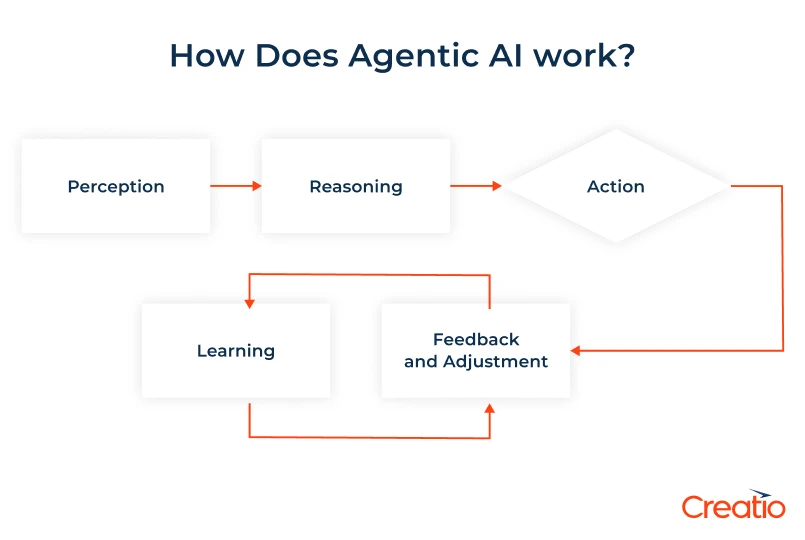
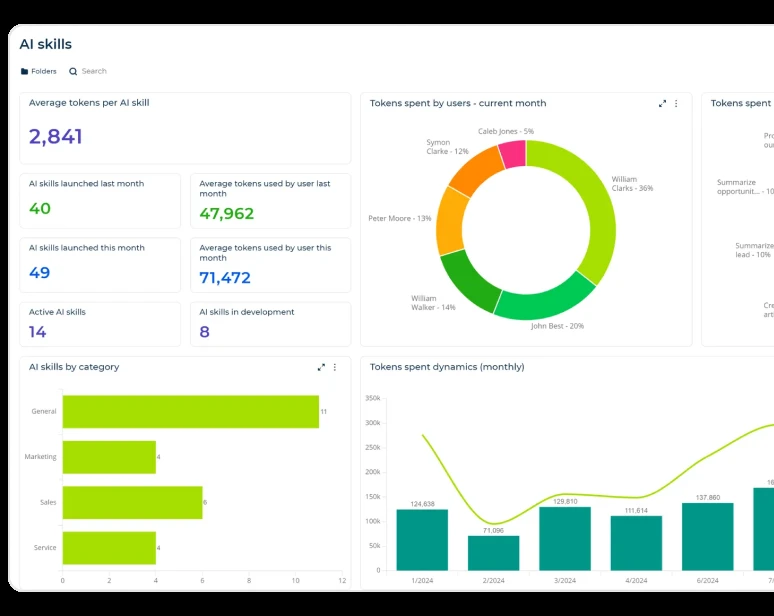
Creatio is an AI-native no-code CRM platform that covers sales, marketing, and service in a single system. Its core differentiation is that AI is embedded at the architecture level; every data object, relationship, and workflow is natively accessible to agents rather than added as a layer on top of a traditional CRM.
Source: Creatio
Core Capabilities:
- Drag-and-drop workflow builders replace traditional coding.
- Lead scoring runs continuously in the background.
- Customer journeys adapt based on real-time behavior across email, web, and mobile.
Pricing: Starts at $25 per user monthly with all AI features included
Benefits:
- No coding required, reducing setup complexity
- Visual workflow designer enables quick autonomous process creation
- Includes marketing, sales, and service automation
Limitations:
- May need training for complex autonomous workflow design
- Smaller integration ecosystem than established enterprise platforms
- Advanced customization might require professional help
2. Salesforce Agentforce 360
Salesforce Agentforce is one of the most built-out agentic platforms in enterprise CRM. Salesforce rebranded Sales Cloud as Agentforce Sales, signaling that the platform is now organized around autonomous agents rather than cloud products. The Atlas Reasoning Engine powers multi-agent coordination, analyzing user intent, identifying required data, and executing multi-step actions without waiting for human approval at each step.
Salesforce has branded the platform Agentforce 360 since Dreamforce 2025. Product mechanics carried over; the name changed.
Core Capabilities:
- Agentforce Builder: A single conversational workspace for building, testing, and refining agents in document-style, canvas, or pro-code script views. Every agent compiles to a portable JSON file for versioning and reuse.1
- Agent Script: A scripting language for deterministic agent control — conditional logic, precise tool use, and guided handoffs with programmatic precision
- Agentforce Voice: Natural on-brand voice conversations across phone, web, and mobile; now extended to Financial Services for autonomous resolution of banking and collections inquiries2
- Agentforce Account Management AI: Deep account research surfaced in Slack, sellers can update opportunities and prep for meetings without leaving the Slack interface
- Agentforce Inbound Lead Generation: Autonomous lead capture from web and messaging channels, with automatic handoff to a Lead Nurturing agent if a meeting is not scheduled3
- Model flexibility: Atlas Reasoning Engine now supports Google Gemini alongside OpenAI and Anthropic (via Amazon Bedrock), giving enterprises model choice at the reasoning layer1
- Data Cloud unifies customer profiles across sources at the point of action for real-time decisions
Pricing: Salesforce sells Agentforce three ways, and the choice shapes the bill more than the feature set does.
- Per-user licensing from $125 per user per month, with higher editions bundling an annual credit allocation.
- Flex Credits. A consumption pool bought in blocks of 100,000 for $500. A standard agent action draws 20 credits, roughly $0.10. A voice action draws 30 credits, roughly $0.15. Rates come from the Flex Credits rate card updated 21 April 2026. Credits also fund Data 360 operations, so a single request that queries, retrieves, and updates a record burns several actions.
- Conversations. A flat rate near $2 per conversation, where a conversation means a 24-hour session.
Strengths:
- Most developed agentic AI in enterprise CRM
- Complete ecosystem supporting complex multi-agent workflows
- Deep integration across sales, marketing, and service functions
Limitations:
- Complex setup requiring specialized expertise
- Higher total cost for full agentic capabilities
- Extensive customization may require ongoing technical support
3. HubSpot with AI Agents and Breeze Copilot
HubSpot’s Breeze platform combines Breeze Assistant (conversational AI for in-platform tasks), Breeze Agents (autonomous, end-to-end workflow execution), and Breeze Intelligence (data enrichment and buyer intent).
Core Capabilities:
- Lead nurturing sequences adjust messaging based on how prospects respond.
- Content generation pulls from customer data, not generic templates.
- Deal scoring ranks opportunities by close likelihood.
- Campaigns run across email, social, and ads without manual coordination.
Recent Updates
- Expanded Channel Support: Customer Agent now deploys across SMS, Instagram, Telegram, LINE, WhatsApp, and Slack via the Custom Channels API, with no code changes required for existing integrations
- Mobile & Document Support: Breeze Assistant available as mobile app with QR code installation; PDF attachment capabilities for prompts
Pricing: HubSpot announced the change on 2 April 2026 and rolled it out on 14 April. Two Breeze agents moved over:
- Breeze Customer Agent bills 50 HubSpot Credits per resolved conversation, roughly $0.50. Charges apply when the agent resolves the ticket, not when a conversation starts.
- Breeze Prospecting Agent bills 100 credits per lead recommended for outreach, roughly $1.
Credits sell at about $10 per 1,000. Included monthly allowances did not change: 500 on Starter, 3,000 on Professional, 5,000 on Enterprise. Since the unit shifted from conversations to resolutions, the same allowance now covers roughly twice as many billable events. The change applied to new and existing customers with no grandfathering.
Strengths:
- User-friendly interface reducing setup complexity
- Strong integration with the existing HubSpot system
- Complete training resources and support documentation
Limitations:
- Advanced agentic features require higher-tier subscriptions
- Limited customization compared to enterprise-focused platforms
- May not scale effectively for complex enterprise workflows
4. Microsoft Dynamics 365 with Copilot
Copilot runs throughout Dynamics 365, creating agentic workflows that connect with Microsoft 365, Azure, and Power Platform. If you already use Microsoft tools, agents can access data across your entire tech stack.
Core Capabilities:
- Qualify leads and follow up autonomously through the Sales Agent
- Route and resolve customer inquiries intelligently
- Generate proposals automatically based on customer data
Recent Updates:
- Agent Mode: Copilot now actively edits Excel (Desktop/Mac), Word, and PowerPoint files while reasoning through changes not just suggesting actions but making autonomous file modifications
- Admin Readiness Dashboard: New Copilot readiness page in admin center provides structured configuration tracking with deployment essentials, user experience settings, and data security organized by completion status
- License Enforcement: Dynamics 365 Finance & Operations now enforces user license requirements; users without proper licenses cannot access non-licensed applications.
Pricing: Copilot Credits are the metering unit for agents. Microsoft includes 1,000 Copilot Credits with each Dynamics 365 Sales Premium license. Additional credits are available on pay-as-you-go with no upfront commitment. Copilot Credits are required to run prebuilt agents and custom agents built in Copilot Studio.
Strengths:
- Deep integration with existing Microsoft technology investments
- Unified platform reducing system complexity and costs
- Strong enterprise support and implementation services
Limitations:
- Best suited for organizations already using the Microsoft ecosystem
- May require significant change management for non-Microsoft environments
- Complex pricing structure for full agentic capabilities
5. Zoho CRM with Zia AI
Zia AI brings agentic capabilities to small and mid-sized businesses. Zoho designed it for teams that want automation without enterprise complexity or cost.
Core Capabilities:
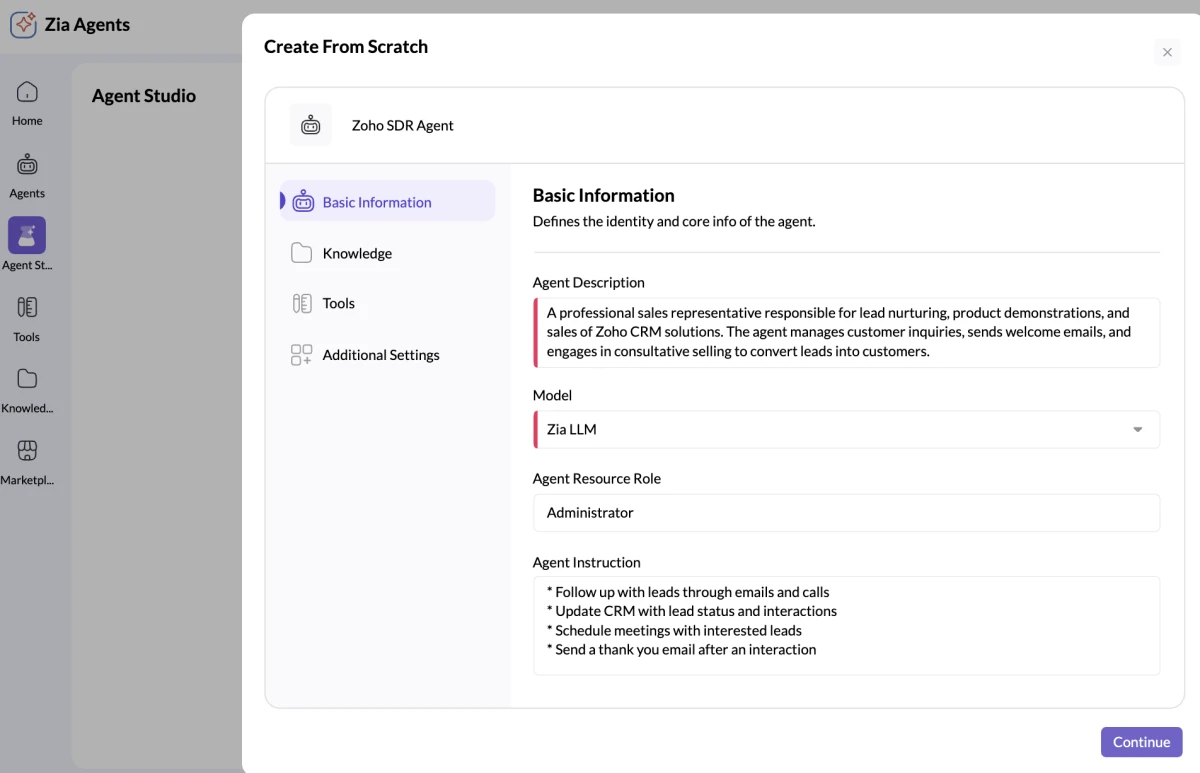
- Zia Agent Studio: A fully prompt-based, no-code (with optional low-code) environment for building custom agents. Over 700 built-in actions across the Zoho ecosystem. Agents can retrieve records, update data, create tasks, analyze documents, and trigger workflows. Supports both the proprietary Zia LLM and OpenAI models.4
- Zia LLM: Proprietary large language models in three sizes (1.3B, 2.6B, 7B parameters) trained on enterprise-specific datasets for structured data extraction, summarization, RAG, and code generation giving Zoho customers a data-sovereign model option
- Agent Marketplace: 25+ ready-to-deploy agents for sales, service, and vertical use cases, with partner-published agents available for distribution
- MCP server: Exposes Zoho’s action library from 15+ applications to third-party agents under strict permission controls, enabling interoperability with agents built outside the Zoho ecosystem
- Ask Zia cross-app intelligence: Natural language queries across CRM, finance, and HR with chart-based answers and transparent data sourcing
Pricing: Starts at $14 per user monthly, with Zia AI features included in higher tiers
Strengths:
- Cost-effective entry point for agentic CRM capabilities
- Complete business suite integration within Zoho ecosystem
- Intuitive interface requiring minimal training
Limitations:
- Limited scalability for large enterprise implementations
- Customization options may not meet complex business requirements
6. Freshworks with Freddy AI
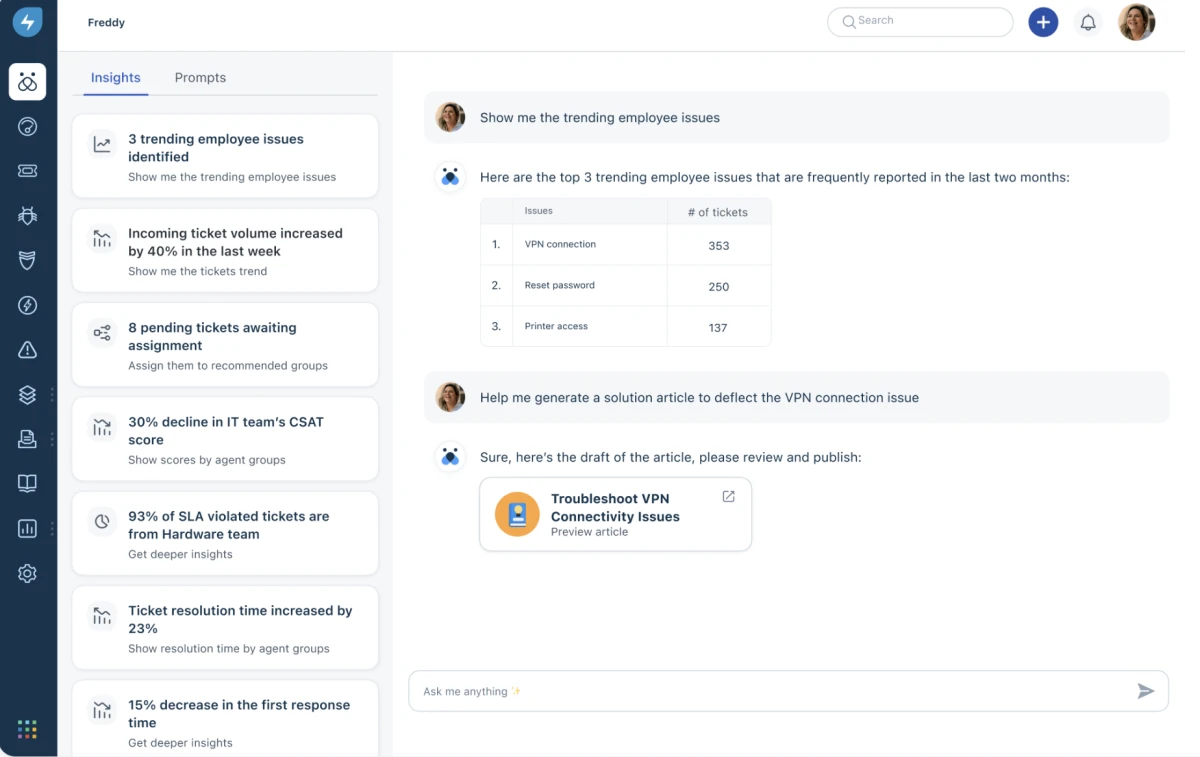
Freshworks Freddy AI is built for customer service and IT service teams that need to deploy autonomous agents quickly without deep technical configuration. The platform’s strongest claims are speed to deployment. Freshworks states agents can go live in minutes using the Agent Studio and resolution rate.
Core Capabilities:
- Freddy AI Agent Studio: A no-code builder for creating, testing, and deploying custom agents. Includes a Skills Library (pre-built action templates for Shopify, Stripe, PayPal, FedEx) and a Skills Builder (visual, no-code environment for custom workflows). Agents can be built from scratch rather than configured from templates.5
- Vertical AI Agents: Pre-loaded agents for eCommerce, fintech, travel, and logistics with 50+ agentic workflows covering order tracking, refund processing, subscription changes, and appointment rescheduling
- Email AI Agent: Reads incoming tickets, drafts contextual replies, and auto-closes tickets when the customer confirms resolution turning standard support inboxes into autonomous channels6
- Freddy AI Copilot: Assists human agents with reply drafting, ticket summarization, sentiment analysis, and Intelligent Related Changes for IT root-cause analysis. Autonomous resolution across email, chat, WhatsApp, and social channels in 60+ languages
Pricing: Free trial available with straightforward licensing for agentic features
Strengths:
- Simple implementation process with minimal technical requirements
- Transparent pricing without hidden costs for AI features
- Strong focus on customer experience optimization
Limitations:
- Limited advanced customization for complex enterprise needs
- Newer agentic capabilities may lack maturity of established platforms
- Integration with non-Freshworks systems is thinner
7. Copper CRM
Copper was built for Google Workspace and runs inside Gmail and Google Calendar rather than as a separate destination. It captures contacts, emails, and meetings automatically from Workspace activity. Copper holds Google’s recommended-CRM designation, which no competitor carries.
Core Capabilities:
- Capture data automatically from Google Workspace interactions
- Manage pipelines intelligently integrated with Gmail and Calendar
- Qualify leads autonomously based on email and meeting patterns
- Provide predictive analytics using Google’s machine learning infrastructure
- Automate workflows across Google ecosystem platforms
Pricing: Subscription-based with Google Workspace integration included
Strengths:
- Deepest Google Workspace integration among general-purpose CRMs
- Low learning curve for teams already working inside Gmail
- A 2025 project management addition consolidated CRM and delivery tracking into one tool, which reduces tool count for agencies and consultancies
Limitations:
- Thin capability outside the Google ecosystem, including limited Outlook support
- AI features assist people rather than acting independently
- Professional and Business tiers may carry a one-time onboarding package
8. Pipedrive
Pipedrive started as a visual sales pipeline and added AI-powered insights. The focus remains sales team productivity not marketing automation or service tickets.
Core Capabilities:
- Nurture leads automatically with personalized communication sequences
- Recommend intelligent deal progression based on pipeline analysis
- Track emails and optimize engagement autonomously
- Forecast sales predictively with adaptive model learning
- Provide real-time pipeline coaching with actionable improvement suggestions
Pricing: Starts at $14.90 per user monthly with AI features in higher tiers.
Strengths:
- User-friendly interface requiring minimal learning curve
- Strong focus on sales productivity and deal management
- Cost-effective pricing for growing sales teams
Limitations:
- Limited functionality beyond sales-specific workflows
- Advanced agentic features require premium subscriptions
9. ActiveCampaign
ActiveCampaign merged email marketing automation with CRM agentic capabilities. The platform handles the entire customer lifecycle, from first email to renewal.
Core Capabilities:
- Run autonomous email marketing campaigns with behavioral triggers
- Segment customers intelligently based on interaction patterns
- Execute automated sales follow-up sequences with personalized messaging
- Model predictive customer lifetime value
- Orchestrate customer journeys across channels
Pricing: Starts at $49 per user monthly, with a 3-user minimum
Strengths:
- Strong customer experience focus throughout lifecycle management
- Responsive customer support with technical expertise
Limitations:
- Higher pricing compared to basic CRM solutions
- Steep learning curve for complex automation setup
- Mobile application requires improvement for field teams
Key Trends in Agentic CRM
AI agent observability is now a baseline requirement. Salesforce’s Agentforce Command Center and HubSpot’s Audit Cards both reflect enterprise demand for visibility into agent decision-making. Organizations deploying agents at scale need logs, replay capabilities, and ROI measurement, not just automation.
Proprietary LLMs as a differentiator. Zoho’s Zia LLM (1.3B–7B) and the multi-model flexibility of Salesforce (OpenAI, Anthropic, Gemini) represent two different responses to the same pressure: organizations want control over which models process their customer data.
Agent builders democratizing custom workflow creation. Salesforce’s Agentforce Builder, Zoho’s Zia Agent Studio (700+ built-in actions), and Freshworks’ Freddy AI Agent Studio all launched or matured in 2025–2026, shifting agent creation from developer-only to business-user accessible.
Omnichannel expansion. HubSpot’s nine-channel support (including SMS, WhatsApp, Instagram, Slack) and Freshworks’ 60-language, multi-channel Freddy AI reflect platform-wide pushes to meet customers wherever they communicate.
FAQs
Agentic CRM platforms plan, execute, and adapt multi-step workflows without a person approving each step. Traditional CRMs store and organize customer data; agentic CRMs act on it. Four capabilities mark the difference: autonomous decision-making, goal-oriented behavior across multi-step processes, learning from results and feedback, and coordination between agents across departments or systems.
Startups and small teams (1–50 employees): HubSpot’s free tier covers basic CRM, though Breeze agents require a Professional or Enterprise plan. Zoho CRM starts at $14 per user with a full agent builder. Pipedrive at $14.90 per user suits sales-only teams that want AI assistance rather than agents.
Small to mid-sized businesses (50–500 employees): Creatio at $25 per user includes AI features without separate AI pricing, which removes the credit-forecasting problem larger platforms create. Freshworks fits teams whose primary need is customer service or IT service rather than sales.
Enterprise (1,000+ employees): Salesforce Agentforce 360 has the most built-out multi-agent tooling. Microsoft Dynamics 365 is the stronger fit for organizations already running the Microsoft stack, since Copilot Credits and licensing sit inside an existing agreement.
Creatio, HubSpot, Zoho, and Freshworks offer no-code or low-code agent builders that business users can operate without engineering support. Salesforce typically requires certified administrators beyond basic configuration. Microsoft Dynamics is most accessible to organizations with existing Microsoft technical resources.
One pattern holds across platforms. Getting an agent running is fast. Getting it to handle edge cases accurately takes far longer, and that gap does not close by picking a different vendor.
Seat prices no longer predict the bill. Salesforce, HubSpot, and Microsoft have all moved agent capabilities onto consumption or outcome meters that run alongside seat charges. Salesforce draws Flex Credits per action and leans on Data 360 for grounding. HubSpot bills per resolved conversation. Microsoft draws Copilot Credits per agent run. Modeling actual monthly volume against each vendor’s unit, action, resolution, or credit, gives a truer figure than the headline seat price.
 Add as preferred source
Cite this research
Pick the format that matches where you're publishing. Pasting the link version into your CMS preserves the backlink.
@misc{dilmegani2026,
  author = {Dilmegani, Cem},
  title  = {{Top Agentic CRM Platforms}},
  year   = {2026},
  month  = sep,
  howpublished    = {\url{https://aimultiple.com/agentic-crm}},
  note   = {AIMultiple. Retrieved September 4, 2026}
}Results and timestamps of 18 data points. Download the summary data shown in this article's charts and tables as a ZIP file containing 2 CSV files.
Want the granular data behind it? Join Premium
Changelog
3 updatesUpdated the Creatio product description.
Added Recent Updates to the HubSpot Breeze section.
Reference Links
Cem's work at AIMultiple has been cited by leading global publications including Business Insider, Forbes, Morning Brew, and Washington Post, global firms like Deloitte and HPE, NGOs like World Economic Forum, and supranational organizations like European Commission. [1], [2], [3], [4], [5]
Throughout his career, Cem served as a tech consultant, tech buyer and tech entrepreneur. He advised enterprises on their technology decisions at McKinsey & Company and Altman Solon for more than a decade. He also published a McKinsey report on digitalization.
He led technology strategy and procurement of a telco while reporting to the CEO. He has also led commercial growth of deep tech company Hypatos that reached a 7 digit annual recurring revenue and a 9 digit valuation from 0 within 2 years. Cem's work in Hypatos was covered by leading technology publications like TechCrunch and Business Insider.
Cem regularly speaks at international technology conferences. He graduated from Bogazici University as a computer engineer and holds an MBA from Columbia Business School.




Be the first to comment
Your email address will not be published. All fields are required. Comments are left in their original language.