


Top 7 HIPAA Compliant File Sharing Services

Healthcare organizations need managed file transfer solutions that comply with HIPAA and securely handle sensitive patient data.
We analyzed solutions based on security certifications, enterprise adoption, and HIPAA-specific features to identify the leading options.
Top 7 HIPAA-compliant file-sharing services
Services | Ratings | Free Trial | Price | Employee Size |
|---|---|---|---|---|
4.8 based on 127 reviews | N/A | Not shared publicly. | 152 | |
4.5 based on 96 reviews | 7-day | Not shared publicly. | 533 | |
4.6 based on 281 reviews | 7-day | Not shared publicly. | 90 | |
4.5 based on 152 reviews | 25-day | $1,599/year | 533 | |
FileCloud | 4.0 based on 377 reviews | 14-day | $12,5/month/user | 125 |
Kiteworks | 4.4/5 based on 119 reviews | 14-day | Not shared publicly. | +400 |
Serv-U by SolarWinds | 4.2 based on 12 reviews | 14-day | Not shared publicly. | 2,625 |
* Ratings are based on Capterra and G2. The HIPAA-compliant file-sharing vendors are listed by rating. We list our subscribers at the top with their links.
All seven tools share a baseline of HIPAA-required capabilities: end-to-end encryption (data at rest and in transit), detailed audit logs, and support for secure transfer protocols including SFTP, FTPS, and HTTPS.
HIPAA-compliant file-sharing services differentiating features
- DICOM medical image support: Built-in preview for medical imaging files such as X-rays, CT scans, and MRIs in DICOM format, reducing the need for separate imaging software.
- Enterprise workflow orchestration: Integrates file transfers with broader business-process automation, enabling complex healthcare data workflows beyond basic file movement.
- Hybrid deployment flexibility: Supports both cloud and on-premises deployments, allowing sensitive data to remain on-site while using cloud capabilities for other operations.
- SOC 2 Type 2 certification: Independent security audits validate security controls over an extended period, providing additional assurance beyond HIPAA requirements.
Stonebranch
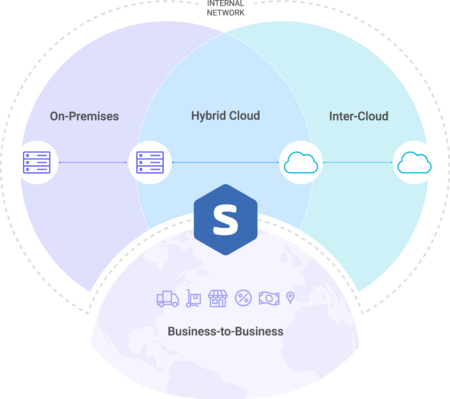
Stonebranch is a workflow orchestration platform that handles file transfers. Where most tools move files between two points, Stonebranch coordinates transfers across multiple systems simultaneously, including SAP, Oracle, mainframe environments, and cloud platforms (AWS, Azure, GCP). For healthcare IT teams managing complex, cross-system data pipelines, this matters.
Security-wise, it handles end-to-end encryption with key management, role-based access with delegation, centralized policy enforcement, and compliance reporting with audit trails. It deploys across cloud-native, on-premises, hybrid, and multi-site distributed environments.
The RESTful API allows integration with third-party applications and automates database and application workflows beyond simple file movement, something smaller MFT tools don’t offer.
JSCAPE MFT Server
JSCAPE lists SOC 2 Type 1 and Type 2, ISO 27001, Drummond Certified™, and FIPS 140-2 and 140-3 validated.
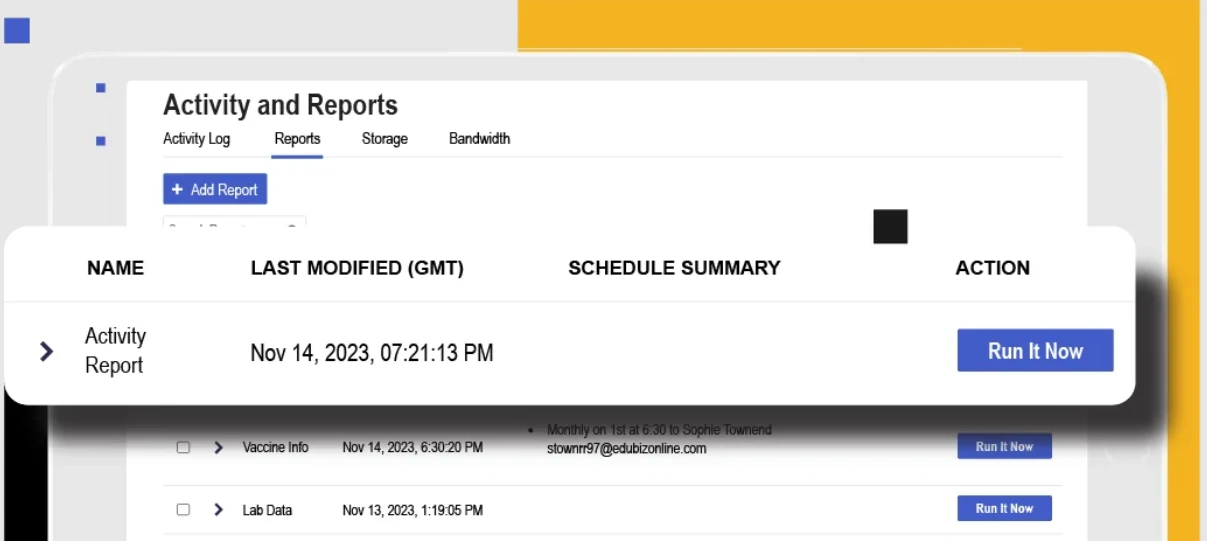
Its HIPAA controls map directly to the rule’s technical safeguards: access controls limit who can access PHI, audit controls log all transfer activity, data integrity checks verify that files aren’t altered in transit, authentication confirms user identity, and transmission security encrypts data end-to-end.
Deployment works on-premises, in a private cloud, or in a hybrid configuration. It connects to databases (MySQL, PostgreSQL, SQL Server), enterprise systems such as SAP and Oracle, and supports REST APIs for custom integrations. Email notifications can be configured for transfer events.
Files.com
Files.com takes the opposite approach to JSCAPE; it’s a fully cloud-based SaaS with no servers to install or maintain. For healthcare organizations looking to replace aging SFTP infrastructure without taking on new hardware management, this is a practical approach.
Data protection uses AES-256 encryption at rest and TLS 1.2+ in transit. The audit trail logs every file action, meeting HIPAA documentation requirements without additional configuration. The platform scales automatically with demand, with no manual provisioning required.
Eight global storage zones let organizations choose where data physically resides, which matters for organizations with data residency requirements beyond HIPAA. Files.com also reduces partner onboarding time; external trading partners can be set up in days.
Cerberus FTP Server
Cerberus FTP Server, owned by Redwood Software, runs on Windows and is worth considering for healthcare organizations that want granular control over security configuration.
It includes access controls, full file activity logging, and Windows Active Directory integration. It also supports LDAP authentication, ODBC database connectivity, and event scripting for custom automation.
FileCloud
FileCloud’s key healthcare advantage is built-in DICOM support. It can preview medical imaging files, such as X-rays, CT scans, and MRIs, directly in the platform. For teams that routinely share diagnostic images, this removes a workflow step that other file-sharing tools cannot address.
 Add as preferred source
Kiteworks
Kiteworks is a secure file-sharing and data transfer platform for organizations handling sensitive information, including protected health information (PHI).
It provides AES-256 encryption for data at rest and SSL/TLS encryption in transit, along with role-based permissions and granular access controls. Audit logs record file access, sharing events, user activity, and timestamps, providing healthcare organizations a record of how PHI moves between employees, providers, and business associates.
Kiteworks also supports managed file transfer, protected email, and external data exchange through a centralized control layer. Administrators can manage security policies and permissions centrally.
For incident response, administrators can receive security alerts and remotely wipe data stored inside Kiteworks’ secure mobile container if a device is lost or stolen. The platform also supports geographically distributed backup and recovery for maintaining access to stored data.
Serv-U by SolarWinds
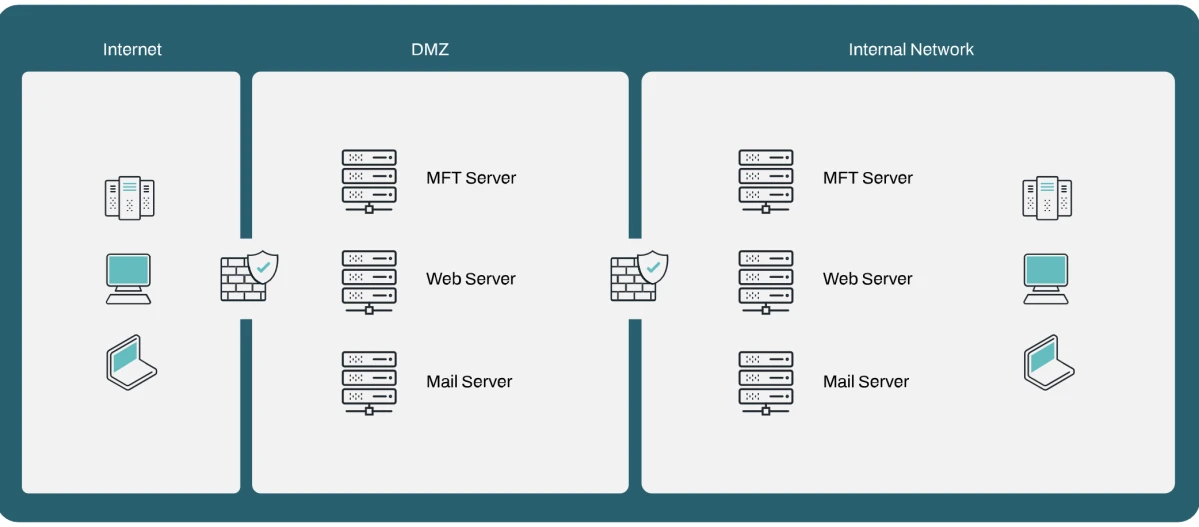
Serv-U covers the deployment scenarios that healthcare organizations most commonly need to keep sensitive data on-site: Windows and Linux on-premises, virtual machine environments, cloud-hosted configurations, and hybrid setups with DMZ deployment. The DMZ option is relevant for healthcare networks that need a security buffer between internal systems and external transfer endpoints.
The platform includes Active Directory and LDAP authentication, database connectivity for user management, a web services API for automation, and email notification integration. The managed file transfer module supports HIPAA, alongside standard transfer operations.
FAQs
HIPAA’s Security Rule requires covered entities to implement technical safeguards for PHI: access controls (authorized users can reach data), audit controls (all access and transfers are logged), data integrity checks (files are not altered or destroyed in transit), and transmission security (encryption during transfer).
A BAA is required when the vendor creates, receives, maintains, or transmits PHI for you, which covers any hosted or cloud service. It usually isn’t required for self-hosted software when the vendor never accesses your PHI, because a software vendor is not a business associate if it merely sells or provides software to a covered entity but does not have access to the covered entity’s PHI.
You need a BAA before using any of these tools with real PHI. Most enterprise vendors in this space will sign one, but it’s not automatic; you need to request it during procurement. If a vendor refuses to sign a BAA, they cannot legally handle PHI under HIPAA.
Neither is inherently more compliant. HIPAA doesn’t specify where data must be stored; it specifies how it must be protected. On-premises gives organizations direct control over physical infrastructure and can satisfy stricter internal security policies. Cloud solutions like Files.com shift the infrastructure management burden to the vendor, which can help if your internal IT team lacks the resources to maintain and patch servers. The right choice depends on your team’s capacity and your organization’s risk tolerance.
Cite this research
Pick the format that matches where you're publishing. Pasting the link version into your CMS preserves the backlink.
@misc{dilmegani2026,
  author = {Dilmegani, Cem and Ermut, Sıla},
  title  = {{Top 7 HIPAA Compliant File Sharing Services}},
  year   = {2026},
  month  = oct,
  howpublished    = {\url{https://aimultiple.com/hipaa-compliant-file-sharing}},
  note   = {AIMultiple. Retrieved October 2, 2026}
}Results and timestamps of 14 data points. Download the summary data shown in this article's charts and tables as a ZIP file containing 2 CSV files.
Want the granular data behind it? Join Premium
Changelog
8 updatesReplaced the Shared Features section with a summary of common capabilities.
Added Stonebranch to the Detailed analysis of leading services section.
Cem's work at AIMultiple has been cited by leading global publications including Business Insider, Forbes, Morning Brew, and Washington Post, global firms like Deloitte and HPE, NGOs like World Economic Forum, and supranational organizations like European Commission. [1], [2], [3], [4], [5]
Throughout his career, Cem served as a tech consultant, tech buyer and tech entrepreneur. He advised enterprises on their technology decisions at McKinsey & Company and Altman Solon for more than a decade. He also published a McKinsey report on digitalization.
He led technology strategy and procurement of a telco while reporting to the CEO. He has also led commercial growth of deep tech company Hypatos that reached a 7 digit annual recurring revenue and a 9 digit valuation from 0 within 2 years. Cem's work in Hypatos was covered by leading technology publications like TechCrunch and Business Insider.
Cem regularly speaks at international technology conferences. He graduated from Bogazici University as a computer engineer and holds an MBA from Columbia Business School.

She previously worked as a recruiter in project management and consulting firms. Sıla holds a Master of Science degree in Social Psychology and a Bachelor of Arts degree in International Relations.


Be the first to comment
Your email address will not be published. All fields are required. Comments are left in their original language.