


Synthetic Users Explained: Top 7 AI User Research Tools

After evaluating 10+ AI research platforms and reviewing independent validation studies, we found synthetic users work best for hypothesis generation and early-stage testing, not final design decisions.
Best Synthetic User Platforms
Tool | Best For | Pricing | Free Trial |
|---|---|---|---|
Viewpoints.ai | Traditional market research replacement | Custom pricing | N/A |
Brox.ai | Behavioral authenticity in UX testing | Not shared publicly | N/A |
Artificial Societies | Large social simulations | Custom pricing | N/A |
Evidenza | Brand messaging validation | Not shared publicly | N/A |
Synthetic Users Inc. | General purpose, easy to use | Not shared publicly | N/A |
Aaru | Business system integration | Not shared publicly | ✓ |
Semilattice | Explainable AI decisions | Play: $1 / month, Launch: $399 / month | ✓ |
1.Viewpoints.ai
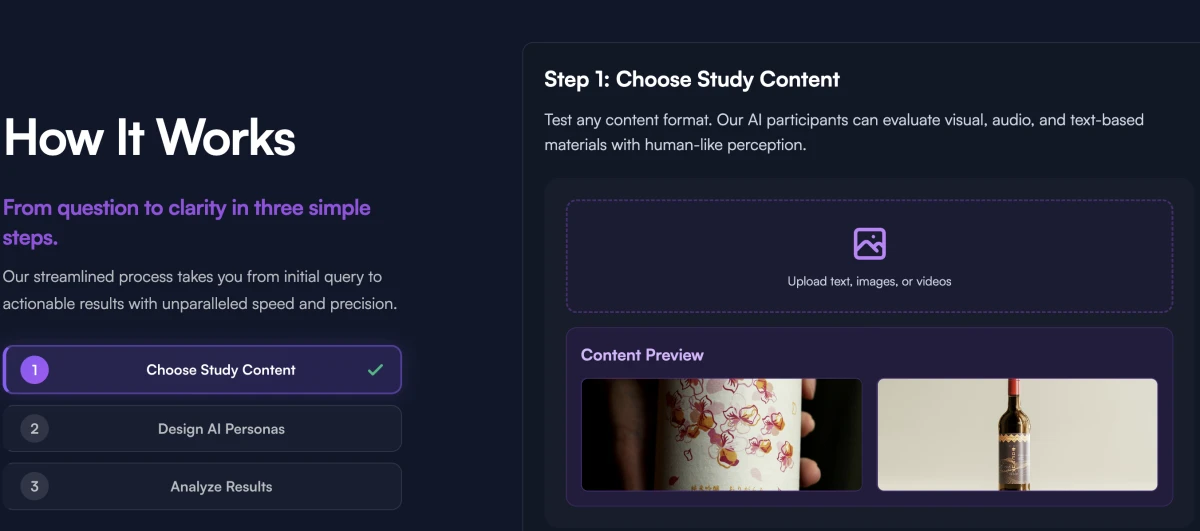
Viewpoints.ai creates synthetic consumer panels for market research testing surveys, concepts, and ad creative without recruiting real participants.
What it does:
- Generates thousands of virtual consumers trained on real-world behavioral datasets
- Tests survey methodology before deploying to real audiences
- Validates marketing concepts across demographic and psychographic segments
- Simulates consumer responses to new product concepts within hours
Key features:
- Virtual consumers based on real consumer behavior data, not just demographic profiles
- Multiple testing rounds within a single day
- No participant recruitment or incentive costs
- Reduces social desirability bias present in traditional surveys
2. Brox.ai
Brox.ai focuses on product testing and UX validation through AI-powered persona simulation. It generates synthetic users that navigate websites and digital interfaces to surface usability issues before real users encounter them.
What it does:
- Identifies friction points and usability bottlenecks in user journeys
- Tests interface designs and interaction patterns
- Simulates behavior across desktop, mobile, and tablet
- Validates accessibility features for users with different abilities and technical skill levels
Key features:
- Personas exhibit realistic hesitation and exploratory behavior, not just direct-path navigation
- Cross-device simulation
- Accessibility personas covering a range of needs and skill levels
- Works alongside existing analytics and testing tools
3. Artificial Societies
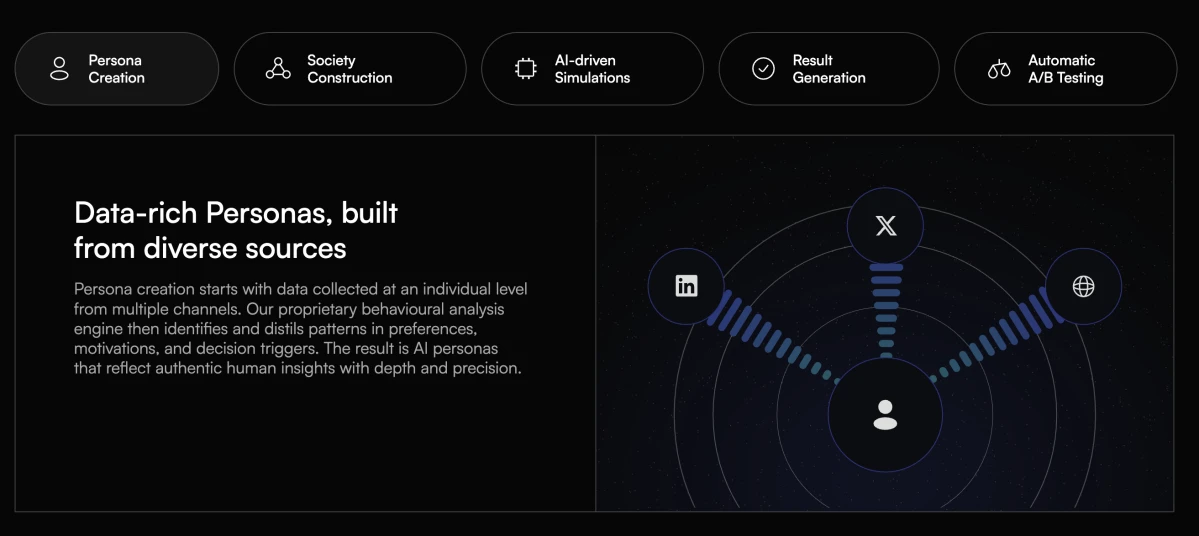
Artificial Societies models communities of synthetic users interacting with one another in complex social environments, distinct from platforms that simulate individual users in isolation.
Community Behavior Modeling: The platform creates interconnected networks of synthetic users to:
- Tests how social features and community guidelines affect group engagement and behavior
- Simulates information spread, trend diffusion, and sentiment movement through user networks
- Models marketplace dynamics, including buyer-seller interactions and trust-building
- Predicts how policy changes affect community adoption
Key Features:
- Network effects simulation showing how individual actions influence group behavior
- Emergent behavior identification surfaces unexpected dynamics from user interactions
- Simulates thousands of interconnected users simultaneously
- Social graph modeling replicating realistic relationship patterns and influence networks
4. Evidenza
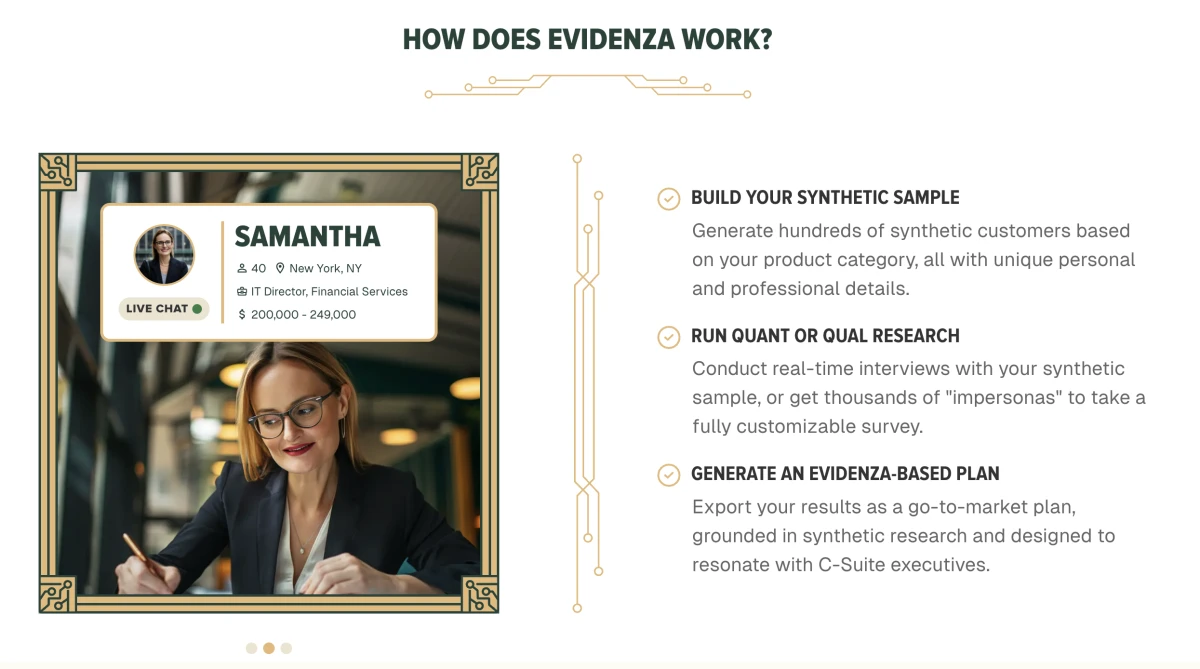
Evidenza tests marketing and communications through AI-powered synthetic personas trained on specific audience data.
Brand Messaging Validation: The platform creates audience-specific synthetic personas to:
- Test brand messaging resonance across different demographic segments and psychographic profiles
- Validate advertising creatives and copy variations for emotional impact and clarity
- Simulate campaign performance across various channels and audience segments
- Optimize message timing and frequency for maximum engagement
Key Features:
- Personas trained on actual customer data and audience insights, not generic demographic profiles
- Emotional response modeling, predicting reactions to messaging and creative
- Cross-channel testing covering social, email, display, and traditional advertising
- Regional and cultural nuances included in persona responses
5. Synthetic Users Inc.
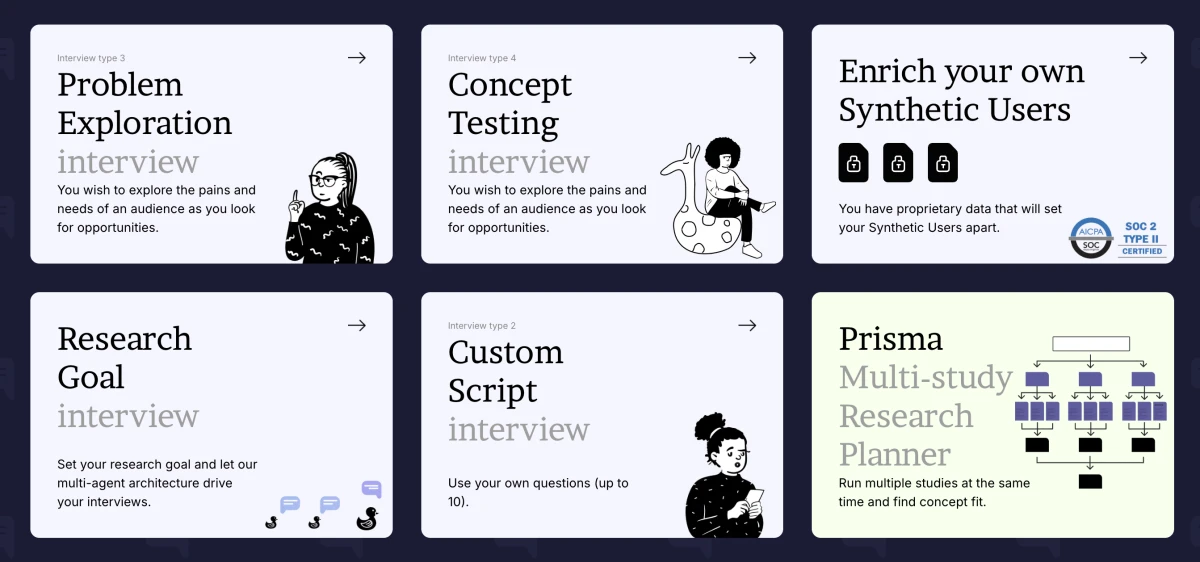
Synthetic Users provides general-purpose synthetic research participants for interviews, surveys, and usability studies. It uses a multi-agent architecture in which multiple LLMs coordinate to produce more diverse responses than single-model approaches, and users can upload proprietary data via RAG to build personas specific to their customer base.
Pricing runs roughly $2–27 per interview, with an additional ~$5 for RAG-grounded personas, and a 7-day free trial.1
Key Features:
- Multi-agent architecture producing more diverse outputs than single-model prompting
- Maintains consistent persona characteristics across multiple sessions
- RAG integration for uploading proprietary customer data to ground personas
- Generates interviews and summary reports; conversation can continue interactively
6. Aaru
Aaru generates thousands of AI agents that simulate human behavior using public and proprietary data to predict how specific demographic or geographic groups will respond to future events. It’s the most heavily funded platform in this comparison: Aaru closed a Series A led by Redpoint Ventures at a “headline” $1 billion valuation, with backing from Accenture Ventures, General Catalyst, A*, Abstract Ventures, and Z Fellows.2
Enterprise Persona Integration: The platform creates synthetic user populations that:
- Align with existing customer segmentation strategies and CRM data
- Integrate with enterprise product development workflows and decision-making processes
- Scale to represent entire customer bases or market segments
- Provide feedback linked to business metrics and KPIs
Key Features:
- Multi-agent simulation of entire demographic populations, not just individual personas
- Enterprise clients include Accenture, EY, and Interpublic Group EY reproduced their six-month
- Global Wealth Research Report using Aaru in a single day, reporting 90% median correlation across 53 questions
- Free trial available
7. Semilattice
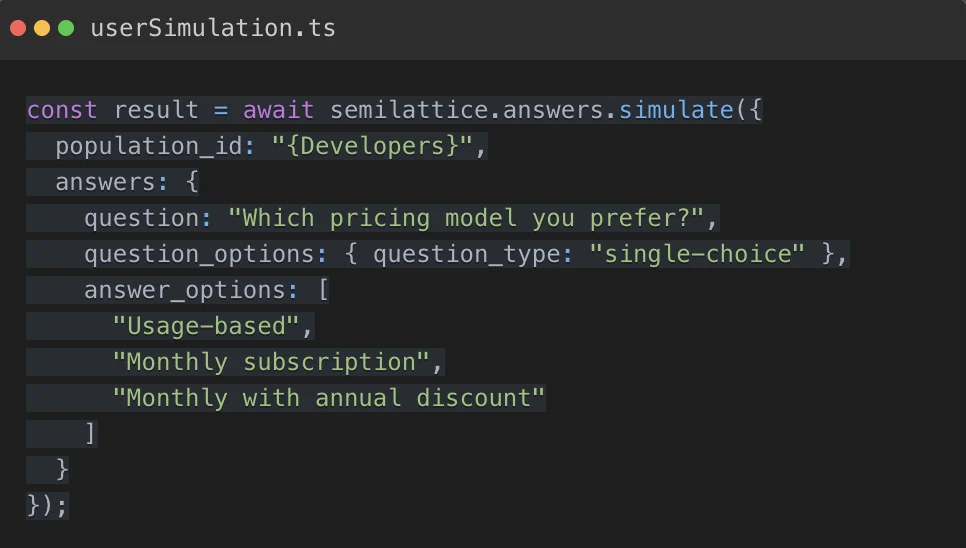
Semilattice focuses on explainable AI decisions — transparent user behavior models that show researchers the reasoning behind persona responses, not just the output.
Explainable Behavior Modeling: The platform creates transparent user behavior models that:
- Provides clear explanations for why synthetic personas make specific decisions
- Uses structured, rule-based models that research teams can audit and validate
- Generates detailed reports on decision-making logic
- Allows researchers to adjust model parameters and observe the effect of changes
Key Features:
- Every persona decision includes an explanation and reasoning path
- Rule-based systems researchers can inspect and modify
- Detailed logs of decision-making processes for compliance and validation
- Fine-tuning of persona characteristics and behavior patterns
Synthetic Users vs. Contextual Design
Contextual design is the gold standard of user research: researchers immerse themselves in users’ natural environments to understand their actual behaviors, workflows, and pain points. Developed by Hugh Beyer and Karen Holtzblatt, it involves observing users performing real tasks at work or at home, capturing the full complexity of human-computer interaction in context.
Synthetic users, by contrast, are AI-generated virtual personas that simulate user behavior based on large language models trained on vast datasets. They can be interviewed, surveyed, and questioned as if they were real users, providing rapid insights without the logistical demands of traditional research.
Synthetic User vs Traditional User
Synthetic personas offer real advantages but also clear limitations.
Best for:
- Hypothesis testing during early ideation
- Exploring hard-to-reach or high-cost segments
- Pre-testing survey wording or messaging clarity
- Generating initial drafts of personas or journey maps before validating with real users
Limitations:
- They cannot replicate authentic emotion, surprise insights, or the spontaneous depth of real interviews
- Overconfidence in AI-generated profiles can mislead decision-making
- Biases in data or prompt design can skew results
FAQs
In today’s fast-moving market, waiting weeks for survey data or running dozens of user interviews slows innovation. Synthetic personas counter this by delivering fast insights using simulated users that mimic behavioral patterns, motivations, and preferences. These personas can be summoned overnight to test product concepts, messaging ideas, or UX flows long before real panels are assembled. It’s about gaining initial direction quickly, not replacing deep, human-centered research downstream. Synthetic personas are best used to test hypotheses and explore user segments efficiently.
Use as a supplement, not a replacement: Kick off your research with them—but always follow up with real human feedback.
Validate assumptions: Treat synthetic outputs as hypotheses. Next, run show-and-tell sessions or interviews with real users to confirm or revise.
Know your data and methods: Understand the sources feeding persona generation—public models, private data, prompt structure—and be transparent about what’s synthetic.
Be explicit with stakeholders: Always flag insights as “synthetic” and clarify they weren’t derived from real people. Misrepresentation damages credibility.
Synthetic personas are built by feeding demographic, psychographic, and behavioral data into a model that crafts a living user profile—one you can interact with. These personas don’t just look real on paper; they act like real users.
Synthetic Users (platform): Generates interview dialogues, transcripts, and summary reports. You specify a target user group and a goal, and the tool simulates interviews you can continue interactively.
Other engines tap browsing behavior, transaction logs, social activity, or proprietary CRM data to form personas that reflect fundamental user dynamics.
- How Synthetic Personas Are Transforming Access to Insights
- Using synthetic personas and research to explore ideas
Cite this research
Pick the format that matches where you're publishing. Pasting the link version into your CMS preserves the backlink.
@misc{dilmegani2026,
  author = {Dilmegani, Cem and Sezer, Sena},
  title  = {{Synthetic Users Explained: Top 7 AI User Research Tools}},
  year   = {2026},
  month  = jul,
  howpublished    = {\url{https://aimultiple.com/synthetic-users}},
  note   = {AIMultiple. Retrieved July 27, 2026}
}Results and timestamps of 27 data points. Download the summary data shown in this article's charts and tables as a ZIP file containing 3 CSV files.
Want the granular data behind it? Join Premium
Changelog
2 updatesAdded pricing for Synthetic Users: $2–27 per interview, plus a RAG add-on.
Removed the "How are Synthetic Users Created?" section.
Reference Links
Cem's work at AIMultiple has been cited by leading global publications including Business Insider, Forbes, Morning Brew, and Washington Post, global firms like Deloitte and HPE, NGOs like World Economic Forum, and supranational organizations like European Commission. [1], [2], [3], [4], [5]
Throughout his career, Cem served as a tech consultant, tech buyer and tech entrepreneur. He advised enterprises on their technology decisions at McKinsey & Company and Altman Solon for more than a decade. He also published a McKinsey report on digitalization.
He led technology strategy and procurement of a telco while reporting to the CEO. He has also led commercial growth of deep tech company Hypatos that reached a 7 digit annual recurring revenue and a 9 digit valuation from 0 within 2 years. Cem's work in Hypatos was covered by leading technology publications like TechCrunch and Business Insider.
Cem regularly speaks at international technology conferences. He graduated from Bogazici University as a computer engineer and holds an MBA from Columbia Business School.





Be the first to comment
Your email address will not be published. All fields are required. Comments are left in their original language.