


Top 12 SIEM Tools & How to Choose the Best Solution

SIEM systems have evolved into more than just log aggregation tools. Some vendors have developed unified product suites that include UEBA, SOAR, and EDR capabilities, claiming they are “next-gen” SIEMs. Others offer products focused on traditional event and log management.
Below is an overview of leading SIEM tools based on their next-gen SIEM and security capabilities:
Next-gen SIEM capabilities
Vendor | UEBA | SOAR | EDR |
|---|---|---|---|
✓ | ✓ | ✕ | |
Exabeam Fusion | ✓ | ✓ | ✓ |
IBM QRadar SIEM | ✓ | ✕ | ✕ |
LogRhythm | ✕ | ✕ | ✕ |
Rapid7 InsightIDR | ✓ | ✓ | ✓ |
Microsoft Sentinel | ✓ | ✓ | ✕ |
FortiSIEM | ✓ | ✓ | ✕ |
Splunk Enterprise Security | ✕ | ✕ | ✕ |
Sumo LogicCloud SIEM | ✓ | ✕ | ✓ |
SolarWinds SEM | ✕ | ✕ | ✕ |
Vendors (marked with “✕”) require integrations to provide the given feature.
- UEBA helps analyze and correlate data in context. By focusing on behaviors rather than raw logs, SIEMs with UEBA provide a more granular view of an attack’s progression, helping security teams see not just raw event data but also patterns.
- SOAR enhances traditional SIEM capabilities by automating security responses, orchestrating security tools for seamless coordination, and providing structured case management through predefined playbooks, enabling faster incident resolution.
- EDR enables SIEMs to gain comprehensive visibility across your network for in-depth endpoint-level analysis. Correlating EDR findings with SIEM data strengthens the context for network-wide investigations and threat hunting.
Buyers already using UEBA software or SOAR software can integrate machine and log data into their SIEM for context-based log analysis.
Security capabilities
- Lateral movement detection: SIEM’s ability to automatically detect and alert on attackers’ unauthorized movement across the network.
- Nonrepudiation (principle): Involves encryption and digital signatures, ensuring that security event logs and data are stored in a tamper-proof manner, so that the parties involved in a digital transaction cannot later deny their authenticity or their involvement. It can be implemented in any SIEM via additional deployment.
- STIX/TAXII format threat feeds: Standardized threat intelligence for real-time identification and blocking of IOCs.
Metrics
- Max EPS: Maximum events per second the SIEM can process. Exceeding this threshold may require additional vendor licensing.
- # Integrations: Number of external systems (e.g., firewalls, servers, EDRs) the SIEM can integrate.
- # Pre-built detection rules: Number of predefined detection rules in the SIEM that help identify common security threats and incidents based on known attack patterns.
- # MITRE coverage: Number of MITRE ATT&CK techniques the SIEM can detect or map to.
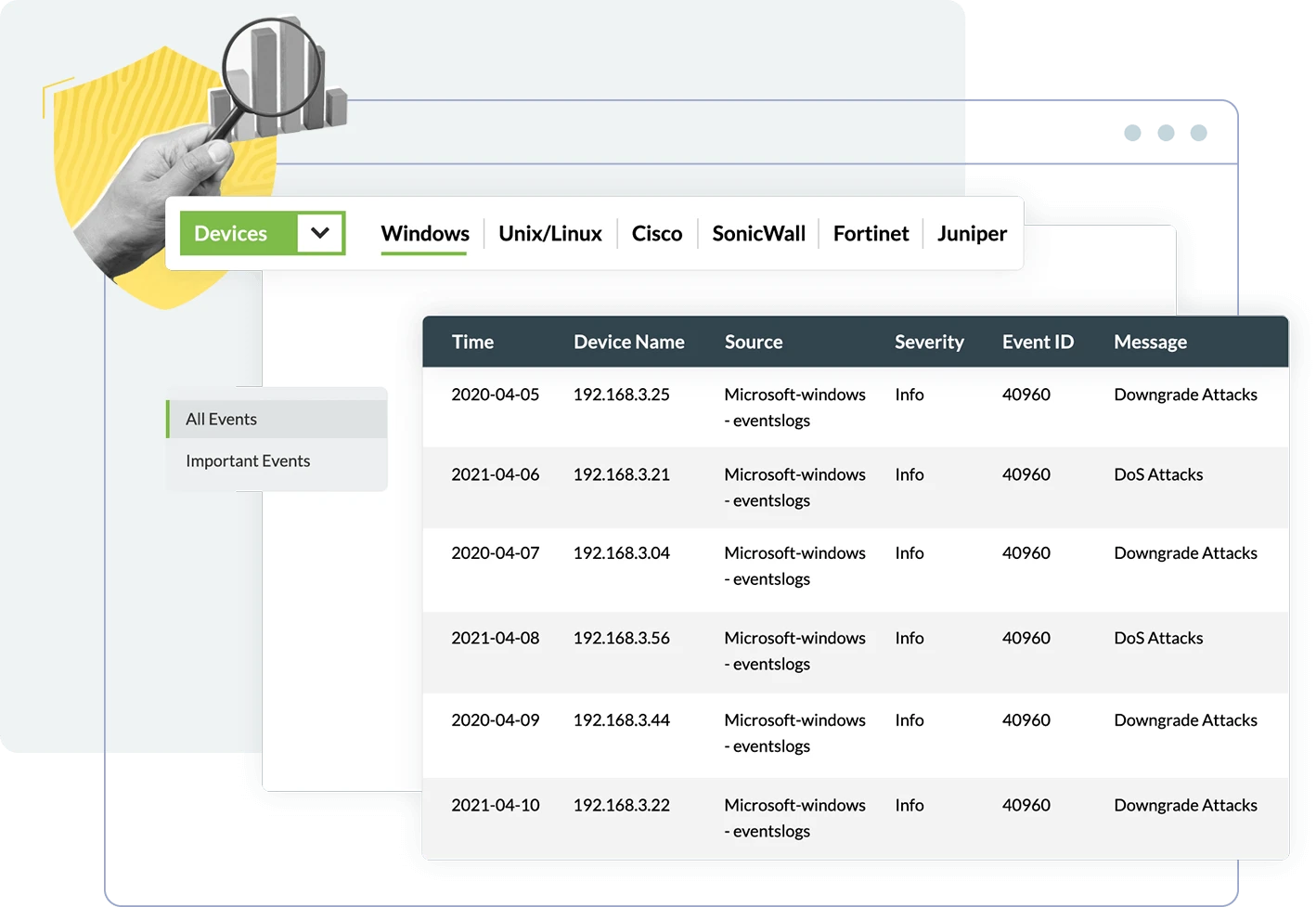
ManageEngine Log360
ManageEngine Log360 is a SIEM platform available in both on-premises and cloud deployments, combining log management, Active Directory auditing, UEBA, and SOAR in a single product. Pricing is based on the number of log sources rather than data volume, which makes cost more predictable for organizations with a defined source inventory. The platform ships with over 1,000 prepackaged report templates covering compliance requirements for GDPR, HIPAA, PCI-DSS, and SOX. Deployment takes under 30 minutes, and automatic device discovery adds monitored sources without manual configuration.
The UEBA module builds behavioral baselines using machine learning and raises risk scores incrementally for anomalous activity, abnormal logon patterns, unusual access, or privilege escalation rather than triggering binary alerts. SOAR workflows execute automatically on incident detection and integrate with help desk platforms, including ServiceNow and Jira, so tickets are raised at detection rather than after manual review.
Log360 Cloud re-engineered its detection architecture adding a centralized security console, cloud-delivered rule updates, and a catalog of over 2,000 predefined detection rules covering insider threats, malware, external attacks, APT behaviors, and identity-based risks, each with MITRE ATT&CK mapping and tuning recommendations. UK data center availability launched the same month, addressing data residency requirements for European customers. In March 2026, the Zia AI insights module added support for OpenAI configuration alongside its existing Azure OpenAI option, giving customers a choice of AI provider while keeping their own keys.1
Exabeam New-Scale Fusion
Exabeam New-Scale Fusion is a cloud-native security operations platform that combines SIEM, UEBA, and SOAR in a unified product.
The platform allows analysts to add case notes and store queries used for monitoring indicators of compromise. Each member can contribute to a shared investigation without navigating a complex language of correlations.
Exabeam can create static detection rules, though parsing may not be fully optimized for all environments. When integrating with external SIEMs such as ELK, ingested source logs may not align with predefined data formats, requiring a custom parser.
In January 2026, Exabeam launched Agent Behavior Analytics (ABA), extending its UEBA engine to AI agents as a new entity type. ABA detects suspicious behavioral deviations in AI agent activity, including first-time data access patterns, guardrail violations, and unusual tool call sequences that static SIEM rules cannot identify. 2
IBM QRadar
IBM QRadar SIEM (Cloud-Native SaaS) is part of the IBM QRadar Suite. It uses a modular design for threat identification and prioritization, and is suited for commodity applications, system logging, and structured data management.
QRadar supports multiple logging protocols, including syslog, syslog-tcp, and SNMP, and can read events from more than 300 log sources. It includes an app store for data synchronization as an add-on, where users can copy events, flows, and configuration files.
QRadar supports open source Sigma rules, with automatic conversion to KQL (Kusto Query Language) for analyst use. The platform has a documented limitation around search speed, and offshore support is a recurring complaint in user reviews.
IBM’s latest update targets the search speed and investigation latency issues users have reported. The release includes modernized parsing with support for multi-value custom properties, expanded high-availability options, and new hardware.
2026 integration: Criminal IP, an AI-powered threat intelligence platform, integrated with IBM QRadar SIEM and QRadar SOAR in February 2026, bringing external IP-based threat context directly into QRadar detection and investigation workflows. 3
LogRhythm SIEM
LogRhythm is a SIEM solution with integrated SOAR capabilities. It supports threat monitoring, threat hunting, threat investigation, and incident response, collecting, normalizing, and interpreting event and log data from over 1,000 third-party and cloud sources.
LogRhythm contextualizes log data through its Machine Data Intelligence (MDI) Fabric, translating complex event information into plain-language summaries for analyst review.
Rapid7 InsightIDR
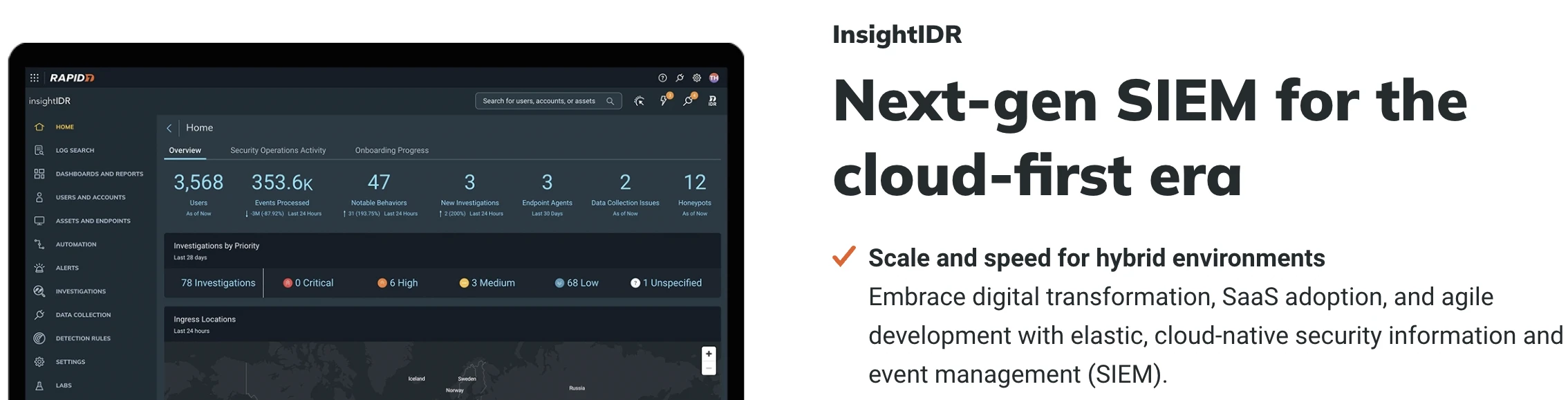
Rapid7 InsightIDR is a cloud-native SIEM and XDR that integrates data from logs, endpoints, and cloud services for real-time threat hunting and response.
It provides 13 months of searchable data storage by default, covering normalized events, security incidents, and indicators of compromise. InsightIDR focuses on real-time threat detection and incident tracking.
Microsoft Sentinel
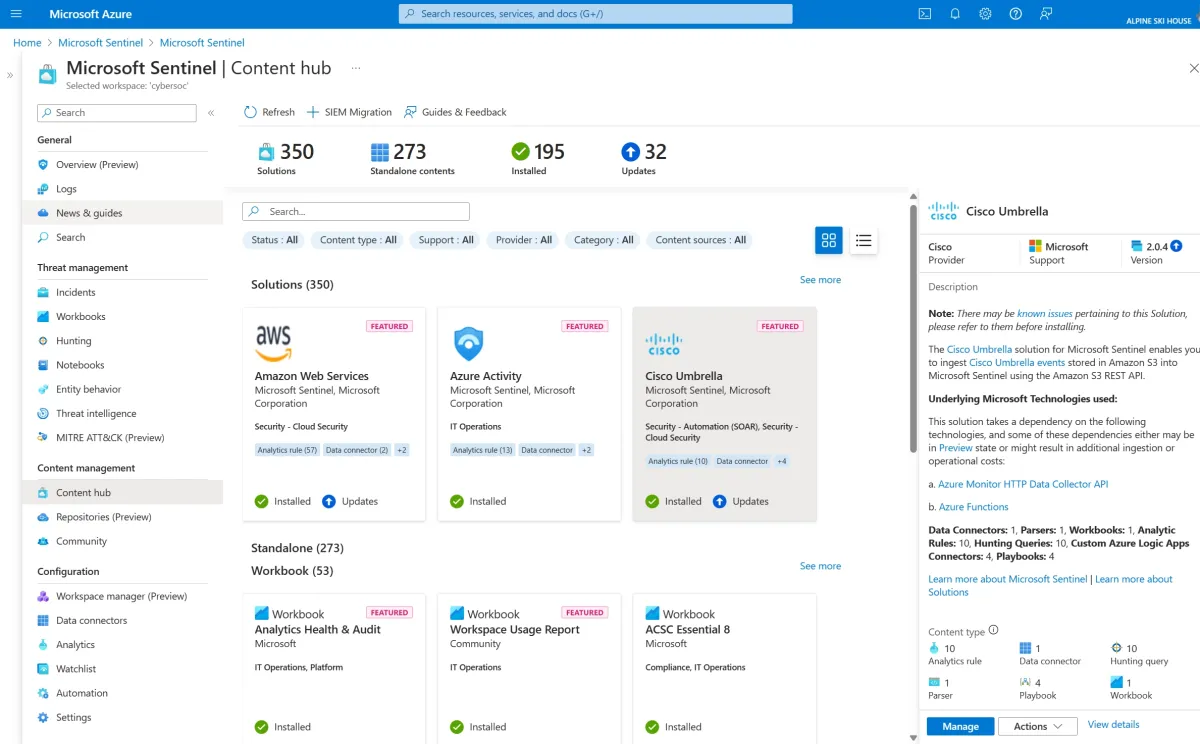
Microsoft Sentinel is a cloud-native SIEM and SOAR platform that collects and correlates security logs from across cloud, SaaS, and on-premises environments.
Sentinel added QRadar-to-Sentinel migration support via an AI-powered SIEM migration experience, a generally available UEBA Behaviors layer that aggregates raw telemetry into human-readable behavioral summaries, and a refreshed ASIM normalization schema for consistent log parsing across sources.
Microsoft 365 Copilot data connector is in public preview and has expanded the connector ecosystem through the transition to a Codeless Connector Framework (CCF), which allows building and maintaining connectors without writing Azure Functions code.
Sentinel will be managed exclusively in the Defender portal. Organizations still using the Azure portal should begin planning migration.4
FortiSIEM
FortiSIEM is a security operations platform with a built-in configuration management database (CMDB) that discovers physical and virtual infrastructure across on-premises and public and private cloud environments.
FortiSIEM assigns risk scores to users and devices, prioritizing security alerts based on the risk level of a specific user or device. This enables identification of high-risk entities before potential breaches occur.
 Add as preferred source
Splunk Enterprise Security
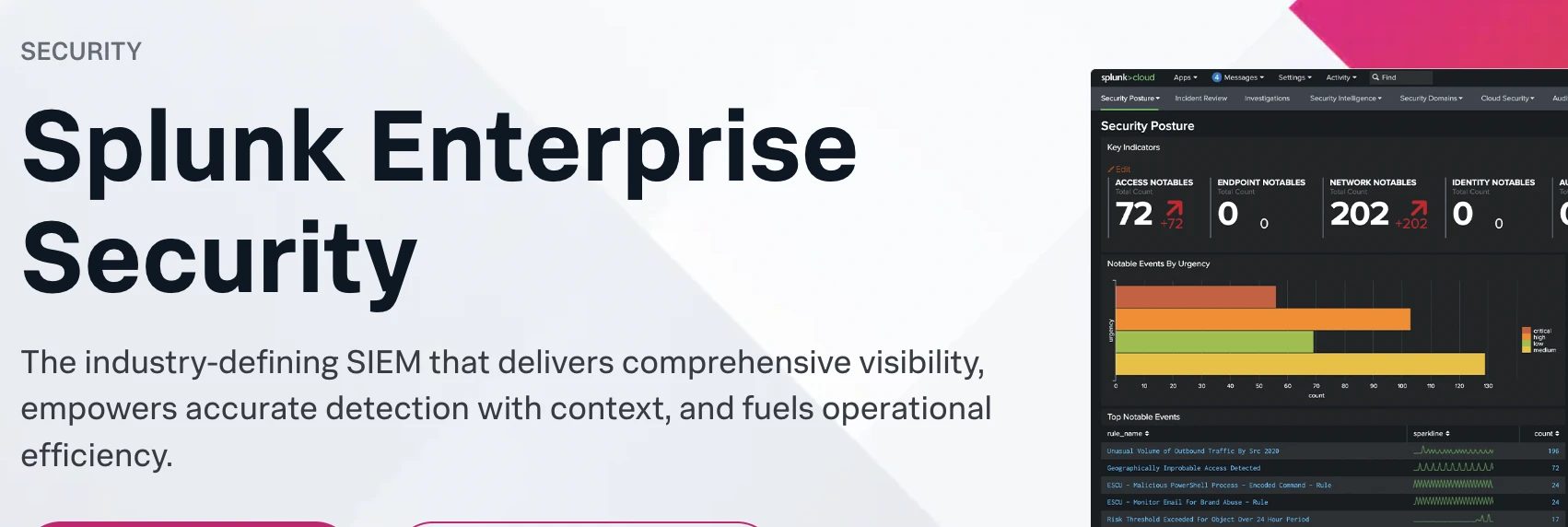
Splunk Enterprise Security is a SIEM platform with application and network monitoring capabilities. In addition to threat detection, it can monitor network and application topologies to identify bottlenecks, making it a useful debugging tool for enterprise-wide operations.
Splunk Enterprise Security Premier adds finding-based detections that automatically group and correlate related alerts at the entity level to reduce noise, and enhanced detection editing with separate findings and intermediate findings sections. 56
Sumo Logic
Sumo Logic offers search capabilities to retrieve and analyze logs using flexible search patterns. Its cloud SIEM automation service executes playbooks either manually or automatically when an insight is created or closed. Sumo Logic offers two SIEM pricing options: Enterprise Suite and Flex.
SolarWinds Security Event Manager
SolarWinds Security Event Manager (SEM) is an on-premises SOC tool. It collects log and security data from the network intrusion detection system (NIDS) and uses it to optimize existing IDS systems and protocols. SEM does not have a cloud-based deployment option. Licensing is available on a subscription or perpetual basis; no detailed public pricing is available.
Elastic Stack
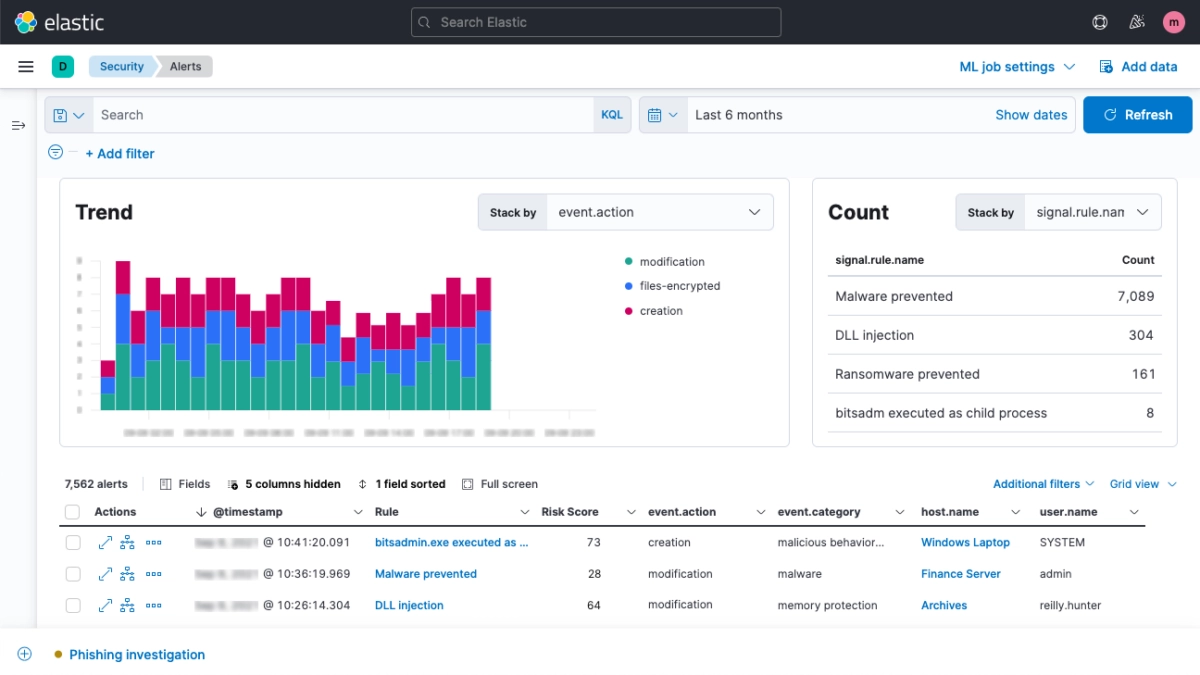
Elastic Security is part of the Elastic Stack (ELK). It provides out-of-the-box integrations, though customizing them requires technical expertise. Some users have reported over 300 hours to tune the system to their environment, though organizations with Elastic expertise in-house may find the process more manageable.
Components of the ELK Stack:
- Elasticsearch: A search and indexing engine optimized for time-series data.
- Logstash: A tool for collecting, processing, and refining data from various sources.
- Kibana: A visualization platform that enables interactive exploration of data within the stack.
- Beats: Lightweight agents that collect and forward data to the stack.
The ELK Stack is not a fully-fledged SIEM system. The free version lacks a built-in correlation engine; open source alternatives, such as Yelp/Elastalert, can provide this functionality. It also lacks built-in reporting, alerting, and pre-configured security rules, which adds to operational overhead when using the stack for security monitoring
Datadog
Datadog is primarily an application performance monitoring (APM) platform that also offers log ingestion. Datadog ingests logs into specific fields for searchability, allowing users to filter and analyze logs, for example, identifying which application is producing the most ERROR logs before running a detailed query.
Once a subset of logs is filtered, Datadog does not support creating visualizations or plots directly from that data, which limits the ability to generate complex reports from logs. For organizations whose primary need is log management for security purposes, Datadog does not offer substantially more than an ELK stack setup.
FAQs
The decision depends on the size, complexity, and regulatory requirements of your organization, and the resources available to manage the system.
When a SIEM makes sense:
SIEM is a later-stage investment. It requires an internal security team or an MSSP to operate effectively. Organizations that benefit most have:
Large or complex IT infrastructure requiring real-time monitoring and event correlation across a diverse environment
Compliance mandates such as PCI-DSS, HIPAA, or GDPR that require continuous monitoring and detailed audit trails
When a SIEM is not necessary:
Organizations with fewer than 100 endpoints or a cloud-native/BYOD setup may not need a full SIEM
Businesses without the personnel or expertise to configure and monitor a SIEM will see limited value from the investment.
A SIEM solution consists of three core components. Log management gathers and analyzes logs from servers, network devices, firewalls, and cloud applications many tools supplement this with threat intelligence feeds to detect and block emerging threats. Event correlation combines data from multiple systems to identify patterns: suspicious activity from a compromised account combined with unusual network traffic can be linked and escalated as a single incident, surfacing threats that would not be visible in isolation. Incident response and monitoring provide continuous coverage of digital and on-premises environments through a central dashboard, with alerts sent to analysts based on preset rules; some platforms also include automated response features, such as isolating an infected system upon malware detection, freeing analysts for more complex investigations.
The four primary use cases are threat detection and response, forensic analysis, real-time security data visualization, and compliance management. Threat detection covers the full range from insider threats to multidomain attacks spanning multiple parts of an organization’s infrastructure. Forensic analysis uses SIEM log data after a breach to reconstruct the attack’s scope, timeline, and movement through the environment. Real-time visualization presents security events via dashboards and charts, allowing analysts to monitor activity without manually reviewing raw logs. Compliance management automates log collection and generates audit reports for GDPR, HIPAA, and PCI-DSS.
No. SIEM, SOAR, and UEBA address different problems. SIEM collects and correlates log data across the environment. SOAR automates response actions through playbooks once a threat is identified. UEBA adds behavioral baselines for users and entities, detecting anomalies that rule-based SIEMs miss. Several vendors now offer all three in a single platform: Splunk ES Premier, Microsoft Sentinel, and Exabeam New-Scale Fusion are current examples, but buyers running standalone tools can also integrate them into an existing SIEM.
Traditional SIEM focuses on log collection, event correlation, and compliance reporting. Next-gen SIEM adds UEBA for behavioral detection, SOAR for automated response, and increasingly agentic AI capabilities that can autonomously conduct multi-step investigations. The practical difference for buyers is alert quality and analyst workload: next-gen platforms reduce noise through behavioral risk scoring and automated triage, while traditional platforms require more manual rule tuning and investigation effort.
Cite this research
Pick the format that matches where you're publishing. Pasting the link version into your CMS preserves the backlink.
@misc{dilmegani2026,
  author = {Dilmegani, Cem and Sezer, Sena},
  title  = {{Top 12 SIEM Tools & How to Choose the Best Solution}},
  year   = {2026},
  month  = may,
  howpublished    = {\url{https://aimultiple.com/siem-tools}},
  note   = {AIMultiple. Retrieved May 26, 2026}
}Results and timestamps of 37 data points. Download the summary data shown in this article's charts and tables as a ZIP file containing 3 CSV files.
Want the granular data behind it? Join Premium
Changelog
5 updatesAdded a ManageEngine Log360 vendor section to the SIEM product reviews.
Replaced the "Exabeam Fusion" product with "Exabeam New-Scale Fusion" in the product list.
Reference Links
Cem's work at AIMultiple has been cited by leading global publications including Business Insider, Forbes, Morning Brew, and Washington Post, global firms like Deloitte and HPE, NGOs like World Economic Forum, and supranational organizations like European Commission. [1], [2], [3], [4], [5]
Throughout his career, Cem served as a tech consultant, tech buyer and tech entrepreneur. He advised enterprises on their technology decisions at McKinsey & Company and Altman Solon for more than a decade. He also published a McKinsey report on digitalization.
He led technology strategy and procurement of a telco while reporting to the CEO. He has also led commercial growth of deep tech company Hypatos that reached a 7 digit annual recurring revenue and a 9 digit valuation from 0 within 2 years. Cem's work in Hypatos was covered by leading technology publications like TechCrunch and Business Insider.
Cem regularly speaks at international technology conferences. He graduated from Bogazici University as a computer engineer and holds an MBA from Columbia Business School.







Be the first to comment
Your email address will not be published. All fields are required. Comments are left in their original language.