


Top 20 Checkout Free Stores and Solution Providers

Long checkout lines may cost $37.7 billion 1 as these queues demotivate people from shopping. One way to tackle this down is adopting checkout-free store systems where customers can shop and leave without a queue as high tech sensors and cameras can track their shopping and payment process.
Explore the list of checkout free stores and their approaches in an alphabetical order.
Store / deployment | Company | Tech vendor | Status |
|---|---|---|---|
Aldi Stores | ALDI | AiFi & Grabango | Closed |
Amazon Go & Amazon One | Amazon | Amazon Just Walk Out | Closed |
Just Walk Out (third-party) | AWS licensees | Amazon Just Walk Out | Operating |
Carrefour | Carrefour | AiFi | Operating |
Sam's Club | Walmart | in-house | Operating |
7‑Eleven | 7‑Eleven | Grabango | Vendor dead |
Lidl Go | Lidl | in-house | Pilot |
Shufersal Shop&Go | Shufersal | Trigo | Operating |
SPAR Stores | SPAR | various | Operating |
Standard Cognition Stores | Standard AI | Standard | Exited |
1. Aldi Stores
Aldi is a German owned discount supermarket chain with over 10,000 stores in 20 countries. 2 Today, it is the UK’s fifth largest supermarket group. The company is famous for fast checkout lines. Yet, the company allocated a budget to develop an autonomous checkout system.
- The Aldi Shop&Go checkout free store opened in January 2022 in Greenwich, London, the UK. Aldi Shop&Go is partnered with AiFi. In March 2026, Aldi ended the trial and converted the store into a standard Aldi Local with self-checkouts.
- The second store was launched in April 2024 in Aurora, Illinois, the USA. Grabango delivers the relevant technology for the US stores. Grabango permanently ceased operations in October 2024, and Aldi has not announced a replacement vendor for the store.
ALDIgo
It is ALDI’s checkout free shopping system, developed in partnership with Grabango and AiFi, leveraging:
- Computer vision
- AI-powered systems
- Facial age verification (Yoti)
In this system, customers scan a smartphone app to enter. They keep shopping while technology tracks the items they choose and charge them. Payment options include the Grabango app to pay via QR code or Grabango pay station. Then, once payment is terminated, they can leave the store. Customers receive a digital receipt automatically after leaving the store.
Hybrid ALDIgo
The Aldi Shop & Go store in Greenwich, London, has transitioned to a hybrid model. Instead of being purely “tap-in and walk out,” customers can now walk in without scanning an app, shop as normal, and then choose how to pay at the exit:
- Via the retailer’s app (checkout-free).
- Via new self-checkout terminals where they can manually scan items.
- Using the AiFi-powered checkout system (walk-out).
This evolution reflects a growing trend where retailers aim to provide maximum flexibility and choice, making the checkout-free experience more accessible to customers who prefer traditional, manual, or self-checkout options. The hybrid model was short-lived: Aldi ended the Shop & Go trial in March 2026, and the store now operates as a regular Aldi Local.
2. Amazon Go
Online retailer Amazon opened its beta version of the cashier-less store on December 5 in 2016, in Seattle. The 1800-square-foot retail store was for employees. Then, the store became open to the public on January 22, 2018. By 2023, Amazon Go announced 43 store locations in Seattle, Chicago, Los Angeles, London and New York City. By 2026, Amazon closed these Amazon Go and Amazon Fresh branded physical stores while checkout-free technology remains a white-label solution for external retailers.3
The technology behind Amazon Go’s checkout-free shopping experience is called Just Walk Out. As of early 2026, Just Walk Out technology is applied over 360 third-party locations globally, including airports and stadiums, doubling its 2025 deployment.
Just Walk Out
Just Walk Out leverages computer vision and deep learning algorithms as well as autonomous driving vehicles. Amazon uses various cameras and sensors to see what customers are putting into their shopping bags.
Customers scan a QR code when they enter the store through an app connected to their Amazon.com account. After shopping, customers can leave the store. Amazon automatically charges the customers’ Amazon account, and the receipt is sent to the app.
It took quite some effort to improve the system. During the pilot, Amazon employees have been trying to fool the system through challenges like wearing Pikachu costumes while shopping. 4 Though the system passed the costume test, it has difficulty detecting customers who shop in groups, such as families.
According to the latest stats provided by Amazon, Just Walk Out technology has driven significant results, with:
- Market Express at ExCel London increasing peak customer service by 300% and annual revenue by 56%.
- Lumen Field reporting an 85% increase in transactions and a 112% rise in sales.
- Delaware North serving 20%-30% more customers in U.S. stadiums.5
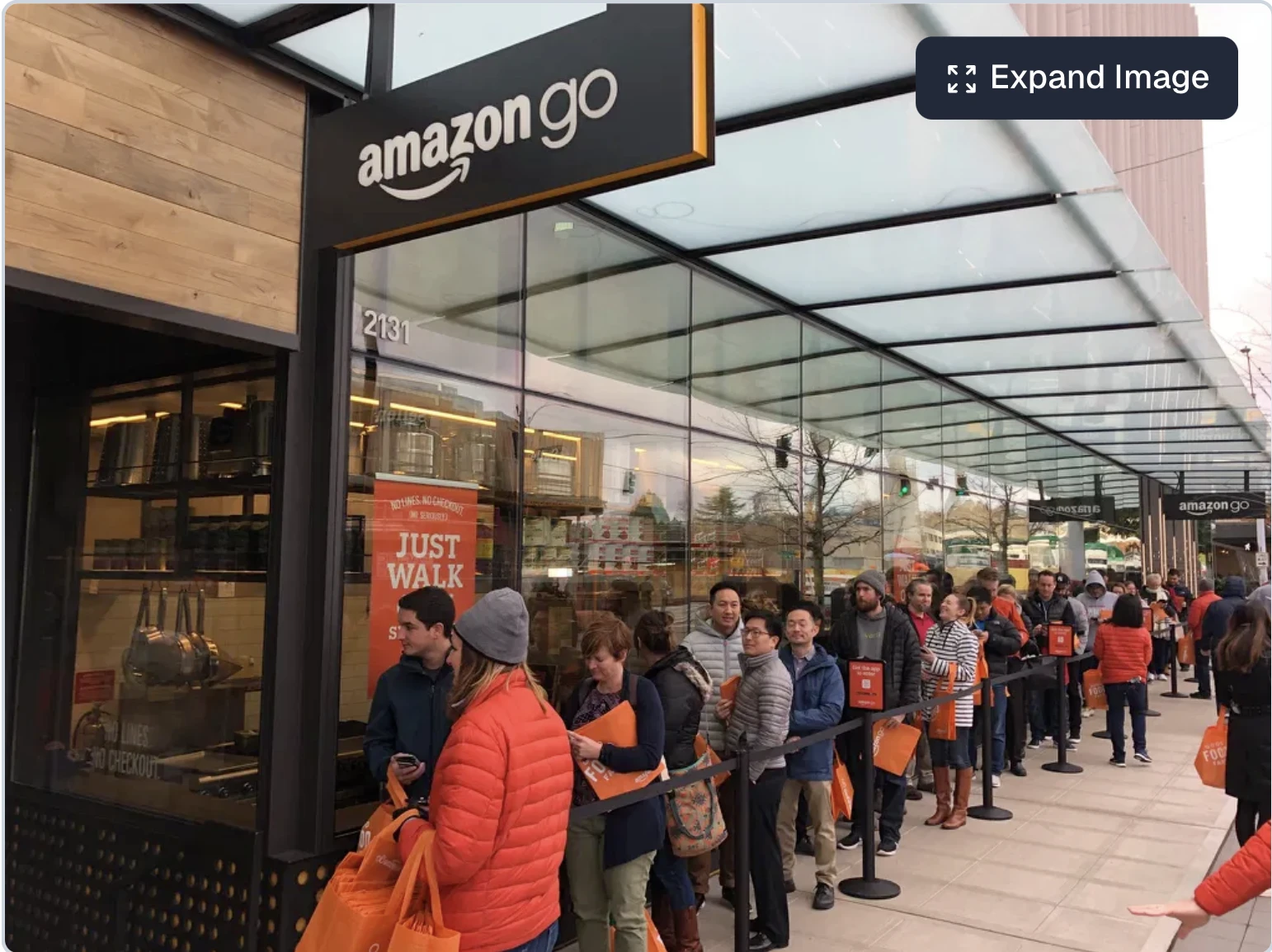
Funnily, Amazon Go stores, which are meant to reduce queues, were causing queues during their initial launch as people lined up to see how they work:
Amazon Dash Cart: The Smart Shopping Companion
For its Amazon Fresh grocery stores and some Whole Foods Market locations, Amazon is pivoting to its proprietary smart cart, the Amazon Dash Cart. This move effectively replaces Just Walk Out technology in most large-format U.S. grocery stores, as customers in these environments preferred a more interactive solution for larger shopping trips.
- Technology & function: The Dash Cart uses a combination of computer vision algorithms, sensor fusion, and integrated weighing scales to identify items. Shoppers log in using a QR code in the Amazon app, scan items as they place them in the cart, and see a real-time receipt and running total on the integrated screen.
- Key features and benefits:
- Shopping companion: The on-cart screen acts as a companion, helping customers locate items using in-store maps and navigation, track savings from digital coupons, and weigh produce accurately.
- Skip the line: Similar to Just Walk Out, customers can skip the traditional checkout line, exiting the store through a designated Dash Cart lane, and receiving an emailed receipt.
3. Carrefour
Carrefour is a multinational retail corporation headquartered in France, operating one of the largest hypermarket chains in the world, with stores across Europe, the Middle East, and Asia.
Carrefour launched several fully automated checkout free stores in multiple locations, such as:
- Carrefour City+ in the Mall of the Emirates, Dubai in September 2021.
- Carrefour Flash, also known as “Flash 10/10,” in Paris, France in November 2021.
- Carrefour BuyBye in Zaventem, Belgium in December 2023.
Customers are required to use the Carrefour app, which grants them access to the market. Then, the market operates as following:
- Products selected by customers are automatically identified using AI-powered sensors and computer vision technology.
- The virtual shopping basket is updated in real-time, and payment is processed directly through the app once the customer leaves the store.
- No scanning, queuing, or manual payment is required.
4. Lidl & Go
Lidl GB introduced “Lidl & Go,” a mobile self-scanning checkout program allowing customers to scan items via their smartphones while shopping and complete payment digitally. Following a seven-store pilot, the trial expanded to 37 additional locations across Scotland and Southern England, bringing the total to 44 stores. 7
The feature is integrated directly into the existing Lidl Plus loyalty app. It eliminates the need for dedicated, hardware-heavy in-store scanning devices by shifting the utility entirely to the customer’s smartphone.
- Real-time telemetry: The app tracks spending and savings in real time as items are scanned, providing immediate budget visibility before reaching the checkout area.
- Loose produce integration: For weighted or loose items like fruits, vegetables, and bakery goods, customers weigh the items at in-store scales and scan the dynamically printed barcode, or scan a dedicated barcode located directly on the electronic shelf labels.
5. Sam’s Club
Sam’s club is a Walmart owned grocery store in Dallas. The Sam’s Club Now test store opened in 2018. The store relies on Walmart’s solution for an autonomous checkout system, the “Scan & Go” program. Walmart introduced this program in selected stores between 2012 and 2014.
Scan & Go
The app allows customers to scan the products with their smartphones and pay by scanning a barcode for their total purchase. Compared to other systems, this is the easiest to deploy system.
- The app utilizes machine learning and purchase data to generate a shopping list for users. It automatically updates the list once items are purchased.
- Customers can search for an item and navigate in the store to find the item.
In 2020, Walmart tested a new self-checkout kiosk at a store in Fayetteville, Ark.8 In this checkout experience, Walmart combined a self-checkout system with human guidance where a host is always available to make the checkout frictionless:
The latest stats show that:
- 1 in 3 members regularly use Sam’s Club’s Scan-and-Go technology.
- Adoption has grown 50% over the past three years due to continued improvements.9
6. 7-Eleven
7-eleven stores in Dallas introduced a Scan and pay self-checkout program in 2018. The system of the app is similar to Walmart’s Scan and Go app. These both require mobile phones. In both systems, customers should manually scan items. 7-eleven installed checkout-free shopping in 10 stores in Australia. Since Grabango shut down in October 2024, 7-Eleven has shifted its checkout-free efforts to a US pilot with AiFi.
Pay and Go
Pay and Go is a mobile payment feature integrated into 7-Eleven’s My 7-Eleven App and it offers manual in-app scanning.
- Scan and Pay: In the initial version, customers scan items or pump fuel using the app and pay directly from their phones.
- Pay and Go 2.0: In this new version, scanning is eliminated entirely. Customers can pick up items and pay via the app without additional steps.
The second version is developed with Grabango, the AI-powered technology that enables checkout-free shopping by automatically tracking items without the need for manual scanning or waiting in line.
Here are the steps to follow to shop checkout free:
- In order to use the 7-Eleven app, the customers should install the app and register for the 7 Rewards loyalty program.
- Customers shop by scanning the barcodes of the items to this app.
- They put their items in plastic bags at the scan & pay station.
- The customers pay via Apple or Google Pay as well as a debit or credit card at the scan and pay station.
- Finally, they receive a QR code to confirm their leave from the store.
7. Shufersal Stores
Shufersal is Israel’s largest supermarket chain with 395 outlets.10 The chain agreed to install cashierless checkout technology to their markets in 2018.
- In 2022, Shufersal opened Israel’s first autonomous store, powered by Trigo’s AI technology.
- Shufersal plans to deploy 2,000 AI-powered cart devices across 30 stores by March 2025, enabling the transformation of these locations into checkout-free stores.
Shufersal’s Shop&Go
The technology they decided on is developed by Trigo Vision. 11 Trigo Vision’s system uses basic off-the-shelf connected cameras, computer vision and machine learning. These cameras identify products people put in their cart.
The shopping process works as:
- Shoppers enter the store by scanning a membership card.
- When they grab and place the products in their baskets, their final bill will be sent to their card.
- They will be able to pay via their pre-loaded payment information in the store’s membership system.
- If they do not want to add any payment information to the membership card, then they will need to use a multi-tender payment kiosk.
8. SPAR stores
SPAR is a global retail chain headquartered in the Netherlands, operating convenience stores, supermarkets, and hypermarkets across over 48 countries, known for its focus on local customer needs and innovative retail solutions.
SPAR has implemented checkout-free shopping solutions in multiple regions:
- In 2017, SPAR Netherlands introduced a mobile-based self-checkout system called Skippen, targeting university stores.
- In 2018, SPAR Ireland introduced checkout-free shopping at the SPAR Dublin Airport store, offering streamlined services in a busy environment.
- In 2018, SPAR Belgium launched a pilot project called Scan.Pay.Go., allowing customers to scan products via a mobile app and complete payments directly through their smartphones, bypassing traditional checkout counters.
- In 2023, SPAR Switzerland opened its third Go24 store in Surava, offering 24/7 shopping without staff or traditional checkouts.
In all these stores, customers are required to install the relevant app to or hold a registered access card to enter the store. Once they select the products and leave, payments are processed automatically through the app.
9. Standard Cognition stores
Standard AI, formerly known as Standard Cognition, has changed its focus from full autonomous checkout to Vision Analytics, offering camera-based in-store behavioral and operational analytics for retailers.12
The company built its checkout-free stores using computer vision technology, deep learning and image recognition techniques to track people and products in real-time in the store. Standard cognition emphasized that their policy on privacy protection. Therefore, they did not monitor the customer with their face but rather with a unique color identification for each client.
Standard’s checkout-free platform allowed:
- Light-touch installation, with cameras on the store ceiling
- Credit, cash and IC cards
- No requirement of any shelf sensors and works with any store design.
As a competitor of Amazon Go, Standard Cognition’s technology was installed in different retailer stores along with two company stores in San Francisco and Tokyo.
10. Wheelys 247 store
Wheelys had a concept like Uber for retail. They provided different mobile sales vehicles and experimented with mobile stores that enabled self-checkout. 13 However, with the COVID-19, they couldn’t raise a series A and ceased operations.13
They had developed a store called Moby 14, where customers can enter through sliding glass doors with an app including their pre-registered credit card information.
In the store, there are no employees, no cashier, no queue, no waiting. Customers scan and bag the products (including fruits, potato chips, coffee, magazines, and even sneakers) with the app and then leave. The app automatically charges the customers.
The Swedish company was testing the 24-hour mobile grocery store in Shangai. The store was also planned to be a self-driving vehicle. However, self-driving technology has not been implemented yet. The company was claiming that Amazon Go copied their idea before they stopped operations.
11. VenHub
VenHub operates robotic staffless Smart Stores within modular shipping-container formats. The company went public on Nasdaq in January 2026 under the ticker VHUB, utilizing an automated dispensing system rather than overhead computer vision tracking.
The system relies on a secure, enclosed inventory matrix operated by dual articulated robotic arms. Customers order via walk-up or drive-thru windows, and the system delivers products to secure compartments within 30 seconds.
- Robotic fulfillment: Dual robotic arms use adaptive grippers (suction and mechanical fingers) to handle various product shapes. Both arms map to the entire store to provide mechanical redundancy.
- Smart shelves: Internal inventory is tracked via weight sensors and RFID tags on the shelves, which automatically update stock levels and trigger restocking alerts.
- Climate control: The enclosure features segmented dry and chilled zones managed by an integrated HVAC system, allowing the store to hold up to 1,600 unique SKUs.
12. Żabka stores
Żabka is the largest convenience store chain in Poland, with over 9,000 outlets. The firm introduced Żabka Nano, brand for checkout free stores:
- In May 2021, the first Żabka Nano autonomous store opened in Warsaw, Poland.
- Żabka Nano is currently Europe’s largest chain of autonomous convenience stores with over 50 autonomous stores now operating in Poland
Żabka Nano
The system is developed with the support of AiFi and uses computer vision, machine learning, and advanced sensor technology to track items selected by customers.
The steps involved in shopping are:
- Customers scan a QR code via the Żappka app to enter the store.
- As they shop, the system records the items they take.
- Once finished, customers walk out.
- The payment is automatically processed through the app, with a receipt sent digitally.
White-label solution providers
These companies develop systems and implement them in a whitelabel manner in 3rd party stores. They do not have their own stores. In addition to these, companies like Amazon Go both operate their own stores and also provide their technology to retail companies.
13. AiFi
AiFi is a technology company specializing in AI-powered, checkout-free retail solutions, enabling retailers to offer autonomous shopping experiences without traditional checkout processes. In 2022, AiFi reached over 80 partnerships to build autonomous stores across North America, Europe, Asia, and the Middle East.
AiFi’s platform utilizes a 100% camera-based system combined with AI algorithms to monitor shopper movements and product selections, eliminating the need for shelf sensors and ensuring scalability and flexibility. Their checkout-free system operates as following:
- Shoppers enter the store by scanning a credit card or using a mobile app.
- Customers pick up products or return them to shelves, which is tracked by AiFi’s computer vision and maintained in an accurate virtual cart.
- Customers leave the store when done; the system automatically charges the linked payment method and sends a digital receipt.
AiFi provides three checkout-free solutions:
- AiFi Refresh: Designed to retrofit existing stores, this solution integrates autonomous checkout systems into current infrastructures without requiring new shelving or significant store modifications.
- AiFi Build: Tailored for new retail locations, it enables the creation of scalable, AI-powered autonomous stores, with customizable formats to suit diverse shopper entry methods like app, credit card, or hybrid options.
- AiFi To-Go: A portable modular store setup that allows retailers to expand into new commercial spaces with fully autonomous, staff-free operations.
 Add as preferred source
14. AI Retailer Systems
AI retailer systems was officially established in September 2020 in Zurich. 15 The company targets European retailers. They focus on delivering the 24/7 in-store shopping experience. Their checkout-free system works as following:
- Customers enter the store with a payment medium they decide. It can be a credit card, debit card or mobile payment.
- While customers shop, the virtual cart will be updating automatically to add or remove the item.
- Finally, depending on the payment method, payment will be confirmed.
In addition to checkout-free systems, the company provides remote assistance with the remote surveillance operator. The operator detects a non-shopping behavior including emergencies.
The system also allows for an effective and consistent in-store analytics. Retailers can view the layout and item placements every day, month and period.
15. Grabango
Grabango was founded in 2016 with a mission to save people’s time. In a year, the company completed their first automated store. By 2020, Grabango signed agreements with top 5 global grocers and filed over 30 patents. The company corresponded to the demand to install cashier-less systems of retailers. Yet, it ceased operations in October 2024 after failing to secure funding. Its technology is no longer available.16
Grabango also used small cameras and sensors mounted to the ceiling. They benefitted from algorithms powered by AI and computer vision tech. These cameras detected products despite elemental and branding changes.
Grabango had two separate approaches to checkout:
- In the first way, customers download and install the Grabango app to “grab-n-go”. They place all items in a bag and walk out. The mobile app charges them accordingly.
- The second approach is to grab items and go to a checkout stand. At the stand, the cashier does not need to scan every item. They know the total items gathered so all customers are asked is to pay via cash, credit, Apple Pay, etc.
By doing so, Grabango could allow customers to checkout with or without a cashier using ceiling-mounted cameras.
16. Imagr for Smart Cart Solutions
Before Amazon and Standard Cognition launched their solution, Imagr showed SmartCart powered by image recognition technology. Like a checkout free store, once you link your phone to the cart with an app, scanning is not necessary. The computer vision system recognizes the products in the cart. Then you pay online via the app and leave the store.
They now have some pilot deployments in countries such as Japan. 17
17. Trigo Vision
Trigo Vision is a Tel Aviv-based autonomous retail store.11 The company modifies existing stores by placing ceiling-mounted cameras. These cameras automatically identify and record items in the store. Customers are either automatically billed or they pay by cash or card. To be billed automatically, they are asked to register their details.
The cameras are demanded because they prevent shoplifting and allow inventory updates. Also, the data gathered by the company is insightful for customer behavior.
In June 2025, Trigo launched a computer vision solution for loss prevention. This marked a strategic pivot toward shrinkage control and staff safety applications alongside its core checkout automation.
The company is currently partnering with global grocery chains across the globe.
Wider adoption of AI-powered loss prevention (Trigo)
An emerging trend in checkout free technology is the “unbundling” of the core computer vision and AI from the full “checkout-free” model to focus specifically on solving the massive retail problem of shrink (theft and operational errors).
Rather than offering a complete “walk-out” store, many technology providers, including companies like Trigo, are focusing on using their systems to monitor store activity and transaction data to flag and deter theft.
For example, Trigo’s technology can be leveraged with a store’s existing CCTV camera network (plus its own sensors), offering a less disruptive and lower-cost entry point for retailers. This approach uses AI to:
- Detect suspicious behavior: The system tracks customer movement and item placement, identifying actions like “pushout theft” (walking out with an unpaid cart) or “sweethearting” (employee collusion with a customer).
- Verify POS transactions: It cross-references video footage with Point-of-Sale (POS) data in real-time. For example, it flags discrepancies when a high-value item leaves the store without being scanned or if a cashier uses an abnormal number of overrides or discounts.
18. Zippin
Zippin provides an autonomous checkout platform specialized for high-traffic environments like sports stadiums and airports. In 2022, the company partnered with Mastercard to integrate its technology into the Shop Anywhere platform.
The system utilizes overhead cameras and smart shelf sensors to track purchases without facial recognition. Their checkout-free system works as follows:
- Customers enter the store by tapping a credit card or scanning a QR code at the entrance.
- AI software uses computer vision and sensor fusion to identify items as they are picked up or returned, building a virtual cart in real-time.
- Customers “zip out” by walking through the exit.
- The virtual cart is finalized and the linked payment method is automatically charged upon exit.
19. MishiPay
MishiPay is a UK-based firm providing mobile and kiosk-based self-checkout solutions. Their technology is often used for “Scan, Pay & Leave” journeys or via RFID-enabled kiosks. In Canada, MLSE (Maple Leaf Sports & Entertainment) stores used this system to reduce average checkout times from 90 seconds to under 20 seconds.
Their checkout system works as follows:
- Customers use the MishiPay app or a mobile web browser to scan the barcodes of items as they shop.
- For stores using RFID, customers can bring a batch of items to an RFID kiosk which identifies all products simultaneously without individual scanning.
- Payment is completed directly on the user’s smartphone or at the kiosk using digital wallets or cards.
- The system provides a digital receipt that acts as an exit pass to verify the purchase.
20. Alibaba Hema (Freshippo)
Alibaba Hema, known as Freshippo in China, operates high-tech supermarkets that blend online and offline retail. The stores serve as both fulfillment centers for 30-minute deliveries and physical retail spaces. The core technology platform is called ReXOS, which manages inventory and checkout via smart IoT devices.
Their checkout-free system works as follows:
- Shoppers log into the Hema app upon entering, which serves as the primary interface for the store.
- Customers use the app to scan electronic shelf labels (ESLs) to see product origins or add items to a digital cart for home delivery.
- For in-store purchases, customers use dedicated self-checkout kiosks that utilize facial recognition (Alipay “Smile to Pay”) or app-based payment.
- Smart carts equipped with sensors and touchscreens are also available in select locations to track items and process payments automatically.
Checkout free market trends
AI shopping assistants and cart integrations
Driven by an industry shift toward hybrid deployment models, the retail sector is transitioning from autonomous checkout-free stores toward smart cart and software integrations. As standalone frictionless stores consolidate, major operators are deploying hardware and software solutions to streamline transactional workflows:
- Smart cart deployments: Hardware providers such as Cust2Mate, Instacart Caper Cart, and Shopic are gaining market dominance by embedding automated scanning and direct checkout capabilities into physical shopping carts.
- Conversational AI integrations: Retailers are increasingly utilizing natural language processing to automate cart assembly:
- Walmart & Google Gemini: This partnership enables shoppers to build digital carts and execute transactions directly through the Google Gemini chatbot ecosystem.
- Uber AI cart assistant: Launched in February 2026, this tool converts unstructured text shopping lists or images of handwritten notes into actionable digital grocery carts within the Uber Eats app.
Hybrid models over pure autonomous
Major retailers like Amazon, Carrefour, and SPAR are shifting from standalone autonomous outlets to hybrid models. This involves integrating AI checkout technology into existing formats rather than relying on pure cashierless stores.
Privacy and regulation
The growth of checkout-free retail has increased scrutiny of facial recognition and data protection. This tension is coming to a head as the EU AI Act’s high-risk biometric provisions reach full applicability in 2026, imposing strict restrictions on biometric identification and age verification systems in retail environments.18
Why are check-out free stores closing?
We observe that many check-out free stores are getting closed or transforming over the last two years. There are few reasons behind it:
- The capex never matched grocery economics: A million dollars of sensors per store cannot be paid back out of grocery margins, but it can be paid back out of a stadium concourse selling beer during a ninety minute window. The technology did not fail. It was pointed at the wrong room. This is why, Amazon did not exit retail entirely but find a new market for Just Walk Out.
- Error rates rise with SKUs: The technology worked in the format with the thinnest margins per square foot and the smallest baskets, and had nowhere to grow into. The weekly shop was never a later phase of the roadmap.
- It never removed the labour, it relocated it: The entire business case was the cashier’s wage, and the cashier’s wage never went away. Staff stayed on to restock, tidy, help confused shoppers and run click and collect. For instance, Carrefour Flash runs with four employees on site.19
- It solved the exit and broke the entrance: Removing the queue only helps if getting in is easy, and these stores made getting in harder by requiring an app. That trade is worst for the fast small basket, which is the only trip the format was built for. Tesco later added checkouts back to three of its four GetGo stores so that customers without the app could shop normally.20
- Customers were the investors: These vendors were mostly funded by the retailers deploying them, which meant demand and capital came from the same place. When retailers lost interest, the vendors lost both at once. AiFi’s Series B investors included Aldi South Group, Żabka Group and REWE, all of whom ran its stores.
FAQs
Checkout free shopping is a retail experience where customers can select products and leave the store without stopping at a traditional checkout counter. Technology such as cameras, sensors, and artificial intelligence automatically tracks items taken by customers and charges their payment method upon exit.
Free checkout refers to a shopping experience where traditional cashier interactions are eliminated. Instead, advanced systems, such as mobile apps or in-store sensors, automatically track purchases and process payments seamlessly.
Checkoutless stores use a combination of cameras, weight sensors, and AI to detect which products customers take. Purchases are linked to their accounts via an app, and charges are processed automatically as they leave the store.
Free standing stores are standalone retail locations not connected to other businesses or shopping centers. These stores are independently located, offering greater visibility and direct access to customers without being part of a larger mall or complex.
Further reading
Explore more on top technologies utilized in retails, such as:
- Generative AI in Retail: Use Cases, Examples & Benefits
- Top eCommerce Technologies: Use Cases & Examples
Cite this research
Pick the format that matches where you're publishing. Pasting the link version into your CMS preserves the backlink.
@misc{simsek2026,
  author = {Şimşek, Hazal},
  title  = {{Top 20 Checkout Free Stores and Solution Providers}},
  year   = {2026},
  month  = jul,
  howpublished    = {\url{https://aimultiple.com/checkout-free-stores}},
  note   = {AIMultiple. Retrieved July 10, 2026}
}Results and timestamps of 22 data points. Download the summary data shown in this article's charts and tables as a ZIP file containing one CSV file.
Want the granular data behind it? Join Premium
Changelog
5 updatesAdded a section on why checkout-free stores are closing.
Added VenHub, a Nasdaq-listed robotic staffless smart store, as a new entry.
Updated the Amazon Go section with new deployment figures for Just Walk Out technology.
Reference Links

Be the first to comment
Your email address will not be published. All fields are required. Comments are left in their original language.