


AI Utilities: Top 25 Use Cases & 48 Case Studies

AI utilities refer to AI solutions leverage real-time sensor, meter, and imagery data to forecast demand, automate inspections, optimize distribution, and improve customer service.
Learn 20 tools and 25 specific real-life use cases of AI utilities:
This chart is based on the 47 AI utilities case studies we compiled and grouped by their main use case:
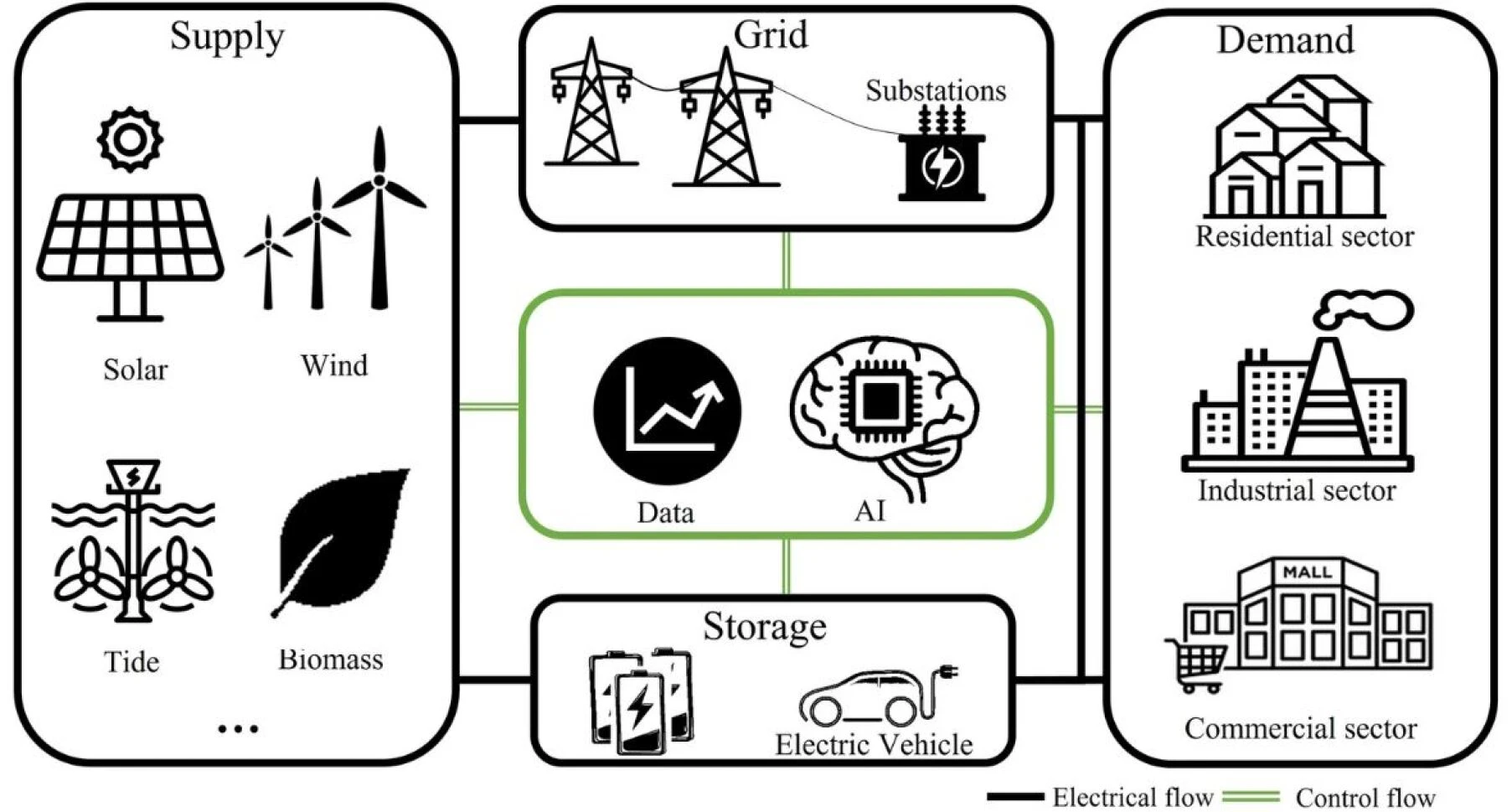
- Grid & energy: EV charging and flexibility, demand forecasting, grid simulation, grid monitoring, and digital twins
- Customer & CRM: AI-assisted contact centers, field force coordination, sales insights, and personalized energy
- Back-office: meter-to-cash billing and low-code process automation
- Assets & environment: wildfire detection, asset inspection, substation security, water quality, waste sorting, and fleet safety
- Data & knowledge: internal AI assistants, utility data platforms
- Telecom: network automation, network optimization, network slicing and data traffic management
See the full case study list for sources and details.
AI utilities for energy
1. Autonomous operations in power plants
AI automates plant inspections by analyzing data from cameras and sensors in real time, reducing reliance on human workers and enhancing safety by detecting leaks or other hazards promptly. This automation meets the demands of an aging workforce and enhances plant efficiency.
Real-life example for power plants
Duke Energy, aiming to achieve net-zero methane emissions by 2030, faced challenges in monitoring natural gas pipelines for leaks. They partnered with Microsoft and Accenture to develop a new platform using Microsoft Azure and Dynamics 365 to integrate satellite, ground sensor data, and AI for real-time leak detection and response.
The platform assessed emissions data, prioritized repair areas, and dispatched crews promptly, helping to reduce greenhouse gas emissions.
- Provided graphic dashboards for prioritizing leak repairs
- Enabled precise geolocation data for quicker repairs
- Scalable to other emission sources and equipment. 1
2. Energy demand forecasting
Efficient utility distribution relies on accurately forecasting energy and water demand, which constitutes a major portion of operational costs. AI in energy demand forecasting helps utility companies manage supply and demand by analyzing factors such as weather patterns, user behavior, and market prices by:
- Forecasting energy demand and optimizes supply distribution
- Predicting renewable energy availability and balances with other sources
- Enabling price optimization based on historical data and potential competitor responses
- Encouraging efficient consumer behavior by notifying users about peak periods.
Real-life example for energy demand forecasting
Plenitude, Eni’s energy retail and renewables company, uses Databricks to forecast customer energy demand and the output of its wind and solar plants, and to group customers by likely needs.
- Up to 60 use cases in production
- Up to 500 reports and dashboards running on the platform.2
3. Energy prosuming
AI solutions for energy prosumers (consumers who also produce energy, e.g., via rooftop solar) help users manage self-produced energy from sources like solar panels or wind turbines. These solutions optimize the use of renewable energy and enable users to sell surplus power back to the grid.
- Balances supply and demand based on consumption peaks and weather conditions.
- Integrates with smart meters for efficient energy management.
- Supports surplus energy trading or sharing with the local grid.
4. Industrial digital twins for power generation
AI-driven digital twins can simulate and predict maintenance needs, optimize performance, and reduce downtime of power generation sites like wind turbines. These models can accurately forecast issues like corrosion, minimizing disruptions and increasing reliability in power supply.
Real-life example for industrial digital twins
For instance, Google’s neural network improved wind energy forecast accuracy, boosting financial returns by 20%. This predictive capability allows for efficient scheduling of energy production and consumption, maximizing resource utilization and profitability. 4
Real-life example for power generation
AcegasApsAmga, an Italian distribution grid operator, began building a digital twin of Trieste’s medium- and low-voltage grid with Siemens’ Gridscale X. The twin can simulate, monitor and manage energy flows in real time to keep power stable for ships plugged in at the Port of Trieste.5
5. Power grid simulation
AI-driven grid simulations allow utilities to model power flow, schedule outages, and test grid resilience, especially with the increased integration of renewable energy sources. This optimizes maintenance and outage management, ensuring minimal impact on customers.
Real-life example for power grid simulation
ElektroDistribucija Srbije (EDS), Serbia’s distribution system operator, needed to modernize its legacy electricity grid to support renewable energy integration and improve reliability across a network serving 3.8 million customers. To address this, EDS implemented EcoStruxure ADMS and EcoStruxure DERMS from Schneider Electric to digitize grid operations.6
Results:
- 10–15% reduction in network losses
- ~20% reduction in outages
- Improved integration of distributed renewable energy resources
- Condition-based maintenance improving operational efficiency
- Increased grid reliability for 3.8 million customers
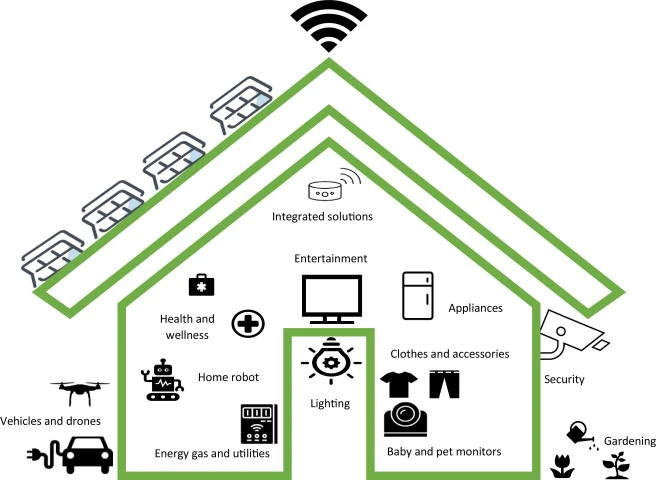
6. Smart Homes as energy hubs
AI-based smart home systems help homeowners monitor and adjust energy usage, reducing costs and minimizing demand on the grid through better load management.
7. Smart meters for real-time power flow
AI-driven smart meters integrate with distributed energy resources to balance demand and supply in real-time, supporting grid resilience and decarbonization efforts.
Real-life example for smart meters
Con Edison, a utility company, aimed to reduce operational costs and environmental impact by leveraging artificial intelligence. AI-powered tools helped lower power generation costs and reduce CO₂ emissions, empowering customers with more control over energy usage.
This AI-driven approach supported Con Edison’s commitment to sustainability and customer-focused energy solutions.
- Reduced power generation costs and CO₂ emissions
- Enabled enhanced customer energy management
- Promoted eco-friendly and customer-centric operations.8
8. AI-managed EV charging
A neighborhood of electric vehicles (EVs) can easily overload the local grid, but AI can optimize charging schedules by shifting consumption to off-peak hours and drawing battery power back during peak demand. This collective pooling creates a “virtual power plant” (VPP), a software-coordinated fleet that behaves like a single, dispatchable power source.
Real-life example for AI-managed EV charging
ChargeScape, a joint venture of BMW, Ford, Honda, and Nissan, aggregates EVs into a virtual power plant for a dozen-plus US utilities, using AI-driven load management to shift charging and export stored energy during peak grid events. This turns EVs from a grid liability into a dispatchable asset.
- Each vehicle delivers ~5 kW of managed-charging demand reduction and up to ~20 kW of export via bidirectional (V2G) charging.9
- Aggregator EnergyHub cut EV charging peaks by up to 50% through AI distribution optimization, shifting 38.3k+ MWh of load across its VPP fleet in 202510
NV Energy used Bidgely’s AI-based EV detection on smart-meter data to find EV owners charging during peak hours. From 20,241 customers, the AI identified 419 EV users and narrowed them to 103 high-value customers responsible for 63% of the load-shifting potential.
- 3x higher load shift per car than the average population
- ~1 kW per car across 20+ managed-charging events, compared with 0.2–0.3 kW typical in the industry.11
AI utilities for waste, water and wildfire
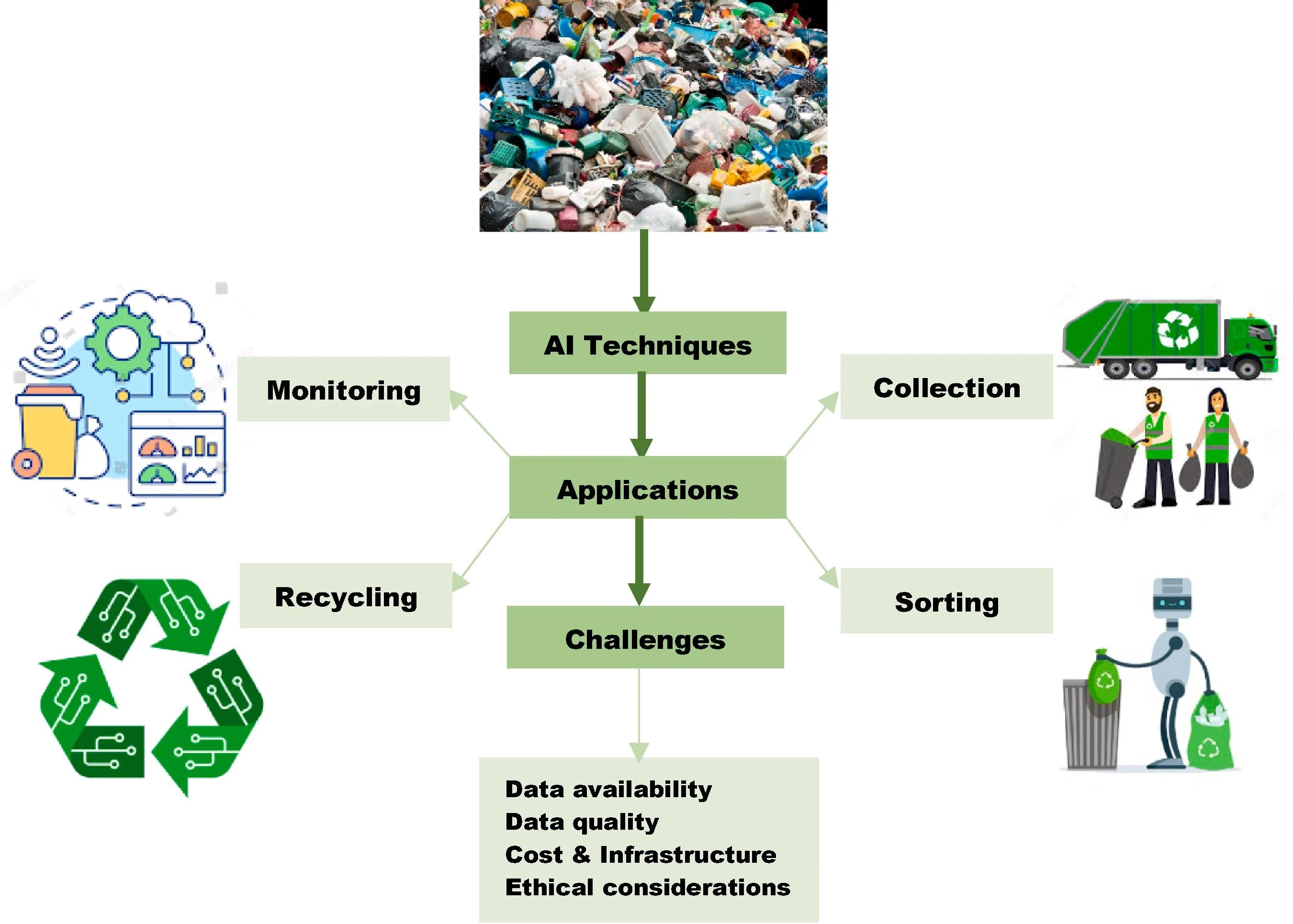
9. Waste management
AI in waste management collects, and analyzes data on waste types, volumes, and patterns, predicts future waste levels, identifies and sorts recyclable materials and discarded food types with computer vision and ML. It can inform pick-up schedules, optimize waste disposal and recycling processes, improve resource management.
Real-life example for waste management
Materials recovery facilities (MRFs) struggle with contaminated single-stream waste, where less than half of inbound material is typically recovered and manual sorting is slow, hazardous, and hard to staff. Bryson Recycling and other European MRFs deployed Recycleye Vision and Recycleye Robotics, which use computer vision and deep learning to identify and robotically pick recyclables from mixed streams, leading to:
- Raised output purity on an aluminum line by 8% and output market value by around 20%,
- Increased purity on a fibre line by 12%,
- Delivered up to 33,000 robotic picks over a 10-hour shift, roughly twice manual sorting speed.12
10.Water quality monitoring
AI can enhance water quality monitoring by analyzing water flow and detecting contaminants in real time. AI-enabled sensors deployed in water systems identify harmful bacteria and particles, enabling faster responses to potential health risks.
- Monitors water quality continuously, detecting contaminants in real time.
- Improves transparency and control over water supply systems.
- Supports quick actions in response to health risks.
Real-life example for water quality monitoring
Phoenix’s Water Services Department uses Kando’s AI-powered sewer sensors to monitor wastewater quality in real time. The system flags sudden changes in pH and temperature caused by illegal dumping, so the team can find the source and isolate pollutants before they reach the treatment plant.
- 16 sensors installed across the sewer network in the initial pilot
- Automated alerts and a dashboard of dumping hotspots
- Supports the city’s water reuse goals.14
11. Wildfire risk detection and prevention
Computer-vision cameras scan for smoke plumes, while ML models rank circuits by fire risk using weather, fuel-moisture, and vegetation data.
Real-life example for wildlife risk detection
Pacific Gas & Electric (PG&E), facing severe wildfire exposure across its California territory, deployed 630+ AI-powered detection cameras from Pano AI and vegetation-intelligence models from Overstory to spot ignitions early in ~90% of its high-fire-risk territory.
- Reported a nearly 50% drop in ignitions with vegetation as a suspected cause in 2025 versus the prior year.
- Improved detection speed and helped cut vegetation-related ignitions.15
Industry-agnostic AI utility use cases
12. Automated asset maintenance
Energy and utilities companies struggle to detect defects in critical infrastructure, leading to costly breakages. AI analyzes aerial imagery, LiDAR, drone and satellite data to identify equipment issues or vegetation risks that could damage infrastructure.
For instance, AI-powered image recognition and computer vision can analyze drone-captured images of assets, allowing for rapid identification of potential failures. This proactive monitoring minimizes service disruptions and reduces fire hazards around power lines, eventually optimizing resource scheduling.
Real-life example for automated asset maintenance
Exelon, a large energy company, sought to improve its grid maintenance and inspection process. Using NVIDIA’s AI tools for drone inspections, Exelon enhanced its defect detection capabilities, creating labeled examples for real-time assessment.
This AI-driven approach improved maintenance accuracy, minimized emissions, and increased the reliability of the energy grid.
- Enhanced grid defect detection through AI-driven drone inspections
- Increased maintenance efficiency and grid reliability
- Reduced emissions through optimized inspection processes.16
13. AI-assisted contact centers & customer experience automation
Legacy billing and customer service platforms force utility reps to switch between disconnected systems, causing high billing error rates and delayed resolutions. Unifying customer data within an AI-enabled CRM allows utilities to deploy autonomous AI agents for routine inquiries across web, mobile, and email while equipping human reps with automated interaction summaries.
Real-life example for full platform & billing automation
Regional Water Authority (RWA) replaced legacy systems with Microsoft Dynamics 365 and Copilot Studio for agent assistance, call transcription, and self-service billing.
- 14,000 billing errors eliminated
- 10 hours saved weekly per customer service employee
- Disconnection identification time cut from 30 hours to 7 hours per week.17
Real-life example for autonomous mobile AI agents
ENGIE Belgium deployed Salesforce Agentforce in its mobile app to explain tariffs, analyze usage, and automate smart EV charging via APIs.
- 71% autonomous case resolution rate over 1,500 daily conversations
- 83% response accuracy across customer inquiries.18
Real-life example for generative AI email responses
Octopus Energy implemented Generative AI to automate email responses to customer inquiries. Octopus energy achieved 80% customer satisfaction score,outperforming human staff by 15%.19
14. Fleet optimization for utility trucks
The energy sector’s complex supply chains require efficient logistics management. AI enhances coordination between operations teams and warehouses, optimizing fleet management and route planning.
For instance, AI optimizes utility truck routes during outages and extreme weather, reducing travel times and improving response times to restore services more quickly. This leads to improved delivery times, reduced operational costs, and better alignment with market demand.
Real-life example for fleet optimization
Xylem Kendall, a vegetation management company operating over 5,500 fleet assets, faced safety concerns from distracted driving, which data linked directly to cell phone use.
To solve this, they deployed next-gen telematics and Motive AI Dashcams to track safety scores and installed hands-free phone holders nationwide, achieving the following results:
- 5% improvement in overall driver safety scores.
- Real-time risk mitigation by detecting distracted behavior and providing immediate in-cab alerts to drivers.
- Data-driven post-trip coaching that allowed supervisors to utilize camera footage for targeted safety training.20
15. Substation safety and security
AI-based video analytics improve substation security by detecting unauthorized intrusions and monitoring worker safety, enhancing compliance and reducing potential incidents.
Real-life example for substation safety and security
US electric utilities face a sharp rise in physical attacks and copper theft at substations, compounding the pressure to comply with NERC CIP-014 physical security requirements. Yet, conventional perimeter alarms drown operators in false triggers. For example, a large substation can generate 50 to 200 perimeter alarms per shift, with over 95% of them being nuisance triggers caused by wildlife, wind, or patrol vehicles.
Several utilities are installing AI video analytics with sensor fusion onto existing cameras to:
- Classify what tripped an alarm (person, vehicle, animal), cutting the nuisance alerts that cause operator alarm fatigue
- Fuse thermal and visual sensors so a second sensor must confirm before an alert is escalated, reducing false dispatches
- Run the same thermal and visual hardware for early detection of equipment temperature anomalies, adding predictive-maintenance value beyond security
- Enable remote, real-time monitoring and faster law-enforcement coordination during an incident.21
16. AI internal workplace & knowledge assistants
Enterprise utility operations require fast access to vast internal documentation, safety protocols, and operational procedures. AI-powered internal virtual assistants act as daily productivity copilots for utility employees, streamlining information search, answering internal queries, and reducing administrative overhead.
Real-life example for virtual assistants
Ontario Power Generation (OPG) collaborated with Microsoft to launch ChatOPG, an AI-powered internal virtual assistant designed to give employees rapid access to operational information and administrative support.
- Improved employee productivity and access to information
- Enhanced safety and operational efficiency
- Promoted AI integration in daily operations for better performance.22
AI utilities for telecom
17. Zero-Touch Network Operations
Zero-touch network operations involve using AI to automate network management tasks, reducing the need for human intervention. This includes self-monitoring, self-healing, and automatic optimization of network resources. By integrating digital twins and machine learning, telecom operators can achieve higher service reliability and operational efficiency.
Real-life examples for network operations
Danish network operator TDC NET uses Ericsson’s Predictive Cell Energy Management, an AI system that predicts traffic and automatically adjusts radio network energy use without human input. By 2025, the company became the first deployment worldwide verified at Level 4 network autonomy, the second-highest level in the TM Forum’s scale for self-running networks, achieving:
- Running in TDC NET’s live network since 2024
- About 5% less energy needed per GB of data transmitted.23
18. Network Optimization and Management
AI-driven network optimization and management systems analyze large volumes of data to predict and address potential issues before they impact services.
Real-life example for network optimization
Saudi operator stc deployed Nokia’s AI-powered MantaRay Cognitive SON in its commercial network to optimize the radio network automatically during the Hajj pilgrimage, one of the world’s most extreme traffic peaks.
- Over 10,000 optimization actions carried out without human intervention
- Stable connectivity maintained despite a 40% increase in traffic.24
19. 5G Network Slicing
By enabling network function virtualization, AI supports 5G network slicing and allows telecom operators to create and allocate network segments for different use cases and customer needs.
Real-life example for network slicing
Nokia and AWS launched AI-driven 5G network slicing, which du (UAE) and Orange are trying out in their live networks. AI agents track network performance along with outside data such as events, traffic and maps, and adjust each network slice automatically to keep its guaranteed service level.
- Network slices adapt automatically to real-world demand
- Use cases include extra capacity on demand and reserved capacity for large events.25
20. Data Traffic Management
AI-powered data traffic management optimizes the allocation of network bandwidth based on real-time demand. This ensures that during peak times, network performance is maintained, leading to a better user experience and more efficient use of resources.
Real-life example for data traffic management
Optus trialed Ericsson’s AI-native link adaptation, which replaces fixed rules with real-time AI decisions on how data is sent over the radio link, to improve 5G download speeds where signal is weak.
- Over 20% higher throughput per cell in medium-to-poor signal conditions
- No extra hardware or spectrum needed.26
AI utilities for CRM
AI agents and copilots built into customer relationship management (CRM) resolve routine requests, summarize interactions for human agents, and coordinate field work.
21. AI-driven field force optimization & resident visit coordination
Disparate scheduling systems and uncoordinated customer communications lead to inefficient field routes, high service costs, and costly missed site visits. AI-driven field service platforms optimize technician dispatch and incident management while sending automated, omnichannel reminders to residents to ensure successful site access.
Real-life example for internal dispatch & incident optimization
Ukrtelecom consolidated contact center, incident management, and field force management onto Creatio’s platform to automate routing and task prioritization.
- 39% enhancement in overall operational productivity
- 30% increase in field force productivity
- 25% reduction in error incidents
- 20% decrease in service time costs.27
Real-life example for resident engagement & appointment coordination
Sureserve deployed Creatio Service with WhatsApp-first resident messaging to send automated visit reminders, confirmations, and self-service rescheduling options.
- Mobilizes 4,000 engineers daily across 1.2 million properties
- Significantly improved first-time fix rates and workforce utilization
- Enabled meeting-time data updates that previously took weeks of development..28
22. AI-guided customer onboarding and contract activation
Complex contract terms, start date confusion, and meter activation timelines create high inbound call volumes and failed customer onboardings. CRM-based AI agents leverage unified contract data and knowledge bases to resolve onboarding questions immediately after contract signature.
Real-life example for AI-guided customer onboarding
ENGIE Italy embedded Salesforce Agentforce into welcome emails, offering new customers a direct self-service portal link to ask specific onboarding and contract questions.
Results:
- 3x increase in click-through rates (rising to 4.5%) on emails with the AI portal link
- Significant drop in failed onboardings across new customer activations.18
23. Unified CRM for clean-energy sales and field installation
Expanding into solar, heat pumps, and EV chargers requires utilities to unify customer data across sales, service, and field crews. A central CRM links sales pipelines with field scheduling, while AI work-order summaries eliminate duplicate back-office tasks.
Real-life example for Unified CRM
To scale its solar and EV installation services, E.ON UK needed to connect sales pipelines with field service scheduling and eliminate back-office inefficiencies. The utility deployed Microsoft Dynamics 365 (Sales and Field Service) along with AI-driven Copilot work-order summaries to streamline technician workflows.
- Improved first-time install success rates across field operations
- 20% reduction in field installation job duration
- Eliminated a 20-minute manual property handoff process per site.29
AI utilities for back-office operations
24. Meter-to-cash and billing automation
Meter-to-cash covers every step from meter reading to collected payment: validating meter data, calculating bills, sending invoices and processing payments. Utilities run these steps as large nightly batch jobs, so one failed job can delay thousands of bills.
Workload automation tools run these jobs end-to-end and flag delays before customers notice. They also deliver clean billing data on time to the AI models that depend on it.
Real-life example for SAP meter-to-cash automation
Stadtwerke München (SWM) supplies Munich with electricity, gas, district heating and water. Its staff started 60–70 SAP billing processes by hand every day. SWM moved to Redwood’s RunMyJobs to automate these runs.
Results:
- Meter-to-cash processing time cut from 14 hours to 8 hours
- 100% accurate daily invoicing,
- 60–70 manually started billing processes per day replaced with automated runs.30
25. Low-code process automation
Utilities rely on many small manual processes, such as safety forms, equipment tracking and approvals, that often live in spreadsheets and email. Low-code platforms allow employees to build apps and workflows without waiting for IT.
Real-life example for enterprise-wide low-code adoption
Pacific Gas & Electric (PG&E) worked with Cognizant to roll out Microsoft Power Platform across the company. Employees built apps to track equipment at emergency sites, an AI chatbot for service-desk questions, and bots that reconcile billing data.
Results:
- 300+ solutions generating about $75 million in annual savings,
- 132 solutions delivered in under a year across nine business units.31
Why should we use AI in utilities?
Here are the reasons to deploy AI in utilities:
Electricity demand surge
Electricity demand requires capacity expansion without compromising supply reliability or affordability. AI technologies can support this transition through smarter demand forecasting and operational optimization.
- Electricity demand is projected to increase 1.4% annually through 2032, resulting in a 46% cumulative rise.32
- In the US, 120 GW of additional electricity demand is expected by 2030, including 60 GW from data centers, roughly equivalent to Italy’s 2024 peak energy use.33
- In the US, residential electricity prices rose about 13% from 2022 to 2025.34
- AI-driven scheduling can deliver 25–30% improvements in field productivity, enhancing workforce and asset management.32
Investment opportunities in utilities
The convergence of digitalization and infrastructure modernization is creating significant investment potential within the utilities sector. AI-enabled analytics can drive smarter capital allocation, helping utilities capture value from emerging demand trends and optimize asset performance.
- Utility stocks are currently undervalued by 5%, not yet reflecting the growing impact of data center demand.32
- U.S. electric companies are expected to invest $1.1 trillion between 2025 and 2029 to upgrade aging infrastructure and expand grid capacity.35
- Through machine learning insights, utilities can reallocate up to 80% of capital based on asset health, strengthening reliability and resilience.32
AI analytics can uncover consumption and pricing trends, driving smarter investment decisions and improving ROI. AI-driven asset management can help utilities prioritize where to invest and prevent overbuilding, particularly as infrastructure constraints and inflation raise costs across the supply chain.
Data center demand growth
Data centers operations increase energy consumption which can be optimized with AI:
- Data center electricity demand could double by 2030, with a 131% increase expected by 2032 in a high-growth scenario.32
- Large plans by AI industry consume power on the scale of entire cities.
- For example, OpenAI and Nvidia’s recent 10-gigawatt data center partnership requires the electricity equivalent of New York City during peak summer use.33
- Renewable projects now make up over 90% of all new capacity waiting for grid connections, highlighting how AI-enabled planning and predictive tools will accelerate the clean energy transition.33
- AI has improved the heat rate or yield of fossil and renewable generation assets by 2–5%, delivering measurable efficiency gains.32
 Add as preferred source
Solutions and tools under AI utilities
Energy companies can benefit from these cutting edge technology advances:
- AI-powered CRM to connect the contact center, meter-to-cash and field operations in one customer record
- Field service management tools to improve first-time fix rates for meter, line and substation work
- Workload automation and enterprise job scheduling software to run billing and data jobs on time with fewer manual errors
- AI-driven cybersecurity tools to detect and contain threats across connected grid and IT systems
- ML algorithms like computer vision, predictive analytics and NLP to spot equipment issues and answer customer inquiries in real time
- IoT devices and smart meters to track grid performance and support condition-based maintenance, with edge computing and 5G for faster response
- Generative AI to draft customer communications, summarize work orders and answer employee questions from internal documents
- Agentic AI to coordinate multi-step processes across generation, distribution and customer systems
- Data infrastructure and cloud platforms to unify meter, grid and customer data for AI models
- Digital twins to simulate asset and grid performance under different scenarios
- Decentralized energy and resource management:
- Smart grid solutions to balance energy flow and integrate renewables
- Distributed energy resource management systems (DERMS) to manage solar, batteries and other distributed resources
- Energy management systems (EMS) to optimize energy production, storage and consumption
- Blockchain and distributed ledger technologies (DLT) to support peer-to-peer energy trading, automated settlement and carbon credit tracking
AI utilities challenges
Here are some challenges of adopting AI in utility industry:
- Data privacy: Training AI systems requires large amounts of data, raising concerns about customer data privacy.
- AI bias: AI systems can exhibit biases, which may lead to unfair treatment of customers or employees. Human oversight is necessary to address AI biases and meet ethical standards.
- Legacy system integration: Grid tends to run on decades-old SCADA, OT, and billing systems. Connecting AI models to this infrastructure is often the single largest cost and delay in a utility AI project.
- Regulatory and compliance constraints: Utilities are rate-regulated. New AI-driven investments, dynamic pricing, and automated decisions must satisfy public utility commissions, explainability and audit requirements. This slows deployment relative to unregulated industries. Learn more on AI compliance.
- Data quality and availability: Models are as good as the meter, sensor, and asset data behind them. Sparse, inconsistent, or poorly labeled historical data limits forecasting and predictive-maintenance accuracy. Explore more about AI data quality challenges and solutions.
- Cybersecurity and expanded attack surface: Connecting more assets (IoT sensors, smart meters, edge devices) and automating control actions increases exposure. AI systems can be targets to data poisoning or model manipulation.
Discover other AI risks and challenges.
AI utilities case studies
Conclusion
AI is transforming the utilities sector by enhancing efficiency, optimizing energy use, and enabling advanced simulations through technologies like digital twins. From power grid modeling to predictive maintenance, AI use cases are proving their value in both operational and strategic domains.
Still, effective adoption depends on addressing key challenges such as data quality, integration with legacy systems, and regulatory constraints.
Further reading
Explore more on AI in other industries:
Cite this research
Pick the format that matches where you're publishing. Pasting the link version into your CMS preserves the backlink.
@misc{dilmegani2026,
  author = {Dilmegani, Cem and Şimşek, Hazal},
  title  = {{AI Utilities: Top 25 Use Cases & 48 Case Studies}},
  year   = {2026},
  month  = oct,
  howpublished    = {\url{https://aimultiple.com/ai-utilities}},
  note   = {AIMultiple. Retrieved October 5, 2026}
}Results and timestamps of 68 data points. Download the summary data shown in this article's charts and tables as a ZIP file containing 2 CSV files.
Want the granular data behind it? Join Premium
Changelog
5 updatesAdded two use cases: AI-managed EV charging and wildfire risk detection.
Removed Figure 1, the Google keyword search chart for AI utilities.
Added a real-life example to the section on smart homes as energy hubs.
Reference Links
Cem's work at AIMultiple has been cited by leading global publications including Business Insider, Forbes, Morning Brew, and Washington Post, global firms like Deloitte and HPE, NGOs like World Economic Forum, and supranational organizations like European Commission. [1], [2], [3], [4], [5]
Throughout his career, Cem served as a tech consultant, tech buyer and tech entrepreneur. He advised enterprises on their technology decisions at McKinsey & Company and Altman Solon for more than a decade. He also published a McKinsey report on digitalization.
He led technology strategy and procurement of a telco while reporting to the CEO. He has also led commercial growth of deep tech company Hypatos that reached a 7 digit annual recurring revenue and a 9 digit valuation from 0 within 2 years. Cem's work in Hypatos was covered by leading technology publications like TechCrunch and Business Insider.
Cem regularly speaks at international technology conferences. He graduated from Bogazici University as a computer engineer and holds an MBA from Columbia Business School.












Be the first to comment
Your email address will not be published. All fields are required. Comments are left in their original language.