


AIM-Agentic RAG Benchmark: Routing Across 11 SQL Databases
We benchmarked 70+ LLMs on 759 questions that require choosing among 11 SQL databases. The benchmark measures whether each model identifies the right database, explores alternatives and states a final choice.

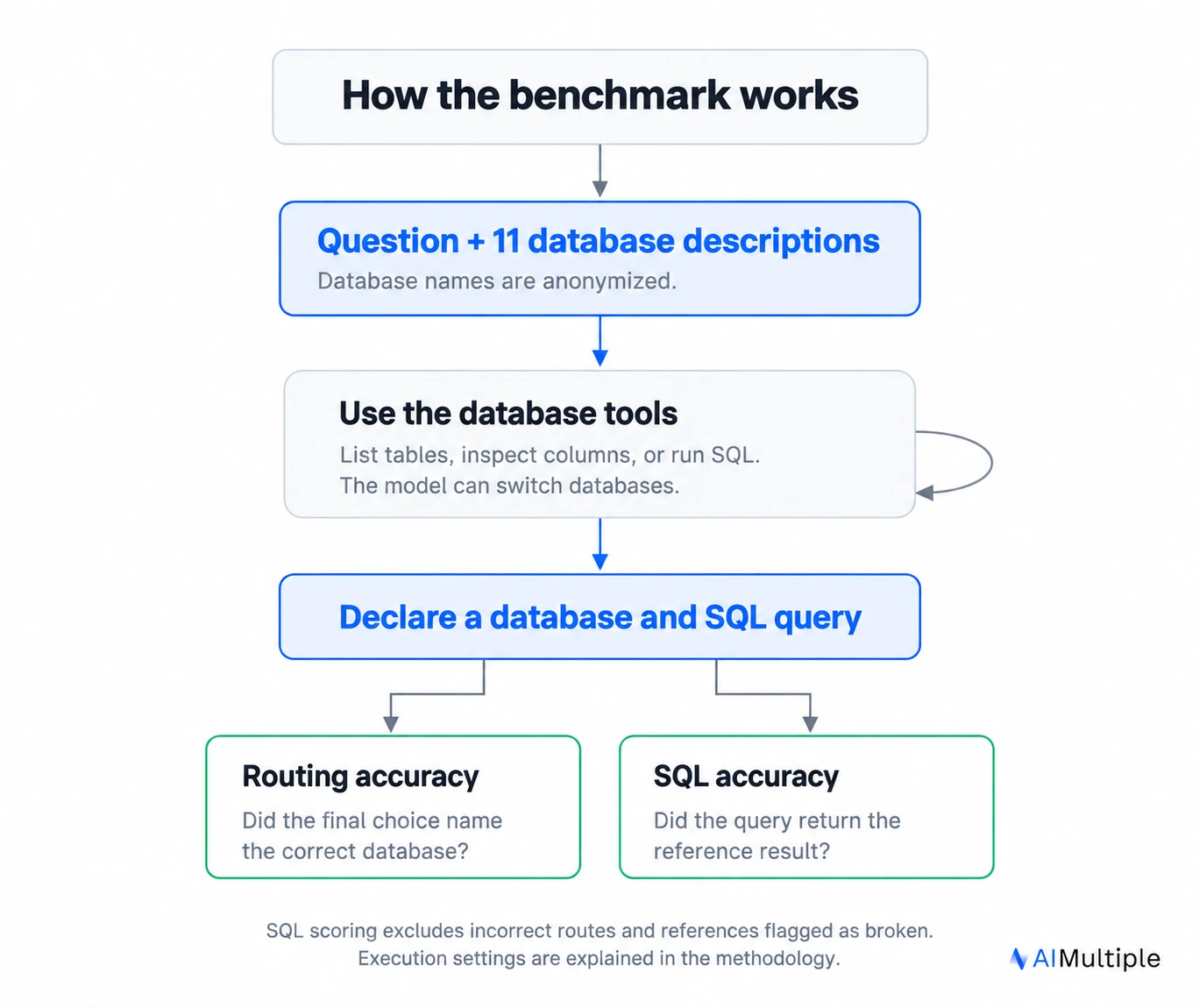
Routing accuracy is the percentage of scored questions for which the model explicitly names the correct database in its final answer. The headline uses the 184 questions flagged as difficult by both our similarity test and a jury of three LLMs. Missing explicit declarations receive no credit.
Database routing findings
Opus 5.5 recorded the highest routing accuracy at 90.2%
claude-opus-5.5 selected the correct database for 166 of 184 hard questions. claude-sonnet-5.5, gemini-3.7-flash and qwen3.8-max-0902 each recorded 85.3%, sharing the highest API score. Opus 5.5 led across all questions at 96.6% (733 of 759).
DeepSeek V4 Flash 0731 recorded 82.1% routing accuracy at $1.37
DeepSeek V4 Flash 0731 answered 151 of 184 hard questions correctly. Its retained responses across all 759 questions cost $1.37. Qwen3.8 Flash scored 79.3% at $2.08, while MiMo-V2.6-Pro reached 82.6% at $4.17.
These costs sum the successful responses retained in each result file. Failed and replaced retry attempts are excluded. These totals depend on the providers and caching conditions used during measurement. CLI runs with subscription costs or unreported costs are excluded from the cost chart.
Grok 4.6 gained 41.8 points after its first database choice
Grok 4.6’s hard-question routing accuracy rose from 38.0% on its first probe to 79.9% on its final declaration. GPT-6 Sol Pro gained 34.2 points within its run. Nova Lite lost 14.0 points.
These changes use questions with a single database on the first turn. They describe recorded trajectories. No separate intervention isolated the benefit of extra calls.
Across all 72 models, 7,085 hard-question records included a database switch:
This table takes the first database in recorded call order, including multi-database first turns. Final credit requires an explicit correct declaration. The percentage-point changes above use the narrower single-first-choice subset.
Database routing results
Models are sorted by routing accuracy, highest first. The methodology identifies differences in the software used to run them. These conditions matter when interpreting small score gaps.
The intervals estimate question-sampling uncertainty. Recorded costs cover the successful records in each run. They reflect the providers and caching conditions used at the time of measurement.
Conditions affecting database selection
Similar databases reduced routing accuracy by about 20 points
We tested the database selection method in a separate experiment on 128 questions. Each question kept its correct database, while the other 10 candidates came either from our selected group or from a random draw.
On the hard subset, claude-opus-4.8 scored 71.3% with similar candidates and 92.0% with random candidates. gemini-3.5-flash scored 77.0% and 96.6%. Both differences had p-values below 0.001 in paired tests.
This experiment used descriptions and one model response per question, without the agentic tool loop. It supports the narrower finding that selecting similar candidates makes database choice harder. The measured gap should not be presented as the effect of agentic exploration.
Names alone produced 68.8% and 71.1% accuracy in a pilot
In another 128-question pilot, claude-opus-4.8 selected the right database 68.8% of the time from names alone. Its score with names and descriptions was 67.2%. gemini-3.5-flash scored 71.1% from names and 75.0% from the full catalog.
Names such as california_schools and toxicology reveal the subject directly. For the main benchmark, we replace database names with aliases from db_01 to db_11. Descriptions still explain each database’s domain, and tool responses expose its table and column names.
Reliability of routing and cost comparisons
Repeat runs changed routing accuracy by 1.6 to 2.7 points
claude-opus-5 selected the correct database for 156 of 184 hard questions on its first run and 151 on its repeat. Its accuracy fell from 84.8% to 82.1%. qwen3.8-max moved from 153 correct answers to 150, a decline from 83.2% to 81.5%.
Both repeats used the same questions, anonymization, temperature and provider settings as their original runs. qwen3.8-max changed its answer on 13 hard questions even though its total moved by three. Improvements on some questions canceled errors on others.
These repeats show that small score gaps can disappear on another run. One repeat per model cannot establish a distribution of outcomes, and the other 35 models have no repeat measurement.
Recorded costs depend on provider and caching settings
Prompt caching reuses previously processed input to reduce billed input costs. The claude-opus-5 run cost $62.78, compared with an estimated $105.54 at uncached list rates for the same recorded usage. That estimate implies a 40.5% saving. It is an accounting comparison, without a separate uncached accuracy run.
Agentic RAG and database selection
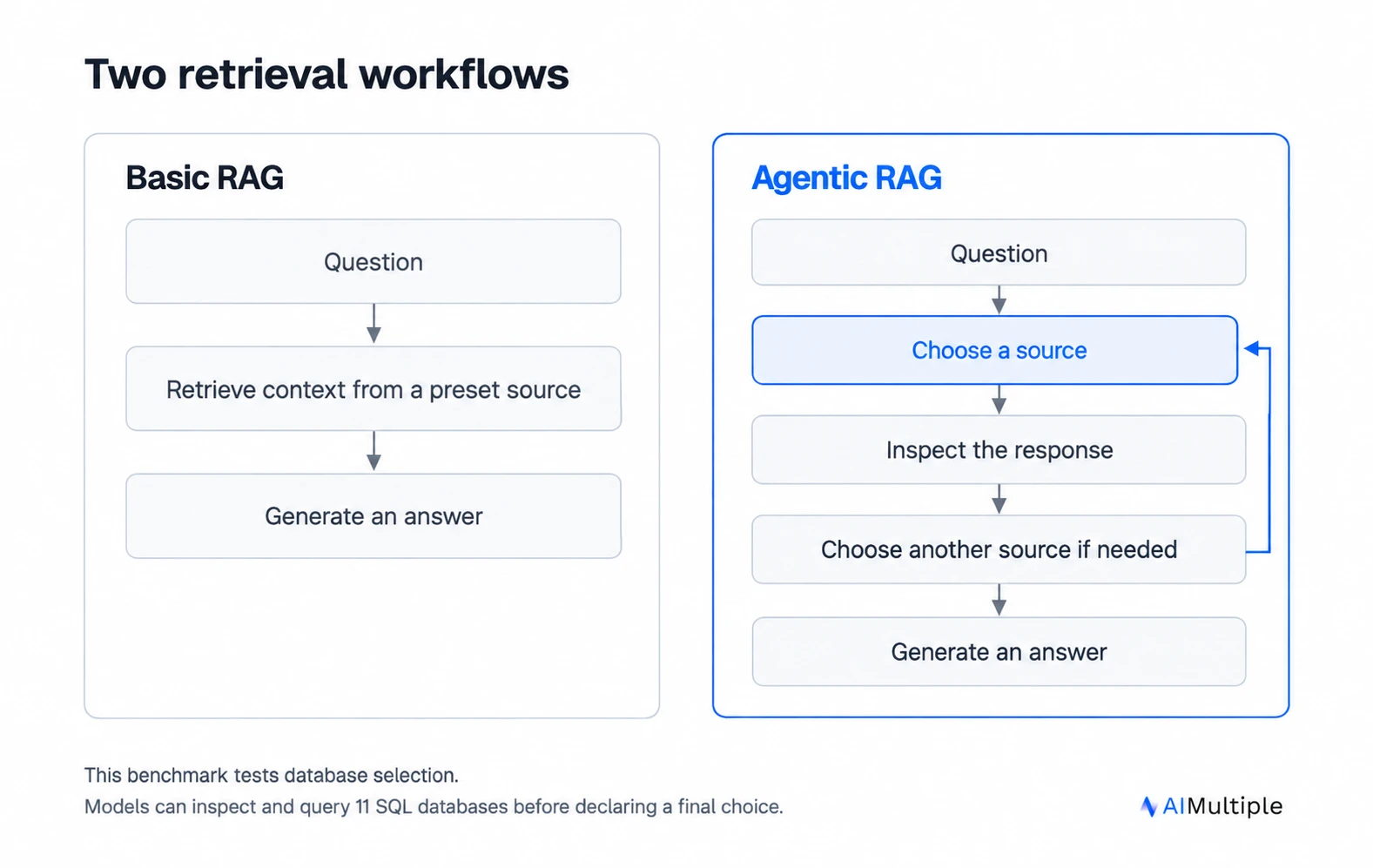
Agentic RAG gives a model control over retrieval decisions. It can choose a source, inspect the response and make another request. A simple RAG pipeline retrieves context through a predetermined sequence before generating an answer.
This benchmark tests source selection through SQL database tools. It contains no document index, retrieved passages or answer-grounding score. Results therefore describe one part of an agentic retrieval system. Document search is covered separately in our agentic search benchmark.
A model starts with short database descriptions. It can request table lists, inspect columns, run SQL and change databases. Its final response contains a database choice and a query. Our text-to-SQL benchmark reports SQL accuracy and two supplementary review scores.
Decision models for database routing
We compared Jev, Kev-9B, Laya English and six LLMs on 243 reviewed questions from the same 11 databases. Each model selected a database from supplied descriptions.
Laya ran locally on an Apple M4. Kev ran on a dedicated A100 service accessed through an SSH tunnel. The other models used hosted APIs. Latency includes the complete client request among valid responses. Accuracy includes every attempted question.
Jev selected the correct database for 240 of 243 questions, compared with 123 for Laya English: 117 more correct selections, a 48.1-percentage-point difference. Jev was the fastest hosted model by median latency in this run. Laya’s local deployment had the lowest median latency overall, alongside substantially lower accuracy.
Kev-9B selected 236 databases correctly, four fewer than Jev. Five of its seven errors involved the fuel debit-card database. Its median response took 952 ms including the network and SSH tunnel. The separately recorded server median was 470 ms. This A100 deployment used FP32 and reference kernels. Its speed depends on that serving configuration.
Gemini 3.8 Flash and Claude Opus 5 both selected the correct database for every question. Opus took 1.72 times as long at the median and its reported API cost was 7.58 times Gemini’s for these questions. Accuracy was equal for these two models on this set.
DeepSeek’s result includes 19 service or output failures: 16 HTTP 429 responses, two responses that broke the required single-alias format, and one exhausted output budget. It selected the correct database in 211 of its 224 valid responses, or 94.2%. Counting all attempts gives the 86.8% shown in the chart and table.
Routing costs: API pricing and hardware estimates
Jev selected the correct database for 98.8% of questions at an API cost of $0.0337 per 1,000 routing attempts. Qwen3.8 Flash recorded 97.9% accuracy at $0.0791, while Gemini 3.8 Flash reached 100.0% at $0.5337. We scaled costs from the same 243-question workload, including incorrect answers and excluding warmups. Jev’s API cost was about 1/120 of Claude Opus 5’s for the same 243 routing attempts.
Laya’s hardware estimate was $0.0141 per 1,000 attempts at 50.6% accuracy. Kev reached 97.1% at an estimated $0.1250. Both estimates assume that the rented machine continuously processes requests. At 10% utilization, each request carries ten times the rental cost, raising Laya to $0.1405 and Kev to $1.2503 per 1,000 attempts.
For the five LLMs with complete charge records, we divided reported API charges by 243 and multiplied by 1,000. Jev charges $0.042 per million input tokens, with free output tokens. Its 194,882 recorded input tokens cost $0.008185 across 243 attempts, or $0.0337 per 1,000.1
Hardware cost per 1,000 attempts equals hourly rental price × mean processing seconds × 1,000 ÷ (3,600 × utilization). Laya averaged 0.2006 seconds per request on an Apple M4. Kev averaged 0.4734 seconds on the A100 server, excluding network and SSH delay. We applied those times to matching hardware at the quoted providers. Performance and billing totals at those providers remain unmeasured.
For Kev, we used $0.9508/hour for one A100 SXM 80 GB at Vast.ai, the lowest matching on-demand listing in our GPU rental price index data.
For Laya, we used Scaleway’s M4-S with 16 GB memory at €0.22/hour. The conversion uses the ECB’s 22 September rate of $1.1463 per euro. Scaleway requires a 24-hour minimum lease, making the minimum rental €5.28, or about $6.05, even for a short job.234
Laya’s model page listed no Hugging Face Inference Provider. Our estimate covers renting a machine and running the model on it. Setup time, storage, network extras, taxes and operations labor are excluded from both hardware estimates.5
How decision models choose a database
For Jev and Laya, the application supplies the context, a question and named options with descriptions. Their Choice interfaces return a selected option, probabilities over the options and a confidence score. Application code decides what to do with that result. For routing, the options are database aliases such as db_03 and db_07.65
This format makes the output easy to use in code. A model can still choose the wrong database. A high confidence score also needs validation against observed correctness before an application uses it to skip review or trigger a fallback.
Laya’s English checkpoint uses a bidirectional ModernBERT encoder with a decision head that scores the supplied options. The option descriptions arrive with the request, so the application can change its available choices. Jev exposes a hosted Choice API. Its documentation places workflow control and actions in application code. The shared interface does not establish that the two models have the same internal architecture.57
Kev-9B uses a LoRA adapter and a pointer head on Qwen3.5-9B-Base. It scores the supplied choices and returns their probabilities without generating answer text. We used its compatible Choice endpoint with the same question and database descriptions.8
 Add as preferred source
Agentic RAG benchmark methodology
The question set is a frozen subset of BIRD-SQL, which pairs natural-language questions with SQL reference queries.9
Two signals define difficulty. The similarity test counts how many of a question’s 20 nearest neighbors belong to other databases. Three LLMs assess whether the question is confounding across databases. Membership in the hardest group requires at least five cross-database neighbors and a confounding jury label.
Routing uses the database named under the explicit selected_database field. A route inferred from prose is excluded from the headline. SQL correctness is scored separately and does not determine routing credit.
The harness is the software that presents tools and records model responses. The panel contains 64 OpenRouter runs, two Claude Code runs and one Codex CLI run. Among the API runs, 47 used v3, 15 used an earlier version, and two combined records from both versions. In v3, a recovery layer parses supported alternative tool-call formats. For llama-4-maverick, the recorded non-native format share was 97.9%, so that result depends heavily on the adapter. minimax-m2.7 was excluded because it did not issue the database tool calls required by the task.
GPT-6 Astra ran inside Codex CLI. Opus 5.5 and Fable 5.1 ran through Claude Code. All three used medium reasoning effort and completed 759 questions. Claude Code runs used subscriptions. Their reported list-price equivalents are excluded from the API cost comparison. Astra reported no dollar cost. The GPT-6 Luna, Luna Pro, Sol and Sol Pro runs and GPT-5.2 used OpenRouter.
Decision-model routing benchmark
The separate routing experiment used 243 unchanged questions selected from 394 candidates after reserving 17 development questions. One Codex review, with source labels visible, assessed whether the question and catalog provided enough information to select a database. It excluded 151 candidates, including 139 of 178 carrying the original hard label. The final set contained 204 originally easy and 39 originally hard questions. Those difficulty labels were not revalidated for this task, and selection was not a blind held-out evaluation.
Four database descriptions were corrected using source schemas and question text before collecting the measured predictions. The other seven retained their compact descriptions. Every model received the same question, 11 aliases and descriptions, and option order for that question. Reference SQL, source labels and supplementary evidence were withheld. Jev and Laya used their native Choice interface. The LLMs were instructed to return one alias. Models had no database tools.
We ran Jev 1.13.0 through its hosted API and the pinned Laya English checkpoint locally with Apple M4 MPS, 16 GiB memory and four Torch threads. Laya’s 404-token context-head limit and 48-token option limit produced no input truncation. Six LLMs ran through OpenRouter with fixed providers and reasoning settings. Requested reasoning was low for Gemini 3.8 Flash, minimal for Gemini 3.5 Flash Lite and high for Opus. It was disabled for DeepSeek, Qwen and Haiku. Each model had one excluded warmup, one request in flight and no retries. Model submission order rotated between questions.
Kev-9B was added on 22 September in a separate run, preserving the original eight results. Its 243 request payloads matched the original Jev inputs exactly, including option order. We pinned checkpoint revision 2629c06a and used an A100 SXM 80 GB with FP32, SDPA attention and unmerged LoRA. Date preprocessing and prefix caching were off. After checking the API on the 17 reserved development questions, we ran one excluded warmup and 243 serial requests with no retries. The service was reserved for our use. Every response confirmed that the full input was retained. Server timings include tokenization and synchronized inference. The chart uses client timings, including SSH and network overhead.
Accuracy divides correct, valid choices by all 243 planned questions, including service and output failures. Median latency measures the complete nonstreaming client request among valid responses, excluding warmup. Reported LLM API costs cover the measured requests. The cost analysis combines API costs with labeled hardware estimates. Rental billing totals were not measured. The comparison describes this curated set and these deployment conditions. Public source data, description revisions, reviewer judgment, different measurement dates and the absence of repeats limit generalization.
Limitations
The hard subset concentrates on commerce. Four databases contribute 171 of its 184 questions, or 92.9%. Five of the 11 databases contribute none. This supports conclusions about choosing among similar databases within a domain, with limited evidence for other domain combinations.
Public benchmark data may have appeared in model training. Controls using 138 validated paraphrases and 65 newly authored questions found no accuracy decline in the tested lower-cost models. Their coverage was limited to six and three databases respectively. They do not resolve contamination for the full panel, and no control used databases released after the models’ training cutoffs.
Schema truncation can hide useful tables. In works_cycles, the 4,000-character limit leaves 26 of 66 tables visible in the initial schema listing. The model can request further details, but the initial view is incomplete.
Conclusion
claude-opus-5.5 recorded the highest hard-question routing score at 90.2%. claude-sonnet-5.5, gemini-3.7-flash and qwen3.8-max-0902 each recorded 85.3%, sharing the highest API score. DeepSeek V4 Flash 0731 reached 82.1% with $1.37 in retained-response costs across the full run.
Execution setup, retries and provider pricing limit comparisons. These results measure database selection among similar SQL sources. Document retrieval and grounded answer generation require separate evaluations.
Further reading
- Text-to-SQL: Comparison of LLM Accuracy
- RAG Frameworks: LangChain vs LangGraph vs LlamaIndex
- Best RAG Tools, Frameworks, and Libraries
- Agentic Search in 2026: Benchmark 8 Search APIs for Agents
Cite this benchmark
Pick the format that matches where you're publishing. Pasting the link version into your CMS preserves the backlink.
@misc{sari2026,
  author = {Sarı, Ekrem},
  title  = {{AIM-Agentic RAG Benchmark: Routing Across 11 SQL Databases}},
  year   = {2026},
  month  = oct,
  howpublished    = {\url{https://aimultiple.com/agentic-rag}},
  note   = {AIMultiple. Retrieved October 1, 2026}
}Results and timestamps of 542 data points. Download the summary data shown in this article's charts and tables as a ZIP file containing 7 CSV files and a README.
Want the granular data behind it? Join Premium
Changelog
16 updatesUpdated the 'What makes a question hard in this benchmark?' section with new content.
Updated the methodology to clarify how the hardest questions are distributed across databases.
Replaced the Agentic RAG benchmark methodology section with a new one that covers 36 LLMs and 11 databases.
Added new models to the benchmark: Claude Fable 5, Claude Opus 4.8, Gemini 3.5 Flash, Grok 4.3, Claude Opus 4.7.
Updated the methodology section with new details on database environment, agent architecture, and evaluation process.
Added a section on long-context models versus agentic RAG.
Removed additional agentic metrics from the methodology.
Reference Links


Be the first to comment
Your email address will not be published. All fields are required. Comments are left in their original language.