

Top 8 Network Segmentation Tools

Traditional network segmentation approaches usually depend on the manual setup and oversight of firewall policies. To overcome these obstacles, organizations may also embrace more sophisticated segmentation strategies by using microsegmentation tools and the Zero Trust framework.
We analyzed network segmentation platforms based on features, deployment flexibility, and verified user reviews. The tools below represent the top options across hardware-based, software-defined, and cloud-native segmentation approaches.
The best network segmentation tools
FireMon
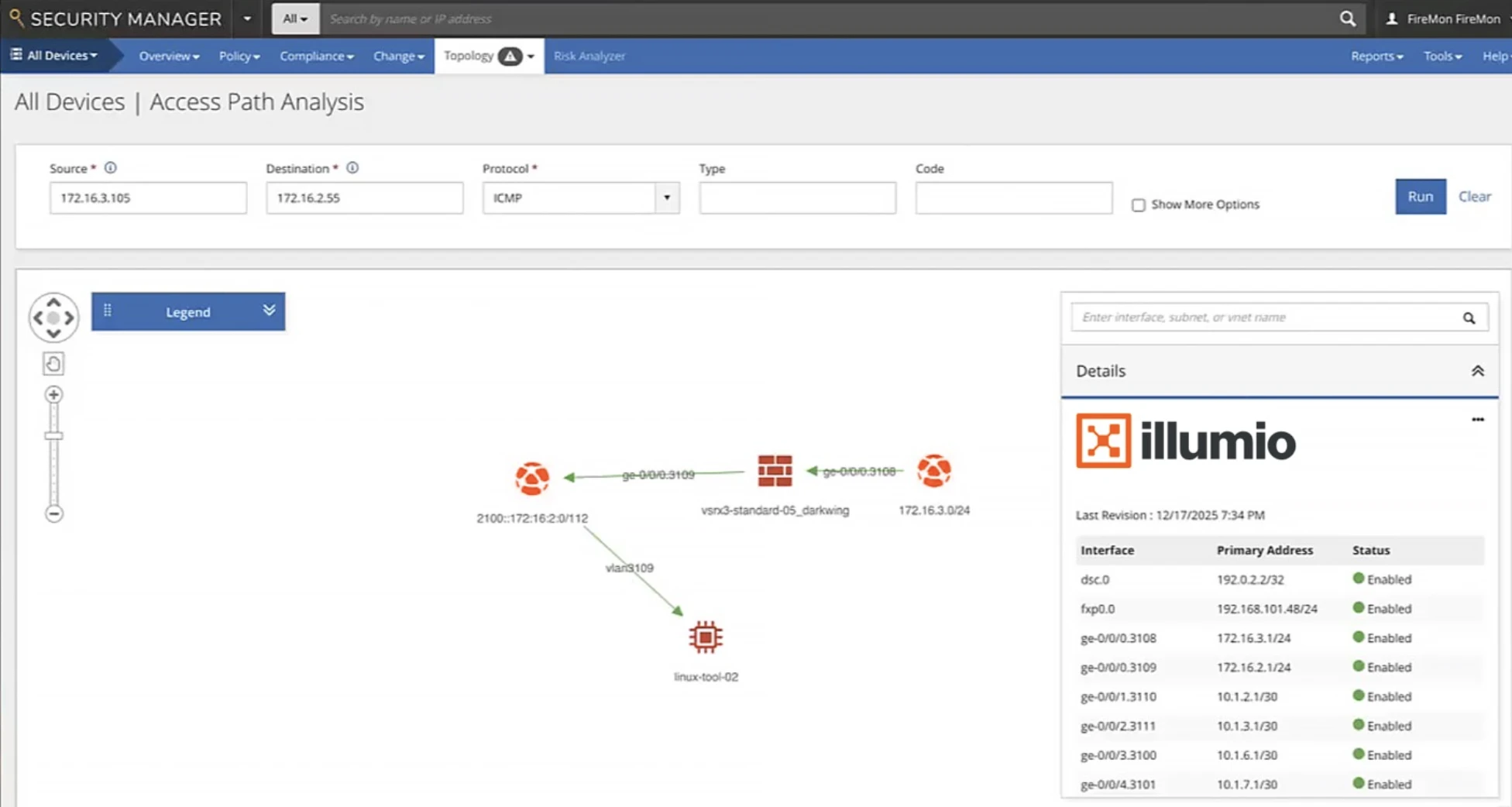
FireMon is a network security policy management platform that provides governance and continuous validation of segmentation policies across multi-vendor firewall environments, cloud, and microsegmentation platforms.
Rather than acting as an enforcement layer itself, FireMon sits above existing segmentation tools, including Illumio and VMware NSX, and ensures that the policies they enforce remain accurate, compliant, and aligned with intent over time. As segmentation environments grow, policy drift and misconfigurations accumulate; FireMon’s role is to detect and remediate those gaps before they become exploitable paths.
Key features:
- Zero Trust microsegmentation governance: Moves Zero Trust beyond initial deployment into continuous, verified control of segmentation rules across network, cloud, and host layers.
- Risk Analyzer: Correlates vulnerability data with network access paths to identify which exposures are actually reachable, prioritizing remediation by real risk rather than severity scores alone.
- Policy Planner: Automates change workflows with built-in risk assessment before policy changes are deployed to firewalls or segmentation platforms.
- Policy Manager: Real-time network security policy management with automated compliance reporting and rule optimization across multi-vendor environments.
- Cloud Defense: Extends policy governance to AWS, Azure, and GCP environments.
- Integrations: Connects with ITSM, SIEM/SOAR, vulnerability scanners, and microsegmentation platforms including Illumio.
Tufin
Tufin is a cloud-hosted network security platform specializing in managing network security policies. It enables the integration of network security management with the protection of cloud services across a hybrid virtual network.
Tufin can be implemented in various environments, including on-site, entirely in the cloud, or through a hybrid approach that blends on-site and cloud elements.
Key features:
- Visibility: Tufin offers insight into network traffic and security settings by directing all packets to their intended destinations or preventing their passage. This solution can be installed on-site or utilized as a cloud-based SaaS offering.
- R25-2 feature: AI-assisted policy insights and broader unified visibility; Tufin’s R25-2 notes also state that TOS can now monitor Akamai Guardicore in both on-premises and SaaS environments.
- Automated network discovery & traffic flow mapping: The vendor uses network management tools to identify all connected network devices and servers, as well as the connections between them. After detecting the devices, including routers, switches, servers, and workstations, the network segmentation software creates a network topology map.
Cisco Secure Workload
Cisco Secure Workload, formerly known as Cisco Tetration, is a zero-trust microsegmentation solution that protects workloads across on-premises data centers, public clouds, and private clouds.
Key features:
- Cisco Secure Workload SaaS release: The release adds broader Azure discovery and operations coverage, including Azure load balancers, private link/private endpoint services, Azure SQL servers, Azure Functions, tag-based filtering, and backup/restore for Azure network security groups.
- Flexible deployment options: Cisco Secure Workload offers Software as a Service (SaaS) and hardware-based appliance models. The SaaS package allows organizations to reduce the need for on-premises hardware maintenance.
- Zero Trust Segmentation: It is a cybersecurity approach that operates on the premise, ensuring that each access request is authenticated and authorized.
- Network security alerts: When potentially malicious activities are detected within a network, network security systems produce notifications. These alerts serve to safeguard network resources, prevent data breaches, security threats, and protect sensitive data.
VMware NSX
VMware NSX is a platform for software-defined networking (SDN) and security, offering a range of security capabilities including micro-segmentation and network access management. It delivers a virtualized networking layer, decoupled from the underlying physical infrastructure.
NSX employs sophisticated threat prevention mechanisms like intrusion detection systems (IDS/IPS), Sandboxing, and network traffic analysis/network detection and response (NTA/NDR) to safeguard against harmful threats and ransomware attacks.
Key features:
- L2-L7 Network Stack: Refers to the layers 2 to 7 in the OSI (Open Systems Interconnection) model, where each layer is tasked with a distinct function in the management of network communications.
- Distributed Firewall: Implements firewall capabilities and rules with precision across various network segments. In contrast to conventional, centralized firewalls that primarily protect the network’s outer edge, distributed firewalls are integrated throughout the network’s infrastructure. This method enables a more adaptable and thorough approach to network security.
- Multi-Site Networking and Security: This method encompasses the planning, deployment, and oversight of networking infrastructure and security protocols across various geographic locations.
Illumio
Illumio offers a cloud-based platform that specializes in Zero Trust Segmentation, enabling a security model adaptable to a range of environments including on-premise data centers, and both private and public clouds.
Illumio Segmentation leverages workload context to apply consistent security policies across computing environments.
Illumio added a policy perspective externalization capability, allowing policy-perspective data to be stored in Azure Blob Storage or AWS S3 for shared access across nodes; Illumio’s 26.1 notes also document performance improvements, including faster rule-overlap checks.
Key features:
- Zero-trust micro-segmentation: This approach combines the principles of Zero Trust (never trust, always verify) with the practice of micro-segmentation (dividing the network into smaller segments).
- Communication visualization: Illumio network segmentation solution enables organizations to visualize all communication and network traffic flows between workloads and network devices.
- Continuous monitoring: Constant monitoring of IT infrastructures and networks is crucial for identifying potential security risks, operational inefficiencies, or regulatory non-compliance.
AlgoSec
The AlgoSec platform facilitates the implementation of security policies across hybrid networks, including cloud services, software-defined networking (SDN), and traditional on-premises infrastructure.
AlgoSec released its Security Management Solution, which introduces the Algo AI bot, broader AWS/Azure/GCP support, Google Cloud Network Firewall Policy work-order recommendations, Strata Cloud Manager visibility, and new compliance mappings, including NIS2 and SOC 2.
Key features:
- Cloud-native Application Protection Platform (CNAPP): AlgoSec implements CNAPP strategy to identify configuration and infrastructure-as-a-service (IaaS) network risks.
- Multiple deployment models: The platform provides a variety of deployment options, including on-premises, cloud-based, and hybrid environments to cater to diverse IT infrastructure needs.
 Add as preferred source
Faddom
Faddom is an IT asset documentation platform that offers network discovery capabilities. It focuses on Application Dependency Mapping (ADM), delivering insights for ensuring compliance and aiding in the transition of data centers and cloud migrations through the detailed mapping of application structures.
Faddom’s IT Infrastructure Mapping tool identifies and visually represents an organization’s IT infrastructure components, including servers and storage devices, enabling a thorough understanding and management of IT assets.
Key features:
- Microsegmentation planning: Microsegmentation is a network security strategy that divides a network into smaller, distinct zones to enhance control over data flow. This approach is instrumental in defending against the unauthorized spread of threats within a network by limiting the pathways available for lateral threat movement.
- Network mapping: Network mapping, or network virtualization, involves identifying and illustrating the various components and connections within a network. This process helps in visualizing both the physical and the virtual aspects of networks, highlighting how different devices and services are interconnected. It provides a comprehensive view of the network’s structure, including its devices, connections, and how each element relates to the others.
- Network discovery: The network discovery process plays a crucial role for network administrators by enabling the identification and connection of devices within a network. This first step is essential for both mapping and tracking the network’s infrastructure, thereby enhancing the management of the entire network system.
- Vulnerability (CVEs) detection: CVE detection involves recognizing and cataloging cybersecurity vulnerabilities and exposures that have been publicly disclosed. This process entails maintaining a list of known security vulnerabilities affecting software or hardware. Each vulnerability listed is allocated a distinct CVE ID, facilitating uniform monitoring and discussion across different security platforms and systems.
Akamai Guardicore Segmentation
Akamai Guardicore Segmentation is a network segmentation platform designed to enhance network security through advanced segmentation. It is available both as a SaaS offering and a network appliance, catering to diverse environments like data centers, multiclouds, and endpoints.
Akamai’s network segmentation solutions use software-defined networking and micro-segmentation to effectively block unauthorized lateral movements within networks, ensuring granular control over individual processes.
Key features:
- Data collection methods: Guardicore Centra employs a diverse method for gathering data from cloud service providers, including agent-based sensors, network-based data collectors, and virtual private cloud (VPC) flow logs. This collected data undergoes processing and contextualization through an automated labeling process. Guardicore Centra’s labeling procedure integrates with the organization’s existing data sources like configuration management databases.
- Dynamic visual map: It offers a real-time graphical depiction of the network infrastructure, constantly refreshed to reflect any changes. This dynamic visual map offers administrators an intuitive way to swiftly detect new devices or security risks as they arise.
- Policy-based segmentation: It involves dividing a network into separate segments according to predetermined rules and policies. This approach monitors the performance of the network segmentation policy and enables organizations to customize their network security protocols to adhere to specific compliance standards.
Check Point CloudGuard Network Security
CloudGuard Network Security is a cloud-native security platform, providing threat protection and automated security for cloud networks. It allows administrators to enforce network segmentation policies, including network firewalls and other security measures.
Key features:
- Automated network security supports: Supports IaC, CI/CD practices, and automation of network security processes using APIs across different segments of a network to ensure continuous compliance.
- Unified security management: Unified Security Management (USM) provides a comprehensive view of an organization’s security posture by integrating security technologies, such as intrusion prevention systems (IPS), legacy firewalls, and vulnerability scanners.
- Multi-layered security controls: Multi-layered security involves the deployment of various security measures across different points in the IT infrastructure, specifically tailored for virtual data centers and Network Function Virtualization (NFV).
Check Point’s on-premises Quantum firewalls support network segmentation through Security Zones. Security Zones are logical groupings of network interfaces, enabling administrators to control traffic between different segments.1
In large deployments, these gateways can be clustered for high availability and throughput, applying multiple layers of inspection on each traffic flow. Such hardware firewalls complement Check Point’s CloudGuard Network Security by enforcing zone-based isolation and security policies in traditional data center environments.
What is a network segmentation tool?
A network segmentation tool is network security software or hardware that divides a network into smaller, distinct segments or subnetworks. This allows teams to improve network security, performance, and management by segmenting network traffic and restricting access to designated network segments.
Cite this research
Pick the format that matches where you're publishing. Pasting the link version into your CMS preserves the backlink.
@misc{karatas2026,
  author = {Karatas, Gulbahar and Sezer, Sena},
  title  = {{Top 8 Network Segmentation Tools}},
  year   = {2026},
  month  = jul,
  howpublished    = {\url{https://aimultiple.com/network-segmentation-tools}},
  note   = {AIMultiple. Retrieved July 27, 2026}
}
Changelog
4 updatesAdded Check Point's Quantum firewall Security Zones feature to the multi-layered security controls section.
Added FireMon as a new vendor entry in the best network segmentation tools section.
Removed the 'Important security software to combine with network segmentation tools' section.
Reference Links





Be the first to comment
Your email address will not be published. All fields are required. Comments are left in their original language.