


RPA Pricing Compared Across Leading Vendors

We reviewed leading RPA pricing in detail to identify the lowest RPA vendor license fees:
- Open source RPA tools have no license fees
- Microsoft Power Automate and Argos Labs offer the lowest license fees among proprietary software for specific usage levels.
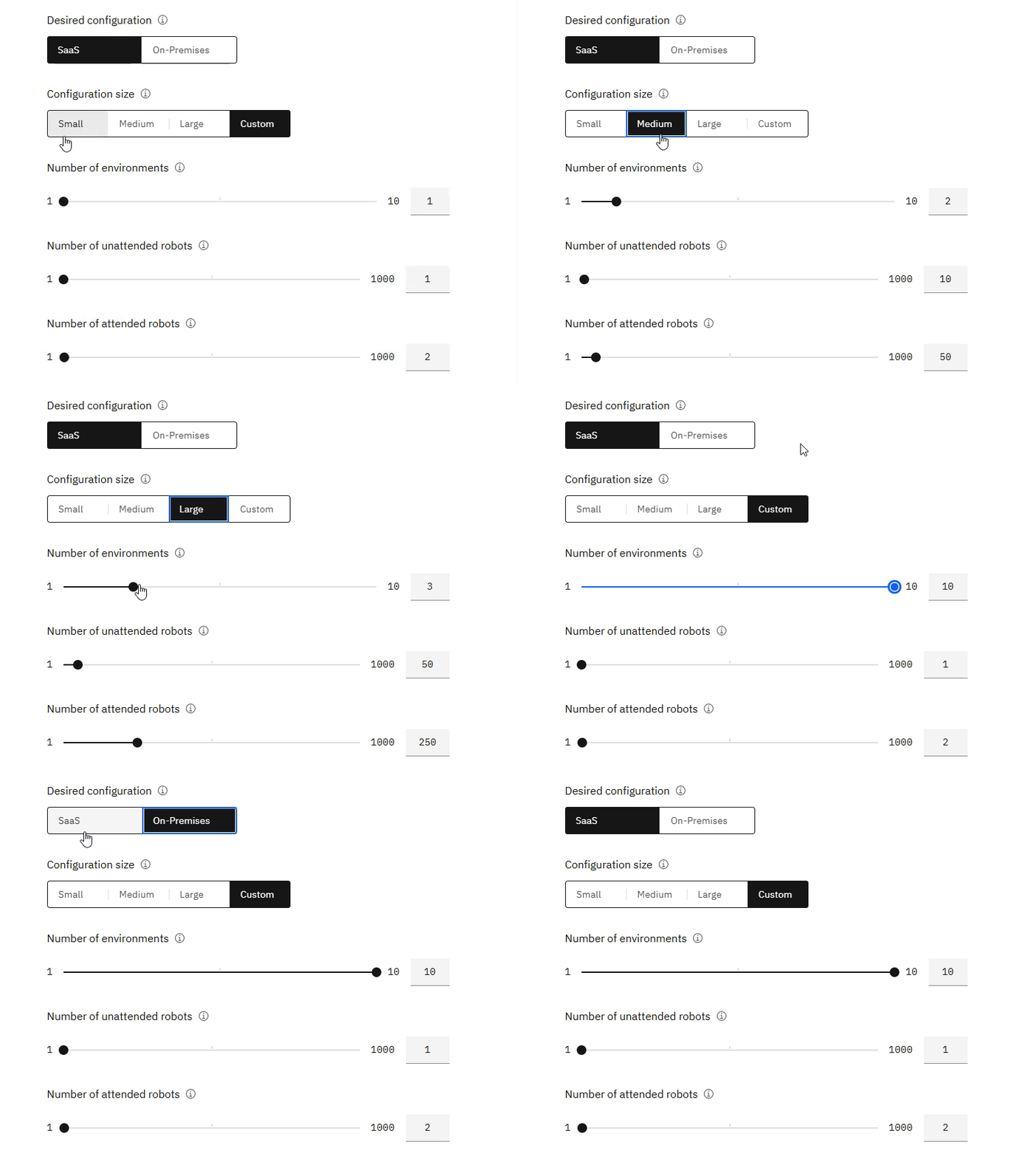
See license costs of market-leading solutions for different scenarios with different numbers and types of licenses:
RPA pricing calculator
Note: We based price estimates on public, verifiable data. Therefore unpublished volume discounts are not included above. If a price point was not available, we extrapolated it based on publicly available information. Specific data and assumptions for each vendor:
Argos Labs: The estimated monthly price is based on an annual cost of $6,000, which includes licenses for a developer and 3 users.
IBM: Assumed that 1 environment would be used. Starting price of its basic plan includes 1 unattended and 2 attended bots.1
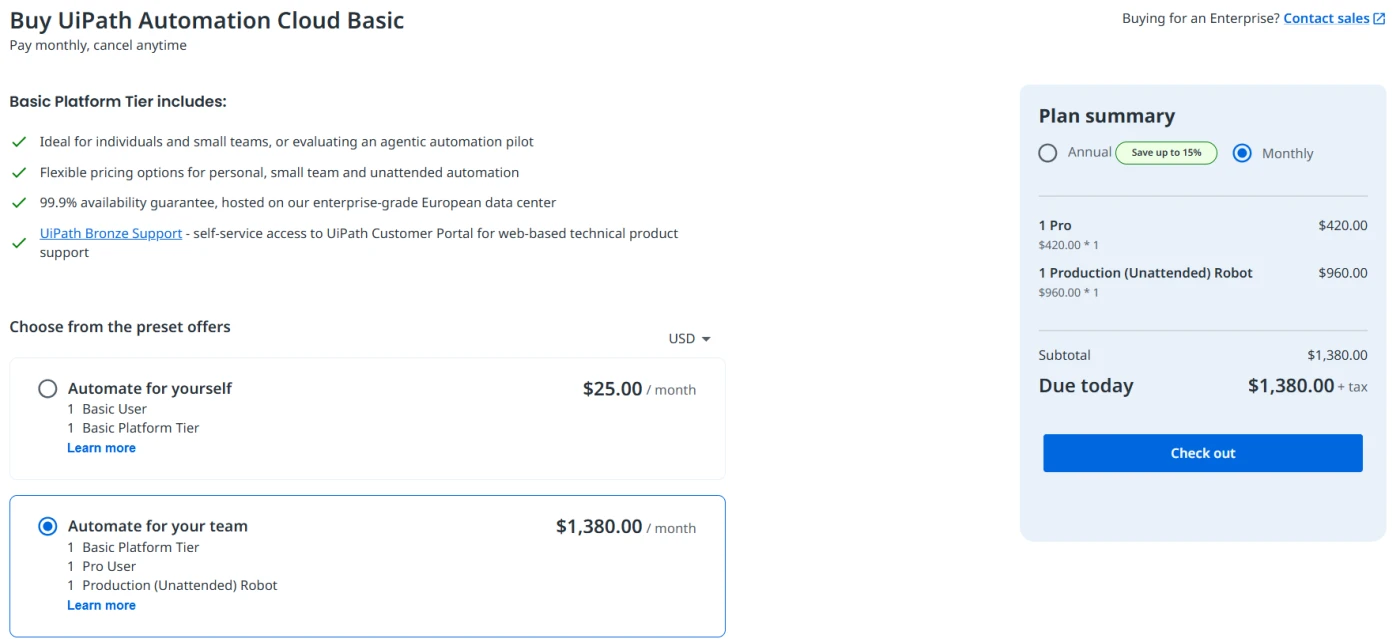
UiPath: 1 unattended bot and 1 attended bot cost $1,380/month.2
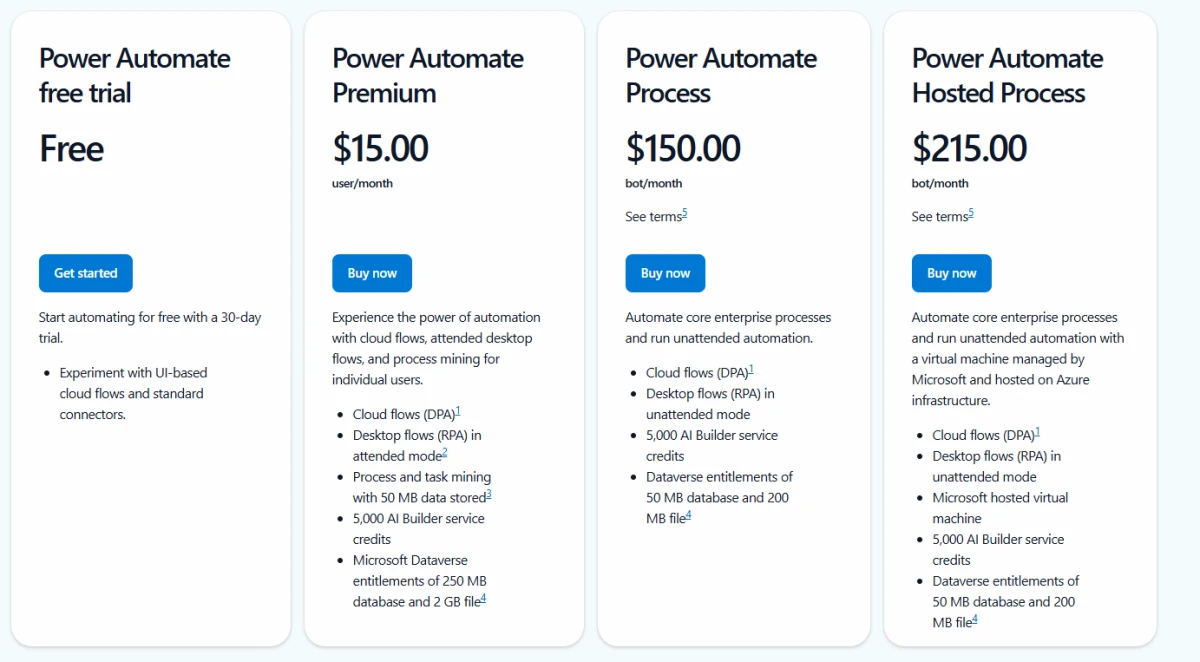
Microsoft Power Automate: We assumed that all employees are either users or their data need to be accessed by bots. So, every employee needs a license. This means volume is based on the total number of employees, who are developers and end users. The price per user is $15/month for attended RPA, and $150/month to purchase the Power Automate Process package which includes unattended automation.34
IBM
The basic package includes:
- 2 attended bots
- 1 unattended bot
- 1 RPA Studio for bot development
- OCR (optical character recognition) & IVA (interactive virtual agent) functionality
IBM has a cost calculator for a wide range of bot volumes.
UiPath RPA
UiPath’s pricing depends on the:
- Number of bots
- Automation Cloud Robots
UiPath offers two packages for SMEs:2
- Pro package: 1 license, 1 attended bot, 1 unattended bot, 1 action center, and 1 orchestrator costing $1,380/month.
- Enterprise package: 100 licenses, an undisclosed number of bots, along with Pro’s offerings and more.
Microsoft’s Power Automate (PA)
Microsoft PA’s pricing depends on:5
- Number of users (both active developer users and those who interact with the bots)
- Number of end-users and users whose data is accessed by the bot
- Number of bots (i.e. flows in Microsoft lingo) but this applied to unattended bots
- Use of unattended bots
- Use of modules (e.g. AI Builder)
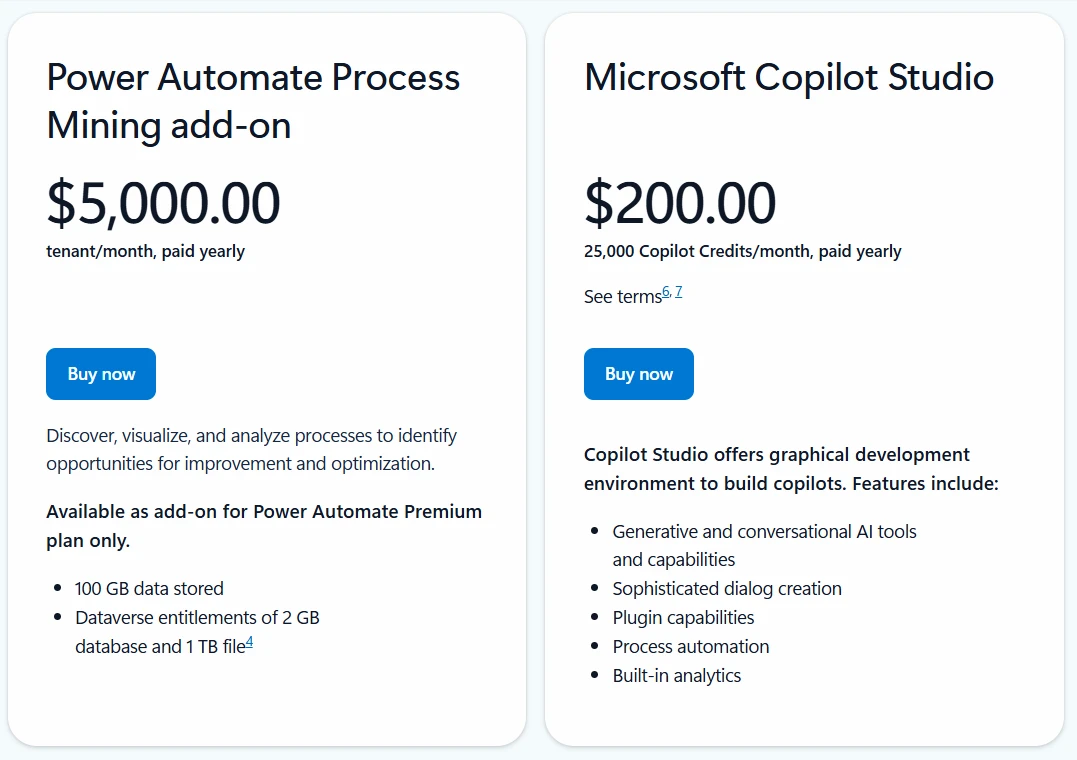
- Use of addons and modules: (e.g., AI Builder, Process Mining)
Source: Microsoft Power Platform Licensing Guide5
Source: Microsoft Power Platform Licensing Guide5
Microsoft has two other paths as well:
- Hosted Process: $215 per bot per month, billed yearly. It matches the Process plan for unattended bots (bots that run with no person present), but Microsoft hosts the machine, so a team runs RPA without its own virtual machines.
- Pay-as-you-go: $0.60 per cloud or desktop flow run, with no yearly commitment. This suits low-volume or uneven workloads, where a per-bot license would sit idle.
In addition to these, there are other cost-effective RPA companies, such as Python RPA tools. We could not include them here since they were not fully transparent with their pricing.
Argos Labs
Argos Labs’ base package annual pricing at $6,000 includes:
- 1 developer account
- 3 bots for development, testing, and deployment. One bot can automate an unlimited number of processes as long as the machine hosting the bot has the necessary resources. Therefore, the hardware limitations of the machine running the bots set the limit on how many different types of processes can be automated.
- ARGOS Supervisor, an orchestrator platform to schedule and monitor the bot execution.
Argos Lab is among the most cost effective vendors on the list for certain volumes. It offers no-code Python RPA solutions which allows citizen developers (non-technical users) and developers to collaborate. For each additional bot costs $1,200 per year.
Argos Labs also offers an extended package, including all features along with security patches, updates, and technical support for an annual price of $12,000.
SAP Build Process Automation
SAP Build Process Automation is a low-code tool for building workflows and software bots. It runs on SAP Business Technology Platform (SAP BTP), SAP’s cloud development platform, and suits teams working in SAP systems.
Pricing is public and follows a per-user, per-month model, billed yearly. Two user types set the base cost:
- Standard user: about $1.82 per user per month. This user runs and takes part in automated processes.
- Advanced (premium) user: about $15 per user per month. This user builds workflows, monitors processes, and deploys bots.
Unattended automation adds cost on top of user licenses. Bots that run on their own draw on capacity units, so the unattended bill tracks execution volume rather than a flat per-bot fee.6
Disclaimers
Potential sources of errors include changes in vendors’ pricing models or our misunderstanding of vendor pricing. Please highlight such issues in the comments or by reaching out to us.
Note that our data is for basic RPA packages. So it’s less relevant for:
- Enterprises that can earn significant volume discounts
- Individual users can rely on the limited but free community editions.
Keep in mind that the pricing we outlined may vary significantly based on:
- The number of licenses: We provided a limited number of combinations of attended and unattended bots. Different combinations can lead to drastically different costs.
- Enterprise discounts: For larger purchases or purchases by large companies, volume discounts could be applied to shared prices.
- The pricing model chosen by the buyer: For example, a company that runs unattended bots alone uses Microsoft’s Power Automate Process pricing model, with their installation priced per unattended bot and receiving a different pricing than what we outlined above, since we didn’t provide any options without attended bots.
- Distribution of attended and unattended bots: Since usually unattended bots cost more than attended bots, even small changes in distribution may change the result drastically.
- Operating environment: For example, cloud or on-premise. On-premise bots may be provided at a higher cost.
 Add as preferred source
What affects RPA pricing?
RPA pricing is not fixed. It depends on several factors:
- Deployment (cloud or on-premise)
- Setup and maintenance (consulting, infrastructure, and repair after the license)
- Number of bots (software robots)
- Type of bots (attended vs unattended)
- Number of users
- Usage level (how often bots run)
- AI and agent usage (consumption units or per-run fees for AI agents)
Because of this, the total cost of ownership (TCO) can change a lot between companies.
How AI agents are changing RPA pricing
For years, vendors charged a flat yearly fee per bot or per user. AI agents have changed the model, since an agent’s cost depends on how hard it works rather than how many seats a company buys.
Two patterns are spreading in 2026:
- Consumption pricing. A buyer pays for what runs, measured in units or runs. UiPath’s Agent Units and Microsoft’s pay-as-you-go runs both work this way.
- Outcome pricing. A buyer pays per result, such as a resolved ticket, rather than per license.
The shift is broad. Automation Anywhere has stated that AI agents force a rethink of software pricing,7 and Gartner expects 40% of enterprise software spend to move to usage or outcome-based models by 2030.8 For buyers, the effect is clear: a fixed per-bot quote no longer describes the full bill, so a cost estimate needs expected run volume and model choice.
For more on RPA
If you are interested in learning more about RPA, read:
- Top 12 RPA Software & Their Features
- UiPath Pricing: RPA Pricing Models Explained
- Top 20 RPA SAP Use Cases & Examples
FAQs
Robotic Process Automation (RPA) assists organizations in cutting operational costs by automating repetitive tasks. Through effective automation efforts, RPA enables a digital workforce to handle rule-based tasks, allowing human employees to focus on strategic activities. Calculating the correct RPA investment and understanding RPA pricing support a clearer view of expected savings.
When planning an RPA implementation, companies should consider multiple factors, including:
-Number and type of RPA bots (attended vs unattended automation)
-Deployment environment (cloud or on-premise systems)
-Frequency of usage and complexity of automation workflows
-Any additional subscription plans or add-ons (e.g., AI Builder, task mining, or process mining)
-Maintenance and ongoing support for potential RPA reconfigurations
Analyzing these aspects will help a company budget with fewer surprises.
Attended automation involves RPA bots assisting human users by automating tasks directly on their desktop, ideal for tasks requiring human oversight. Unattended automation refers to RPA bots operating independently, typically through cloud flows, performing tasks such as data processing from CSV files, executing scheduled workflows, and integrating with enterprise software without human interaction. Choosing the right mix of these automations depends on the mix of tasks a company automates.
Before starting an RPA implementation, companies can effectively analyze processes using techniques like process mining and task mining. These methods help identify the most suitable and cost-effective processes to automate, which points to the processes worth automating first, and lowers the risk of rework after launch. Proper analysis allows businesses to detect inefficiencies, make necessary adjustments, and smoothly transition tasks to their new digital workforce, minimizing the risk of significant changes post-deployment.
Cite this research
Pick the format that matches where you're publishing. Pasting the link version into your CMS preserves the backlink.
@misc{dilmegani2026,
  author = {Dilmegani, Cem and Arslan, Ezgi},
  title  = {{RPA Pricing Compared Across Leading Vendors}},
  year   = {2026},
  month  = jul,
  howpublished    = {\url{https://aimultiple.com/rpa-pricing}},
  note   = {AIMultiple. Retrieved July 2, 2026}
}
Changelog
14 updatesAdded a section on how AI agent usage is changing RPA pricing models.
Removed Fortra Automate RPA from the pricing details.
Reference Links
Cem's work at AIMultiple has been cited by leading global publications including Business Insider, Forbes, Morning Brew, and Washington Post, global firms like Deloitte and HPE, NGOs like World Economic Forum, and supranational organizations like European Commission. [1], [2], [3], [4], [5]
Throughout his career, Cem served as a tech consultant, tech buyer and tech entrepreneur. He advised enterprises on their technology decisions at McKinsey & Company and Altman Solon for more than a decade. He also published a McKinsey report on digitalization.
He led technology strategy and procurement of a telco while reporting to the CEO. He has also led commercial growth of deep tech company Hypatos that reached a 7 digit annual recurring revenue and a 9 digit valuation from 0 within 2 years. Cem's work in Hypatos was covered by leading technology publications like TechCrunch and Business Insider.
Cem regularly speaks at international technology conferences. He graduated from Bogazici University as a computer engineer and holds an MBA from Columbia Business School.





Be the first to comment
Your email address will not be published. All fields are required. Comments are left in their original language.