

Top 9 User and Entity Behavior Analytics (UEBA) Tools

As a CISO in a highly regulated industry with ~2 decades of cybersecurity expertise, I compared the top 9 user and entity behavior analytics (UEBA) tools that can help SOCs detect abnormal and potentially dangerous user and device behavior:
Feature comparison
See feature descriptions.
User and entity behavior analytics (UEBA) tools help enterprises discover modern zero-day and insider threats on their networks that would remain undetected by traditional security tools.
To detect these threats, UEBA tools use ML to create baselines for individual users and resources in a network, then use statistical analysis to identify deviations from those baselines.
These anomalous activities may indicate that an entity or a user’s account has been compromised. When the UEBA solution detects such a variation, it assigns a risk score and provides incident information and remediation suggestions.
These tools are often used alongside other enterprise security solutions such as security information and event management (SIEM), data-centric security, data loss prevention (DLP), and employee monitoring software.
Disclaimer: Insights (below) come from our experience with these solutions as well as other users’ experiences shared in Reddit 1, Gartner 2, and G23.
1. SIEM tools with UEBA
Relying exclusively on SIEM tools leaves gaps. Attackers using valid credentials obtained through phishing or brute-force attacks may go undetected by rule-based systems.
UEBA fills that gap by analyzing authentication patterns and comparing current events to historical and peer baselines, catching logins from unusual locations or devices.
Benefits of integrating SIEM with UEBA:
- More data sources
- More accurate analysis
- More actionable alerts
- More efficient incident response
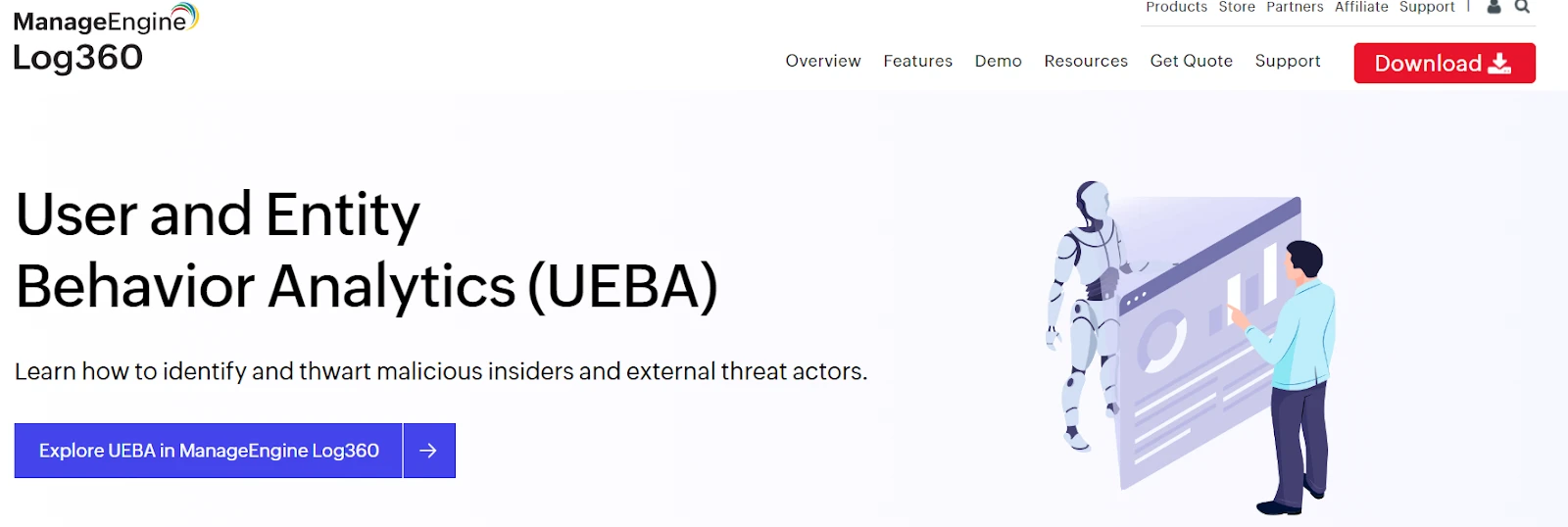
ManageEngine Log360
ManageEngine Log360 is a UEBA-integrated SIEM with SOAR capabilities. The UEBA module can be added alongside ADAudit Plus, EventLog Analyzer, and Cloud Security Plus.
Key features:
- Anomalous user and entity activity analytics: Identifies unusual activity such as logins at unusual times, repeated login failures, and file deletions from hosts the user rarely accesses.
- Anomaly reporting across devices and applications:
- Windows: startup/shutdown events, USB activity, application whitelisting, logins, file changes, firewall modifications
- Unix: USB activity, logons, VMware logins, file transfers
- Routers: configuration changes and login activity
- Active Directory: logins, process activity, user management actions
- Microsoft SQL Server: data modifications, logins, password changes
- FTP servers: file transfers, logons, file activity
- Score-based risk assessment: Visualizes a risk score per user and host across five categories: insider threats, data exfiltration, compromised accounts, logon anomalies, and cloud/database/file server anomalies
- Centralized detection console (2026): A single view that unifies MITRE ATT&CK-mapped rules, UEBA, correlation, and threat intelligence. Includes object-level filtering at user, group, and OU levels to reduce alert noise from test and developer accounts, plus rule tuning insights based on real-world signal metrics4
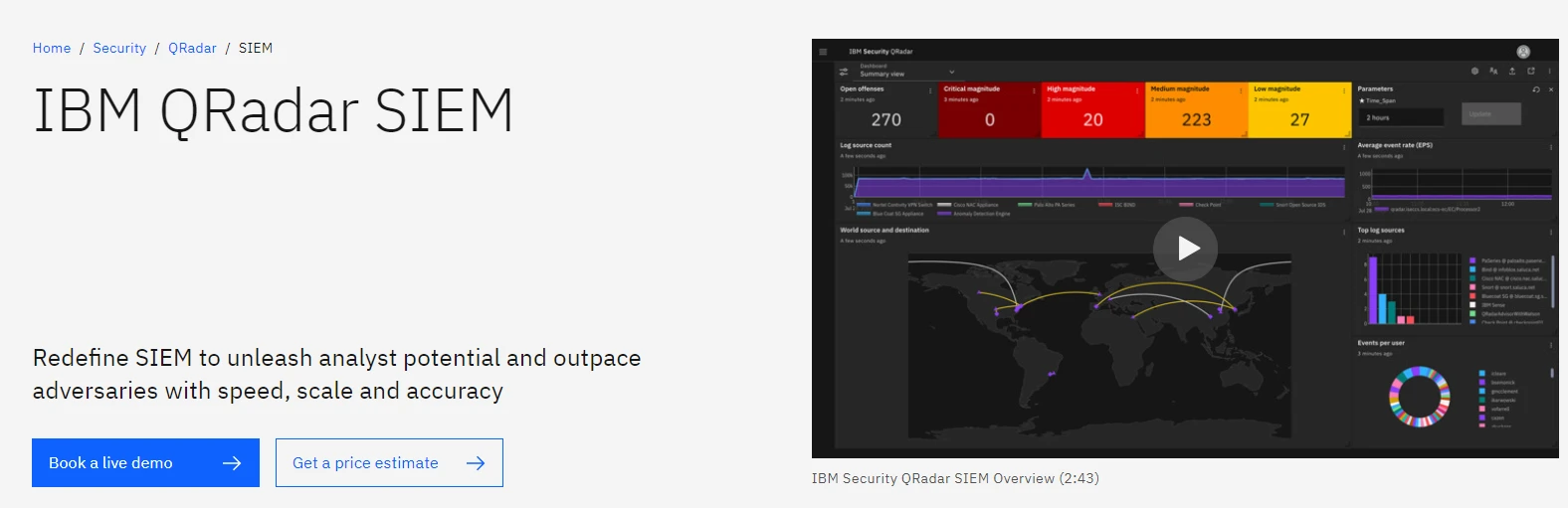
IBM Security QRadar SIEM
IBM Security QRadar is a SIEM platform with user behavior analytics (UBA). It tracks each threat and correlates related behaviors across the environment.
Key features:
- QRadar analytics: Analyzes threat intelligence, network activity, and user behavior to identify vulnerable network components.
- Risk profiling: Attributes risk to security use cases based on criteria such as malicious site visits, with each event scored by severity and reliability.
- Unified user IDs: Builds user threat profiles by correlating event and flow data already in QRadar.
- Three traffic categories monitored: network access and authentication; proxy, firewall, IPS, and VPN activity; endpoint and SaaS application logs.
Exabeam
Exabeam New-Scale is a security operations platform with behavioral analytics (UEBA) at its core. It runs as a SIEM augmentation layer on top of existing SIEMs (IBM QRadar, Splunk, Microsoft Sentinel, OpenText ArcSight, LogRhythm, McAfee Nitro, Sumo Logic, Google Cloud Pub/Sub) or as a standalone SIEM replacement via New-Scale Fusion.5
Key features:
- Rule and signature-free detection: Identifies unknown and zero-day threats by analyzing patterns and anomalies in real-time. Automatic incident timelines: Combines associated security events into a timeline that traces an issue across users, IP addresses, and systems.
- Dynamic peer groupings: Groups similar entities (users from the same department, IoT devices of the same class) to contextualize behavioral deviations.
- Agent Behavior Analytics: Exabeam extended its UEBA to monitor AI agents as non-human identities the first platform to do so. When an agent accesses systems outside its function or pulls unusual volumes of sensitive data, the platform detects the deviation and automatically generates a forensic timeline of every action. Integrates with Google Gemini Enterprise for real-time agent activity visibility.6
- Agentic AI Security dashboard: A board-ready view showing AI risk posture, coverage gaps, and maturity tracking for AI agent activity across the organization.
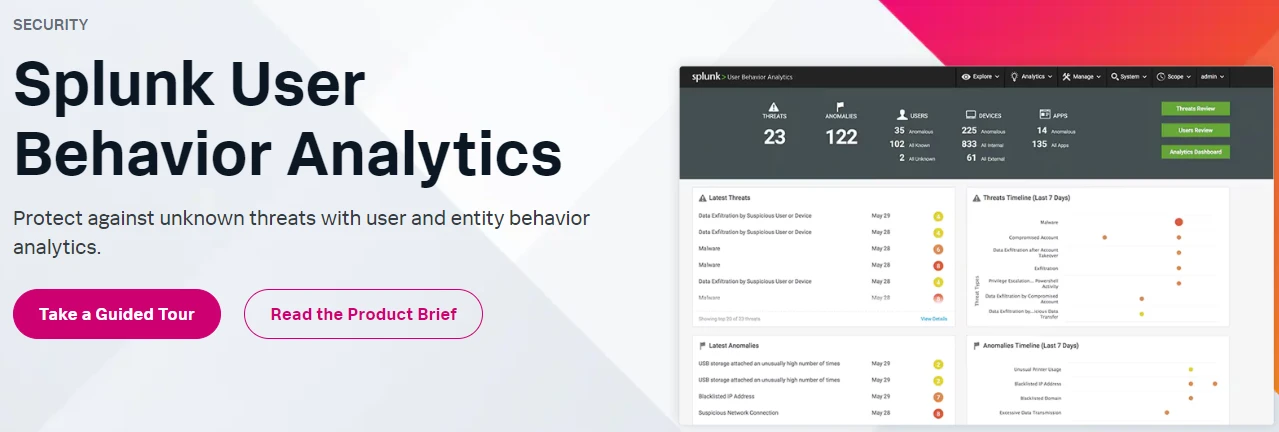
Splunk User Behavior Analytics
Splunk UBA can no longer be purchased as a new license. Cisco and Splunk have integrated UEBA capabilities directly into Splunk Enterprise Security (ES) Editions. Existing customers should plan migration before December 10, 2026, when all technical support, bug fixes, and security updates cease.7
Key features:
- Threat review and exploration: Visualizes threats throughout an attack path.
- Threat severity and detection feedback: Provides granular feedback for customized anomaly models based on your organization’s processes, assets, and user roles.
Key considerations (standalone UBA, for existing customers only):
The standalone product re-packages various open-source components rather than running natively on the Splunk platform. It exports raw events from Splunk and re-ingests them into open-source analytics engines, which means your infrastructure must handle the additional search and ingestion load.
2. DLP tools with UEBA
UEBA gives DLP tools behavioral context. A DLP system alone flags an email with a sensitive attachment, but without behavioral baseline data, it cannot tell whether that action is suspicious for that particular user. With UEBA, the system also checks whether the email was sent outside normal hours, to an unusual recipient, or at abnormal volume.
Benefits:
- Behavioral analysis
- Insider threat detection
- Contextual signals: user location, device type, network activity
Real-life example: A global media and telecom provider automated mitigation of 80% of non-malicious policy violations by combining UEBA with DLP.
Teramind
Teramind is a DLP and insider risk platform that monitors employee, remote user, and contractor activity to prevent data leaks. It tracks apps, websites, emails, instant messages, social media, file transfers, printers, and networks. Administrators configure rules to notify, block, log out, or redirect users.
Supports compliance with GDPR, HIPAA, PCI DSS, and ISO 27001.
Key features:
- Behavior monitoring: Identifies excessive personal internet usage, unauthorized access attempts, and policy violations.
- Active vs. idle time analysis: Reports on productive vs. inactive time per user.
- Mobile app: Android dashboard for mobile visibility. Available as Cloud, On-Premise, or Private Cloud (AWS, Azure).
Forcepoint Insider Threat
Forcepoint Insider Threat has over 15 years of deployment in government and Fortune 100 environments. It monitors user behavior (logins, print jobs) and entity information (HR data) to detect internal threats.
The solution can monitor user behavior (e.g., logins, print jobs) and entity information (e.g., HR data).
Key features:
Scoring systems: Forcepoint Behavioral Analytics uses several scoring systems and analytics to provide insights about individuals based on their actions.
Automated notifications: The solution provides granular, configurable settings that allow security managers to establish automated notifications for specific employee actions of concern
Key considerations:
Forcepoint Insider Threat is effective in enabling proactive security measures by connecting user behavior to data movement. We recommend Forcepoint Insider Threat for:
- Large companies that demand broad monitoring capabilities and have the budget to integrate the product with other Forcepoint tools for a stronger security posture.
- Companies with a history of insider threats.
While Forcepoint Insider Threat offers robust capabilities to address complex security needs, its implementation can be challenging, often requiring substantial resources and specialized expertise to integrate seamlessly with existing IT infrastructure.
Additionally, Forcepoint Insider Threat offers more seamless integration with Forcepoint products than third-party tools, making its integration options more effective for organizations already committed to the Forcepoint ecosystem.
3. Data-centric security software with UEBA
UEBA enriches data security software through:
- Contextual insights: Adds behavioral data to log events, so a login to a sensitive database at 2am from an unfamiliar device is scored as higher risk than the same login during business hours from a known device.
- Dynamic threat evaluation: Enriches logs with user profiles and metadata for more accurate severity assessment.
- Adaptive baselines: Models update continuously as new patterns emerge, reducing false positives over time.
Benefits:
- Enriched activity logs
- Dynamic threat assessments
- Proactive risk management
Cynet
Cynet combines incident response, intrusion detection, UEBA, and XDR. It monitors endpoints and networks, analyzing suspicious activity. Automated remediation is available alongside manual analyst review.
Deployment: On-premise, IaaS, SaaS, hybrid.
Key features:
- Customizable behavioral baselines: Define normal patterns based on role, group, geography, and working hours.
- Automated alerts and remediation: Sends alerts on suspicious activity. Can automatically block compromised accounts or escalate for review.
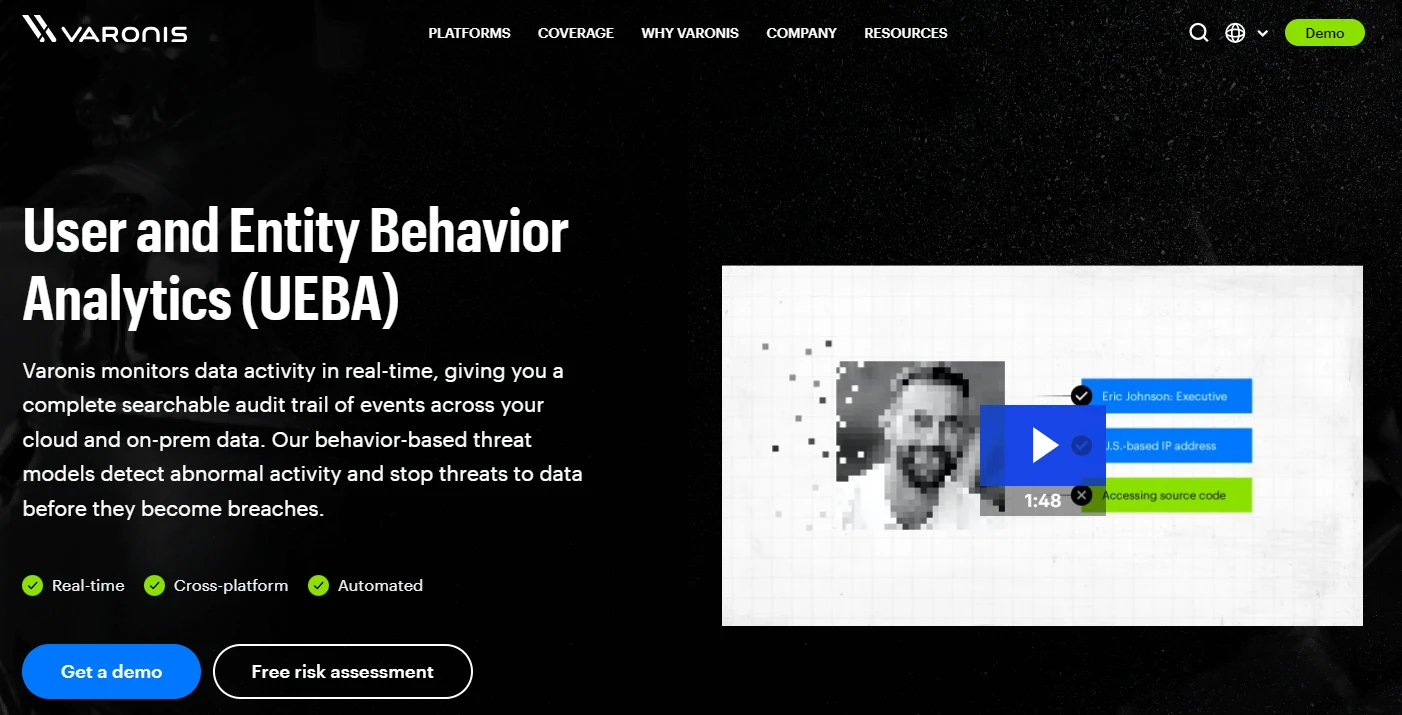
Varonis Data Security Platform
Varonis provides data security posture management (DSPM), including sensitive data discovery, data access governance, behavioral anomaly detection, GDPR compliance assistance, incident playbooks, and forensic reporting.
Connector integrations: Splunk, QRadar, Palo Alto Cortex XSOAR, Google Chronicle SOAR, and others.
Key features:
- Threat hunting: Monitors data access, user activity, and network behavior to proactively detect threats.
- Managed data detection and response (MDDR): Focuses on data threats rather than endpoints. Detects and responds to data-related incidents in real-time.
Key considerations:
Varonis is the right choice for data-centric organizations, particularly for data classification, access governance, and alerting on anomalous file activity, such as ransomware patterns. Integrates into existing SIEM/SOAR via connectors or syslog/SNMP. Strong fit for security teams that need to track who accessed or modified files.
 Add as preferred source
4. Insider risk management solutions with UEBA
Insider risk platforms are built specifically for threats from trusted users. UEBA gives these tools behavioral context: elevated access requests, unusual file deletions, or late-night logins all contribute to a risk score that evolves as behavior changes.
Benefits:
- More accurate insights for privileged access breaches
- More accurate lateral movement detection
- Context-rich insider threat investigations
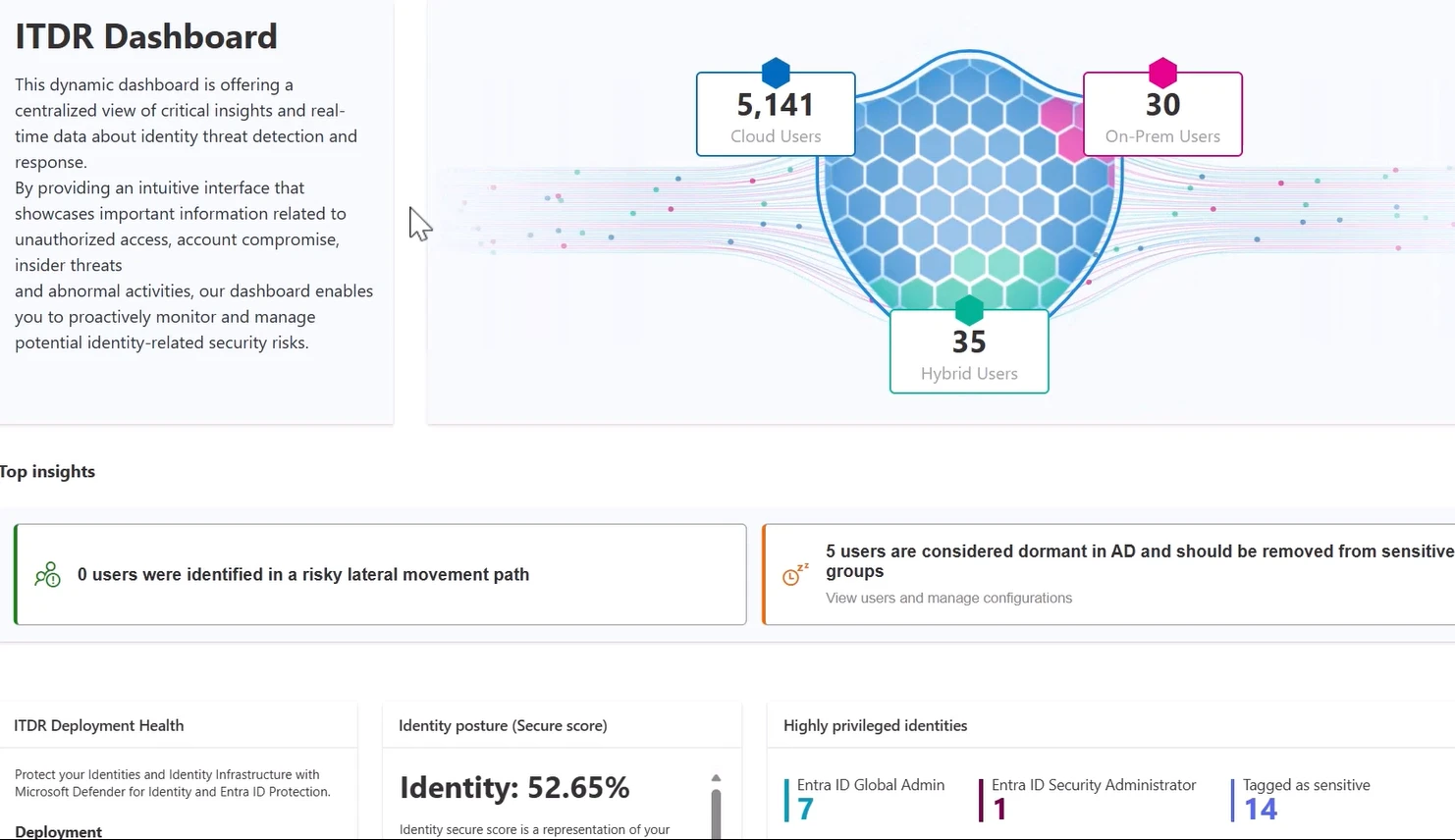
Microsoft Defender for Identity
Microsoft Defender for Identity (formerly Azure Advanced Threat Protection / Azure ATP) focuses on Active Directory threats.
Data collected:
- Network traffic to/from domain controllers, including DNS queries
- Windows security event logs
- Active Directory information including subnets
- Entity information: names, email addresses, phone numbers
Key features:
- Alert scoring: Shows each user’s impact on a specific alert, scored by severity, user impact, and activity frequency.
- Activity scoring: Estimates the probability of a user undertaking a specific activity based on their own and their peers’ behavioral history.
Key considerations:
Defender for Identity monitors on-premises AD because agents are installed on domain controllers. For endpoint protection against malicious activity, integration with Defender for Endpoint is required.
Integrations:
- Microsoft tools: Correlates identity alerts with signals across the Microsoft security ecosystem.
- SIEMs: Send syslog alerts to any SIEM server when a security alert fires.
Key factors to consider while implementing UEBA tools
1. UEBA tools alert, they do not block
UEBA detects and flags potential attacks, malware, phishing, whaling, social engineering, and DDoS, but does not prevent them. The response action comes from the security team or from integrated platforms.
2. UEBA tools are not standalone
UEBA is a layer that works alongside existing security systems. It enhances network monitoring and data security posture; it does not replace them.
3. UEBA works best when integrated
Pairing UEBA with software-defined perimeter (SDP) solutions, for example, adds perimeter context DNS, VPN, web proxy data to behavioral baselines, giving SOC analysts more precise alerts.
Feature descriptions
Vendors with:
- Peer group analysis can use machine learning to identify users and hosts with similar characteristics and categorize them as one group. This helps identify the context behind a user’s behavior and compare it with the behavior of a relevant peer group.
- Threat intelligence provides detailed, actionable threat informatio,n including:
- tactical intelligence (real-time)
- operational intelligence (proactive)
- strategic intelligence (far outlook)
Key differentiators in UEBA applications
FAQs
User and entity behavior analytics provide anomaly detection through a variety of analytics approaches, typically combining:
–basic analytics methods (e.g., rules that use signatures, pattern matching, and simple statistics)
–advanced analytics (e.g., supervised and unsupervised machine learning).
Vendors utilize integrated analytics to assess the activity of users and other entities (hosts, apps, network traffic) to detect possible issues (activities that deviate from the regular profiles and behaviors of users and entities).
Examples of these activities include anomalous access to systems and data by insiders or third parties.
UEBA tools collect logs and alerts from all connected data sources and analyze them to create baseline behavioral profiles of your organization’s entities (e.g., users, hosts, IP addresses, and apps) over time and peer group boundaries.
These tools can then leverage anomaly-based threat detection to provide comprehensive user and entity insights into unusual activity and assist you in determining if an asset has been hacked. This helps SOCs to prioritize investigation and incident response. For more: Incident response tools.
Note that, unlike user behavior analytics (UBA), UEBA has an extended scope. While UBA focuses only on evaluating user activity, UEBA encompasses the behavior of both users and network entities, including:
-network devices
-routers
-databases
Traditional IPS/IDS (intrusion detection systems) use signature-based detection and cannot detect patterns or indicators of new, unknown threats.
Attackers may bypass these security features using means such as:
-Denial of service
-Fileless malware
-Obfuscation (attackers use code obfuscation, which involves altering the malware code)
-Zero-Day Exploits
Some IPS/IDS solutions address this challenge by comparing current network data to baseline traffic patterns. While this approach enables more configurable and adaptive intrusion detection, it comes with certain drawbacks.
These systems tend to be more costly and resource-intensive to implement and maintain. Additionally, despite their capabilities, IPS/IDS systems are not foolproof.
SIEM, SOAR, and UEBA are all security technologies, but each has unique features.
-SIEM collects and analyzes security event logs.
-SOAR automates incident response procedures.
-UEBA detects insider threats with analytics that track user actions.
SIEMs are not outdated. They play an important role in cybersecurity, providing a comprehensive picture of security events across the network and promptly capturing data for early evaluation. SIEMs, when paired with technologies like UEBA, can improve their capabilities and enable more analytical and detailed threat detection and response.
Top 9 UEBA-integrated tools reviewed
A UEBA product needs to:
-Use machine learning to create baseline behaviors for individual users and resources in a network.
-Monitor the network, users, and resources to detect anomalies in user behavior patterns.
-Provide incident information and remediation suggestions or integrated incident response capabilities.
Further reading
Cite this research
Pick the format that matches where you're publishing. Pasting the link version into your CMS preserves the backlink.
@misc{hafa2026,
  author = {Hafa, Adil},
  title  = {{Top 9 User and Entity Behavior Analytics (UEBA) Tools}},
  year   = {2026},
  month  = mar,
  howpublished    = {\url{https://aimultiple.com/ueba-tools}},
  note   = {AIMultiple. Retrieved March 26, 2026}
}Results and timestamps of 13 data points. Download the data used in this article as a ZIP file containing 2 CSV files.
Reference Links









Be the first to comment
Your email address will not be published. All fields are required. Comments are left in their original language.