


Types of Virtual Reality & Use Cases

Gartner names spatial computing a top strategic trend projected to reach $1.7 trillion by 2033.1 Virtual reality (VR) and augmented reality (AR) are the core technologies behind this market.
Explore VR types, use cases and challenges:
What is Virtuality Reality (VR)?
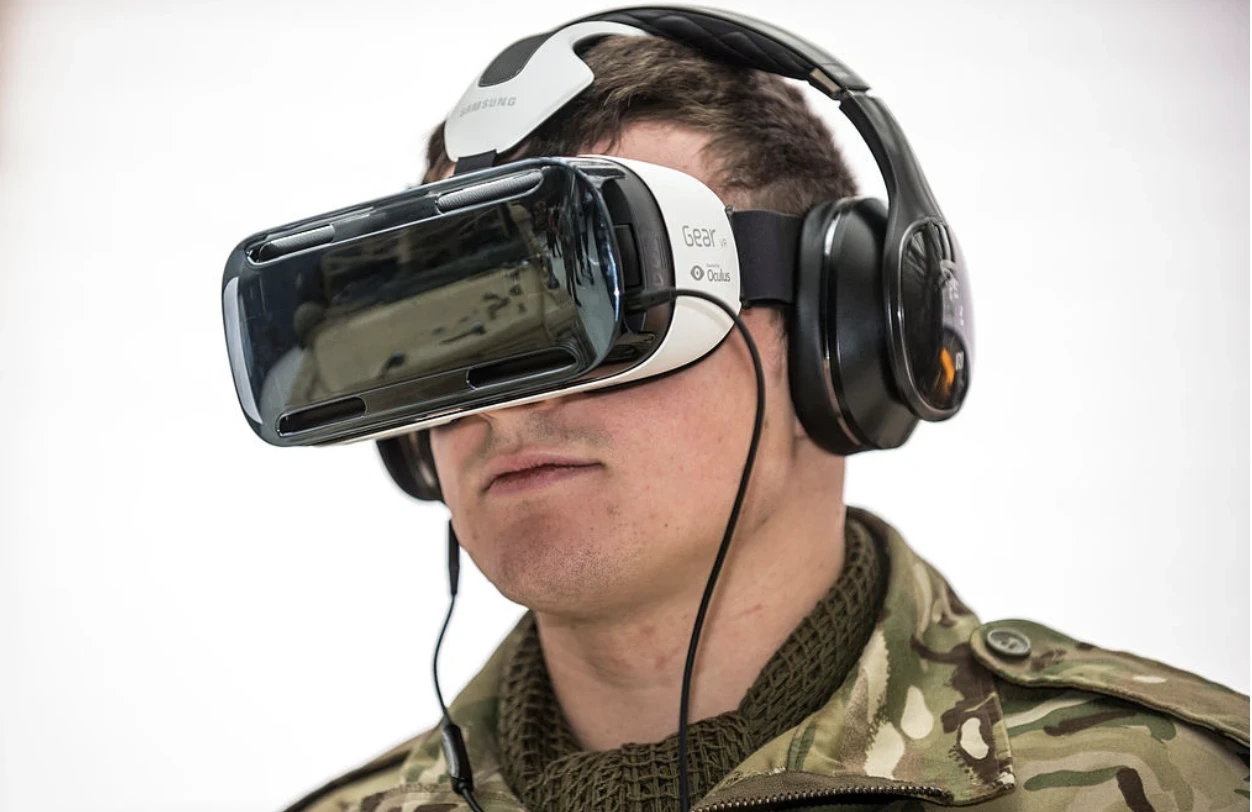
Virtual Reality (VR) refers to the usage of computer technology to create three-dimensional (3D) artificial environments that users can explore and interact with. With the help of special equipment, such as headsets, VR technology allows users to be immersed in virtual experiences instead of a flat-screen digital experience.
How Does VR Technology Work? Components and Processes
Virtual reality systems work by simulating as many senses as possible to trick the human brain into perceiving the virtual environment as reality. To accomplish this, special hardware components are used, such as:
- Head-mounted displays (HMDs) are worn on the head and provide a 3D view of the virtual world. HMDs provide a realistic visual experience by delivering a field of view and a frame rate that resembles human vision.
- Headphones with spatial audio provide an audio landscape that matches the visuals from HMD and mimic an audio landscape that you would expect in a similar real environment.
- Gyroscopes, accelerometers, and magnetometers for head and motion tracking that adjust the virtual environment according to the position of the user within the room and direction of the head.
- Controllers, gloves, treadmills, and other equipment to engage with the virtual environment and to simulate other senses such as touch.
- Generative AI engines: Modern VR systems utilize local and cloud-based AI to render responsive environments in real-time. Instead of static 3D models, these engines generate dynamic assets and NPC behaviors based on user input, reducing development time and increasing the depth of simulation
What are the types of VR?
There are five primary types of VR:
- Fully immersive VR is the type that provides the most realistic virtual experience. It involves head-mounted displays (HMDs), headphones, and other equipment to simulate as many senses as possible and to establish a realistic experience. In fully immersive VR, users are completely isolated from their physical surroundings.
- Gaming: Oculus Quest, HTC Vive, and PlayStation VR for immersive games like Beat Saber or Half-Life: Alyx.
- Training: Military and medical simulations for combat or surgical training.
- Virtual Tours: 360-degree real estate tours using VR headsets.
- Semi-immersive VR allows users to experience virtual environments while remaining connected to their physical surroundings. In this sense, semi-immersive VR provides a partial virtual experience. The video below demonstrates an example of semi-immersive VR in pilot training where the control panel is real while windows displaying virtual content.
- Simulators: Flight simulators for pilot training or driving simulators for training drivers.
- Education: Virtual lab experiments for physics or biology. Several examples are included on digital transformation in education.
- Entertainment: Theme park rides with VR projections.
- Non-immersive VR refers to the type of VR that provides computer-generated environments without the feel of immersion. Video games are common examples of non-immersive virtual reality.
- Gaming: PC games like The Sims or World of Warcraft.
- Education: Desktop-based learning simulations for chemistry experiments or architectural design.
- Business: CAD software for product design.
- Augmented Virtuality (AV) blends physical and virtual environments but leans more heavily toward the virtual side. It incorporates elements of the physical world, such as objects or gestures, into the virtual environment.
- Virtual Meetings: Incorporating physical documents into virtual office spaces.
- Training: Surgery simulators where real-world tools interact with virtual models.
- Gaming: Games that integrate physical props, such as a steering wheel, into the VR experience.
- Collaborative VR enables multiple users to interact and collaborate in the same virtual environment, often in real time. Users are represented by avatars, making it ideal for social interaction and teamwork.
- Social Platforms: VRChat, AltspaceVR, and Meta Horizon Worlds for virtual socializing.
- Workspaces: Virtual meeting tools like Spatial or Engage.
- Education: Collaborative VR classrooms where students can learn together virtually.
- Augmented Virtuality (AV) integrates physical objects into a virtual environment via high-fidelity passthrough sensors on mixed reality (MR) headsets. For example, a user may interact with a physical keyboard or specialized medical instruments while the rest of their field of view remains a computer-generated simulation.
Virtual reality (VR) vs. augmented reality (AR)
Both VR and Augmented reality (AR) are a spectrum of Extended Reality(XR). These technologies are unified by generative AI and Mixed Reality (MR) capabilities but the key difference reamins:
Key definitions
- Augmented Reality (AR): augments the real-world experience by projecting digital elements on it. AR is primarily utilized via AI-enabled smart glasses for real-time navigation and contextual data assistance.
- Virtual Reality (VR): Replaces the physical environment with a fully simulated digital world, used for high-fidelity training, gaming, and remote collaboration.
Core advancements
- Generative AI: GenAI allows for the instant creation of 3D environments. It also enables realistic, unscripted interactions with virtual avatars via Large Language Models (LLMs).
- Hardware evolution: The need for “high-end computers” has been replaced by standalone headsets with built-in spatial processors. High-resolution color passthrough allows these devices to switch between VR and AR (Mixed Reality).
- Obsolescence: Smartphone-insert solutions like Google Cardboard are obsolete. The market has shifted to lightweight Spatial Glasses and all-in-one MR headsets that blend digital objects with physical surfaces.
Top VR Use Cases
Apart from its usage in gaming, applications of VR have impacts in a wide range of industries including:
Healthcare
Virtual reality is used in medical training and allows students to practice surgeries and other procedures without risking human lives. 2 Moreover, VR systems are also used in patient care such as treating patients with post traumatic stress disorder (PTSD); a treatment was created by a team in Cardiff University to help individuals with PTSD to overcome avoidance, by walking towards a traumatic scene on a treadmill. The team claims that candidates experimented an average improvement in their symptoms of 37%.3
Education
VR systems can be used to help students better engage with the subject. It can enable virtual field trips to historical locations or learning-by-doing for applied sciences. For instance, Google Arts and Culture Expeditions enable users to take virtual trips to various destinations. VR technology can also improve distance learning which is even more relevant due to the pandemic.
Automotive
VR allows automobile manufacturers to design and test vehicles before expensive prototyping. VR also enables globally distributed teams to collaborate on 3D vehicle designs in real-time, eliminating the need for multiple physical prototypes and accelerating the time-to-market for new models.
Manufacturing
Manufacturers use VR to create high-fidelity digital twins of production lines. Producers can simulate assembly processes in a virtual environment before physical implementation, which helps reducing factory planning costs
Retail
Virtual fitting rooms that allow customers to try clothes, shoes, eyeglasses, or even new haircuts can replace physical ones. After the COVID pandemic, virtual samplings have increased 32% and the AR/VR market in retail is expected to reach $18 billion by 2028.4
Real estate
VR allows homebuyers to visit properties through virtual tours from their homes. Compared with photos or videos of the property, virtual tours can give a better sense of the dimensions and other features of the property without physically visiting it. This can save buyers, sellers, and real estate agents a lot of time and effort. Here’s an example virtual property tour:
 Add as preferred source
What are the challenges to VR?
- Health problems: As we mentioned earlier, VR systems work by making human brains believe that the virtual environment is the reality. However, when you move in a virtual environment while your body stands still, you can get disoriented which can cause nausea, headaches, and drowsiness. This is called motion sickness. VR treadmills can help with motion sickness by simulating walking.
- High cost: VR headsets and computers with required specifications can get quite pricey. Moreover, VR development can also be expensive since it requires companies to hire developers that are specialized in VR applications. However, VR can be cost-effective in the long run.
- Infrastructure and latency: While hardware costs have decreased, cloud-rendered VR requires high-bandwidth connectivity like 5G or Wi-Fi 7 to avoid performance lags.5 The high computational demands of generative AI requires a technical balance between local headset processing and edge computing.
Further Reading
Cite this research
Pick the format that matches where you're publishing. Pasting the link version into your CMS preserves the backlink.
@misc{dilmegani2026,
  author = {Dilmegani, Cem and Şimşek, Hazal},
  title  = {{Types of Virtual Reality & Use Cases}},
  year   = {2026},
  month  = jul,
  howpublished    = {\url{https://aimultiple.com/virtual-reality}},
  note   = {AIMultiple. Retrieved July 28, 2026}
}
Changelog
5 updatesReplaced enterprise VR adoption statistics with new industrial and Fortune 500 figures.
Expanded the VR vs. AR section with key definitions, generative AI advances, and hardware evolution.
Added a Manufacturing section on VR digital twins of production lines to the use cases.
Reference Links
Cem's work at AIMultiple has been cited by leading global publications including Business Insider, Forbes, Morning Brew, and Washington Post, global firms like Deloitte and HPE, NGOs like World Economic Forum, and supranational organizations like European Commission. [1], [2], [3], [4], [5]
Throughout his career, Cem served as a tech consultant, tech buyer and tech entrepreneur. He advised enterprises on their technology decisions at McKinsey & Company and Altman Solon for more than a decade. He also published a McKinsey report on digitalization.
He led technology strategy and procurement of a telco while reporting to the CEO. He has also led commercial growth of deep tech company Hypatos that reached a 7 digit annual recurring revenue and a 9 digit valuation from 0 within 2 years. Cem's work in Hypatos was covered by leading technology publications like TechCrunch and Business Insider.
Cem regularly speaks at international technology conferences. He graduated from Bogazici University as a computer engineer and holds an MBA from Columbia Business School.






Be the first to comment
Your email address will not be published. All fields are required. Comments are left in their original language.