


15+ Use Cases & AI Applications of Augmented Reality

Augmented Reality (AR) is a digital media platform that allows the user to integrate virtual context into the physical environment in an interactive, multi-sensory way.
Implementing AI enhances the AR experience by allowing deep neural networks to replace traditional computer vision approaches, and add new features such as object detection, text analysis, and scene labeling. We explore AI in AR, its applications, examples, and vendors.
How does AI transform AR?
Historically, AR software used traditional computer vision techniques called Simultaneous Localization and Mapping (SLAM). SLAM algorithms compare visual features between camera frames in order to map and track the environment.
However, modern AR applications rely on deep learning to provide more advanced functionality. AR developers can leverage AI algorithms to offer AR features like enhanced interaction with the surrounding physical environment. AI technologies such as machine learning, GenAI and deep learning are well suited to AR environments because:
- There is an opportunity to collect more data for the AI algorithm to train on since the cameras are always on.
- The input to the AI algorithm is rich in detail because AR environments rely on multiple sensors (e.g. the device’s gyroscopes, sensors, accelerometers and GPS). This provides better reliability than systems relying on a single sensor.
In parallel with deep learning, AR systems are increasingly using spatial intelligence which combines semantic segmentation, depth estimation, and context modeling to understand entire environments. This allows AR content to behave physically realistically (e.g., occlusion, anchored shadows, and lighting adaptation) and enables advanced features like contextual recommendations based on scene category (office vs. outdoor) or inferred user intent.
8 AI applications in AR
1. Object labeling
Object labeling utilizes machine learning classification models. When a camera frame is run through the model, it matches the image with a pre-defined label in the user’s classification library, and the label overlays the physical object in the AR environment. For example, Volkswagen Mobile Augmented Reality Technical Assistance (MARTA) labels vehicle parts, and provides information about existing problems and instructions on how to fix them.
2. Object detection and recognition
Object detection and recognition utilize convolutional neural network (CNN) algorithms to estimate the position and extent of objects within a scene. After the object is detected, the AR software can render digital objects to overlay the physical one and mediate the interaction between the two.
For example, the IKEA Place ARKit application scans the surrounding environment, measures vertical and horizontal planes, estimates depth, and then suggests products that fit the particular space.
For more, feel free to read our image recognition tools comparison.
3. Text recognition and translation
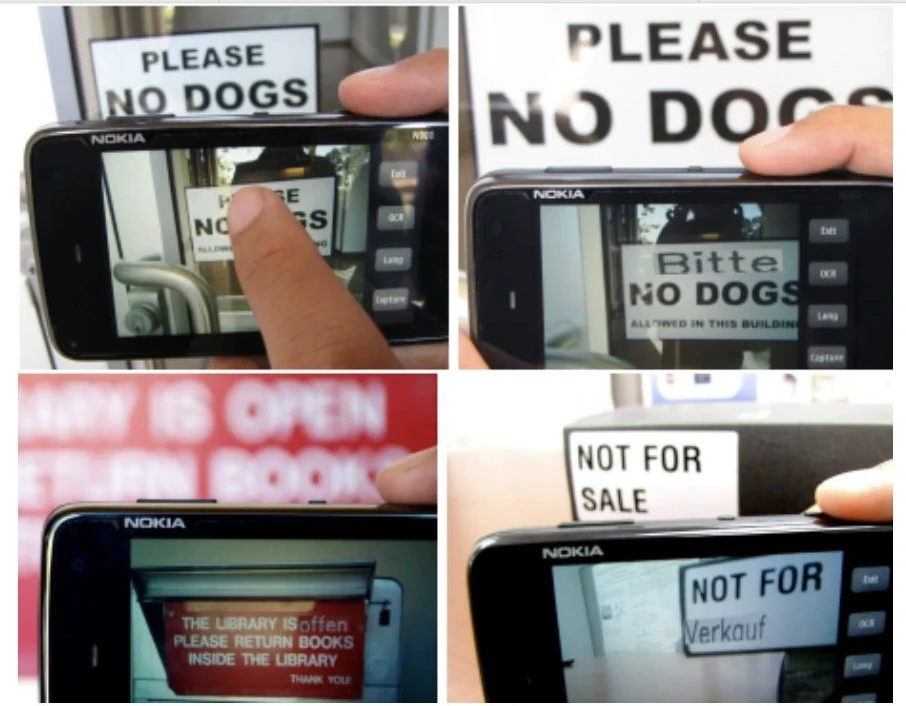
Text recognition and translation combine AI Optical Character Recognition (OCR) techniques with text-to-text translation engines such as DeepL. A visual tracker keeps track of the word and allows the translation to overlay the AR environment. Google Translate offers this functionality.
4. Automatic Speech Recognition
Automatic Speech Recognition (ASR) uses neural network audiovisual speech recognition (an algorithm that relies on image processing to extract text). Specific words trigger an image in the library labeled to fit the word description, and the image is projected onto the AR space.
Example:
An example is the Panda sticker app.
Another example that combines ASR with sensor-based hand gesture tracking is smart glasses technology. Smart glasses with in-lens displays project visual data like messages, media controls, and live speech captions directly into the wearer’s line of sight.
For more, please read our collection of top speech recognition use cases.
5. Gesture and natural interaction
AI-powered gesture tracking and multimodal interaction enable AR systems to recognize hand, body, and finger movements in real time. Combined with voice AI, these systems allow users to interact with virtual objects without touch, creating more intuitive and hands-free AR experiences.
Example:
In industrial maintenance, AI AR systems can interpret hand signals to manipulate 3D holograms of machinery, while voice commands trigger contextual instructions or warnings. Accessibility-focused AR apps use gestures and voice to navigate interfaces for users with limited mobility.
Use cases:
- Industrial AR applications for hands-free equipment control
- Accessibility apps that provide gesture-based navigation and commands
- Gaming and entertainment where gestures control virtual objects
- AR training and simulation environments with natural interaction
6. Environment Mapping and Scene Understanding
Beyond simple object detection, AI enables semantic scene understanding, allowing AR systems to classify entire environments (e.g., kitchen, office, street) and adapt overlays accordingly. Deep learning models like SceneNet or IBM’s Visual Recognition can analyze spatial context, lighting, and surface types to tailor the AR experience.
Example:
Snapdragon Spaces uses AI to detect walls, surfaces, and room types in real time, enabling more realistic placement of virtual furniture or game elements.
Use cases:
- Interior design apps that recommend furniture based on room type
- AR wayfinding that adapts signage to indoor/outdoor environments
- Smart retail that changes promotional content based on store sections.
7. Generative AI for Dynamic Content Creation in AR
GenAI models can dynamically generate 3D assets, voices, or even entire scenes based on prompts or user interactions within AR environments. This eliminates the need for preloaded libraries and enables users to generate personalized environments without preloaded assets
Example:
A marketing app could let users describe their ideal living room, and GenAI would generate furniture and layout in AR.
Relevant models/tools:
- Luma AI (text-to-3D)
- RunwayML for video overlays
- Pika Labs or Spline for real-time 3D modeling
8. Anomaly detection for industrial inspection
AI-enabled AR can help with real-time anomaly detection in manufacturing or fieldwork. Computer vision models trained on what “normal” looks like (e.g., pipe integrity, machine surfaces) can detect deviations and highlight them in the user’s view using AR.
A 2020 study in Sensors compared AR glasses guidance against printed documentation in control cabinet wiring and identified a decrease in process time by 45%, saving 6.5 to 7 minutes on a 20 wire assembly.2
Real-life example on anomaly detection:
Porsche uses AR with AI inspection tools to highlight wear, corrosion, or misalignments in auto parts during remote maintenance.
Use cases:
- Maintenance and safety inspections in factories
- Utility infrastructure (e.g. power lines, pipelines)
- Aircraft or vehicle repair assessments.
More AI/AR applications in various industries
Snapchat users were reported to play AR Lenses more than 9 billion times per day on average in Q1 2026 , with 75% of daily users engaging with AR every day, indicating AR’s scale in consumer entertainment.3
- Construction: Architecture, design, project planning, site revision, safety and inspection, underground constructions, and training.
- Education: Scene expedition (Museum, factory), model experiments in labs (chemistry, physics, geometry, anatomy). What the empirical evidence proves:
- High learning gains: Across 252 controlled studies (2010–2022), AR learners outperformed 73% of peers in traditional settings.4
- Impact skews young: In the 252 pool, age-matched trials show learning gains peak with children, tapering through teens, and dropping by half for adults.
- Built for skills, not abstract theory: Outcome tracking shows AR excels at teaching skills and facts, but lags in complex reasoning and spatial tasks.5
- Entertainment: real time info from sports arenas, augmented music concerts, interactive ads, movies, and games.
- Medicine: diagnosis, surgical navigation, training surgeons on new procedures, and modeling drug effects.
- Logistics: warehouse planning and operations, transportation optimizations, and inventory management
- Manufacturing: design and prototyping, maintenance, repair and training,
- 37% of construction companies intend to invest in AR within two years.6
- According to 158 industry experts, the primary barriers to AR adoption in manufacturing are budget constraints (21%), a lack of understanding from senior management (17%), and limited technical knowledge among design teams (17%)7
- Check out more examples on AR in manufacturing
- Military: aircraft navigation, weapon aiming, and telepresence in military operations.
- Real estate: Marketing, interior design, floor planning, construction staff training.
- Fashion: try-before-you-buy, in-store navigation, personalized shopping, AR window shopping, and makeup apps. In a survey of 4,028 shoppers aged 13 to 49 across the US, UK, France and Saudi Arabia found that:
- 80% of the shoppers felt more confident in their purchase after using AR,
- Two thirds said they were less likely to return the item.8
AI enabled AR Software Vendors
According to Statista, the global market of augmented reality (AR), virtual reality (VR), and mixed reality (MR) is estimated to reach $100B by 2026.9 Companies such as Apple and Google are in the market for developing AI-enabled AR software to enhance customers’ AR experience.
Apple ARKit
ARKit is Apple’s augmented reality (AR) development platform for iOS iPhones and iPads. ARKit provides object labeling, people occlusion, motion capture, and multiple face tracking. ARKit has been used in:
- Education to model practical experiments in science, physics, or chemistry labs, such as Labster
- Construction and architecture to measure spatial dimensions and suggest products or solutions, such as IKEA place.
- Entertainment, such as Pokemon GO.
Google ARCore
ARCore is Google’s AR platform that integrates digital content into the physical environment via motion capture and object detection and recognition. ARCore has been used in:
- Real estate to visualize, decorate, and design empty spaces. Such as Sotheby’s Curate app
- Lifestyle and maintenance to connect users with professionals who provide guidance and instruction, take measurements, and project potential solutions into the space. For example Streem app.
- Entertainment such as TendAR virtual pet game app.
Others
Other AI/AR software vendors include:
- Amazon Sumerian
- Microsoft Mesh
- Unity
- Vuforia Engine
- Zap Works
AI AR wearables and XR platforms
Beyond SDKs, hardware platforms are now integrating deep learning models directly into AR wearables. For example, devices like the Apple Vision Pro provide spatial computing with hand, eye, and voice input that enhances contextual intelligence and AR interaction.
Meta’s Ray‑Ban Display smart glasses and other lightweight AI‑AR wearables are bringing contextual overlays, live translation, and interactive visual guidance to everyday use cases.
 Add as preferred source
Cite this research
Pick the format that matches where you're publishing. Pasting the link version into your CMS preserves the backlink.
@misc{dilmegani2026,
  author = {Dilmegani, Cem and Şimşek, Hazal},
  title  = {{15+ Use Cases & AI Applications of Augmented Reality}},
  year   = {2026},
  month  = jul,
  howpublished    = {\url{https://aimultiple.com/ar-ai}},
  note   = {AIMultiple. Retrieved July 23, 2026}
}
Changelog
4 updatesAdded learning-outcomes research data to Education use case section.
Expanded the "AI applications in AR" section with a new introduction.
Reference Links
Cem's work at AIMultiple has been cited by leading global publications including Business Insider, Forbes, Morning Brew, and Washington Post, global firms like Deloitte and HPE, NGOs like World Economic Forum, and supranational organizations like European Commission. [1], [2], [3], [4], [5]
Throughout his career, Cem served as a tech consultant, tech buyer and tech entrepreneur. He advised enterprises on their technology decisions at McKinsey & Company and Altman Solon for more than a decade. He also published a McKinsey report on digitalization.
He led technology strategy and procurement of a telco while reporting to the CEO. He has also led commercial growth of deep tech company Hypatos that reached a 7 digit annual recurring revenue and a 9 digit valuation from 0 within 2 years. Cem's work in Hypatos was covered by leading technology publications like TechCrunch and Business Insider.
Cem regularly speaks at international technology conferences. He graduated from Bogazici University as a computer engineer and holds an MBA from Columbia Business School.




Comments 2
Share Your Thoughts
Your email address will not be published. All fields are required. Comments are left in their original language.
No mention of Microsoft (e.g. HoloLens, Mesh, Remote Assist, …) even in the “other vendors” list? Strange…
Thank you for the comment. You are right, added Microsoft's platform to the list
Hello! I'm interested in AR glasses content composed by AI Can I send my architecture? I want to know whether this is possible to achieve or not. I need help to improve my idea and make it come true. I'll wait your answer. Thank you.
Hi Heejin, thank you for your comment. I would advise you to reach out to vendors in this space. They would be the ones who can examine your idea in detail and identify how it can be implemented.