


Top 20+ Predictions from Experts on AI Job Loss

As a McKinsey consultant, I helped enterprises adopt new technologies for a decade. My quick answers:
- How will AI impact roles? 90% of all white-collar roles I have seen can be automated today with the right agent harness. This transformation can take a decade due to process complexity.
- How will AI impact jobs? Rapidly shifting job responsibilities can increase unemployment as not all employees can switch to new roles.
- What are others thinking? Some AI experts predict half of entry-level white-collar jobs to be lost by 2030. This is not yet proven except in fields like translation where Jevons paradox did not increase employment.
AI job loss predictions
Note: The size of the plots is correlated with the size of the job loss prediction.
The percentages referenced in our analysis are derived from assumptions about overall job displacement. In specific scenarios, these assumptions included potential job gains resulting from AI adoption. However, to maintain consistency in evaluating net job loss, any estimated job gains have been explicitly excluded from the calculation.
As a result, the final percentages presented reflect net job losses, ensuring a more conservative and focused interpretation of the potential impact on the workforce from AI implementation.
Most predictions estimate that millions of jobs may be displaced or significantly altered. Most roles will evolve, and the workforce must prepare for a sharp increase in disrupted employment.
Prediction market results on AI job loss
Prediction markets show uneven disruption rather than immediate mass unemployment. Forecasters expect the broader labor market to remain functional over the next several years, although they see a meaningful risk of weaker employment conditions for specific groups.
The concern is in entry-level and highly automatable work. Recent college graduates may struggle as AI reduces demand for junior knowledge workers, while call-center employees, translators, software professionals, and other workers performing routine digital tasks face a higher risk of displacement.
For more details, read what prediction markets forecast about AI-related job loss.
Karpathy’s AI exposure and job market analysis
Note: The above graph shows AI exposure vs. median pay across 340 US occupations. Each dot is one occupation. The horizontal axis shows Karpathy’s AI exposure score (0-10), the vertical axis shows median annual pay (on a log scale), and color indicates the BLS occupational supergroup. The plot size shows employment in 2024.
In March 2026, AI researcher Andrej Karpathy (OpenAI co-founder and former Tesla AI director) published a dataset that scores 342 US occupations on a 0–10 AI-exposure scale, drawing on data from the Bureau of Labor Statistics’ Occupational Outlook Handbook, which covers roughly 143 million US jobs.1
Karpathy framed the project as a development tool for visually exploring BLS data rather than a formal research paper. The methodology showed that each occupation’s BLS description was passed to a large language model (Gemini Flash) along with a scoring rubric, which produced a 0–10 score and a written rationale for every job.
Each occupation was rated on a single AI exposure axis that captures two effects:
- Direct automation: The amount of work that AI can perform on its own
- Indirect productivity: The amount of AI raises worker output, potentially reducing the headcount needed.
The rubric applies a core heuristic: if a job can be performed entirely from a home office on a computer (writing, coding, analyzing, communicating), exposure is inherently high (over 7). Jobs requiring physical presence, manual dexterity, or unpredictable real-world navigation score lower.
The findings showed that the weighted average exposure across all 342 occupations is 4.9 out of 10. However, the distribution is uneven:
- Roles paying above $100,000 per year average 6.7/10 exposure.
- Roles paying below $35,000 per year average 3.4/10.
- The highest-scoring occupations are medical transcriptionists (10/10), customer service representatives (9/10), software developers (9/10), bookkeeping clerks (9/10), and paralegals (9/10).
- The lowest-scoring are janitors, roofers, construction laborers, and home health aides (all 1–2/10).
Approximately 42% of US workers are in occupations scoring 7 or higher, representing roughly 59.9 million jobs and $3.7 trillion in annual wages. However, these findings should be taken with a pinch of salt since job definitions are not perfect and historically, it has been difficult to estimate which jobs would be impacted by technology.
What are the implications?
- Office and administrative roles average roughly 8/10 exposure across the board, regardless of pay or rank.
- By contrast, healthcare shows a varied distribution: hands-on roles (nursing assistants, dental hygienists, physical therapists) score 2–3/10, while information-processing roles in the same sector (medical transcriptionists, medical records specialists, health information technologists) score 8–10/10.
- Physicians and surgeons ($239,200 median) score 5/10, below lawyers ($151,160; 8/10) and software developers ($131,450; 9/10) at similar pay levels. The protective factor is the physical, in-person component of the work.
Karger, Kuusela, Abaluck, Bryan
“Forecasting the Economic Effects of AI, 2026” study uses a large-scale survey-based forecasting approach to collect quantitative predictions from economists, AI experts, superforecasters, and the general public.
Participants gave probabilistic forecasts (medians and uncertainty ranges), assigned likelihoods to each AI scenario, and evaluated the impact of different policy responses. The results show that:
Productivity and economic growth
AI is expected to increase productivity and economic growth, but within plausible ranges. Total factor productivity (TFP) is projected to rise from around 1-2% to roughly 2-2.5%.
Even in optimistic scenarios, experts do not foresee extreme outcomes such as exponential growth in GDP. Instead, AI is seen as a meaningful but incremental accelerator of economic performance, on a scale similar to past technological shifts, rather than a singular economic break.
Labor market and workforce effects
The most significant impact of AI is expected to be on the labor market, particularly through a decline in labor force participation rather than a rise in unemployment.
The labor force participation rate (LFPR) is projected to fall from about 62.6% in 2025 to around 61% by 2030 and as low as 55% by 2050.
Importantly, unemployment rates themselves remain relatively stable, suggesting that people may exit the labor force entirely rather than remain unemployed.2
AIMultiple
With the launch of Claude Code and the latest models in Anthropic and Gemini families, I have seen:
- Continued improvements in AI model benchmarks
- Capability to automate processes like agency and consulting projects. I didn’t think of these as automatable before LLMs.
Competitive dynamics and improving models will create a race to automate and improve margins. As a result, my prediction is a 90+% reduction in current white collar roles by 2035. These roles are automatable with current LLMs and the right agent harness but since enterprise processes are complex, it can take a decade to redesign and automate the processes.
This may not lead to a “jobs apocalypse” since human work will remain the bottleneck and thanks to automation, we will need more human workers in tasks that are not automated.
However, this may lead to lower employment levels since:
- Rapid changes to the work to be done would lead to the unemployment of workers who are not flexible enough to transition to new roles.
- The benefits of most productivity improvements since 1980s have been captured by top managers and shareholders.3 We can expect them to benefit from this wave of automation as well and use it as a lever for layoffs.
Lower employment levels can limit consumption, lead to economic depression and increase political instability.
Our current situation is similar to climate change where piecemeal actions have so far failed to delay a future catastrophe. Great power competition and inter-company competition have the potential to limit cooperation and lead us to underemployment.
Why will automating most white-collar work take so long?
Automating automatable work spanning enterprises will require years. You can’t assign anything significant to a newcomer to the company and you can’t expect LLMs to work like capable employees. Enterprises will need to redesign work and invest in model harnesses to implement automation. This is company-specific work similar to digital transformation that will take years.
Goldman Sachs
Goldman Sachs Research in 2025 projects that AI’s impact on overall employment will be mild and short-lived, rather than causing widespread and long-term job losses. They estimate that the unemployment rate may rise by about 0.5% during the transition as workers displaced by AI seek new roles, reflecting short-term friction rather than structural unemployment.
In terms of job displacement risk, around 2.5% of U.S. employment would be at risk of displacement from AI efficiency gains, with a broader but still limited estimate of 6–7% displacement if AI is widely adopted.
Goldman Sachs also forecasts that generative AI could raise labor productivity by approximately 15% when fully integrated across developed markets, leading to short-lived unemployment upticks during adoption periods.
Additionally, the analysis evaluated over 800 occupations and identified those most vulnerable to AI. These roles include computer programmers, accountants and auditors, legal and administrative assistants, and customer service representatives, while roles such as air traffic controllers, CEOs, radiologists, pharmacists, and clergy are identified as least at risk.4
Geoffrey Hinton
Geoffrey Hinton, a Nobel Prize–winning computer scientist known as the “godfather of AI,” warned that artificial intelligence will increase unemployment while driving higher profits, a result he attributes to capitalism rather than the technology itself in 2025. He noted that while mass layoffs have not yet materialized, AI is reducing entry-level opportunities.
Hinton sees healthcare as one of the few sectors that could benefit, as efficiency gains for doctors would expand access to care. However, he dismissed universal basic income as inadequate for addressing the loss of dignity and purpose tied to work.
He also cautioned about long-term risks, estimating a 10–20% chance that AI could pose an existential threat through uncontrollable superintelligence or misuse by malicious actors, while criticizing the weak regulatory efforts in the United States.5
Kiran Tomlinson, Sonia Jaffe, Will Wang, Scott Counts, Siddharth Suri
According to Microsoft’s “Measuring the Occupational Implications of Generative AI” research in 2025, occupations vary widely in their susceptibility to AI, with some jobs being significantly more likely to be affected than others.
The study ranks roles based on an AI applicability score that combines:
- The amount of the job that AI can do (coverage)
- How completely it can do those tasks (completeness).
- The variety of tasks it can handle (scope).
Jobs like interpreters, translators, historians, and customer service representatives scored highest, meaning AI can perform most of their work effectively, especially in text- or communication-heavy tasks.
Conversely, occupations such as nursing assistants, dishwashers, roofers, and surgical assistants scored near zero, indicating that AI is currently not capable of taking over their primarily physical, hands-on, or human-interaction-heavy responsibilities.
This suggests that while AI is rapidly advancing in automating cognitive and routine digital work, it remains limited in replacing roles that require dexterity, emotional intelligence, or real-world adaptability.6
Eric Schmidt
Dr. Schmidt (former CEO of Google) predicted that AI will do most programming work in 2025.
Tools using reinforcement learning and planning are evolving rapidly. These systems can write, debug, and optimize code better than most humans, especially for routine or complex but repetitive tasks.
AI is also expected to reach the level of top graduate mathematicians in the near future. Schmidt explains that AI models now operate well in mathematical reasoning because math has a simpler, structured language. With tools like Lean theorem proving, AI can solve and verify complex mathematical problems.7
Dario Amodei
Dario Amodei (Anthropic’s CEO) warned in 2025 that AI could eliminate 50% of all entry-level white-collar jobs within the next five years, potentially pushing U.S. unemployment rates to 10–20%.8
Calling it a possible “white-collar bloodbath,” Amodei emphasized that many remain unaware of AI’s short-term disruptive power. However, he has partially backpedaled recently by mentioning Jevons paradox.9
Kai-Fu Lee
Kai-Fu Lee echoed Amodei’s concern in 2025 by validating the projection that AI could displace 50% of jobs by 2027.
As a prominent voice in the field, his agreement adds credibility to the estimate that AI job loss could soon impact half of the global workforce. While his statement is brief, it underscores growing consensus among experts that AI may reshape employment far more aggressively than previous technological change.10
International Monetary Fund (IMF)
The IMF emphasized that most jobs will undergo task-level transformation, rather than outright loss. In high-income countries, service-heavy economies make the workforce especially exposed.
The report classified AI’s effects into three categories: automatable (routine, rule-based), augmentable (judgment-driven), and unaffected tasks. Two-thirds of jobs are expected to experience partial automation. It emphasized the complementarity of AI and human labor, particularly in decision-making, pattern recognition, and knowledge retrieval.
The report also highlighted the urgent need for reskilling, projecting that over 40% of workers will require significant upskilling by 2030. Legal, financial, and insurance sectors will undergo the most significant transformation; education and healthcare will remain relatively resistant due to their reliance on human interaction and complex processes.11
GPTs and the U.S. Workforce (Eloundou et al.)
A 2023 study on the effects of generative AI and large language models concluded that 80% of the U.S. workforce could have at least 10% of their tasks affected.
For around 19% of workers, at least half of their daily tasks could be disrupted.
The most exposed roles include writers, public relations specialists, legal secretaries, mathematicians, and tax preparers, all requiring extensive language or logic-based work.
Unlike past automation, which primarily targeted blue-collar work, LLMs are poised to transform higher-wage, highly educated professions across multiple sectors. Their impact is independent of physical infrastructure, broadening the scale of potential displacement.12
Eric Dahlin
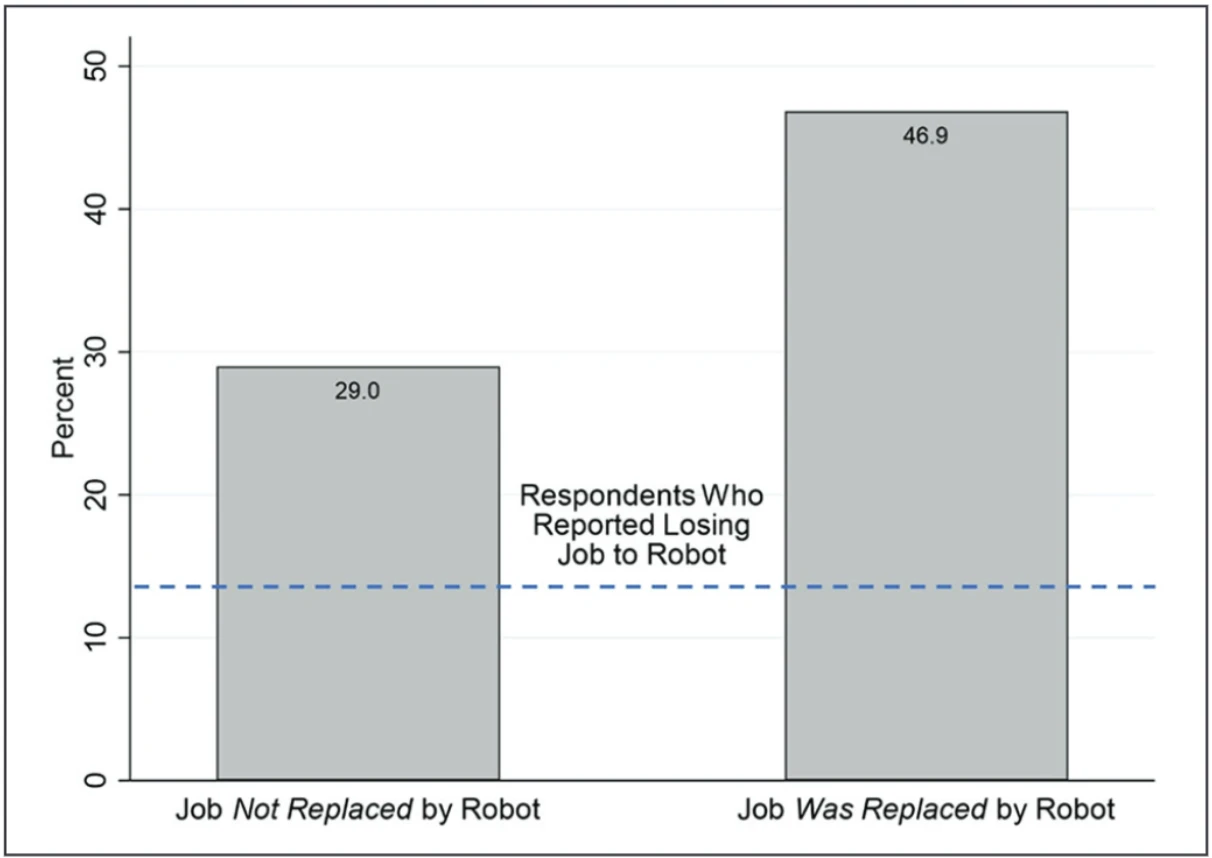
A 2021 survey by sociologist Eric Dahlin found that approximately 14% of Americans reported losing their jobs to robots.
Despite this modest actual rate, public perception was significantly inflated: those not affected believed 29% had lost their jobs to automation, while those who were displaced estimated the rate at 47%.
This gap between perception and experience reflects deep anxiety about AI’s impact, even when real-world job loss rates remain lower than often assumed.
The study’s inclusion of robots in non-industrial contexts (airports, libraries, eldercare) further highlighted AI’s reach across different sectors of life and work.
Figure 1: The graph illustrates that respondents significantly overestimated the likelihood of robot-driven job loss, with perceptions ranging from 29% to 47%, compared to the actual rate of approximately 14%.13
PwC
PwC’s global CEO survey in 2019 found that 42% of CEOs believe AI will displace more jobs than it creates, while 39% disagree, reflecting a divided outlook.
Job loss concerns are highest in the Asia-Pacific region, especially in China, where 88% of CEOs expect net job displacement. The report highlights a persistent skills gap, with 55% citing the inability to innovate due to a lack of key skills.
Most CEOs (46%) view retraining and upskilling as the most effective solution. Despite 85% agreeing AI will significantly change business within five years, 10% have adopted it at scale, hindered by talent shortages and data challenges.14
OECD Study
An OECD study in 2016 found that 9% of UK jobs were at high risk of automation, but that 35% would undergo radical transformation in the next two decades.
This conclusion suggests that fears of mass unemployment may be overstated and that significant changes are more likely to occur through job evolution and reskilling, rather than widespread elimination.15
Bowles
Building on Frey and Osborne’s methodology, Bowles estimated in the “EU Jobs Risk” study that 54% of jobs in the European Union were at risk of computerization in 2014.
This emphasized how AI’s impact extends beyond U.S. borders and raised questions about how regional differences in labor protections and education systems might shape the outcomes of technological disruption.16
Frey & Osborne
In one of the first major academic studies on AI job loss, Frey and Osborne estimated in 2013 that 47% of U.S. jobs were at risk of computerization. Their research classified occupations based on their susceptibility to machine learning and automation.
This early work helped frame later debates on the future of employment, drawing attention to how tasks rather than entire jobs are automated, prompting nuanced discussions around task restructuring and skills transition.17
Other key questions regarding job losses
- How about Jevons Paradox? As the cost of machine intelligence decreases, more machine intelligence will be consumed. However, human intelligence remains costly and demand for human intelligence will likely stagnate if machines can work autonomously.
- Are current job losses due to AI? Pandemic-era overhiring is likely to be the culprit as enterprises are still at the early stages of AI transformation. Pundits are calling this AI redundancy washing.18
Views that AI will lead to net job creation
Sam Altman
OpenAI CEO Sam Altman has taken a less alarmist view of AI-driven job losses in 2026. Although he previously warned that AI could replace many existing jobs and eliminate some job categories, he now argues that a large-scale “jobs apocalypse” is unlikely in the near term.19
Altman’s revised view is based on three observations:
- AI adoption is still in its early stages: While AI models have become highly capable, many companies are still learning how to integrate them into workflows, measure productivity gains, and manage risks related to security and reliability.
- The most aggressive AI adopters may not be cutting the most jobs: In a June 2026 interview, Altman argued that the companies that have adopted AI most deeply are also among those hiring the most. He suggested that some firms citing AI as a reason for layoffs may be using the technology as a convenient explanation for cuts they would have made anyway, rather than reflecting the direct impact of AI adoption.20
- Human interaction remains important: Altman notes that many jobs involve more than merely completing tasks. They also involve communication, trust, judgment, and collaboration, which people may not want to fully outsource to AI.21
However, Altman does not dismiss AI’s long-term impact on work. He expects businesses to be reorganized around AI, especially as AI agents become more capable and companies adapt to faster technology cycles. His current position suggests that AI is likely to reshape jobs and workflows, but the transition may be more gradual and complex than earlier predictions implied.
HBR / Davenport & Srinivasan
A 2026 Harvard Business Review analysis speculated that companies are laying off workers based on AI’s potential rather than its demonstrated performance since overall U.S. unemployment remains relatively low.22
Yale The Budget Lab
The 2025 analysis did not find a material impact of LLMs on jobs based on the rate of job losses, hiring and transitions in the US.23
World Economic Forum
The WEF Future of Jobs Report 2025, surveying over 1,000 employers representing 14 million workers across 55 economies, projected that 92 million jobs will be displaced by 2030 while 170 million new ones will be created, a net gain of 78 million jobs. AI and information processing are expected to affect 86% of businesses by 2030. The report identified AI development, cybersecurity, and sustainability as the fastest-growing role categories.24
Jensen Huang
At VivaTech 2025 in Paris, Nvidia CEO Jensen Huang pushed back against Anthropic CEO Dario Amodei’s warning that AI could replace up to half of entry-level office jobs within five years.
Huang rejected the idea that AI is so dangerous or powerful that a select few should develop it, instead arguing for open and responsible advancement.
While he acknowledged AI will transform the workplace, making some jobs obsolete, he emphasized that greater productivity typically leads to more hiring, not less, and criticized the fear-driven narrative surrounding AI’s impact on employment.25
Dilan Eren
While not focused on percentages, Professor Dilan Eren of Ivey Business School offered a structural critique of firms that, in 2025, respond to AI by eliminating junior roles. Eren warned that cutting entry-level positions for cost savings is an “exponentially bad move” that threatens the internal talent pipeline.
Without juniors, organizations risk shortages of experienced staff in the coming years, especially as mentorship and on-the-job learning decline. Eren urged firms to develop strategies that support dual development: juniors must build domain expertise, while senior staff must upskill in AI.
Delegating all tasks to machines, Eren argued, risks undermining judgment and weakening collaborative learning within companies.
Ravi Kumar
Ravi Kumar, CEO of Cognizant, argued in 2025 that AI will create more job opportunities, especially for recent graduates.
As more companies adopt advanced software, he expects an increase in demand for skilled labor.
According to Kumar, AI can act as a force multiplier, enabling workers to achieve “more for less” while raising expectations, not reducing them. 26
Did AI actually lead to job loss?
Four recent studies, using different data and methods, reach noticeably different conclusions on the root cause of recent job market disruptions:
Frank, Sabet, Simon, Bana & Yu (2026) combine US unemployment insurance records, 10.6 million LinkedIn profiles, and 3 million course syllabi. They show that unemployment risk in highly LLM-exposed occupations, especially computer and mathematical roles, started rising in early 2022, several quarters before ChatGPT launched in November 2022.
The trend then flattened after the launch rather than accelerating. LinkedIn data shows the same timing: graduates from the 2021 cohort entered AI-exposed jobs at lower rates than earlier cohorts.
The authors point to monetary tightening, the post-pandemic tech-hiring correction, and the R&D tax change as likely drivers. They also find that graduates with more AI-exposed curricula earned higher salaries and found jobs faster after ChatGPT, so LLM-relevant education kept its value.27
Dominski & Lee (2025) argue that existing studies use static AI exposure scores, while capability continues to evolve. They build a five-stage exposure framework (pre-ChatGPT ML, early LLMs, multimodal, reasoning models, agentic AI) and ask GPT-4o and Claude 3.5 Sonnet to re-score each O*NET task at each stage.
Linking these dynamic scores to CPS data, they find that higher AI exposure correlates with lower employment, higher unemployment, and shorter hours.
Effects are larger for workers under 30 and over 50, as well as for college-educated workers. Reasoning-heavy occupations are hit hardest, whereas manual physical occupations are barely affected.28
Brynjolfsson, Chandar & Chen (Nov 2025), “Canaries in the Coal Mine,” used ADP payroll data covering millions of workers monthly. According to the results, workers aged 22 to 25 in the most AI-exposed occupations saw sharp employment declines: software developers in that age band fell nearly 20% from their late-2022 peak.
After controlling for firm and time fixed effects, the same group showed a 16% relative decline in employment in the most exposed quintile compared with the least exposed.
Results held when the authors dropped tech occupations, dropped IT firms, and split the sample by teleworkability, college share, and interest-rate exposure. Their explanation is that AI substitutes for the codified knowledge that young workers and formal education supply, while complementing the tacit knowledge that comes with experience.29
Chen, Kane, Kozlowski, Kunievsky & Evans (Sept 2025), leveraged Synthetic Difference-in-Differences on CPS data from January 2010 through August 2025. They report the opposite result: high-exposure occupations gained roughly $89 per week in real January 2010 earnings after ChatGPT, while the unemployment effect was about 0.2% points.
Their interpretation is that LLMs work as short-run complements that raise productivity, and that the adjustment runs through wages rather than employment.30
So, did AI cause job losses?
A reasonable answer in early 2026 is that, for the workforce overall, there is no clear aggregate signal yet. Two of the four studies find essentially zero unemployment effect at the occupation level. For workers aged 22 to 25 in highly exposed occupations, the answer is most likely yes, at least in part, because the ADP evidence survives firm-time controls, the exclusion of tech firms, and the non-teleworkable subsample.
On wages, the evidence is mixed and could reflect gains for experienced workers alongside reduced hiring of juniors. On timing, Frank and coauthors show that some of the deterioration in AI-exposed occupations was underway in early 2022, so attributing the full 2022 to 2025 weakening to LLMs overstates the case.
To sum up, AI has plausibly begun to depress entry-level hiring in highly exposed occupations, but has not yet produced visible aggregate unemployment or wage losses. A meaningful share of what appears to be AI displacement reflects monetary tightening, pandemic-era over-hiring corrections, and broader softness in the entry-level market. Whether that picture changes as agentic capabilities arrive is the substantive concern that animates most of the predictions we mentioned earlier, and it remains an open empirical question.
What prediction markets forecast about AI-related job loss
Manifold Market
Manifold is a community prediction platform where participants trade on the outcomes of real-world questions.
- A Manifold market with 27 participants resolved “No” on whether artificial intelligence would be directly connected to an increase of at least 5 percentage points in the US unemployment rate by the end of 2025.31
- 194 participants predicted whether some US software engineers would suffer reduced income, job security, or hiring opportunities because of AI by the end of 2025. The market resolved “Yes”, based on its requirement that at least three reputable news reports document such effects.32
- 10 participants resolved “No” on whether a Fortune 500 company would mostly or entirely replace its customer-service workforce with AI by 2026. The result does not rule out partial automation, but the market’s more demanding threshold of replacing most or all of the workforce was not met.33
As of August 2026:
- 174 participants assigned a 25% probability that AI would cause the US unemployment rate to exceed 10% before 2030.34
- 54 participants estimated a 19% probability that AI would cause mass unemployment in the United States by 2030.35
- 43 participants assigned a 61% probability that the job market would remain “fine” regarding AI-related job losses and unemployment over the next several years.36
- 11 participants predicted a 79% probability that AI would cause a large decrease in translator and interpreter employment by the end of 2027. This suggests relatively strong community confidence that language-related occupations will experience measurable displacement earlier than the overall labor market.37
- 54 participants estimated an 81% probability that AI would replace most call-center workers by 2030. This was among the highest probabilities in the reviewed markets.38
- 7 participants forecast which occupation would have the largest percentage of roles replaced by AI by the end of 2026. The market assigned 38% to “other” occupations, 34% to customer service, 10% to software engineers, 8% to administrative assistants, and 5% each to truck drivers and researchers.39
- 8 participants forecast that approximately 34% of 11 selected occupations would experience an employment shortfall of at least 15% that could plausibly be attributed to AI by 2031.40
Kalshi Prediction Market
Kalshi is a US-regulated event-contract exchange where participants trade contracts tied to specified outcomes. Kalshi’s public market pages report total dollar trading volume but do not provide the number of unique participants.
- In June 2026, a Kalshi market asking whether AI would be the number-one stated reason for US job cuts in May resolved “Yes”. The market recorded approximately $36,552 in trading volume and used the Challenger, Gray & Christmas monthly job-cuts report as its resolution source.41
- In July 2026, the equivalent market (approximately $2,919 was traded) for June job cuts also resolved “Yes”.42
As of August 2026:
- The ongoing market assigned a 58% probability that AI would be the leading stated reason for US job cuts during July. The market had recorded approximately $1,453 in trading volume.43
- Kalshi traders assigned a 15% probability that the “Citrini scenario” would occur by July 2028, with approximately $25.9 million in trading volume. The Citrini trade is a bet that rapid AI adoption will cause mass layoffs, unemployment, and broader economic decline by 2028.44
Metaculus Community Predictions
Metaculus’ community forecasts aggregate estimates from individual forecasters, while its Labor Automation Forecasting Hub focuses specifically on how AI may affect employment, occupations, and labor-market indicators.
As of August 2026:
- 26 forecasters estimated that AI systems capable of performing jobs from beginning to end would replace 17.8% of today’s workers by 2030. The displayed forecast interval ranged from approximately 9.1% to 25.7%.45
- 49 forecasters contributed to the underlying forecast of overall US employment after accounting for AI-related displacement and other labor-market effects. The community predicted that employment would be 1.9% below its 2025 level in 2030 and 4.4% below it in 2035.46
- 61 forecasters assigned a 24% probability that unemployment among recent US college graduates would reach at least 20% for three consecutive months before 2030.47
- The Metaculus Labor Automation Forecasting Hub predicted that some of the largest employment declines by 2035 would occur among financial specialists, software developers, and lawyers and law clerks, down 14.1%.46
Recent developments: AI impact on jobs
We gathered data from 2023, following the launch of ChatGPT, to show how AI affected tech layoffs. The above chart tracks the cumulative number of jobs affected by layoffs in which companies either directly cited AI, automation, or AI-driven restructuring, or credible reporting linked the cuts to AI-related shifts.
The trend shows a modest rise through 2023 and 2024, followed by a sharp acceleration in 2025 and 2026 as more companies reorganized teams, reduced support or operational roles, and redirected resources toward AI-focused priorities.
Several major companies explicitly cited AI when announcing job cuts:
- GitLab began restructuring to flatten management, reduce its country footprint by up to 30%, and rewire internal processes with AI agents, with most of the savings reinvested into its “agentic era” strategy.48
- Intuit cut 17% of its workforce (about 3,000 employees) to refocus resources on key bets, including AI.49
- Cisco cut nearly 4,000 jobs (around 5% of its workforce) to shift investment toward AI, cybersecurity, silicon, and optics.50
- Cloudflare reduced its workforce by more than 1,100 employees, stating that AI had made roles obsolete.51
However, some experts argue that AI is being used as a convenient justification. Fabian Stephany of the Oxford Internet Institute noted that many firms overhired during the pandemic, and current layoffs may reflect a market correction rather than actual AI-driven displacement.52
The future of entry-level jobs
While graduate job anxiety around AI is understandable, the dramatic 67% drop in UK graduate job postings since 2022 (43% in the US) appears driven primarily by economic uncertainty, post-COVID normalization, and accelerated offshoring rather than AI displacement.
For workers aged 22–25, Anthropic’s labor market impacts research finds that fewer young people are starting jobs in highly AI-exposed occupations compared with low-exposure occupations. The job-finding rate for these roles fell by about 14% compared with 2022 (pooled post estimate −14.3, SE = 7.2), though the authors state the result is barely statistically significant. They also found no similar decline for workers older than 25.53
According to a recent Financial Times article, jobs have fallen sharply even in low AI-exposure sectors like HR (77%) and civil engineering (55%), suggesting broader economic factors are at play.
MIT’s David Autor points to political turmoil and government cuts as more significant drivers, while LinkedIn’s chief economist emphasizes macroeconomic uncertainty as the primary cause.
Although AI will likely transform work in the coming years, current evidence shows weak correlations between AI-vulnerable occupations and actual job losses; some AI-exposed fields, such as accounting, are experiencing growth in youth employment.
The real challenges appear to be traditional economic pressures: inflation, higher interest rates, business uncertainty, and accelerated offshoring enabled by remote work capabilities. This makes the “AI is killing graduate jobs” narrative premature despite legitimate future concerns about technological disruption.54
Research initiatives to understand the impact of AI job loss
Anthropic launches Economic Futures Program to address AI’s workforce impact
Anthropic has introduced the Economic Futures Program, a new initiative designed to explore the economic effects of artificial intelligence, particularly its impact on jobs, productivity, and long-term value creation. The program aims to provide data-driven insights and develop policy proposals that address both the risks and opportunities AI presents to the global economy.
Responding to job displacement risks
As a response to CEO Dario Amodei’s recent predictions, the program focuses on understanding these shifts and preparing for significant workforce impact, including the need for reskilling in affected sectors.
Key components of the program include:
- Research grants: Anthropic is offering rapid grants of up to $50,000 for short-term empirical studies on the economic impact of AI. Research can focus on labor market effects, productivity changes, or the creation of new forms of value.
- Policy development forums: Anthropic will host symposia in Washington, D.C., and Europe to gather policy ideas from diverse perspectives. Topics include reskilling strategies, job creation in AI-driven economies, and workflow transitions.
- Data infrastructure: Building on its Economic Index, launched earlier this year, Anthropic will expand its datasets to track AI’s usage and long-term effects on economic structures and employment trends.
Anthropic’s program focuses more on potential job loss and mitigation strategies. The Economic Futures Program reflects a growing effort among tech companies to take responsibility for the disruption they help create and to support inclusive economic growth.
This initiative places special emphasis on understanding labor market transitions, identifying areas for reskilling, and creating a framework for managing AI’s evolving economic role.55
 Add as preferred source
Implications of AI on different industries
Analysis of administrative unemployment data shows that AI-exposed occupations historically faced lower unemployment risk than less-exposed ones. That advantage narrowed sharply starting in early 2022, especially in computer and mathematical roles, and did not worsen noticeably after ChatGPT’s launch.
Evidence from LinkedIn profiles reinforces this pattern for early-career workers: graduates from the 2021–2023 cohorts entered AI-exposed jobs at lower rates and took longer to find their first job than earlier cohorts, with gaps emerging before late 2022.
Similar slowdowns also appear when comparing high-salary and average-salary jobs, pointing to a general tightening of the entry-level job market rather than a change unique to AI-exposed roles.
Most exposed roles and industries
Industries that rely on structured tasks performed routinely by humans face the highest risk. Clerical, legal, finance, and data processing roles are among the most vulnerable.
According to Anthropic’s labor market impacts research, the most exposed individual occupations include computer programmers (74.5%), customer service representatives (70.1%), data entry keyers (67.1%), medical record specialists (66.7%), and market research analysts (64.8%).
These jobs are typically easy to automate using AI systems and tools. Tasks that involve predictable patterns or follow fixed rules are most susceptible to errors. Entry-level positions, particularly for young workers, are at high risk of being eliminated.
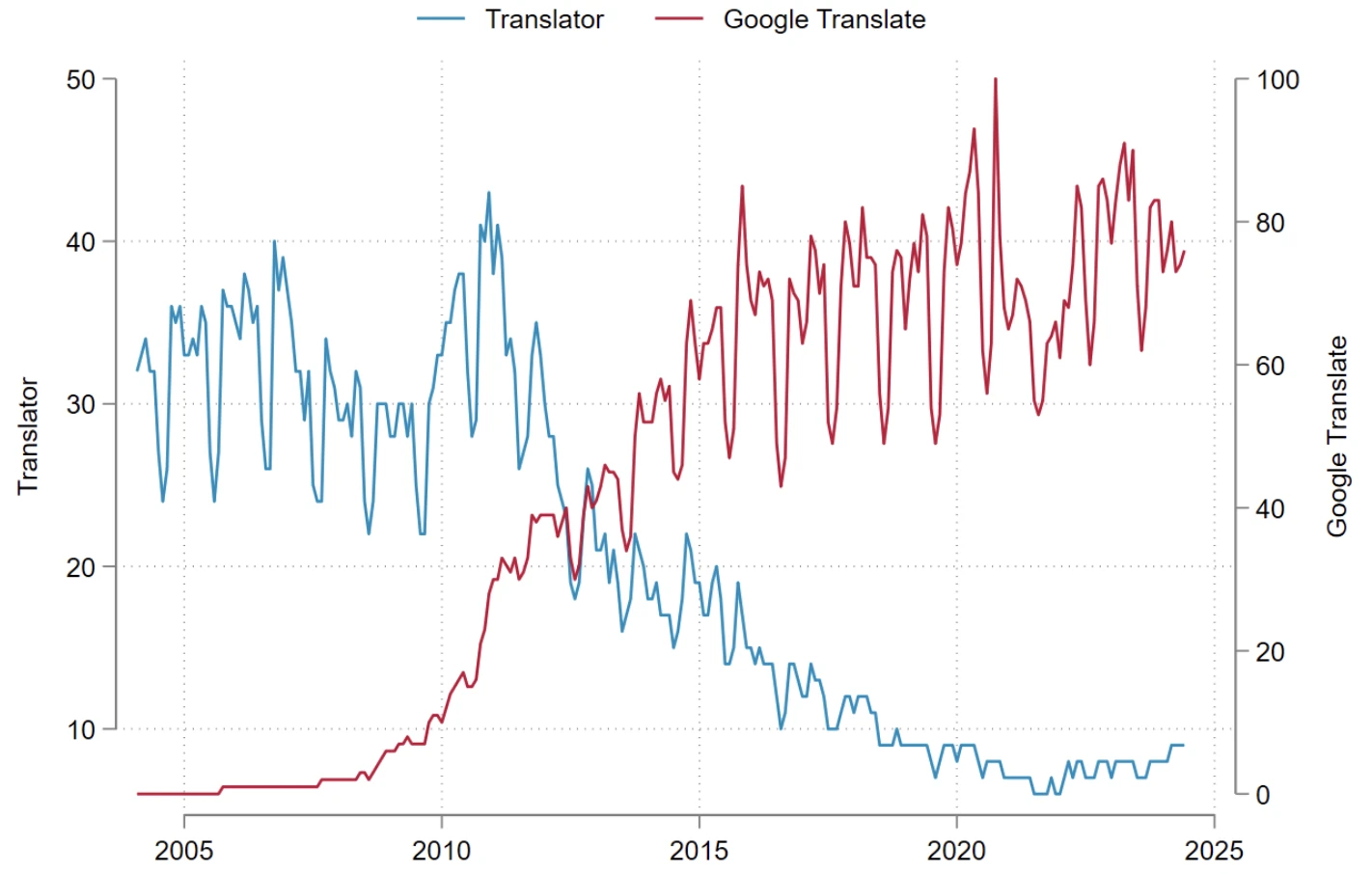
For example, a study investigated the adoption of Google Translate across regions between 2010 and 2023. The findings indicate that areas with higher usage saw slower growth in translator and interpreter jobs, with employment growth falling by about 0.7 % points for each percentage-point increase in adoption.56
Figure 2: The chart shows monthly Google Trends interest for two search terms: “translator” and “Google Translate”.57
The effects extend beyond the translation profession, as job postings requiring foreign language skills grew more slowly in high-adoption regions, particularly for widely used languages such as Spanish, Chinese, and German.
While language skills remain more relevant in technical fields like IT and engineering, the overall evidence suggests that improved machine translation is gradually reducing employers’ reliance on bilingual workers, with implications for education, labour markets, and global services trade.
Uneven impact across sectors
Healthcare and education are less exposed due to the complexity of human interaction required. These sectors are more resistant to automation and large language models.
Partial automation vs. full displacement
Not all job losses will result in full unemployment. In many cases, AI will automate tasks within roles rather than remove entire jobs.
Around two-thirds of current roles are expected to undergo task-level change. Workers will need to adjust to new responsibilities that require human decision-making, reasoning, and creativity. This partial automation still creates pressure on workers to adapt quickly.
Economic and geographic variation
The impact of artificial intelligence will vary by region. High-income economies with service-heavy job markets are more exposed. Emerging markets may face challenges due to limited access to digital infrastructure and fewer resources to reskill the workforce. The differences in local policy responses will influence how AI’s impact unfolds worldwide.
What are the perceptions of the actual workers?
Mismatch between perception and reality
Public perception of job losses is higher than the actual reported figures. While real displacement remains below 15% in recent years, workers believe a larger share of the workforce has been affected.
This reflects growing anxiety about AI’s impact and the future of employment, despite actual data showing a slower pace of change.
Regulatory responses and misconceptions about AI-driven job losses
The AI-Related Job Impacts Clarity Act, introduced by Senators Mark Warner and Josh Hawley, would require companies and federal agencies to report the number of layoffs directly attributable to artificial intelligence.
While the proposal aims to increase transparency around AI’s role in employment changes, its core premise can be misguided: most AI tools are embedded in broader workflows, making it extremely difficult to determine whether a job loss was caused explicitly by AI rather than by regular productivity improvements or broader business pressures.
Existing labor-tracking systems monitor employment dynamics, meaning the bill adds unnecessary bureaucracy while risking stigmatizing AI adoption and discouraging companies from using tools that could boost productivity. Instead, policymakers should focus on improving how AI adoption is measured, studying real-world impacts on workflows and productivity, and supporting worker retraining.58
What types of jobs will AI create?
Despite AI’s role in diminishing certain job sectors, it is also expected to generate substantial opportunities in technical and adjacent fields. Roles such as engineers, forward-deployed engineers, solutions engineers, and field engineers are increasingly in demand as organizations seek support for integrating and optimizing AI systems.
Advice claiming that “computer science is unnecessary because AI will write all code” is fundamentally flawed. While LLMs can automate specific coding tasks, abstraction has always been central to software engineering. The core value lies not in typing code but in determining what to build and architecting systems that are efficient, secure, and economically valuable.
Beyond engineering, roles that are not automatable are also positioned for growth. As automation reduces operational costs, companies can enter new markets or expand existing ones, increasing demand for roles such as sales and customer success.
Ethical and societal implications of AI job displacement
Core ethical challenges
The implementation of AI in the workplace raises fundamental ethical questions that go beyond simple economic considerations. These challenges center on fairness, human dignity, and the moral obligations of organizations deploying transformative technologies that affect livelihoods and communities.
Distributive justice and inequality: AI displacement affects lower-skilled workers and marginalized communities disproportionately, increasing existing socioeconomic disparities.
This creates potential for a divided workforce where AI-augmented employees gain advantages while displaced workers face diminished prospects.
The concentration of AI benefits among technology owners while costs fall on vulnerable populations raises fundamental questions about the fair distribution of technological progress.
Algorithmic bias and discrimination: AI systems inherit biases from training data, potentially amplifying discriminatory practices in hiring, evaluation, and task allocation.
These automated decisions affect employment outcomes at scale without adequate oversight mechanisms. Addressing bias requires diverse datasets, detection protocols, and regular auditing of AI systems used in employment contexts.
Human autonomy: Widespread AI adoption challenges traditional concepts of work value and purpose. Workers face risks of skill degradation and professional identity loss as cognitive tasks become automated.
Preserving meaningful human agency in work processes remains essential for maintaining worker dignity and ensuring technology enhances rather than replaces human capabilities.
Transparency and accountability: Many AI systems operate as “black boxes,” obscuring decision-making processes that affect employment.
This opacity complicates responsibility attribution when AI systems produce harmful outcomes. Clear accountability frameworks and explainable AI systems are necessary for maintaining fairness and trust in employment-related applications.
Societal implications
Beyond individual workplace impacts, AI-driven job displacement poses broader threats to social cohesion, economic stability, and democratic governance.
Political and social stability: Large-scale displacement creates potential for political volatility and social unrest, particularly when communities perceive unequal distribution of technological benefits.
Addressing these concerns requires policies that distribute AI benefits broadly across society. Those policies can work in the global context as wealth distribution in a single country leads the wealthy to migrate from that country.
Intergenerational impact: Entry-level position displacement disrupts traditional career entry pathways for younger workers. This affects standard professional development models and may create barriers to career advancement for new workforce entrants.
Alternative pathways for professional development and advancement need to be developed to accommodate AI’s role in the workplace.
Implementation framework
Addressing AI’s ethical challenges requires structured approaches that balance technological advancement with social responsibility. Here are some of the principles for organizations and policymakers to guide AI deployment while protecting affected communities and workers:
Stakeholder engagement: AI deployment decisions should incorporate input from affected workers, unions, communities, and civil society organizations.
Governance structures must include diverse perspectives and maintain ongoing dialogue regarding impacts and necessary adjustments.
Harm mitigation: Organizations should prioritize augmentation over replacement when feasible, implementing gradual rather than abrupt transitions.
Benefit distribution: AI productivity gains should extend to workers through wage increases, hour reductions, or improved conditions rather than accruing solely to capital owners.
Mechanisms such as profit-sharing or worker ownership models can help ensure equitable distribution of AI-generated value across stakeholders.
How to leverage AI for workforce advantage?
Importance of reskilling
By 2030, over 40% of workers will need to develop new skills to remain employed. According to the IMF, 1 in 10 job postings in advanced economies require at least one new skill, with IT leading to more than half of this demand.59
Reskilling is especially important for young people entering the job market, where entry-level opportunities are shrinking. Employers must develop strategies that align humans with machines, rather than replacing them entirely.
Organizational risks of cutting junior roles
Firms that eliminate junior roles to reduce costs face long-term risk. Without entry-level staff, organizations lose future talent and weaken internal training structures.
Mentorship and on-the-job learning decline, which impacts decision-making and institutional knowledge. While AI can automate tasks, relying solely on systems creates gaps in workforce development.
Potential for economic growth
Despite widespread concern, artificial intelligence could lead to long-term economic gains. Estimates suggest that AI might boost global GDP by 7%, partly offsetting job losses.
This mirrors past general-purpose technologies that initially displaced workers but eventually created new jobs. However, the challenge lies in managing the short-term disruption without causing unemployment and social instability.
Diverging expectations about the future
Some executives expect artificial intelligence to create more job opportunities. As companies increase adoption, demand may shift toward roles involving AI development, cybersecurity, and sustainability.
These jobs require new skills and align with the growth of AI, which continues to impact how businesses operate. On the other hand, many managers still expect job cuts in the near term, indicating that the outlook remains divided.
FAQs
Based on the range of expert predictions and their underlying assumptions, a realistic projection suggests:
15-25% of jobs will experience significant disruption by 2027, 5-10% net job displacement after accounting for new job creation, peak displacement of 60,000-275,000 jobs annually in countries like the UK, and entry-level positions face the highest immediate risk, particularly in white-collar sectors.
The IMF emphasized the complementarity of AI and human labor, particularly in decision-making, pattern recognition, and knowledge retrieval. Workers will need skills in human decision-making, reasoning, and creativity as AI automates more routine tasks.
Over 40% of workers will require significant upskilling by 2030, with emphasis on skills that complement rather than compete with AI capabilities.
Yes, several new roles are emerging. The World Economic Forum projected that roles involving AI development, business intelligence, cybersecurity, and sustainability are expected to grow.
Goldman Sachs predicted that artificial intelligence could increase global GDP by 7%, thereby creating new job opportunities and fields, suggesting that entirely new categories of work will emerge alongside AI implementation.
Research indicates that AI is impacting specific job categories more than others. For example, the study “Lost in Translation: Artificial Intelligence and the Demand for Foreign Language Skills” reports a significant correlation between trends in translator employment and Google Translate search volumes.57
As AI tools improve, translators increasingly need to focus on more complex linguistic challenges where large language models (LLMs) still underperform.
Customer service roles have also been affected. According to Site Selection Group, customer service employment in the United States declined by approximately 80,000 positions between 2022 and 2024.60Benchmarks for AI in customer service consistently show rapid improvements in capability, contributing to this shift.
AI-driven automation plays a role in some workforce reductions, but it is not the sole factor. Companies across industries are cutting jobs due to multiple pressures, including:
1. Pandemic-era over-hiring.
2. The use of “AI automation” as a convenient narrative to justify layoffs while avoiding acknowledging hiring misjudgments.
3. Preparation for potential economic downturns, since entering a recession with high burn rates can make fundraising significantly more costly.
For example, Amazon has publicly stated that recent reductions were motivated by cultural priorities, specifically, maintaining organizational efficiency, rather than solely by AI adoption.61
Cite this research
Pick the format that matches where you're publishing. Pasting the link version into your CMS preserves the backlink.
@misc{dilmegani2026,
  author = {Dilmegani, Cem and Ermut, Sıla},
  title  = {{Top 20+ Predictions from Experts on AI Job Loss}},
  year   = {2026},
  month  = jul,
  howpublished    = {\url{https://aimultiple.com/ai-job-loss}},
  note   = {AIMultiple. Retrieved July 23, 2026}
}Results and timestamps of 369 data points. Download the summary data shown in this article's charts and tables as a ZIP file containing 4 CSV files.
Want the granular data behind it? Join Premium
Changelog
17 updatesAdded summary of prediction market forecasts on AI job loss in Karpathy analysis section.
Added prediction markets section covering Manifold, Kalshi, and Metaculus forecasts on AI job loss.
Added a Sam Altman section under the views that AI will lead to net job creation.
Replaced the 2026 tech layoff figure in Recent developments with about 200,000 job losses.
Added a section on Karpathy's AI exposure dataset scoring 342 US occupations, with a pay-versus-exposure chart.
Added a "Did AI actually lead to job loss?" section comparing four recent studies.
Added the Karger, Kuusela, Abaluck, Bryan 2026 forecasting study and Anthropic's labor market impacts findings on AI-exposed occupations.
Removed a sentence from the introduction.
Added AIMultiple, 2026 to the AI job loss predictions according to experts section.
Added a new study by Frank, Sabet, Simon, Bana, and Yu to the 'AI Job Loss Predictions' section.
Reference Links
Cem's work at AIMultiple has been cited by leading global publications including Business Insider, Forbes, Morning Brew, and Washington Post, global firms like Deloitte and HPE, NGOs like World Economic Forum, and supranational organizations like European Commission. [1], [2], [3], [4], [5]
Throughout his career, Cem served as a tech consultant, tech buyer and tech entrepreneur. He advised enterprises on their technology decisions at McKinsey & Company and Altman Solon for more than a decade. He also published a McKinsey report on digitalization.
He led technology strategy and procurement of a telco while reporting to the CEO. He has also led commercial growth of deep tech company Hypatos that reached a 7 digit annual recurring revenue and a 9 digit valuation from 0 within 2 years. Cem's work in Hypatos was covered by leading technology publications like TechCrunch and Business Insider.
Cem regularly speaks at international technology conferences. He graduated from Bogazici University as a computer engineer and holds an MBA from Columbia Business School.

She previously worked as a recruiter in project management and consulting firms. Sıla holds a Master of Science degree in Social Psychology and a Bachelor of Arts degree in International Relations.






Comments 3
Share Your Thoughts
Your email address will not be published. All fields are required. Comments are left in their original language.
AI and his "bros" acting directly to cause a society collapse, just to eliminate jobs and increase profits...how this can be so normalized? I hope the collapse of society devore them firstly
Predictions regarding job losses due to AI may appear alarming; however, experts concur on a singular point: adaptability is key to success. As certain roles evolve, new opportunities arise at an equally rapid pace. The true strategic advantage lies in maintaining a sense of curiosity, embracing learning with confidence, and transforming each disruption into a new opportunity. https://boarddeveloper.com/
In these sorts of articles I see little if any concern that large reductions in wages/salaries will reduce demand for products and services. Aren't those analyzing the impacts of AI, as well as corporate leaders, taking that into consideration?
You are right. Reduced demand can lead to economic stagnation or depression but unfortunately, most corporate leaders are far more focused on their compensation and business profitability than long term economic or societal impact.