


Chatbot vs ChatGPT: Differences & Features

Traditional chatbots retrieve pre-written answers from a fixed knowledge base. ChatGPT generates responses from scratch using a large language model trained on broad internet-scale data. That single architectural difference is why they solve completely different problems and why choosing the wrong one costs time and money.
Let’s clear up what separates traditional chatbots from ChatGPT, and why it matters for anyone choosing between them.
How do you pick between a traditional AI chatbot and a generative chatbot?
Best For | Traditional Chatbots | Generative AI Chatbot |
|---|---|---|
Simple, repetitive tasks | ✓ | |
Creative, human-like conversations | ✓ | |
Structured, rule-based interactions | ✓ | |
Budget-friendly and easy to maintain | ✓ | |
Context-aware, dynamic responses | ✓ | |
Advanced infrastructure and customization | ✓ |
The decision comes down to one question: can you write down every answer your bot will ever give?
If yes, a traditional chatbot is cheaper, faster to deploy, and easier to audit. If not, you need generative AI.
Go traditional when your queries are predictable, and the cost of a wrong answer is high.
A rule-based bot works well for password resets, order status checks, appointment scheduling, and FAQ deflection queries where the right answer is always the same. At 10,000 interactions per month, a rule-based system can cost 80–90% less to run than an LLM-backed alternative.[^1] In regulated industries (healthcare, legal, finance), it also gives you something generative models can’t: a guaranteed, auditable response for every scenario.
The failure mode is rigidity. If a user phrases their question in a way the bot wasn’t trained on, it breaks and the frustration compounds fast.
Go generative when your queries are unpredictable or multi-part.
Generative chatbots handle the long tail of questions that no template could anticipate. They’re also significantly better when a single conversation involves multiple topics a customer asking about a delayed order, a return, and a billing question in one message. ChatGPT, Claude, and Gemini can track all three threads simultaneously; a rule-based bot would require three separate flows and likely fail the handoff between them.
The trade-off is cost and risk. You pay more per interaction, and you need monitoring in place to catch confident wrong answers (hallucinations). For most B2C support deployments, this means maintaining a human escalation path for low-confidence responses.
Three Types of Chatbots
Not every “AI chatbot” is built the same way. The differences matter when you’re deciding what to build or buy. The wrong choice means either overpaying for a capability you don’t need or hitting a ceiling the first time a user asks something unexpected.
1. Rule-based chatbots
A rule-based bot is a decision tree. You define the questions, you define the answers. When a user’s input matches a pattern you’ve written, it returns the right response. When it doesn’t match, it either asks the user to rephrase or escalates to a human.
This is not a limitation you can train your way out of it’s fundamental to how they work.
- Where they hold up: High-volume, low-variance workflows. Password resets, appointment confirmations, and shipping status. Anywhere, the right answer is always the same word-for-word, and where regulators or legal teams need to verify exactly what the bot said.
- Where they break: The moment a user deviates from your script. A user who types “my package hasn’t shown up” instead of “track my order” may get nothing, because the pattern doesn’t match.
2. AI-Powered Chatbots
These use machine learning to understand what a user means, not just what they literally typed. Instead of pattern matching, they classify intent so a bot trained on return queries knows that variations like “send it back,” “I don’t want this anymore,” and “how do I get a refund” all map to the same workflow.
The ceiling is their training domain. An AI chatbot built for e-commerce returns handles returns well and nothing else. Ask it about your loyalty points, and it either fails silently or escalates. Expanding its knowledge requires retraining, not just updating a knowledge base.
3. Generative Chatbots
ChatGPT, Claude (Anthropic), and Google Gemini (Gemini 3 series as of 2026) generate every response from scratch using large language models trained on internet-scale data. They have no fixed topic boundary the same model that helps debug Python code can explain a lease agreement or draft a performance review.
This changes what a chatbot conversation can look like. A user can ask a three-part question about a delayed order, a billing dispute, and a return in one message and get a coherent answer that addresses all three. A rule-based or domain-specific AI bot would require three separate trained flows to attempt the same thing, and likely fail the transition between them.
Memory: How Each Platform Retains Context
Memory determines whether your chatbot can hold a coherent conversation across sessions or start from scratch every time.
- ChatGPT loads a persistent user memory profile into every conversation by default across all paid tiers. This memory is model-managed: ChatGPT decides what to store and surface, based on what it judges to be relevant to you. Go and Plus users get expanded memory capacity compared to the free tier.
- Claude Opus 4.7 takes a different approach. Its 1M token context window means an entire long conversation set can stay in active context rather than being summarized away. When conversations do approach the token limit, context compaction automatically condenses older turns to preserve continuity. Critically, Claude’s memory is project-scoped and user-exportable: you can see exactly what it has stored, edit it, and delete it selectively. This matters in enterprise deployments where data governance requirements apply.
- Google Gemini (Gemini 3 series) integrates memory through Google Workspace Docs, Gmail, and Drive, giving it access to your existing context without requiring you to manually feed it information. For teams already operating in Google’s ecosystem, this is the lowest-friction memory implementation of the three.
Reasoning Capabilities by Chatbot Type
Reasoning capability is the most practical differentiator when choosing between chatbot types and the gap is larger than most people expect.
Rule-based: No reasoning, only matching
A rule-based bot has no intelligence in the sense of reasoning. It compares your input to a list of patterns and returns the associated response. “Refund” returns the refund policy. “I want my money back” returns nothing, because the pattern doesn’t match.
There is no understanding of intent, context, or implication. Every edge case has to be manually anticipated and written.
Domain AI chatbots: Intent recognition, single-turn
ML-based chatbots understand what you mean rather than what you literally typed. They handle phrasing variation well within their training domain.
What they cannot do is chain logic. Ask “What’s your return policy?” and then “Does that apply to sale items?” and many domain AI chatbots lose the thread. The follow-up has to be understood as a continuation of the first question, which requires holding context across turns. Some advanced implementations handle this; most don’t.
Practical ceiling: Works reliably when each query is self-contained. Degrades when users ask follow-up questions or describe multi-part problems.
Generative AI: Reasoning across conditions, context, and domains
This is where the qualitative gap becomes significant. Generative models like GPT-5.5, Claude Opus 4.7, and Gemini 3.1 Pro don’t retrieve answers; they reason through problems the way a knowledgeable person would.
Multi-condition reasoning. A single query can contain several distinct problems requiring different logic applied simultaneously:
“I ordered three items. One arrived damaged, one is delayed, and one is perfect. What are my options for each?”
A rule-based bot needs three separate trained flows. A domain AI chatbot likely fails on the damaged item clause. GPT-5.5 and Claude Opus 4.7 handle all three in one response, correctly applying different policies to each condition.1
Cross-domain synthesis. Generative models draw on knowledge across fields without being explicitly trained on their combination:
“Compare renewable energy subsidy structures in the U.S. and Germany, and explain how the difference affects their respective grid stability challenges.”
Answering this requires policy knowledge, grid engineering, and comparative economics, none of which a domain chatbot was trained to connect. Frontier models connect them naturally.
Uncertainty awareness. The most underrated capability of frontier models is knowing when not to answer confidently. Rather than producing a wrong answer in a convincing tone, GPT-5.5 Pro and Claude Opus 4.7 will flag ambiguity:
“There are two reasonable interpretations of your question. If you mean X, the answer is [A]. If you mean Y, the answer is [B]. Which did you have in mind?”
Agentic execution: Beyond answering questions
The frontier as of 2026 has moved past question-answering into multi-step task execution. GPT-5.5 is built to take a complex, multi-part goal and see it through planning, using tools, checking its own work, and continuing across context switches without losing the thread.1 GPT-5.3-Codex, released February 5, 2026, was the first model to support real-time human steering mid-task on multi-hour agentic coding workflows.2
Claude Opus 4.7 similarly handles long-running software engineering tasks, with Anthropic documenting improvements over Opus 4.6’s previously benchmarked 14.5-hour autonomous task horizon.3
Anthropic has also released Claude Mythos Preview, an invitation-only model restricted from public release due to its advanced cybersecurity capabilities, deployed via Project Glasswing to help secure critical infrastructure.4
How does a chatbot work?
Chatbots are programs designed to engage with humans through human-like interactions. They adhere to the following steps while doing this:
- Receiving user input: A text or voice-based message or command from the user.
- Processing input:
- Tokenization: The Input is tokenized into individual words. For example, “How are you?” is tokenized into “How,” “are”, “you”, “?”.
- Intent understanding: The chatbot uses natural language processing (NLP) and natural language understanding (NLU) to understand the user’s intent. They determine whether the query is a question, a command, or a sentiment.
- Entity recognition: Identifies entities or keywords in the input. For example, in “Book a ticket to Paris”, “Paris” is an entity representing a destination.
- Determining the response: The chatbot generates appropriate responses based on its type. In the next sections, we will focus solely on generative chatbots. For more comprehensive information, refer to the article on chatbot types.
- Returning the response: The best-matched response is finally returned to the user.
What are the differences between traditional chatbots and ChatGPT?
AI-based and generative chatbots like ChatGPT are conversational agents that automate user interactions. However, there are differences among them.
Architecture and design
- AI chatbots: Leverage ML models to create responses based on the specific data they’re trained with.
- ChatGPT: An advanced language model, built on the Transformer, that generates new responses based on patterns learnt from vast amounts of data.
Flexibility
- AI chatbots are moderately flexible. They can create different kinds of the same answer, but can’t expand beyond their training data.
- ChatGPT can generate responses to many questions since they don’t rely on pre-defined templates.
Training
- AI chatbots are trained on specialized datasets tailored to specific applications or domains. They may require fine-tuning or additional data. They will likely not answer questions outside of their domain. AI chatbots offer depth determined by the training data and their ML algorithms.
- For instance, if trained on data about dogs, they could answer dog-related questions. However, if you asked it to name a different mammal besides dogs, it would likely not respond, because it only knows dogs.
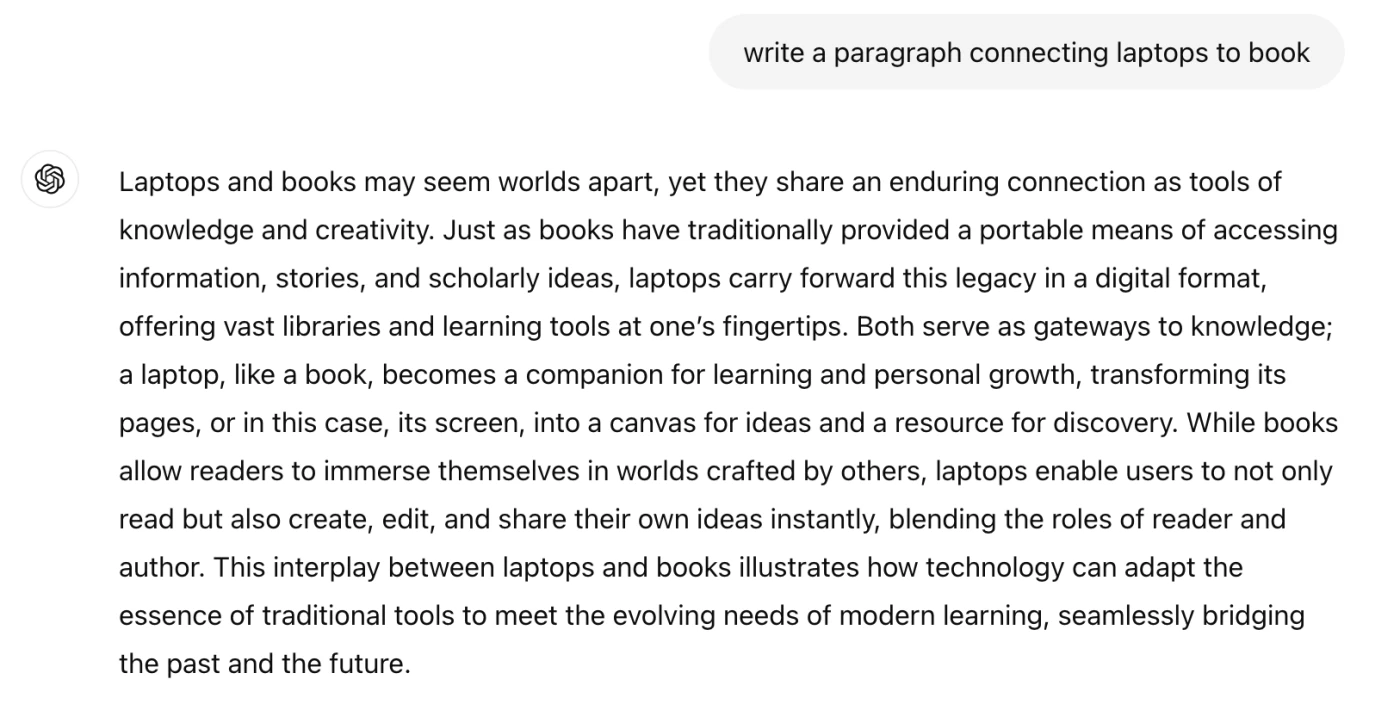
- ChatGPT is trained on more diverse datasets than other AI chatbots, which enables it to possess knowledge across a wide range of topics and generalize original data. This capability is arguably its most considerable appeal to users. ChatGPT offers greater depth than typical AI chatbots and can connect various topics effectively.
Figure 1: ChatGPT connecting laptops to books.
Multimodality
AI chatbots: Generally text-only. Advanced ones might handle images, but multimodality isn’t standard.
ChatGPT: Can process and generate responses from both text and images. You can upload a photo and ask questions about it, request captions, generate code based on a screenshot, or create alt text for accessibility.
Personalization
AI chatbots: Can personalize within their domain.
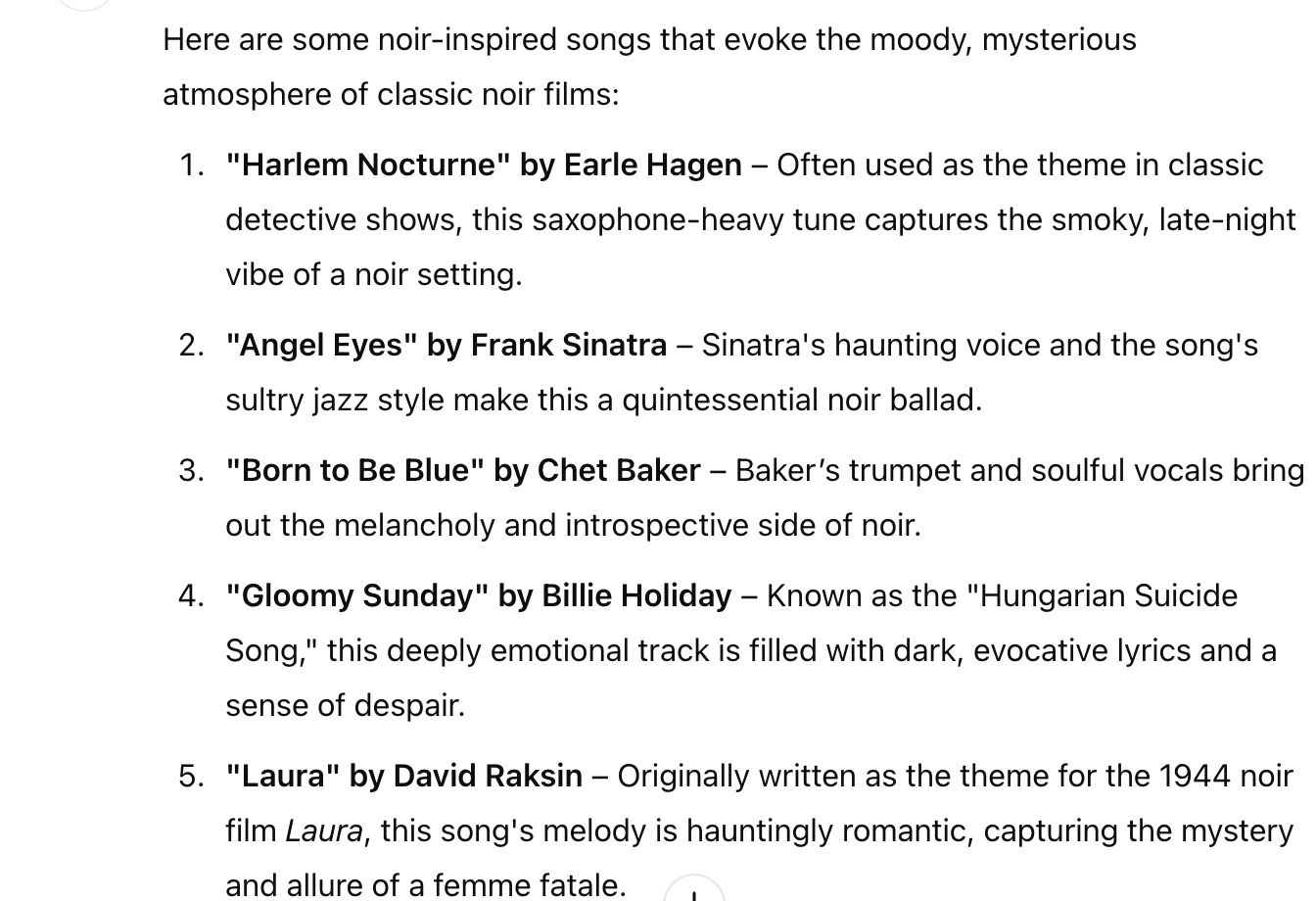
Example: A music chatbot trained on genre data can recommend songs based on your stated preferences for rock or jazz.
ChatGPT: Personalizes across domains.
Figure 2: ChatGPT making cross-references between different categories.
 Add as preferred source
FAQs
A chatbot is a software program that engages users in conversation, either by matching their input to stored responses (rule-based) or by generating replies using machine learning. The spectrum runs from simple flowchart bots to frontier generative models capable of agentic, multi-hour autonomous tasks.
Traditional chatbots retrieve pre-written answers from a fixed knowledge base. ChatGPT generates every response from scratch using a large language model trained on broad internet-scale data meaning it can handle novel questions, synthesize across domains, and reason through multi-step problems that would break any rule-based or domain-specific AI chatbot.
Further reading
Cite this research
Pick the format that matches where you're publishing. Pasting the link version into your CMS preserves the backlink.
@misc{dilmegani2026,
  author = {Dilmegani, Cem},
  title  = {{Chatbot vs ChatGPT: Differences & Features}},
  year   = {2026},
  month  = may,
  howpublished    = {\url{https://aimultiple.com/chatbot-vs-chatgpt}},
  note   = {AIMultiple. Retrieved May 4, 2026}
}Results and timestamps of 6 data points. Download the summary data shown in this article's charts and tables as a ZIP file containing one CSV file.
Want the granular data behind it? Join Premium
Changelog
9 updatesExpanded the chatbot types section with per-platform memory, reasoning tiers, and current models including GPT-5.5, Claude Opus 4.7, and Gemini 3.
Updated the "How Smart Are They Really?" section with new levels of reasoning and current model examples.
Expanded the 'Memory Implementation' data in the 'Responses can be inconsistent' section.
Reference Links
Cem's work at AIMultiple has been cited by leading global publications including Business Insider, Forbes, Morning Brew, and Washington Post, global firms like Deloitte and HPE, NGOs like World Economic Forum, and supranational organizations like European Commission. [1], [2], [3], [4], [5]
Throughout his career, Cem served as a tech consultant, tech buyer and tech entrepreneur. He advised enterprises on their technology decisions at McKinsey & Company and Altman Solon for more than a decade. He also published a McKinsey report on digitalization.
He led technology strategy and procurement of a telco while reporting to the CEO. He has also led commercial growth of deep tech company Hypatos that reached a 7 digit annual recurring revenue and a 9 digit valuation from 0 within 2 years. Cem's work in Hypatos was covered by leading technology publications like TechCrunch and Business Insider.
Cem regularly speaks at international technology conferences. He graduated from Bogazici University as a computer engineer and holds an MBA from Columbia Business School.





Comments 1
Share Your Thoughts
Your email address will not be published. All fields are required. Comments are left in their original language.
Excellent compilation !!