


See the future of large language models by comparing approaches, such as self-training, fact-checking, and sparse expertise, that could address LLM limitations.
Future trends of large language models
1- Real-Time Fact-Checking With Live Data
LLMs access external sources during conversations instead of relying on training data. The model queries external databases, retrieves current information, and provides citations.
Limitation: Still makes errors. Citations don’t guarantee accuracy; models sometimes cite sources incorrectly or misinterpret cited content.
Microsoft Copilot: Microsoft and OpenAI announced that GPT-6 Astra is available in Copilot Cowork and Copilot Studio, as well as in Microsoft Foundry and GitHub Copilot. The Researcher agent combines GPT for initial research with Anthropic’s Claude reviewing outputs for accuracy and citation quality before delivery, a 13.8% improvement on the DRACO deep-research benchmark over standalone systems.1
- ChatGPT: Searches the web when asked about recent events. Cites sources in responses.
- Perplexity: Built specifically for cited search. Every answer includes source links.
2- Synthetic training data
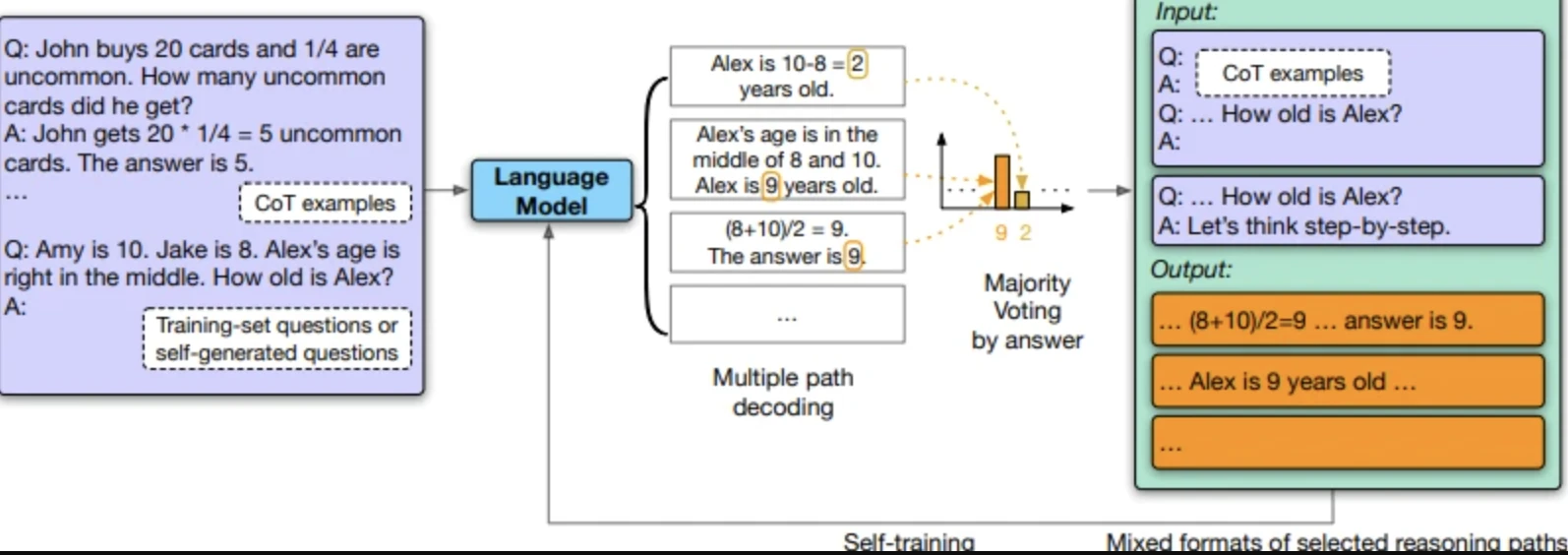
Models generate their own training datasets instead of requiring human-labeled data.
Google’s self-improving model (2023 research):
- The model creates questions
- Curates answers
- Fine-tunes itself on generated data
Performance improved: 74.2% to 82.1% on GSM8K math problems, 78.2% to 83.0% on DROP reading comprehension.
OpenAI, Anthropic, and Google are all using synthetic data to supplement human-labeled datasets. This reduces data labeling costs but introduces new bias risks; models can amplify their own mistakes.
Source: “Large Language Models Can Self-Improve”
A March 2026 survey found that 76% of AI researchers believe the gains from scaling compute and data have plateaued, with major labs reporting diminishing returns despite massive investments. The finding suggests the next leap in LLM capability is more likely to come from architectural innovation, such as improved training efficiency, sparse architectures, or reasoning improvements, than from scaling existing approaches further.2
3- Sparse Expert Models (Mixture of Experts)
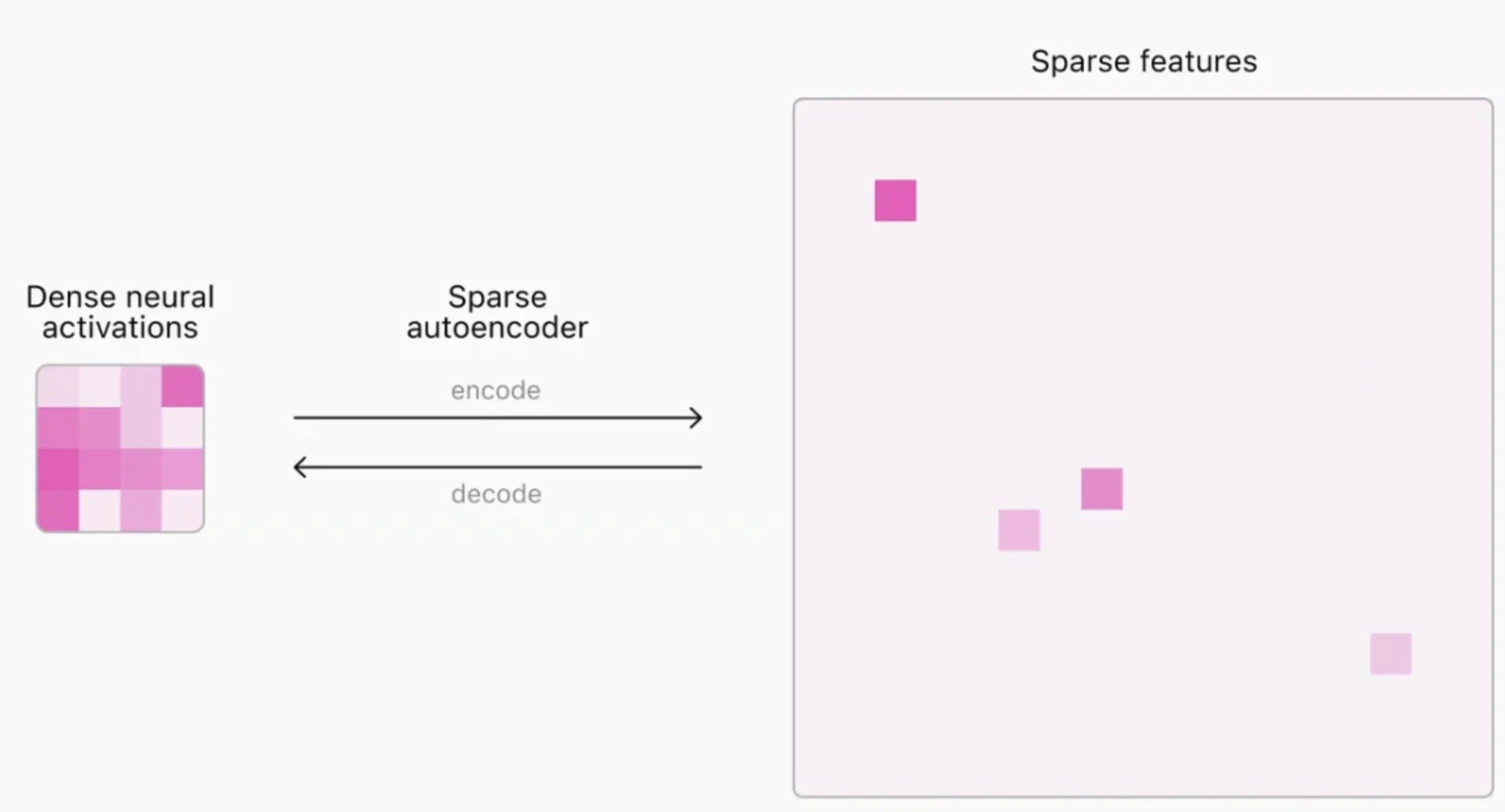
Instead of activating the entire neural network for every input, a relevant subset of parameters activates, depending on the task. The model routes input to specialized “experts” within the network. Only activated experts process the query.
Real-life examples:
- DeepSeek V4-Pro: A Mixture-of-Experts model with 1.6T total parameters and 49B activated, alongside the smaller DeepSeek-V4-Flash at 284B parameters (13B activated), both supporting a one-million-token context.3
- Qwen3.8-Max (Alibaba): Built on the Qwen 3.5 architecture, it scales to 2.4 trillion parameters with 95B active, and is the first Max-class Qwen model whose weights Alibaba committed to open-sourcing.
- Mistral Devstral 2: Purpose-built for software engineering. 123B parameters, 256K-token context window, 72.2% on SWE-bench.4A smaller variant, Devstral Small 2 (24B parameters), runs locally under Apache 2.0. Mistral’s newest model is Mistral Large 4, an open-weight multimodal MoE model with a 1M context window, launched in public preview on October 6, 2026, with weights due later this month.
4- Enterprise Workflow Integration
LLMs are embedded directly into business processes rather than used as standalone tools.
Real-life examples:
- Salesforce Agentforce (formerly Einstein Copilot): Integrates LLMs into CRM operations. Answers customer queries, generates content, and executes actions in Salesforce, grounded in the organization’s CRM data and metadata via the Einstein Trust Layer.5
- Microsoft 365 Copilot: Embedded across Word, Excel, PowerPoint, and Outlook. Drafts documents, analyzes spreadsheets, generates presentations, and summarizes email threads, drawing on company data through Microsoft Graph to ground responses in organizational context.6 The Researcher agent uses a multi-model architecture where GPT handles initial research and Claude reviews outputs before delivery the first confirmed commercial deployment of competing AI vendors inside a single enterprise product.
- Anthropic Claude for Enterprise: Project-based memory separation keeps work contexts distinct across teams. Claude Opus 4.6 introduced agent teams, allowing multiple Claude agents to split larger tasks into parallel workstreams, and integrated Claude into PowerPoint as a native side panel. Anthropic’s recommendation is to start with Claude Opus 5.5 for most workloads, and to use Claude Fable 5.1 for demanding reasoning and long-horizon agentic work.7
5- Hybrid LLMs with multimodal capabilities
Large multimodal models integrate multiple forms of data, such as text, images, and audio, enabling them to understand and generate content across different media types.
- Gemini 3.8 Flash: Google describes it as its most intelligent Flash model, built for long-horizon software engineering, autonomous agents, and complex enterprise workflows. Introductory pricing is $0.75 per million input tokens and $3.75 per million output tokens through December 31, 2026; standard pricing of $1.50 and $7.50 starts January 1, 2027. Google has restricted the older Gemini 2.5 models to users who already used them, and points new projects to 3.5 Flash-Lite or 3.8 Flash.8
- Meta Muse Spark 1.3 and Muse Glimmer: Muse Spark, introduced on April 8, 2026, replaced Meta’s Llama line. Muse Spark 1.3 has a 1M-token context window, and its weights remain closed, though Meta lists an open-weights release on its roadmap.9For open weights, Muse Glimmer is a 30-billion-parameter model with a dedicated perception encoder, distilled from Muse Spark and designed for agentic tasks on consumer hardware, released under Apache 2.0.10
Multimodal capability is standard across frontier models. The remaining challenge is consistency: models perform well on common image-text combinations but degrade on rare visual contexts, low-resolution inputs, and cross-modal reasoning that requires connecting visual and textual evidence.
6- Reasoning models
Models that think through problems step by step rather than generating immediate responses.
This shift from prediction to reasoning is critical for enabling:
- Agentic behavior, where models plan, execute, and adapt tasks autonomously.
- Interpretable AI, where outputs are step-by-step and logically sound.
- Claude 5.5 family and Fable 5.1 (Anthropic): All four models offer a 1M-token context window, 128K max output, adaptive thinking, and a June 2026 reliable knowledge cutoff. API pricing per million tokens: Fable 5.1 at $10 input / $50 output, Opus 5.5 at $4 / $20, Sonnet 5.5 at $2 / $10, and Haiku 5.5 at $0.10 / $0.50 for prompts up to 100,000 tokens.11
- GPT-6 Astra (OpenAI): Standard API pricing is $10 per million input tokens and $50 per million output tokens; a Fast mode runs up to 2x faster at 2x the price.12
7- Domain-Specific Fine-Tuned Models
Models trained on specialized data for specific industries instead of general-purpose training.
Google, Microsoft, and Meta have all released major proprietary domain-specific and fine-tuned models targeting enterprise-specific use cases in addition to their general-purpose offerings.
These specialized LLMs can result in fewer hallucinations and higher accuracy by leveraging domain-specific pre-training, model alignment, and supervised fine-tuning.
GitHub Copilot: Fine-tuned on code repositories. As of July 2025, 20 million developers use GitHub Copilot, a 400% year-over-year increase, and 90% of Fortune 100 companies use it. It autocompletes code, generates functions, and suggests bug fixes.13
BloombergGPT: 50-billion-parameter LLM trained on a 363-billion-token dataset of Bloomberg financial documents, outperforming models of comparable size on financial NLP benchmarks, including sentiment analysis, named entity recognition, and question answering.14
Google’s Med-PaLM 2: Fine-tuned on medical datasets, reached 85%+ accuracy on U.S. Medical Licensing Examination (USMLE)-style questions, the first LLM to reach expert-level performance on this benchmark. It powers MedLM, Google Cloud’s family of healthcare foundation models.15
ChatLAW: An open-source language model specifically trained on Chinese legal domain datasets.16
8- Ethical AI and bias mitigation
- Anthropic and OpenAI conducted a mutual alignment evaluation in mid-2025, testing each other’s public models for sycophancy, whistleblowing tendencies, and self-preservation behaviors. The exercise found sycophancy in all models tested, including cases where models validated harmful decisions from simulated users exhibiting delusional beliefs. Anthropic subsequently developed the Bloom testing framework specifically to benchmark this behavior in new models.
- Anthropic also released Claude Mythos Preview (Project Glasswing) an invitation-only model made available to a small set of organizations specifically to find and fix cybersecurity vulnerabilities in major operating systems and web browsers. Anthropic has stated it does not plan to make this model available. The controlled-access approach represents a new framework for deploying highly capable specialist models where the risk profile requires restricted rollout. Anthropic’s API pricing page also lists Claude Mythos 5.1 among its additional models, at $10 input / $50 output per million tokens.
- Google DeepMind: Published “The Ethics of Advanced AI Assistants,” offering the first systematic treatment of ethical and societal questions raised by AI agents, covering value alignment, manipulation risks, anthropomorphism, privacy, and equity. The company’s Responsible AI evaluation included over 350 adversarial red-team exercises and introduced a new Critical Capability Level specifically for harmful manipulation, treating it as a frontier-level risk alongside cyberattacks and CBRN threats.
Limitations of large language models (LLMs)
1- Hallucinations
Models generate plausible-sounding but incorrect information.
The Vectara hallucination leaderboard is the industry’s most widely referenced grounded summarization benchmark. On the original Vectara dataset, Google’s Gemini models consistently occupy the top positions, with Gemini Flash variants achieving under 1% hallucination rates. OpenAI’s GPT family clusters between 0.8% and 2.0%.
Vectara launched a significantly harder benchmark in late 2025 7,700 articles (up from 1,000), longer documents up to 32K tokens, and content spanning law, medicine, finance, and technology. The findings on the new dataset reveal a counterintuitive pattern: reasoning and thinking models that excel at complex tasks frequently hallucinate more on grounded summarization than smaller, faster models. Most thinking-class models show hallucination rates above 10% on the harder dataset, while lighter models like Gemini Flash variants maintain lower rates.17
Note: No single benchmark gives a definitive “hallucination rate” for any model. A responsible evaluation cross-references at least two benchmarks measuring different things: one grounded task (Vectara), one open-ended knowledge task, and specifies the exact model version and calling conditions.
All models hallucinate. Frequency has reduced substantially from approximately 21% in 2021 to under 5% for the best performers on standard benchmarks, but is not eliminated. Critical applications still require human verification.
2- Bias
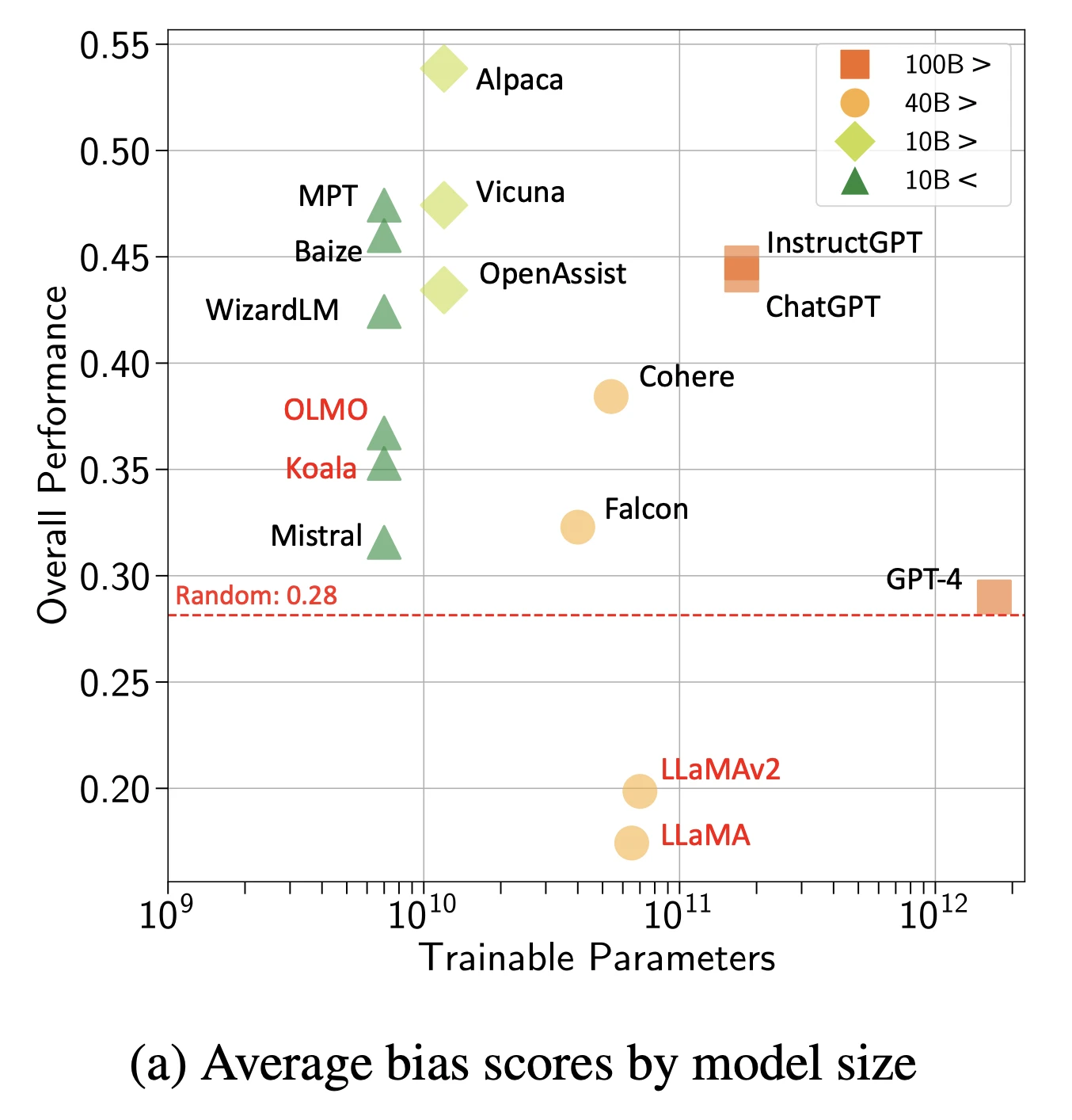
Models absorb and amplify social biases from training data.
Source: Overall bias scores by models and size.18
Types of bias observed:
- Gender bias in occupation suggestions
- Racial bias in resume screening simulations
- Age bias in healthcare recommendations
- Socioeconomic bias in educational content
3- Toxicity
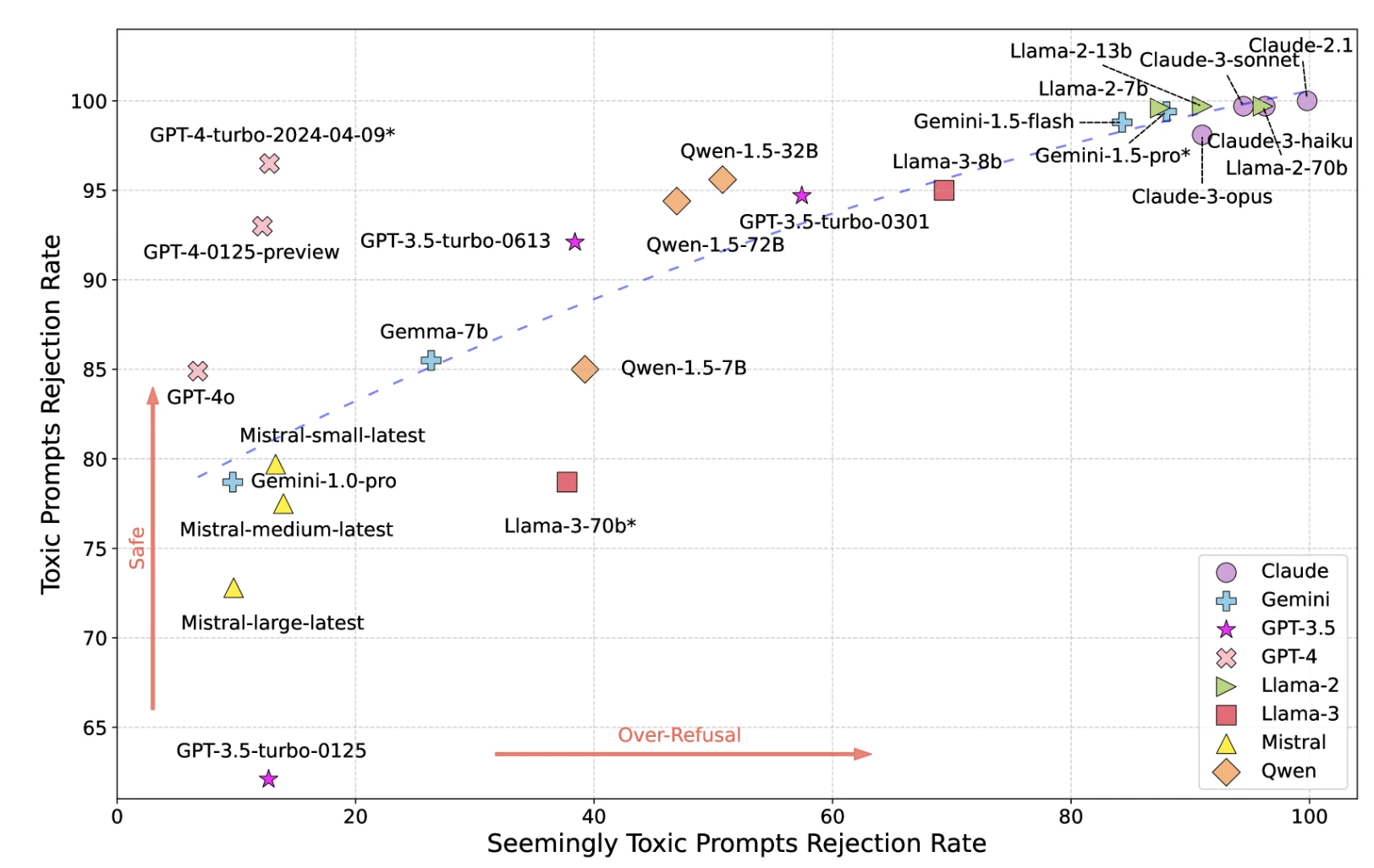
Models may generate harmful, offensive, or toxic content despite safety measures.
Source: LLMs’ toxicity map from UCLA, UC Berkeley Researchers19
*GPT-4-turbo-2024-04-09*, Llama-3-70b*, and Gemini-1.5-pro* are used as the moderator, the results could be biased on these 3 models.
Strict safety measures reduce toxicity but increase false positives (refusing harmless requests). Loose measures allow toxicity through.
4- Context Window Limitations
Every model has a fixed memory capacity the number of tokens it can process in a single session. Exceed that limit, and the model either truncates earlier content or refuses the request. The practical gap between models is wide enough to matter for real workloads.
- Llama 4 Scout (Meta): 10M tokens, the largest context window among major open-weight releases. Meta has since moved its frontier work to the Muse line, so Scout is no longer being updated.
- Claude Opus 5.5, Sonnet 5.5, Haiku 5.5, Fable 5.1: 1M-token context window and 128K max output across all four. Claude 4.6 and later models (except Haiku 5.5) bill the full 1M window at standard rates.
- GPT-6.1 Sol: 1,050,000-token context window. OpenAI charges higher rates for long-context requests on its flagship models.20
- Gemini 4 Argon: Google raised the output token limit to 1M tokens, up from 64K.21
- DeepSeek V4.1 Flash and V4-Pro: 1M context, up to 384K output.22
A large context window does not automatically mean better performance across it. Recall degrades toward the middle of long contexts on most models, and costs scale with input length processing 1M tokens costs significantly more than processing 10K tokens on the same model. For most production workloads, the practical question is not which model has the largest window, but which model retrieves reliably at the context lengths your use case actually requires.
5- Static Knowledge Cutoff
Models rely on pre-trained knowledge with a specific cutoff date. Don’t have access to information after training unless connected to external sources.
Problems:
- Outdated information on current events
- Inability to handle recent developments
- Less relevance in dynamic domains (technology, finance, medicine)
Solution: Web search integration. ChatGPT, Claude, and Perplexity all offer real-time search. But search doesn’t eliminate hallucinations; models sometimes misinterpret search results.
Major LLM Platforms
GPT-6
GPT-6 Astra became available to the general public on September 4, 2026; GPT-6 Sol and GPT-6 Luna followed on September 22, 2026.
Its biggest improvements are in coding, computer use, scientific reasoning, and cybersecurity, with particularly large gains on difficult problem-solving benchmarks. It also follows instructions more reliably and makes fewer mistakes.
GPT-6.1 Sol is available to Plus, Pro, Business, Enterprise, and Edu users through ChatGPT Work and Codex, but not yet in regular ChatGPT conversations; developers access it as gpt-6.1-sol.
API pricing (standard, per million tokens): gpt-6-astra $10 input / $50 output; gpt-6.1-sol $2 / $10; gpt-6-luna $0.10 / $0.50.
Limitations: Astra shares the highest base price in this list with Claude Fable 5.1, at $10/$50 per million tokens. OpenAI says Astra meets the Critical cybersecurity threshold under its Preparedness Framework, and the launch version refuses advanced cyber tasks such as writing proof-of-concept exploits. Still hallucinates, and still needs web search for anything after its training cutoff.12
Claude Fable 5.1 / Opus 5.5 / Sonnet 5.5 / Haiku 5.5
Anthropic positions Fable 5.1 for demanding reasoning and long-horizon agentic work, Opus 5.5 for long-running agentic coding and knowledge work, Sonnet 5.5 as the speed-intelligence balance, and Haiku 5.5 for high-volume, latency-sensitive tasks like classification and routing.
Pricing per million tokens: Fable 5.1 $10/$50, Opus 5.5 $4/$20, Sonnet 5.5 $2/$10, Haiku 5.5 from $0.10/$0.50.
Limitations: Claude 4.7 and later models use a newer tokenizer that produces roughly 30% more tokens for the same text, which raises effective cost compared with list prices.
Gemini 3.8 Flash / Gemini 4 Argon
Google introduced Gemini 3.8 Flash, a faster, lower-cost model focused on complex coding, autonomous workflows, and reasoning, alongside Flash Cyber, a specialized cybersecurity model.
Flash scores 54.9% on HLE-Verified and costs $0.75 per million input tokens and $3.75 per million output tokens until the end of 2026, though complex tasks may consume more tokens.
Flash Cyber achieves over 70% success on Google’s internal vulnerability-discovery benchmark and 47.2% on an external patching benchmark, with access restricted to trusted defenders.
Pricing: $0.75 per million input tokens and $3.75 per million output tokens.23
Google’s Gemini 4 Argon focuses on complex, long-running tasks in software engineering, finance, legal work, and cybersecurity. It supports up to 1 million output tokens, scores 77.9% on DeepSWE and 51.3% on AutomationBench, and can autonomously discover and patch security vulnerabilities. Google reports using it internally for large-scale code migrations and data-center optimizations.
Pricing starts at $2 per million input tokens and $10 per million output tokens, doubling after the introductory period. Access is currently restricted to trusted testers and cybersecurity defenders.21
Meta Muse Spark 1.3 / Muse Glimmer
Meta’s Muse Spark 1.3 focuses on improving AI agents for long, complex workflows and coding tasks. Compared with version 1.2, Meta’s internal engineering tests show 20% fewer tool calls and 25% fewer tokens for coding tasks. Meta also reports improved resistance to prompt injections and better judgment around irreversible actions.
The model is available through Muse Code and, the Meta Model API, with open weights planned for a future release.24
Open weights: Muse Glimmer is a 30B-parameter open model, Apache 2.0 licensed, that runs on a single GPU and is tuned for tool use, long tasks, and failure recovery.
Who uses it: Muse Spark suits teams already in Meta’s ecosystem who want API access. Muse Glimmer suits on-premise and local deployments, and developers avoiding vendor lock-in.
Limitations: Muse Spark’s weights are closed. Llama 4 models remain downloadable but are no longer Meta’s frontier line.
DeepSeek V4
V4-Pro is a Mixture-of-Experts model with 1.6T total parameters and 49B activated, with a one-million-token context.
On September 10, 2026, DeepSeek released V4.1-Flash, the smallest model in its architecture family, with native multimodal visual understanding. V4.1 Flash supports vision, but V4-Pro does not.25
API pricing (per million tokens, peak hours): V4.1 Flash costs $0.30 input (cache miss) and $1.20 output; V4-Pro costs $1.32 input and $3.96 output. Off-peak rates are half the peak rates.22
Cite this research
Pick the format that matches where you're publishing. Pasting the link version into your CMS preserves the backlink.
@misc{dilmegani2026,
  author = {Dilmegani, Cem and Ermut, Sıla},
  title  = {{The Future of Large Language Models}},
  year   = {2026},
  month  = jun,
  howpublished    = {\url{https://aimultiple.com/future-of-large-language-models}},
  note   = {AIMultiple. Retrieved June 25, 2026}
}
Changelog
12 updatesRemoved the hallucination benchmark chart for popular LLMs.
Added a benchmark methodology section detailing models tested and scoring.
Replaced GPT-5.2, Gemini 3.1 Pro and DeepSeek V3.2 with GPT-5.5, Gemini 2.5 Pro, DeepSeek V4 and Claude Opus 4.7.
Updated the 'Real-life examples' data in the 'Domain-Specific Fine-Tuned Models' section.
Updated the "Future trends of large language models" section with new real-time fact-checking examples.
Reference Links

Cem's work at AIMultiple has been cited by leading global publications including Business Insider, Forbes, Morning Brew, and Washington Post, global firms like Deloitte and HPE, NGOs like World Economic Forum, and supranational organizations like European Commission. [1], [2], [3], [4], [5]
Throughout his career, Cem served as a tech consultant, tech buyer and tech entrepreneur. He advised enterprises on their technology decisions at McKinsey & Company and Altman Solon for more than a decade. He also published a McKinsey report on digitalization.
He led technology strategy and procurement of a telco while reporting to the CEO. He has also led commercial growth of deep tech company Hypatos that reached a 7 digit annual recurring revenue and a 9 digit valuation from 0 within 2 years. Cem's work in Hypatos was covered by leading technology publications like TechCrunch and Business Insider.
Cem regularly speaks at international technology conferences. He graduated from Bogazici University as a computer engineer and holds an MBA from Columbia Business School.

She previously worked as a recruiter in project management and consulting firms. Sıla holds a Master of Science degree in Social Psychology and a Bachelor of Arts degree in International Relations.




Comments 1
Share Your Thoughts
Your email address will not be published. All fields are required. Comments are left in their original language.
Insightful read! The future of large language models looks incredibly promising. It’s exciting to see how they’ll keep transforming the way we work and communicate. Loved the detailed explanation in the article.