


Large Quantitative Models: Applications & Challenges

Modern systems are becoming too complex for traditional statistical analysis, as institutions now handle massive datasets, including patient, weather, and financial market data.
Large quantitative models (LQMs) help by processing these datasets, integrating structured and unstructured data, and applying predictive modeling to uncover patterns and provide data-driven insights that traditional methods cannot deliver.
Discover what large quantitative models are, the key problems they tackle, real-life examples, and the future of LQMs.
Large Quantitative Models (LQMs) vs Large Language Models (LLMs)
Large Quantitative Models (LQMs) and Large Language Models (LLMs) both rely on advanced neural networks; however, their data focus, learning approaches, and core uses set them apart.
Aspect | Large Quantitative Models (LQMs) | Large Language Models (LLMs) |
|---|---|---|
Primary focus | Structured numerical data and quantitative problems | Unstructured text and language-based tasks |
Typical data | Financial metrics, scientific measurements, molecular data, sensor data | Text corpora, documents, conversations, articles, code, and other language data |
Core uses | Forecasting, risk assessment, scenario simulation, anomaly detection, scientific modeling | Chatbots, summarization, translation, question answering, content creation |
Learning approach | Combine probabilistic modeling, simulations, and generative methods such as VAEs or GANs | Transformer architectures to learn context, syntax, semantics, and meaning |
Strengths | Precision, numerical reasoning, synthetic data generation, modeling real-world systems | Language understanding, coherent text generation, reasoning over written content |
Best suited for | Finance, science, healthcare, engineering, logistics, and other quantitative domains | Communication, research assistance, writing, education, coding, and conversational AI |
How are LQMs built and used?
Building LQMs involves integrating data usage, computational resources, and expertise across multiple disciplines.
- Data requirements: Massive datasets are essential, including historical data, training data, and synthetic data to strengthen model reliability. These models often need strict access controls to maintain data integrity and prevent biased data from influencing outcomes.
- Computational infrastructure: High-performance systems, often enhanced by advanced AI systems and optimization algorithms, are required for performing complex calculations and processing large datasets.
- Collaboration: Interdisciplinary teams of scientists, economists, engineers, and domain experts work together, combining statistical methods, numerical analysis, and contextual and interpretive abilities.
Monte Carlo simulation as part of Large Quantitative Models
Monte Carlo simulation is a computational method that uses repeated random sampling to estimate the probability of different outcomes in uncertain situations.
Monte Carlo simulations are utilized in various fields, including artificial intelligence, finance, project management, and pricing. Unlike models with fixed inputs, these models incorporate probability distributions, allowing for sensitivity analysis to examine how inputs affect outcomes and correlation analysis to understand the relationships between variables.
How does the simulation work?
Instead of relying on fixed values, Monte Carlo simulation draws random values from probability distributions and recalculates results repeatedly. Thousands of runs generate a range of likely outcomes, each with its corresponding probability.
For example, rolling two dice has 36 possible combinations. A Monte Carlo experiment can simulate thousands of rolls to produce accurate estimates of outcome probabilities. This repetitive process also makes the method effective for long-term forecasting.
Steps in using Monte Carlo methods
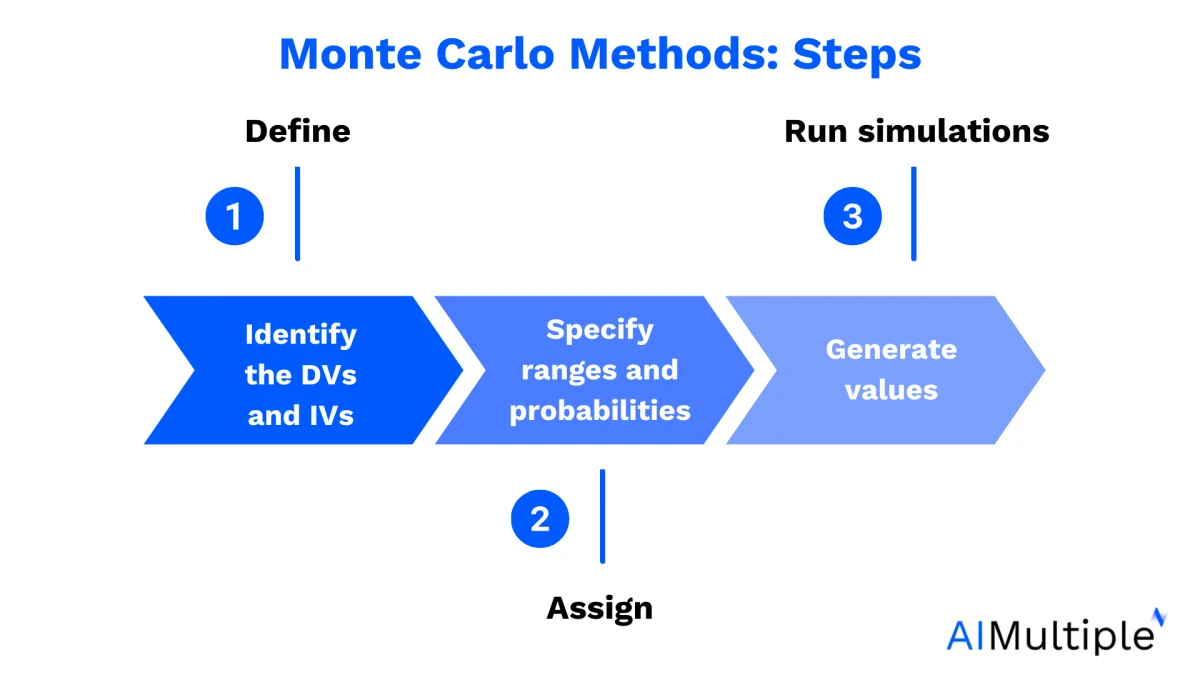
Monte Carlo techniques typically follow three steps:
- Define the model: Identify the outcome (dependent variable) and the inputs or risk factors (independent variables).
- Assign probability distributions: Use historical data or expert judgment to specify ranges and probabilities for each input.
- Run simulations: Generate random values for inputs and record results until a representative set of outcomes is obtained.
The results can be analyzed using variance and standard deviation, which indicate the spread of outcomes. Smaller variances suggest more consistent predictions.
What problems can LQMs solve?
Large quantitative models are particularly valuable in domains that rely on large-scale numerical datasets, predictive modeling, and quantitative analysis.
Finance
Financial institutions rely on accurate tools to manage risk assessment and market forecasting. LQMs use market data, historical data, and even synthetic data to identify patterns that may not be visible with standard statistical methods.
They enable financial analysts to conduct scenario analysis and provide valuable insights into investment strategies and potential crises. This allows institutions to extract critical data from complex datasets and enhance their decision-making.
Healthcare
In medicine, the ability to analyze patient data accurately is critical. LQMs can process vast datasets of patient records, training data, and clinical trial outcomes to support drug discovery, predict disease progression, and evaluate treatment effectiveness.
For example, GPT-Rosalind is OpenAI’s life sciences AI model designed to support research in biology, chemistry, genomics, drug discovery, and translational medicine. It helps scientists review literature, analyze biological data, connect findings across studies, and generate stronger research hypotheses.
In real-world use, organizations such as Amgen, Moderna, Novo Nordisk, Benchling, NVIDIA, Oracle Health and Life Sciences, and UCSF are exploring how it can support tasks like drug target evaluation, genomics interpretation, protein engineering, and experiment planning.1
Environmental planning
Climate change, sustainability applications, and ecological systems involve massive datasets and complex calculations. LQMs can integrate weather data, satellite imagery, and environmental models to perform scientific simulations that forecast natural disasters, assess resource sustainability, and identify potential risks.
Policy and logistics
Governments and organizations face challenges in allocating resources, planning infrastructure, and managing crises. By using scenario analysis with large quantitative models, decision-makers can test strategies under various conditions, optimize supply chains, and anticipate potential disruptions. LQMs process data inputs from multiple sources to provide realistic data and practical insights for handling even more complex challenges.
LQMs real-life examples
SandboxAQ’s enterprise LQMs
SandboxAQ has developed large quantitative models that focus on solving quantitative problems in enterprise environments. Unlike large language models, SandboxAQ’s approach is grounded in physics, chemistry, and mathematics. These models process input data, perform complex calculations, and provide predictive modeling that supports decision-making across industries.
In June 2025, SandboxAQ launched the Structurally Augmented IC50 Repository (SAIR), an open dataset containing about 5.2 million cofolded structures covering 1,048,857 unique protein-ligand systems, with each complex annotated with experimental binding affinity data (e.g., IC50) and structural fidelity evaluated using the PoseBusters tool to support benchmarking and model evaluation.2
Optimization in enterprise AI
SandboxAQ’s LQMs are designed to optimize for specific objectives, such as improving material properties, forecasting battery life, or enhancing cybersecurity. Instead of extracting patterns from natural language, these models generate quantitative data directly from physical and scientific principles. This enables enterprises to leverage the strengths of quantitative analysis in domains where complex systems cannot be fully understood through text or historical data alone.3
Key use cases across industries
- Materials science: SandboxAQ uses its AQChemSim platform to explore large-scale numerical datasets of chemical compositions. By running scientific simulations, the model identifies new materials that meet engineering requirements, reducing the need for costly trial-and-error in laboratories.
- Battery development: In partnership with industrial firms, SandboxAQ utilizes LQMs to predict the performance of lithium-ion batteries. The models process training data from experiments and provide insights into battery degradation, cutting prediction times from months to days and improving accuracy with less data usage.
- Drug discovery: AQAffinity is designed to predict protein–ligand binding affinity, a key step in early drug discovery. Built on OpenFold3, it can estimate drug potency directly from sequence data without requiring experimentally determined protein structures, enabling faster large-scale screening of drug candidates. This helps researchers prioritize promising compounds earlier and reduce costly laboratory experiments.
- Cybersecurity: The AQtive Guard platform applies LQMs to encryption management and risk assessment. By mapping cryptographic assets and analyzing usage patterns, it can identify potential risks and automate remediation. The platform also provides AI Security Posture Management (AI-SPM) to detect and manage shadow AI deployments across enterprises.
- Energy and navigation: SandboxAQ also applies LQMs in energy systems, using computational fluid dynamics to optimize industrial processes and reduce emissions. In navigation, the models process magnetic field data and provide location services without relying on GPS, which can be critical in defense or remote operations.
Boltz PBC for protein structure prediction, binding affinity, and drug design
Boltz is an AI infrastructure platform for computational drug discovery that uses biomolecular foundation models and AI agents to design molecules, predict protein interactions, and help pharmaceutical researchers identify promising drug candidates.4
- Small-molecule drug discovery: AI agents screen large chemical spaces to identify promising drug-like molecules. Researchers can prioritize compounds likely to bind to a biological target before synthesis or testing.
- Protein and biologics design: The platform can design or optimize proteins that bind specific targets, enabling biologics such as antibodies and engineered proteins.
- Molecular structure and interaction prediction: Boltz models predict 3D biomolecular structures and binding affinity, helping scientists understand how molecules interact and whether a drug candidate will be effective.
- AI-driven preclinical research workflows: Pharmaceutical teams can integrate their experimental data into the system to iteratively refine drug candidates and guide early-stage discovery programs.
Energy-based reasoning: Kona 1.0 (Logical Intelligence)
Kona 1.0 is an AI reasoning system developed by Logical Intelligence based on Energy-Based Models (EBMs).
The system analyzes all possible states simultaneously, scoring them based on whether they satisfy defined rules or constraints. Rather than predicting the most likely output (as LLMs do), Kona identifies solutions that are mathematically consistent with the system’s constraints, enabling deterministic and verifiable decision-making.
Logical Intelligence positions Kona as a foundational layer beneath modern AI stacks, ensuring that automated systems act within verified boundaries before executing actions.5
Key idea: Constraint-based reasoning
Kona’s architecture is designed for constraint satisfaction problems, in which a solution must satisfy many rules simultaneously. It evaluates candidate solutions and adjusts them until all constraints are satisfied, rather than generating answers step-by-step, as language models do.
For example, in a Sudoku benchmark, Kona solved 96% of hard puzzles, while tested LLMs solved about 2%, illustrating its advantage in structured reasoning tasks.
Kona use cases
- Autonomous systems: Robotics control, autonomous infrastructure and vehicles, and Safety-critical automation where systems must obey strict operational constraints.
- Industrial and infrastructure control: Energy grid optimization, industrial control systems, and complex operational workflows requiring valid configurations.
- Finance and trading: High-frequency trading systems and financial decision engines where rule compliance and risk constraints must be guaranteed.
- Engineering and system design: Chip design and robotics firmware.
Digital twins in healthcare: testing treatments before surgery
Digital twins in healthcare can be viewed as a specialized application of LQMs because:
- They rely on structured datasets (MRI scans, sensor data, lab results).
- They combine probabilistic and physics-based simulations, which are central techniques in LQMs.
- They are used to generate predictions and run “what if” experiments (core purposes of quantitative modeling).
Researchers are developing digital replicas of patients’ organs, known as digital twins, to test medical treatments before implementing them in real-life scenarios. These computational models utilize data from medical exams, wearable devices, and imaging scans to simulate how an individual’s body may respond to various interventions, including drugs, surgery, or other treatments.
Digital twins for irregular heartbeat treatment
At Johns Hopkins University, researchers developed personalized digital models of patients’ hearts to help treat ventricular tachycardia, a dangerous heart rhythm disorder that can lead to sudden cardiac arrest.
These digital twins are built using advanced cardiac imaging and patient-specific data. The model shows how electrical signals move through the heart and where they become trapped or disrupted by damaged tissue. Doctors can then test treatment strategies virtually before applying them to the patient.
How the process works
The main treatment for ventricular tachycardia is ablation, a procedure where doctors burn small areas of heart tissue that are causing abnormal electrical activity. Traditionally, this process can involve trial and error, as doctors search for the right tissue to target during the procedure.
With a digital twin, doctors can simulate ablation in advance. The model helps identify the most important areas to treat and shows whether targeting those areas may stop the irregular rhythm or create new problems.
Challenges
Although the early results are promising, the study was small. The technology was tested in 10 patients, and larger studies are needed before it can become widely used in hospitals.
Researchers are also exploring whether digital twins can support treatment for other conditions, including atrial fibrillation and cancer care.6
What are large quantitative models (LQMs)?
Large quantitative models (LQMs) are advanced computational frameworks that combine scientific equations, quantitative data, and computational simulations to represent real-world systems.
Unlike traditional quantitative models, which often rely on simplified statistical methods or historical data alone, LQMs integrate large-scale numerical datasets and complex calculations to generate quantitative data and simulate outcomes under a wide range of conditions.
- Traditional models are usually limited to narrow contexts and use straightforward statistical analysis.
- Large quantitative models LQMs incorporate input data from multiple disciplines such as physics, economics, and biology, enabling them to handle massive datasets and perform complex data-driven insights that simpler statistical modeling cannot achieve.
This distinction makes LQMs more adaptable for predictive modeling in areas where uncertainty and interdependent variables dominate.
Why are LQMs important now?
- Traditional quantitative models are inadequate for analyzing vast datasets required for accurate scenario analysis.
- With advances in artificial intelligence, neural networks, and advanced machine learning techniques, it has become possible to build models that can process data.
- Financial institutions, healthcare organizations, and scientific research teams face even more complex challenges that require sophisticated predictive analytics.
 Add as preferred source
The limitations of large quantitative models
Despite their strengths, large quantitative models face limitations:
- Dependence on data integrity: If the input data contains biased data or poor-quality information, the resulting predictions and numerical reasoning will be flawed.
- Assumption sensitivity: Statistical modeling and numerical analysis depend heavily on underlying assumptions, which may not fully reflect real-world complexities.
- Uncertainty: Even with advanced AI systems and large datasets, uncertainty in complex systems cannot be eliminated. Predictive modeling can highlight future trends, but cannot ensure precise outcomes.
- Resource intensity: Handling massive datasets requires high computational power, specialized expertise, and ongoing maintenance.
FAQs
The question of whether to fear or embrace large quantitative models hinges on their ethical and societal implications.
– Potential misuse: Financial institutions may use LQMs to manipulate market data or extract critical information for an unfair advantage. In healthcare, misuse of patient data without strict access controls can compromise data integrity and privacy.
– Value when used responsibly: When managed with proper governance, strict access controls, and transparency, LQMs can provide reliable insights and identify potential risks in ways that improve decision-making across sectors.
Rather than fearing LQMs, it is more practical to adopt a balanced perspective:
– Recognize their strengths in quantitative analysis, predictive modeling, and performing complex calculations.
– Remain aware of the risks associated with data inputs, biased data, and the misuse of large datasets.
With thoughtful application and consideration of ethical implications, LQMs can serve as practical tools to address complex challenges rather than posing threats to fairness or accountability.
Future trends indicate the integration of LQMs with advanced AI systems, quantum computing, and natural language processing (NLP) capabilities.
– AI technologies: By utilizing advanced machine learning techniques, neural networks, and natural language understanding, LQMs will expand their contextual and interpretive abilities.
– Quantum computing: Future systems may enhance scenario analysis and optimization algorithms by performing complex calculations more efficiently and on a larger scale.
– Synthetic data: Generating realistic data can help overcome limitations in data availability and privacy, especially when analyzing sensitive patient data or financial data.
Cite this research
Pick the format that matches where you're publishing. Pasting the link version into your CMS preserves the backlink.
@misc{ermut2026,
  author = {Ermut, Sıla},
  title  = {{Large Quantitative Models: Applications & Challenges}},
  year   = {2026},
  month  = jun,
  howpublished    = {\url{https://aimultiple.com/large-quantitative-models}},
  note   = {AIMultiple. Retrieved June 25, 2026}
}Results and timestamps of 6 data points. Download the summary data shown in this article's charts and tables as a ZIP file containing one CSV file.
Want the granular data behind it? Join Premium
Changelog
2 updatesAdded GPT-Rosalind, OpenAI's life sciences model, to the Healthcare section.
Removed the 'What are large quantitative models (LQMs)?' section.
Reference Links
She previously worked as a recruiter in project management and consulting firms. Sıla holds a Master of Science degree in Social Psychology and a Bachelor of Arts degree in International Relations.





Be the first to comment
Your email address will not be published. All fields are required. Comments are left in their original language.