


Generative AI Copyright: Law & Litigation

We reviewed court decisions, regulatory actions, and licensing agreements to answer three key questions about generative AI and copyright.
- Can copyright-protected data be used to train AI? There is no uniform legal approach. In the US, courts apply fair use on a case-by-case basis. District courts have reached different results depending on the purpose of the use, how the material was obtained, and its effect on existing markets.
- Are AI-generated works eligible for copyright protection? The answer depends on the jurisdiction. US copyright law requires human authorship. Some other countries have specific rules for computer-generated works.
- Who owns copyright in AI-generated work? Ownership depends on whether copyright exists and who the law recognizes as the author. No court has recognized an AI system itself as a copyright author.
1. Can copyright-protected data be used as training data?
United States
Sony Music Publishing and Warner Chappell sue Anthropic
In August 2026, Anthropic faced further copyright litigation from major music publishers. Sony Music Publishing and Warner Chappell filed suit in August 28, following an August action by Round Hill Music.1
Concord and UMG seek more than $3 billion from Anthropic
In January 2026, BMG and a group led by Concord Music Group and Universal Music Group also sued Anthropic.2
The Concord/UMG-led complaint alleges that Anthropic unlawfully obtained more than 20,000 copyrighted songs, lyrics, compositions, and sheet-music works. The plaintiffs claim potential statutory damages exceeding $3 billion.
Bartz v. Anthropic on AI training fair use
In Bartz v. Anthropic, the Northern District of California held that Anthropic’s use of books to train its models was fair use. The court separately held that acquiring and retaining millions of pirated books for a central library was not protected by fair use.
In July 2026, Judge Araceli Martínez-Olguín granted final approval of the $1.5 billion settlement in Bartz v. Anthropic and entered final judgment. Class counsel reported claims covering at least 91.3% of eligible works, while 350 valid opt-outs covered 1,802 works. The court rejected the requested $187.5 million attorney-fee award and approved approximately $101.56 million.3
The settlement resolves specified claims involving works included in the settlement class. It does not authorize future training or resolve separate claims involving model outputs or other copyrighted works.
Third Circuit reviews AI-training fair use
In June 2026, the Third Circuit heard oral argument in Thomson Reuters v. Ross Intelligence. The case is the first federal appellate proceeding to address whether using copyrighted material to develop an AI system qualifies as fair use. The panel focused on transformativeness and market harm. As of September 2026, no appellate decision has been issued.4
California AB 2013 requires training-data disclosures
California AB 2013 took effect in January 2026. Developers must publish information about the datasets used to train generative AI systems. Required disclosures include dataset sources, data types, whether copyrighted material is included, whether datasets were licensed or purchased, and whether they contain personal information.5
Kadrey v. Meta on AI training
In Kadrey v. Meta, another federal court rejected the plaintiffs’ infringement claims based on the evidence presented, including because they did not establish sufficient market harm.6
These rulings do not establish a general rule that all AI training is fair use.
France
France’s competition authority (Autorité de la concurrence) fined Google €250 million for using news articles without permission in training Gemini. This was a regulatory enforcement action, not a copyright ruling.7.
United Kingdom
UK government on removing protection for computer-generated works
In March 2026, the UK government published its report on copyright and artificial intelligence.
The report proposes removing the special copyright protection for computer-generated works under Section 9(3) of the Copyright, Designs and Patents Act. The provision remains in force unless Parliament changes the law.8
Getty v. Stability AI on model-weight infringement claim
In Getty Images v. Stability AI, the UK High Court rejected Getty’s secondary copyright infringement claim concerning Stable Diffusion model weights. The court did not consider the model itself to be an infringing copy for that claim.9
European Union
CJEU and its first generative AI copyright case
The Court of Justice of the European Union is considering Like Company v. Google Ireland, Case C-250/25. The Grand Chamber held oral arguments in March 2026.
The case addresses whether LLM training involves copyright-relevant reproduction, whether the EU text-and-data-mining exception can apply, and when chatbot outputs containing protected material may infringe copyright. As of September 2026, the case remains pending.10
Article 53 GPAI copyright compliance
Article 53 of the EU AI Act requires providers of general-purpose AI models to maintain a policy for complying with EU copyright law.
Providers must also publish a sufficiently detailed summary of the content used for training and address rights reservations made under Article 4(3) of the Digital Single Market Directive.11
Germany
GEMA wins copyright case against Suno
In July 2026, the Munich Regional Court ruled that AI music company Suno infringed copyrights in songs represented by German collecting society GEMA.
The court found that Suno lacked permission to process the protected songs and ordered the company to disclose revenue linked to the infringement.12
GEMA wins lyrics case against OpenAI
The Suno decision followed GEMA’s November 2025 judgment against OpenAI concerning copyrighted song lyrics reproduced through ChatGPT. OpenAI has appealed that decision to the Munich Higher Regional Court.13
Japan
Japan adopts generative AI transparency principle code
In August 2026, Japan’s Intellectual Property Strategy Headquarters published its Principle Code for the Protection of Intellectual Property and Transparency for the Appropriate Use of Generative AI.14
The Principle Code is non-binding and follows a comply-or-explain approach. It encourages AI businesses to disclose information about training processes, dataset categories, and data-collection methods.
Japan’s Copyright Act contains an exception that can permit the use of copyrighted works for information analysis, including some AI training.
The exception is subject to statutory limits, including whether the use allows enjoyment of the work’s expressive content and whether it unreasonably harms the copyright holder’s interests.
Singapore
Singapore on AI and copyright
In August 2026, Singapore’s Ministry of Law and Intellectual Property Office launched a public consultation on AI and intellectual property.
The consultation covers the computational data analysis exception, copyright-risk management when AI systems are deployed, and the role of human creativity in AI-assisted works.15
2. Are AI-generated works eligible for copyright protection?
India Rejects DABUS as an Author
In August 2026, India’s Copyright Office rejected Stephen Thaler’s application to register the DABUS-generated image “A Recent Entrance to Paradise”.16
The Copyright Office found that the image met India’s originality threshold but concluded that DABUS could not legally be recognized as the author.
Under Section 2(d)(vi) of India’s Copyright Act, the author of a computer-generated work is the person who causes the work to be created. The Copyright Office concluded that Thaler, rather than DABUS, fulfilled that role.
AI-assisted artwork received copyright protection
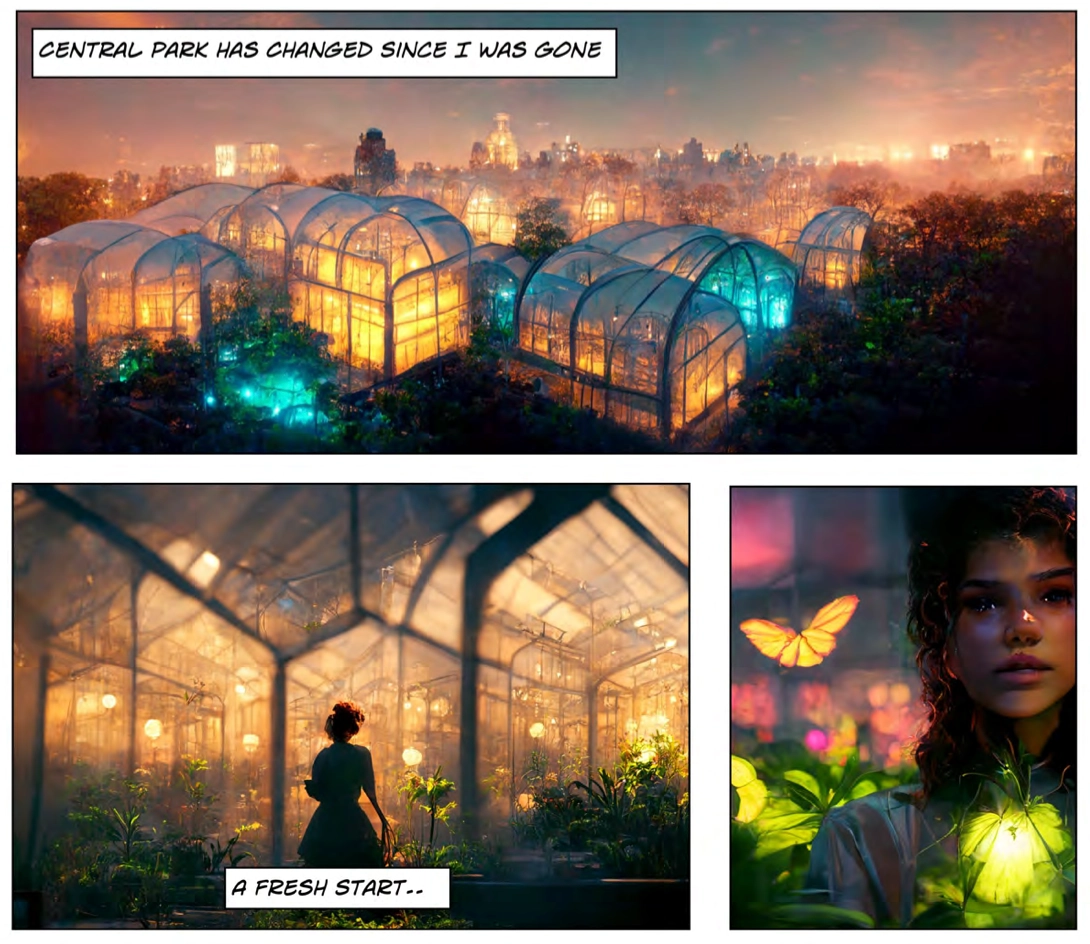
In September 2022, the US Copyright Office issued a registration for the comic book Zarya of the Dawn, created using the text-to-image AI tool Midjourney.17
The author clarified that the artwork was AI-assisted, not solely AI-generated. She structured the story, designed the page layouts, and made artistic decisions to arrange the elements alongside the AI-generated images.
Figure 1: Drawings from the last page of AI-generated comic book Zarya of the Dawn.
The award-winning Midjourney image was denied copyright protection
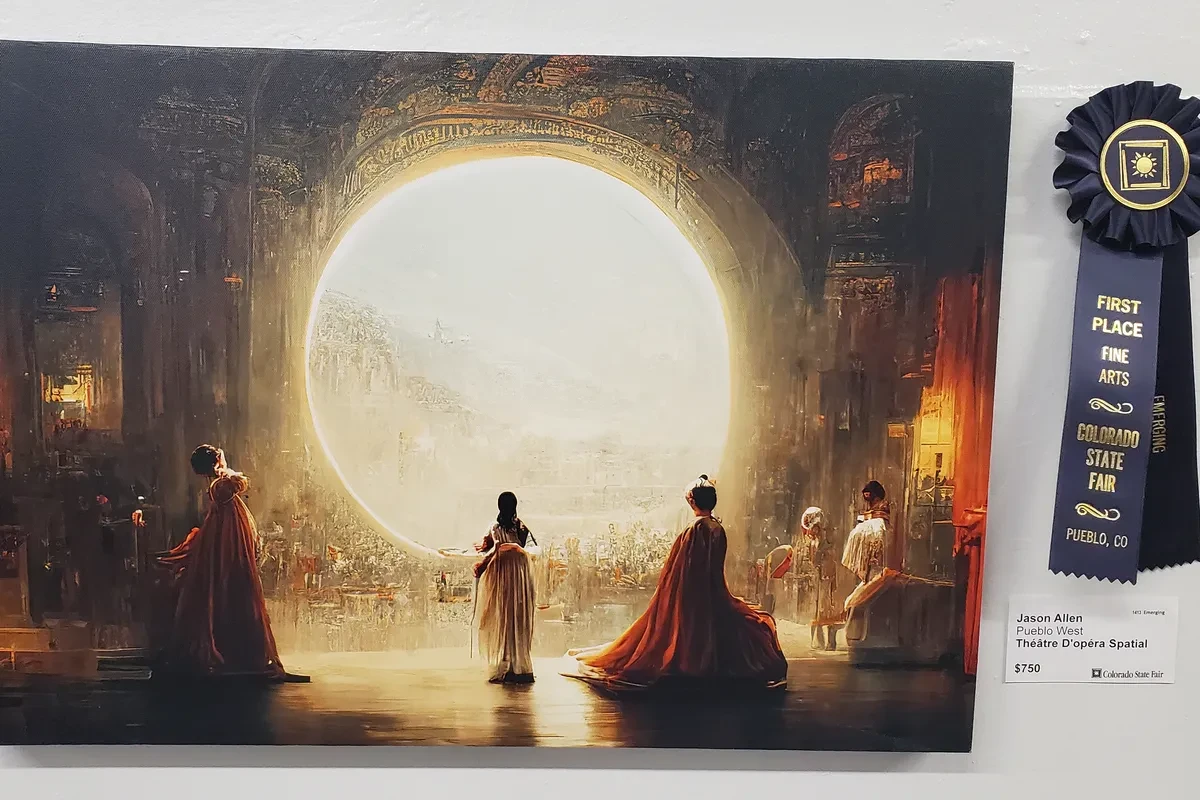
In 2022, Jason Allen won first place in the Colorado State Fair’s digital arts category with Théâtre D’opéra Spatial, an image created with Midjourney.
Allen used text prompts to generate the image, then made further edits before printing and submitting it. The award drew criticism from artists who argued that AI-generated works should not compete on the same terms as traditionally created art.
Figure 2: The award-winning AI-generated print Theatre d’Opera Spatial.18
In September 2023, the US Copyright Office refused to register Jason Allen’s artwork as a copyrighted work because the image contained more than a minimal amount of AI-generated material.
Allen argued that he had used hundreds of prompts and later edited the image in Photoshop. The Copyright Office concluded that the Midjourney-generated elements were not the product of human authorship.19
3. Who owns the copyright in AI-generated work?
In most countries, copyright law assigns ownership to the creator of a work. When AI produces the work, the question of who the creator is and, therefore, who owns it has no settled universal answer.
- United Kingdom: The Copyright, Designs and Patents Act provides that, for a qualifying computer-generated work, the author is the person who undertakes the arrangements necessary for its creation.
- India: For a computer-generated work, the statutory author is the person who causes the work to be created.
- United States: AI-generated material without sufficient human authorship is not protected by copyright. Where an AI-assisted work contains copyrightable human contributions, ownership follows the rules applicable to those human authors.
For more on generative AI
- Generative AI in Healthcare: Benefits, Challenges, Potentials
- Generative AI in Fashion: 5 Use Cases with Case Studies
- Top 5 Use Cases of Generative AI in Education
 Add as preferred source
Cite this research
Pick the format that matches where you're publishing. Pasting the link version into your CMS preserves the backlink.
@misc{dilmegani2026,
  author = {Dilmegani, Cem and Ermut, Sıla},
  title  = {{Generative AI Copyright: Law & Litigation}},
  year   = {2026},
  month  = sep,
  howpublished    = {\url{https://aimultiple.com/generative-ai-copyright}},
  note   = {AIMultiple. Retrieved September 3, 2026}
}
Changelog
14 updatesRemoved the AI licensing deals, best practices, and glossary sections.
Updated the USA section with new rulings and litigation details.
Updated the "Can copyright-protected data be used as training data?" section with new information on fair use in the US.
Reference Links
Cem's work at AIMultiple has been cited by leading global publications including Business Insider, Forbes, Morning Brew, and Washington Post, global firms like Deloitte and HPE, NGOs like World Economic Forum, and supranational organizations like European Commission. [1], [2], [3], [4], [5]
Throughout his career, Cem served as a tech consultant, tech buyer and tech entrepreneur. He advised enterprises on their technology decisions at McKinsey & Company and Altman Solon for more than a decade. He also published a McKinsey report on digitalization.
He led technology strategy and procurement of a telco while reporting to the CEO. He has also led commercial growth of deep tech company Hypatos that reached a 7 digit annual recurring revenue and a 9 digit valuation from 0 within 2 years. Cem's work in Hypatos was covered by leading technology publications like TechCrunch and Business Insider.
Cem regularly speaks at international technology conferences. He graduated from Bogazici University as a computer engineer and holds an MBA from Columbia Business School.

She previously worked as a recruiter in project management and consulting firms. Sıla holds a Master of Science degree in Social Psychology and a Bachelor of Arts degree in International Relations.


Be the first to comment
Your email address will not be published. All fields are required. Comments are left in their original language.