


Generative AI ERP Systems: 10 Use Cases & Benefits

Enterprise resource planning (ERP) software helps businesses integrate workflows across finance and operations. Generative AI, alongside technologies like RPA, has the potential to enhance ERP processes.
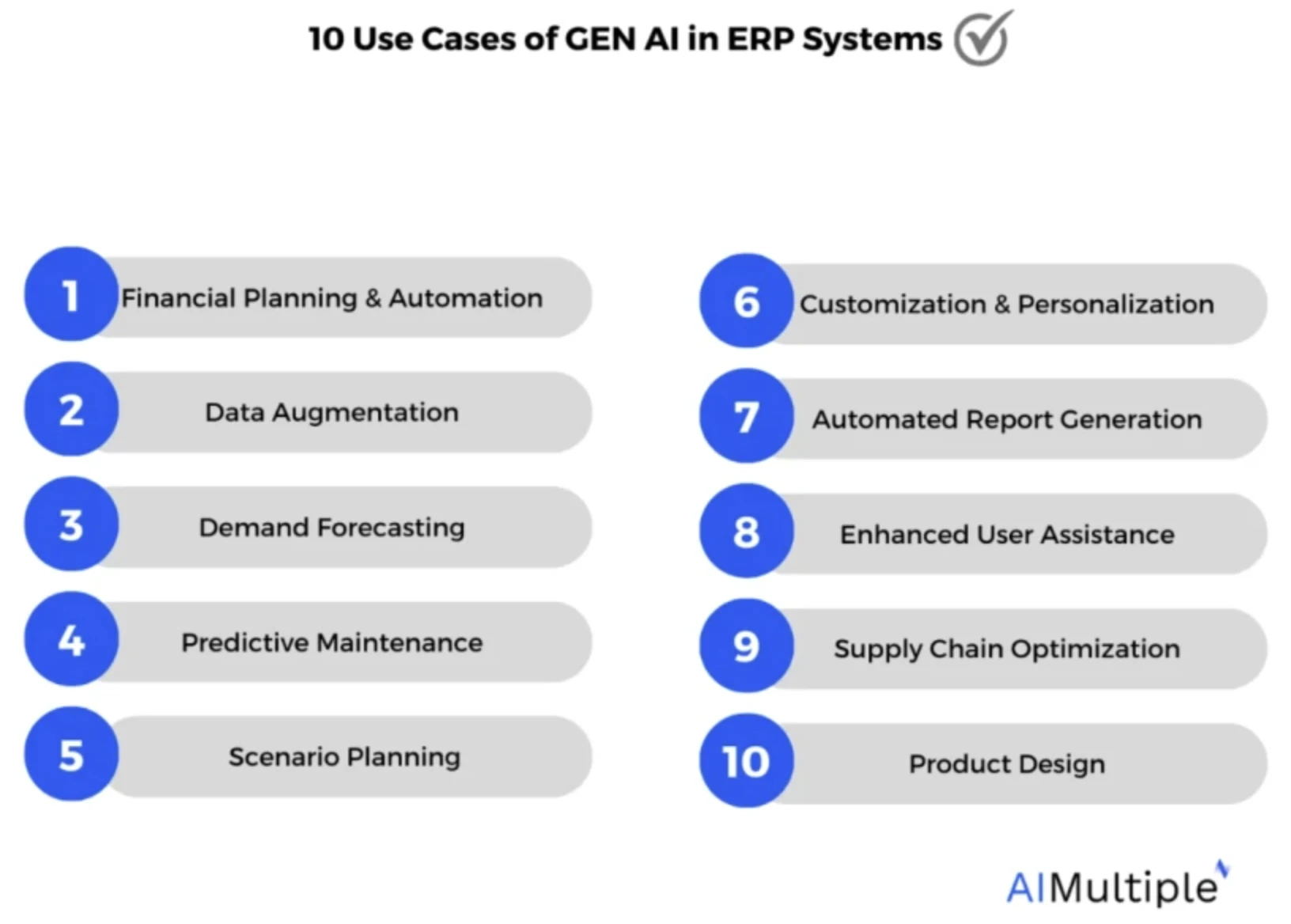
What are the use cases of generative AI ERP systems?
1- Financial planning & automation
The financial use of Generative AI in ERP systems can cover the automation of entire procure to pay cycle and such as the accounts payable process.
Another important element for ERP systems is financial planning. Advanced generative AI models are capable of generating potential financial models or projections based on varying business conditions or strategies, which can be a good contribution to enterprise financial planning. Also, it can be used for improving fraud detection capabilities.
2- Data augmentation and enhancement
Generative AI tools are increasingly evolving in data analysis skills. For example, ChatGPT has a new Code Interpreter plugin for data analysis and visualization. Specifically, they can contribute to ERP data analysis and protection by:
- Synthetic data generation: Filling in gaps or creating synthetic datasets from actual business data and customer data for improved analytics, especially when actual data might be scarce or sensitive.
- Data cleaning: Predicting and correcting data entry errors based on patterns in the data.
3- Demand forecasting
Generative AI models can predict product or service demands by generating potential future scenarios based on historical data and market trends.
4- Predictive maintenance
Using generative models to anticipate when parts or equipment may fail by simulating various operational conditions can enable the prediction of potential problems that can occur in business processes beforehand.
5- Scenario planning & simulation
Generative AI models are competent for creating different scenarios given the correct prompt and context. By using its potential for scenario planning and simulation, businesses can create “what if” scenarios for business strategy planning so that they can anticipate potential challenges or opportunities.
6- Customization and personalization
Generative AI tools can be used to generate customized user interfaces or experiences based on individual user behavior, roles, or preferences within the ERP system.
These tools can also be integrated in marketing and sales operations for improving customer experience, such as personalizing content for specific target audiences.
7- Automated report generation
Creating detailed, coherent, and customized reports for different departments, stakeholders, or purposes without human intervention is an important contribution generative AI can bring into the ERP.
8- Enhanced user assistance
By understanding natural language queries of users, AI chatbots and voice assistants are especially promising generative AI technologies for simplifying user interactions within ERP systems.
9- Supply chain optimization
Generative AI helps supply chain management teams test ‘what if’ situations, so they can be ready for changes like delays, shortages, or demand spikes.
10- Product design and development
In manufacturing modules, generative AI could aid in generating new product designs based on specified criteria or customer feedback.
Generative AI ERP real-life examples
Microsoft Dynamics 365 Customer Experience
Microsoft Dynamics 365 Customer Experience is expanding its AI capabilities by adding workforce engagement management features to Dynamics 365 Contact Center and Customer Service.1
- Workforce engagement management: Embeds WEM capabilities into Dynamics 365 Contact Center and Customer Service workflows.
- AI agent support: Adds AI agents that help supervisors with analytics, real-time guidance, and operational intelligence.
- Real-time wallboards: Enable supervisors to monitor contact center metrics and track changes in service performance.
- Autonomous agents: Introduces agents for Customer Intent, Knowledge Management, Quality Evaluation, and Case Management.
- Supervisor assistance: Quality Assurance Agent supports real-time review, coaching, scored interactions, compliance flags, and agent nudges.
- Microsoft 365 Copilot integration: Adds embedded Copilot features, a Customer Service plugin for Copilot Cowork, and the Service Agent in Microsoft 365 Copilot.
- Unified CX operations: Helps reduce complexity by connecting data, human agents, and AI agents within Dynamics 365.
AMD GenAI Supply Chain Troubleshooter
AMD developed a Generative AI-powered Supply Chain Troubleshooter on the SAP Business Technology Platform to help supply chain specialists analyze sales order issues more quickly.2
- Supply chain issue resolution: Helps specialists investigate sales order problems such as allocation, supply, order, and availability checks.
- Generative AI assistant: Allows users to ask questions in natural language and receive quick explanations, recommendations, and next steps.
- SAP BTP integration: Uses SAP Business Technology Platform, SAP AI Core, SAP AI Launchpad, and a SAP Cloud Application Programming Model application.
- SAP S/4HANA connection: Pulls enterprise supply chain data from SAP S/4HANA to support accurate analysis and decision-making.
The results are:
- Manual effort reduction: Cuts manual order-processing effort by an estimated 90%.
- Faster response times: Reduces issue analysis from about 20 minutes to around 2 minutes per request.
- Operational scale: Supports analysis of more than 10,400 orders per year.
- Productivity gains: Expected to save approximately 3,120 hours of specialist productivity annually.
SA Power Networks AI-Assisted Infrastructure and HR Management
SA Power Networks uses SAP Business AI, SAP Business Technology Platform, and SAP SuccessFactors HCM to improve asset management, field operations, and HR processes. The company applies AI to help field teams access infrastructure information faster, reduce manual inspection work, and make employee services easier to use.3
- AI-assisted field operations: Gives technicians quick access to manuals, diagrams, site details, and safety information through natural-language queries.
- Document grounding: Uses SAP BTP to provide contextual answers from uploaded manuals and technical documents.
- Asset inspection optimization: Applies SAP Datasphere data and AI models to identify poles with a low likelihood of corrosion.
- Cost savings: Saves more than A$1 million per year by reducing unnecessary corrosion inspections.
- Higher inspection efficiency: Achieves a 99% success rate in identifying poles unlikely to corrode.
- Field data access: Provides up to 50 years of asset history to field workers.
- HR process improvement: Uses Joule and SAP SuccessFactors HCM to help employees find answers from complex HR documents.
- Employee productivity: Reduces repetitive HR queries and helps employees create and refine performance goals with embedded AI.
- Safety impact: Supports safer fieldwork by giving crews faster access to the right information and reducing hazardous manual tasks.
DualEntry
DualEntry is an AI-native ERP and accounting platform designed for finance teams. It combines core accounting functions with AI-driven automation to reduce manual bookkeeping tasks and provide real-time financial insights.4
- AI-powered accounting automation: Automates tasks such as reconciliation, transaction categorization, journal entries, and error detection using machine learning.
- General ledger and financial management: Tracks all financial transactions with automated audit trails, real-time posting, and customizable workflows.
- Multi-entity and multi-currency support: Manages multiple subsidiaries, currencies, and intercompany transactions with automated consolidation and reporting.
- Automated reconciliation and anomaly detection: Matches bank transactions automatically and flags potential errors or fraud.
- AI document processing: Uses OCR and AI to extract information from financial documents and automatically create accounting records.
- Real-time analytics and reporting: Generates customizable financial reports and dashboards.
- Workflow automation and integrations: Supports customizable financial workflows and connects with thousands of bank and business systems.
Flow (by LiveFlow)
Flow is an AI-native ERP platform developed by LiveFlow for businesses managing complex financial operations, such as companies with multiple entities, locations, and intercompany transactions.5
- Unified accounting and FP&A: Combines accounting ledger and financial planning and analysis (FP&A) in one system to support both reporting and forecasting workflows.
- Multi-entity management: Built to manage multiple subsidiaries, locations, and intercompany transactions within a single platform.
- Real-time financial visibility: Processes financial activity continuously so teams can monitor performance without waiting for month-end closing cycles.
- Automated consolidation and reporting: Consolidates financial data across entities to maintain a continuously updated financial view.
- Faster close and forecasting: By reducing the lag between transactions and reporting, the platform helps finance teams close books faster and produce more accurate forecasts.
Zoho’s SynProERP
SynProERP is a manufacturing management system built on Zoho Creator that helps manufacturers manage the entire production lifecycle in one platform.
The system supports advanced manufacturing functions such as multi-level bills of materials (BOM), production routing, quality control, and outsourcing, while also enabling efficient resource allocation through work orders, shift planning, and material requirements planning (MRP).
Additionally, SynProERP integrates with Zoho applications and third-party tools, helping teams collaborate across departments and improving operational visibility and efficiency.6
What are the benefits of integrating generative AI into ERP systems?
Organizations leveraging generative AI solutions with their SAP applications data are seeing stronger business performance.7
- Enhanced data analytics: Generative AI, by producing synthetic datasets that augment existing data, enable better testing, modeling, and insights, especially when real data might be sparse or confidential.
- Improved decision-making: By simulating various business scenarios, generative AI offers insights into potential outcomes, assisting leaders in making more informed and proactive decisions.
- Improved operational efficiency through intelligent automation: Tasks like content generation, report creation, or predictive analysis can be automated with generative AI, reducing manual effort and the potential for human error.
- Personalization: Generative AI can customize interfaces, recommendations, or content to individual users or departments, leading to a more tailored and efficient user experience in the business applications.
- Better demand forecasting: Generative models, by accurately predicting product or service demands by generating potential future scenarios based on historical data and market trends, ensure optimized inventory management and resource allocation.
Future of generative AI in enterprise applications
SAP, working with NVIDIA to integrate generative AI into ERP systems,8 predicts that ERP will become a smart assistant, offering timely insights, learning from users, and helping teams make faster, better decisions.9
More human interaction
ERP systems have traditionally required users to adapt to them. Employees will be able to talk to ERP systems in plain language, like asking a question or giving a command to a colleague. Whether it’s filtering a report or generating a summary, tasks will become simpler and more intuitive.
Personalized user experiences
Generative AI will allow ERP systems to tailor experiences based on the user’s role, behavior, and preferences.
Better forecasting for real-world problems
With the help of generative AI, ERP systems will be able to analyze vast datasets and detect patterns more effectively. Business analysts will have access to powerful tools that were once locked behind technical expertise.
Automation that learns from you
While automation is helping reduce repetitive tasks, future ERP systems will go further. They’ll learn from how users work, adapting to corrections and making smarter suggestions.
A system you can trust
AI will also help ERP systems become more secure. Continuous monitoring will detect strange behavior, flag potential threats, and alert users. Vendors will need to build AI with ethics, privacy, and safety in mind, so users can rely on it without worry.
 Add as preferred source
Cite this research
Pick the format that matches where you're publishing. Pasting the link version into your CMS preserves the backlink.
@misc{dilmegani2026,
  author = {Dilmegani, Cem and Arslan, Ezgi},
  title  = {{Generative AI ERP Systems: 10 Use Cases & Benefits}},
  year   = {2026},
  month  = jun,
  howpublished    = {\url{https://aimultiple.com/generative-ai-erp}},
  note   = {AIMultiple. Retrieved June 26, 2026}
}
Changelog
4 updatesAdded Microsoft Dynamics 365, AMD, and SA Power Networks real-life examples
Added three products, DualEntry, Flow, and SynProERP, to the "Generative AI ERP real-life examples" section.
Reference Links
Cem's work at AIMultiple has been cited by leading global publications including Business Insider, Forbes, Morning Brew, and Washington Post, global firms like Deloitte and HPE, NGOs like World Economic Forum, and supranational organizations like European Commission. [1], [2], [3], [4], [5]
Throughout his career, Cem served as a tech consultant, tech buyer and tech entrepreneur. He advised enterprises on their technology decisions at McKinsey & Company and Altman Solon for more than a decade. He also published a McKinsey report on digitalization.
He led technology strategy and procurement of a telco while reporting to the CEO. He has also led commercial growth of deep tech company Hypatos that reached a 7 digit annual recurring revenue and a 9 digit valuation from 0 within 2 years. Cem's work in Hypatos was covered by leading technology publications like TechCrunch and Business Insider.
Cem regularly speaks at international technology conferences. He graduated from Bogazici University as a computer engineer and holds an MBA from Columbia Business School.




Be the first to comment
Your email address will not be published. All fields are required. Comments are left in their original language.