

Network observability gives organizations visibility into network performance, enabling faster identification and resolution of infrastructure issues. Tools in this category increasingly use AI to automate anomaly detection across traffic and device health.
Top 8 network observability tools
Vendors | Reviews | Free Trial | Employees** | Price |
|---|---|---|---|---|
5.6/5 based on 91 reviews | ✅ for 30-days | 350 | Starting $1,750 /month -50 devices | |
Obkio | 4.9/5 based on 51 reviews | ✅ for 14-days | 24 | Starting $399 /month -10 agents |
ManageEngine Site24x7 | 4.7/5 based on 233 reviews | ✅ for 30-days | 302 | Standard Edition: $245 [25 devices] Professional Edition: $345 [25 devices] and more options |
Dynatrace | 4.5/5 based on 1,242 reviews | ✅ for 15-days | 4,200 | Full-Stack Monitoring: $0.08 per hour for an 8 GB host. Infrastructure Monitoring: $0.04 per hour Kubernetes Monitoring: $0.002 per hour and more options. |
Cisco ThousandEyes | 4.5/5 based on 77 reviews | ✅ for 15-days | 761 | Not shared publicly |
LogicMonitor | 4.5/5 based on 502 reviews | ✅ for 15-days | 1,070 | Logs correlation: $4.00 USD/GB/month for 30 day retention $7.00 USD/GB/month for yearly retention and more options |
Datadog | 4.3/5 based on 464 reviews | ✅ for 14-days | 5,200 | Starting $15 /month per host |
Zabbix | 4.3/5 based on 185 reviews | N/A | 126 | open source |
* Reviews are based on Capterra and G2. Transparency statement: Vendors are ranked according to their average ratings, except sponsors which receive links.
** The workforce size is gathered from companies’ LinkedIn pages.
Common Features of Network Observability Tools
Below are the key shared features of network observability tools that make these tools indispensable for organizations:
- Real-time network monitoring: All mentioned tools can monitor network performance in real time.
- Cloud, hybrid, and on-premises support: These network observability tools integrate with cloud, hybrid, and on-premises environments.
- Analytics and visualization: With the deployment of analytics and visualization tools, these platforms provide insights into network performance.
- Root Cause Analysis: Helps pinpoint the sources of problems for faster troubleshooting.
- Web app monitoring (HTTP, FTP, Browser): Network observability tools provide insights into web application performance.
Leading Network Observability Tools
1. Paessler PRTG
Paessler PRTG Network Monitors network traffic, bandwidth, device performance, and availability across on-premises and hybrid environments. It is sensor-based: each monitored metric (a port, an interface, a service) consumes a sensor license, which gives teams precise control over what they monitor and what they pay for.
Key features:
- Over 250 sensor types covering SNMP, NetFlow, WMI, REST, SSH, and more
- Customizable alert thresholds with notifications via email, SMS, and push
- Dashboards and maps configurable per team or per customer (MSP use cases)
- Multi-Platform Probe for Linux-based, non-Windows monitoring
Strengths:
- Intuitive setup relative to the breadth of what it monitors
- Strong depth for on-premises infrastructure: servers, switches, printers, UPS, OT equipment
Weaknesses:
- Sensor-count licensing gets expensive at scale; large networks require careful sensor planning
- Not designed for container or Kubernetes-native environments
PRTG added five new experimental sensors, including Proxmox VE Virtual Machine Status, Proxmox VE Container Status, and Siemens SIMATIC sensors for OT environments. The SSL/TLS Certificate sensor was rewritten to work on the Multi-Platform Probe. SSO users can now create API keys directly within PRTG. Veeam 13 compatibility was also fixed.1
2. Obkio
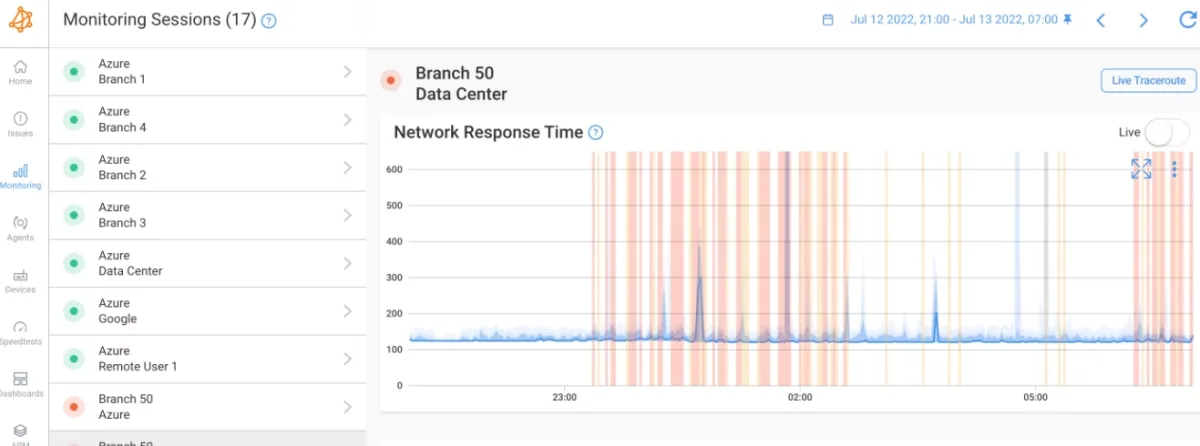
Obkio measures network performance from the end user’s perspective: latency, jitter, packet loss, and application responsiveness across WAN, SD-WAN, and cloud paths. It deploys lightweight monitoring agents at key locations, offices, data centers, and cloud regions, and runs synthetic traffic between them continuously to detect degradation before users report it.
Key features:
- Software agents for Windows, Linux, VMware, and Hyper-V
- Plug-and-play hardware agent for locations without dedicated IT infrastructure
- Continuous synthetic monitoring between agent pairs
- Performance history and session replay for troubleshooting past events
Strengths:
- Agents are up and collecting data quickly; straightforward deployment
- Hardware agent removes the need for a dedicated server at small locations
- Focused on what matters to end users: is the network actually working from where they sit
Weaknesses:
- Narrower scope than full-stack tools; does not monitor server or application internals
- An agent-based model requires installation at every location you want visibility from
- Less suited to data center or cloud-native teams
3. Dynatrace
Dynatrace is a full-stack observability platform with an AI engine (Davis) at its core. Davis performs causal analysis correlating events across the full stack, identifying root causes, and distinguishing signal from noise using dependency context rather than static thresholds.
Key features:
- Smartscape: real-time topology map of all entities and their dependencies
- Full-stack coverage: infrastructure, APM, logs, user experience, network
- Davis AI for automated root cause analysis and anomaly detection
- OpenTelemetry ingestion and correlation alongside proprietary instrumentation
- Kubernetes monitoring with control plane and workload visibility
Figure 4: Dynatrace User Interface
Source: Dynatrace Website2
Strengths:
- Causal AI that explains its conclusions not just alerts, but reasons
- One of the most complete observability platforms available; reduces the need for multiple point tools
- Strong enterprise integrations: ServiceNow, ITSM workflows, CI/CD pipelines
Weaknesses:
- Pricing complexity has increased significantly with new tiers introduced in early 2026; validate current costs directly with Dynatrace before budgeting
- Implementation and onboarding time is higher than simpler tools
- Can be overkill for straightforward monitoring requirements
Domain-specific agents: Dynatrace announced modular, lightweight instrumentation agents initially targeting Java and .NET environments. These reduce the resource overhead of the traditional monolithic agent in container-dense and serverless environments.3
AI Observability app: A new AI Observability app provides end-to-end tracing for agentic AI workloads from LLM prompts through agent orchestration to infrastructure. Supported frameworks include Amazon Bedrock AgentCore, LangChain Agents, Google ADK, OpenAI Agents SDK, and Model Context Protocol (MCP). Signals are unified via OpenTelemetry and OpenLLMetry.4
DevCycle acquisition: Dynatrace acquired DevCycle, a feature flag management platform, integrating feature flags as observable runtime primitives. The platform can now automatically identify which feature toggle caused a performance degradation and trigger a rollback.5
4. Cisco ThousandEyes
ThousandEyes provides visibility into network paths that organizations do not own: the public Internet, cloud provider networks, CDNs, SaaS delivery paths, and BGP routing. It runs continuous synthetic tests from a global network of agents cloud agents, enterprise agents in customer infrastructure, and endpoint agents on user devices and correlates results to show where problems originate.
Key features:
- Synthetic monitoring for network paths, application performance, HTTP, DNS, and BGP
- Internet Insights: macro view of outages and routing disruptions across the public Internet
- Cloud Insights and Traffic Insights: flow-based visibility into cloud VPC traffic (AWS, Azure, GCP)
- Endpoint Experience: end-user device health correlated with Wi-Fi, LAN, and application performance
- Integration with Meraki, Catalyst, and Splunk for cross-domain correlation
Strengths:
- Unmatched Internet and SaaS path visibility the vantage point density is unique
- Directly useful when user experience depends on networks outside your control
- Deep integration into Cisco’s networking stack for existing Cisco customers
Weaknesses:
- ThousandEyes Unit pricing makes cost forecasting difficult without a usage model
- Infrastructure monitoring depth (servers, containers) is limited; ThousandEyes complements rather than replaces infrastructure tools
- Cisco-first in practice; some features require Cisco hardware
AI Canvas, Intelligent Testing, MCP Server GA: Intelligent Testing is an AI-driven mode that automatically creates and updates synthetic tests based on observed performance patterns. AI Canvas brings unified cross-domain context from Meraki, ThousandEyes, and Splunk into a single investigative workspace for faster root-cause determination. ThousandEyes MCP Server was announced as generally available, exposing network intelligence data to AI workflows and agents.6
5. LogicMonitor
LogicMonitor is a hybrid observability platform covering on-premises infrastructure, cloud environments, containers, and network devices from a SaaS console. It is built for managed service providers and enterprise IT teams operating multi-tenant or multi-site environments.
Its Edwin AI engine handles anomaly detection, dynamic thresholds, and alert correlation. Its collector architecture supports a wide range of monitoring protocols without requiring per-device agents.
Key features:
- Agentless monitoring via collectors for SNMP, WMI, JMX, REST, and custom scripts
- Multi-tenant architecture with role-based access, suited to MSP deployments
- Edwin AI for anomaly detection and alert noise reduction
- Network monitoring, server monitoring, cloud monitoring, and log correlation in one platform
- ServiceNow and FreshService integrations for ITSM workflows
Strengths:
- Purpose-built multi-tenant architecture for MSPs
- Broad protocol coverage without per-device agents
- Active roadmap with specific focus on hybrid cloud and agentic AIOps in 2026
Weaknesses:
- Less suited to purely cloud-native workloads than Datadog or Dynatrace
- Collector management adds operational overhead at scale
- Logs, infrastructure, and Internet monitoring (Catchpoint) are now billed as separate components
Figure 6: LogicMonitor User Interface
Source: LogicMonitor Website7
Automated Remediation: LogicMonitor is rolling out Automated Remediation, which closes the loop between issue detection and resolution by executing fixes automatically within approved boundaries.
6. Datadog
Datadog is a cloud-native observability and security platform that has expanded from infrastructure monitoring into APM, log management, network monitoring, real user experience, security, and LLM observability.
Figure 8: Datadog User Interface
Source: Datadog Website8
Key Aspects:
- Live network maps: Datadog offers a dynamic visualization of network traffic flow and dependencies.
- Service-level objective (SLO) tracking: This tool monitors and ensures the network performance aligns with business objectives.
Pros:
- Network Observability: Datadog enables end-to-end visibility into application performance, infrastructure health, and security posture by integrating distributed tracing with metrics, logs, and telemetry.
- Advanced Problem Detection: With features like automatic anomaly detection, code profiling, and real-time service monitoring, Datadog identifies operations and infrastructure issues, facilitating timely optimizations and preventing potential disruptions.
Cons:
- Complexity for Smaller Teams: The features of Datadog can be overwhelming for smaller teams or organizations without dedicated DevOps or security personnel, potentially steepening the learning curve.
- Cost at Scale: The tool’s price can increase significantly as it ingests and processes large volumes of logs and telemetry data, potentially affecting projects with tight budgets.
Datadog added AI Agent Monitoring, LLM Experiments, and an AI Agents Console to its LLM Observability product. These capabilities allow teams to monitor agentic systems, run structured prompt experiments, evaluate third-party agent behavior, and track usage patterns, enabling both deployment governance and iteration on LLM-powered applications. 9
7. Zabbix
Figure 10: Zabbix Advanced Visualization, dark theme
Source: Zabbix Website10
8. Zabbix
Zabbix is an open-source monitoring platform covering network devices, servers, cloud services, virtual machines, and applications. It is free to use under the GNU AGPL v3 license; Zabbix SIA offers paid support contracts and professional services for organizations that need them.
Key features:
- Agent-based and agentless monitoring (SNMP, IPMI, JMX, HTTP checks)
- Flexible alerting with escalation policies and configurable media integrations
- Distributed monitoring via proxies for geographically distributed or segmented networks
- Template library covering network devices, servers, cloud platforms, and applications
- Dashboards, maps, and reports with no per-user or per-device licensing constraints
Strengths:
- Highly flexible; can monitor almost any target if a sensor or script exists for it
- Large community with extensive template contributions
- Capable of very large deployments with proper architecture
Weaknesses:
- Setup and configuration require significant expertise Zabbix rewards teams willing to invest in learning it
- Interface is functional but less polished than commercial alternatives
- No native SaaS option; infrastructure and maintenance are the operator’s responsibility
9. SolarWinds Network Performance Monitor (NPM)
SolarWinds NPM monitors network performance, bandwidth, device health, and traffic flows across on-premises, hybrid, and cloud environments. It uses SNMP, NetFlow, and IPFIX to collect data from routers, switches, firewalls, and servers, and provides hop-by-hop path analysis through its NetPath feature. NPM runs on the SolarWinds Observability Self-Hosted platform (formerly Orion) and is also available as part of a SaaS offering.
Key features:
- NetPath provides hop-by-hop path visualization across on-premises and cloud environments to isolate where latency or packet loss originates
- PerfStack correlates metrics from multiple sources (network, server, application) in a single timeline view for cross-domain root cause analysis
- AIOps-powered anomaly-based alerting in addition to traditional threshold alerts
- Intelligent Maps automatically create and maintain dynamic topology maps as the network changes
- Multi-vendor support: manages devices from Cisco, Juniper, Palo Alto, Fortinet, Aruba, and others from a single interface
Strengths:
- Depth of network-specific features rivals any commercial alternative at scale
- Orion’s modular architecture allows adding NCM, NTA, IPAM, and other SolarWinds modules to extend capability within the same platform
- Large Thwack community and extensive documentation make self-service troubleshooting practical
- 30-day free trial gives accurate element counts, which helps scope licensing before purchase
Weaknesses:
- Pricing is element-based (each monitored interface or node counts against the license); costs escalate quickly on large networks and require careful planning upfront
- No published pricing; all quotes are custom, making total cost of ownership difficult to estimate without a sales conversation
10. Nagios
Nagios is one of the oldest and most widely deployed open-source monitoring platforms. It exists in two forms: Nagios Core, which is free, open-source, and plugin-driven; and Nagios XI, a commercial product built on Core that adds a web interface, automated discovery, configuration wizards, advanced reporting, and enterprise support.
Key features:
- SNMP-based network device monitoring: routers, switches, firewalls, and any device with an SNMP agent
- Thousands of community-developed and official plugins covering network, server, database, cloud, and application checks
- Nagios Fusion for centralized visibility across multiple Nagios instances in distributed environments
- Nagios Network Analyzer for NetFlow, sFlow, and IPFIX traffic analysis as a separate licensed product
Strengths:
- Perpetual licensing model with no recurring per-device fees makes long-term cost predictable for stable infrastructure
- Nagios Core is free viable for budget-constrained teams willing to manage configuration manually
- Plugin architecture is genuinely extensible; if you can script a check, you can monitor it
- Long deployment history means Nagios coexists with almost every infrastructure type and ticketing system
Weaknesses:
- No native agentic AI, automated remediation, or OpenTelemetry ingestion teams expecting these capabilities need to build or source them separately
- Initial configuration is complex; the plugin model requires familiarity with Nagios syntax and the available check libraries
- Support quality scales with the XI license purchased; Core users rely on community forums
 Add as preferred source
11. Wireshark
Wireshark is an open-source network protocol analyzer used to capture and interactively inspect packet data in real time. It supports more than 3,000 network protocols and runs on Windows, macOS, and Linux.
Key features:
- Live packet capture from network interfaces, or offline analysis of saved capture files (pcap, pcapng, BLF, and others)
- Dissectors for thousands of protocols, updated continuously as new protocols are ratified or extended
- Display filters for isolating specific traffic by protocol, address, port, flag, or payload content
- Follow Stream view to reconstruct TCP, UDP, TLS, or HTTP conversations for end-to-end session analysis
Strengths:
- Unmatched protocol depth: if a packet format exists and is documented, a Wireshark dissector likely exists or can be written
- Works alongside any monitoring platform; captures can be triggered from automation pipelines and analyzed programmatically with tshark
- SharkFest conferences and official Wireshark University training provide professional development for analysts
Weaknesses:
- Performance degrades on very high-throughput links; capturing at 10+ Gbps requires specialized hardware and configuration
- TLS decryption requires access to key material, which is not always available in production environments
- Steep learning curve for teams unfamiliar with packet analysis; reading raw traffic fluently takes practice
FAQs
While related, network monitoring and observability tools serve distinct functions in managing network health. Network observability tools are focused on tracking specific metrics and thresholds to maintain network performance. In contrast, network observability offers a more expansive and in-depth perspective, incorporating network monitoring’s capabilities while adding context, real-time visibility, and adaptability for complex and evolving networks.
Think of network observability tools as an advanced stage of network monitoring. It enhances monitoring’s foundational aspects by incorporating more diverse data sources, sophisticated analytics, and intelligent automation. This evolution enables deeper insights into network infrastructure, facilitating informed decision-making for superior network performance, security, and reliability.
Problem-Solving and Root Cause Identification: Provides detailed insights into network operations, enabling faster, more accurate troubleshooting and issue resolution for network observability tools.
Network Performance and Resource Optimization: Allows for the analysis of network usage and performance data to identify optimization opportunities, improving efficiency and user experience.
Network Capacity Management and Growth Planning: Supports strategic planning for network capacity and scalability by analyzing usage trends and forecasting future demands.
Network Behavior Insights: Offers a holistic view of the network, aiding understanding of complex interactions and optimizing network performance.
Data-Informed Strategic Decisions: Empowers organizations to make informed decisions regarding network management and optimization based on actionable data insights.
While the scale and complexity may vary, small businesses also face network observability and security challenges that can be effectively managed with the right observability tools.
AI and machine learning algorithms analyze vast amounts of data to identify patterns, anomalies, and predict potential issues, enabling more proactive and efficient network observability.
Telemetry is the automated process of collecting data from remote or inaccessible devices and systems, crucial for network monitoring. It enables the real-time tracking of network observability, health, and operational metrics, facilitating proactive issue detection and resolution, thereby enhancing network observability and efficiency.
Choosing the network observability tools depends on several factors, including the size and complexity of your network, specific monitoring and analytics needs, budget constraints, and integration requirements with existing systems.
Integration: Look for solutions that seamlessly integrate with your existing IT ecosystem.
Customization: Customizable dashboards and alerts can greatly enhance usability and relevance.
Support and Community: Consider the level of support offered by the vendor and the presence of an active user community for sharing best practices.
For more on network monitoring
- Top 10 Network Monitoring Software based on 3,000+ Reviews
- Top 5 AI Network Monitoring Use Cases and Real Life Examples
Cite this research
Pick the format that matches where you're publishing. Pasting the link version into your CMS preserves the backlink.
@misc{dilmegani2026,
  author = {Dilmegani, Cem and Sezer, Sena},
  title  = {{Top 10+ Network Observability Tools}},
  year   = {2026},
  month  = mar,
  howpublished    = {\url{https://aimultiple.com/network-observability-tools}},
  note   = {AIMultiple. Retrieved March 3, 2026}
}
Reference Links

Cem's work has been cited by leading global publications including Business Insider, Forbes, Washington Post, global firms like Deloitte, HPE and NGOs like World Economic Forum and supranational organizations like European Commission. You can see more reputable companies and resources that referenced AIMultiple.
Throughout his career, Cem served as a tech consultant, tech buyer and tech entrepreneur. He advised enterprises on their technology decisions at McKinsey & Company and Altman Solon for more than a decade. He also published a McKinsey report on digitalization.
He led technology strategy and procurement of a telco while reporting to the CEO. He has also led commercial growth of deep tech company Hypatos that reached a 7 digit annual recurring revenue and a 9 digit valuation from 0 within 2 years. Cem's work in Hypatos was covered by leading technology publications like TechCrunch and Business Insider.
Cem regularly speaks at international technology conferences. He graduated from Bogazici University as a computer engineer and holds an MBA from Columbia Business School.









Be the first to comment
Your email address will not be published. All fields are required. Comments are left in their original language.