


Analysis of Top 5 Firewall Change Management Software

As the Chief Technology Officer (CISO) of a rapidly-growing organization, I oversee a growing network footprint. To manage the risks associated with firewall configuration changes, I reviewed the leading firewall change management software:
Top 5 Firewall change management tools
Feature comparison
Software | Confliction detection | Inactivity detection | Critical changes detection | Change orchestration | Deployment |
|---|---|---|---|---|---|
FireMon Policy Manager | ✓ | ✓ | ✓ | ✕ | hybrid |
SolarWinds Network Configuration Manager | ✕ | ✕ | ✓ | ✕ | hybrid |
Tufin SecureChange | ✓ | ✓ | ✓ | ✓ | hybrid |
ManageEngine Firewall Analyzer | ✕ | ✕ | ✕ | ✕ | cloud |
AlgoSec FireFlow | ✓ | ✓ | ✓ | ✓ | hybrid |
Features summary:
- Conflicting rules detection: Detects and notifies administrators when firewall rules conflict or override each other, in real time or via scheduled alerts, helping prevent unintended access or security gaps.
- Inactive or unused rules detection: Identifies rules that have not been triggered for a defined period (e.g., 90 days) and generates alerts based on user-defined thresholds to support rule cleanup and policy optimization.
- Detection in changes of mission-critical rules: Monitors modifications to highly sensitive rules, such as broad “any-any allow” or “any-any block” rules, and sends real-time or scheduled notifications to ensure immediate visibility and control over high-risk changes.
- Deployment: Defines the operational environment, eg. cloud, on-premise, or hybrid, where the management software is hosted and executed.
Customized reporting: Generates tailored data visualizations and compliance audits based on specific security metrics and organizational needs. It is a core feature.
Platform compatibility summary
The table summarizes the platform support of the given firewall change management software.
Notification channels
The table specifies the supported notification delivery channels: API and Webhook Integrations.
FireMon Policy Manager
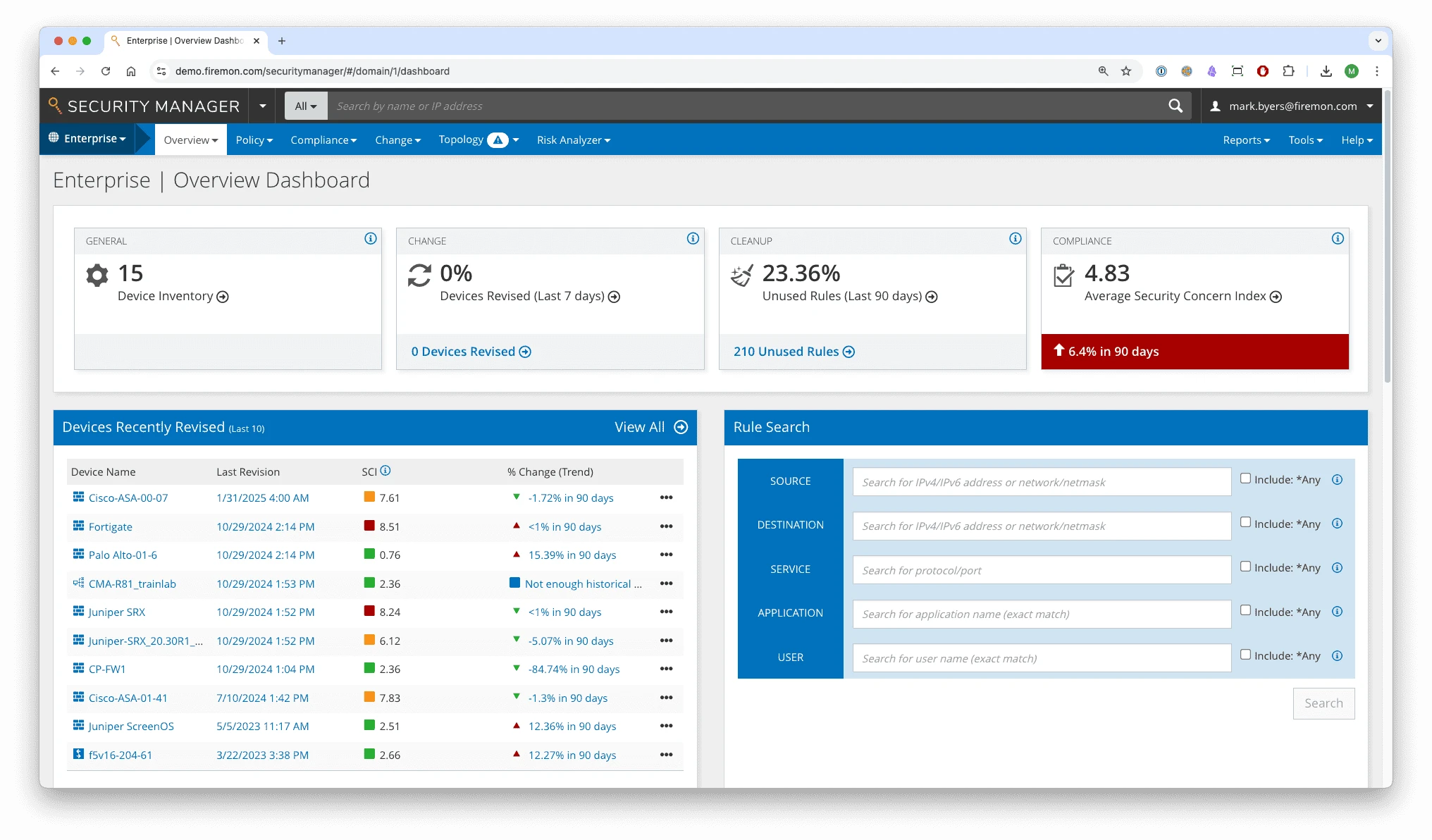
FireMon is designed to help security teams make safe, accurate, and fast policy updates by focusing on automation, visibility, and risk reduction. It centralizes policy visibility, covers more than 120 firewall and cloud platforms, and automates the full change workflow from request to deployment. Other differentiating features include:
- Pre-deployment compliance checks: FireMon analyzes every proposed change before it goes live. It checks for overly permissive rules, conflicts, and compliance issues. This proactive analysis reduces misconfigurations, which remain a major cause of firewall-related incidents.
- Impact analysis for safer decisions: FireMon simulates the effect of a new rule on the network.
In 2026, FireMon added Policy Workbench, which validates proposed changes against frameworks such as PCI DSS and NIST before deployment.1
SolarWinds Network Configuration Manager
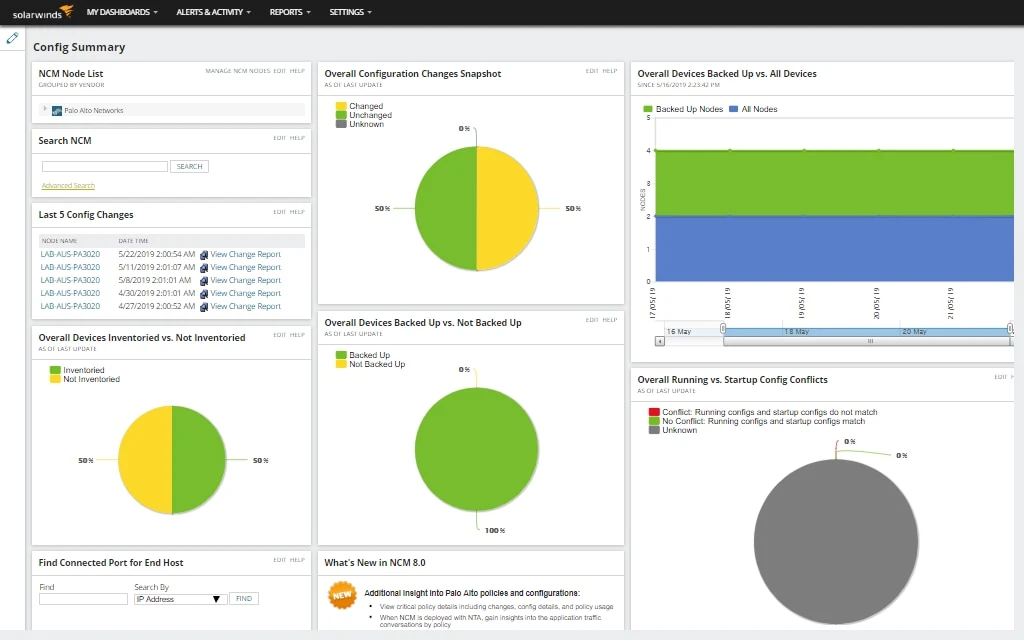
SolarWinds Network Configuration Manager (NCM) automates the tracking and management of network device settings. It helps ensure configurations remain secure, compliant, and consistent across the entire network.
- Automated compliance audits: NCM conducts automated audits and generates detailed reports. This continuous monitoring enables teams to identify and address non-compliance issues before they become a risk.
- Network inventory and visibility: NCM keeps a real-time inventory of all network devices. Teams can track changes and quickly identify which device or setting caused a problem.
Tufin SecureChange
Tufin SecureChange helps network security teams automate and manage firewall and network policy changes. It focuses on streamlined workflows, broad coverage, and scalability, while maintaining control over risk and compliance. Key differentiator:
- Automated change orchestration: The tool automates the full lifecycle of firewall changes, from request to approval, deployment, and decommissioning. This reduces manual effort, accelerates change requests, and helps teams meet strict SLAs.
- Incident management: Tufin tracks, prioritizes, and resolves security breaches or policy violations through structured workflows and automated alerts.
- Topology map: SecureChange provides a visual representation of the network infrastructure to illustrate traffic flow and dependencies between firewalls and devices.
ManageEngine Firewall Analyzer
ManageEngine Firewall Analyzer continuously monitors firewall configurations, providing security teams with a clear record of every change. The tool can compare current (running) configurations with startup defaults, identify conflicts, and generate detailed reports for auditing. Teams can also schedule reports and filter out repetitive or routine changes to focus on important updates. Key differentiating features include:
- Configuration change monitoring: The tool fetches firewall configurations via CLI or API and tracks who made each change, what was modified, and when. It can compare running and startup configurations, detect conflicts, and generate detailed reports for auditing.
- Scheduled and customizable reports: Teams can schedule reports, filter out recurring or known changes, and export data in multiple formats. This helps reduce clutter and focus on critical modifications.
AlgoSec FireFlow
AlgoSec FireFlow provides automated, intent-based change orchestration aligned with business applications. Beyond risk analysis and change planning, the platform automates the full change lifecycle. It provides automated firewall compliance auditing that continuously checks rule changes against regulations, identifies gaps, and generates audit-ready reports with full change documentation.
FireFlow integrates business context into firewall change processes, ensuring that security policies support application connectivity requirements while maintaining compliance and minimizing risk.
Key features:
- Proactive risk management: By analyzing traffic and policy gaps, AlgoSec tightens overly permissive rules and reduces unnecessary exposure. Teams can manage rules across all firewalls, ensuring consistent security across the network.
- Topology awareness and impact analysis: AlgoSec identifies all firewalls that will be affected by a proposed change. It evaluates the impact on security, compliance, and business operations before implementation. This helps prevent misconfigurations and reduce network risk.
- Intent-based change orchestration: AlgoSec automates the full change lifecycle, from planning, risk assessment, approval, implementation and validation, using intent-based orchestration that aligns firewall changes with business application requirements.
- Business-intent impact analysis: Before any change is applied, AlgoSec identifies which applications and services will be affected and evaluates security, compliance and business impact so teams can prevent misconfigurations that disrupt critical apps.
What is firewall change management?
Firewall change management refers to the systematic process of updating, patching, and modifying firewall configurations to maintain security, compliance, and network performance. Since firewalls serve as the first line of defense against external threats, they must be kept current with the latest patches and rule updates to address known vulnerabilities and adapt to evolving network requirements.
Key objectives
- Reduce security risks: Timely updates and controlled configuration changes help close vulnerabilities before they can be exploited.
- Maintain firewall effectiveness: Ensures protection mechanisms remain aligned with emerging threats and evolving network topologies.
- Ensure compliance and auditability: Provides a documented process for all modifications to meet internal and regulatory standards. Recent rules add pressure here. PCI DSS version 4.0.1, mandatory since March 31, 2025, asks teams to review network security controls at least every six months and to record a business reason for each rule. A change management tool keeps that history in one place and produces it for auditors.2
Firewall change management process
The process typically includes:
- Request: Submitting a formal request for a change (e.g., patch, configuration update, or new rule).
- Review and risk assessment: Evaluating potential security and operational impacts of the change.
- Approval: Obtaining authorization through defined workflows to ensure accountability.
- Implementation: Applying the update or rule modification in a controlled, documented manner.
- Verification and audit: Testing and confirming that the change was successful and did not introduce new risks.
When automated, this process allows faster and more secure updates by minimizing human error and ensuring that every change is tracked and compliant.
AI is entering firewall change management
Vendors are adding AI to speed up change work and cut errors.
- Tufin launched TufinAI in April 2025. It includes TufinMate, a chat assistant that answers policy and compliance questions in plain language. 3
- In March 2026, Tufin went further and announced autonomous agents for compliance, posture, and policy management.4
- AlgoSec offers a similar assistant, AlgoBot, that lets teams describe a change in plain words instead of writing rules by hand.5
The shift raises a new question: who, or what, is allowed to make a change. AI agents can request and apply firewall changes at machine speed, with less human review. Change management tools now track these agent-driven requests alongside human ones.
A caution: AI can inflate rule sets
AI speeds up rule creation, but speed brings a risk. Some AI tools add new rules on top of old ones instead of merging or removing them. A rule base of a few hundred entries can grow into thousands.
Hidden inside are duplicates, contradictions, and forgotten exceptions. These weaken security and make audits harder. Standards such as PCI DSS and NIST 800-53 require least-privilege access and a clear rationale for each rule. A bloated, AI-built rule base makes that record hard to keep. Rule cleanup and review stay necessary, even with AI in the loop.
FAQs
Although they work hand in hand, firewall change management and firewall configuration management address different aspects of controlling and maintaining network environments.
Change management is concerned with how and when alterations are introduced into the network. It emphasizes structured planning, formal approval steps, and controlled deployment of updates or modifications.
Configuration management, on the other hand, concentrates on what currently exists within the network. It ensures that accurate, up-to-date records of device settings, system parameters, and infrastructure configurations are maintained.
Firewall change management tools focus on controlling how changes are introduced, managing workflows for requesting, reviewing, approving, and implementing updates to firewall rules or software. Their purpose is to ensure changes happen safely, consistently, and with minimal disruption.
Firewall configuration management tools focus on maintaining an accurate, real-time record of the firewall’s current settings, including firewall rules, policies, and device parameters. They help detect configuration drift, validate compliance, and ensure the firewall’s state matches defined security standards.
 Add as preferred source
Cite this research
Pick the format that matches where you're publishing. Pasting the link version into your CMS preserves the backlink.
@misc{dogan2026,
  author = {Dogan, Sedat and Arslan, Ezgi},
  title  = {{Analysis of Top 5 Firewall Change Management Software}},
  year   = {2026},
  month  = sep,
  howpublished    = {\url{https://aimultiple.com/firewall-change-management-software}},
  note   = {AIMultiple. Retrieved September 28, 2026}
}Results and timestamps of 15 data points. Download the summary data shown in this article's charts and tables as a ZIP file containing 3 CSV files.
Want the granular data behind it? Join Premium
Changelog
4 updatesAdded a section on AI in firewall change management, covering TufinAI and AlgoBot.
Expanded the "Key differentiator" section with new features.
Expanded the "Features summary" section with new detection capabilities.
Replaced Algosec with Algosec FireFlow in the product descriptions.
Reference Links
- Has 20 years of experience as a white-hat hacker and development guru, with extensive expertise in programming languages and server architectures.
- Is a board advisor at a VC investing in early-stage technology firms and at Ödeal, a regional digital payment platform serving 125,000 merchants.
- Has led the technology infrastructure and cybersecurity of seven national elections, and has been recognized in the cybersecurity Hall of Fame by global technology leaders including Twitter.





Be the first to comment
Your email address will not be published. All fields are required. Comments are left in their original language.