


Compare Top 21 Manufacturing AI Solutions & Software

Manufacturing AI solutions can lower maintenance costs and customize product designs. After reviewing over 50 manufacturing AI tools, we identified the top options in the market.
Selecting top manufacturing AI software
Sorting by alphabetic order within their specific group, except the subscribers which are placed at the top. We typically consider B2B reviews, but since large manufacturing AI providers have more reviews, overshadowing smaller startups, we chose not to focus on review data for this list.
While identifying the top manufacture AI tools, we took into account two factors:
- Number of employees to classify the tools into categories such as scale-ups, startups, and big tech providers based on their size.
- Players that delivers designed AI systems for manufacturing processes. We excluded complementary solutions like AI-driven production planning tools.
Cross-industry AI tools
Note that information above relies on vendor claims. For missing information:
- N/App: Not applicable by design
- N/Doc: Not documented by the vendor
1.) AWS Industrial solutions
AWS, a subsidiary of Amazon, offers a suite of cloud services, including AI solutions tailored for the manufacturing sector. Their platform enables manufacturers to leverage advanced analytics, machine learning, and IoT for improved operational efficiency and innovation.
Key features
AWS delivers a set of tools for data analytics, AI based predictive maintenance, and process optimization. Its cloud-based infrastructure allows manufacturers to deploy and scale AI applications.
2.) Google Cloud Manufacturing Data Engine
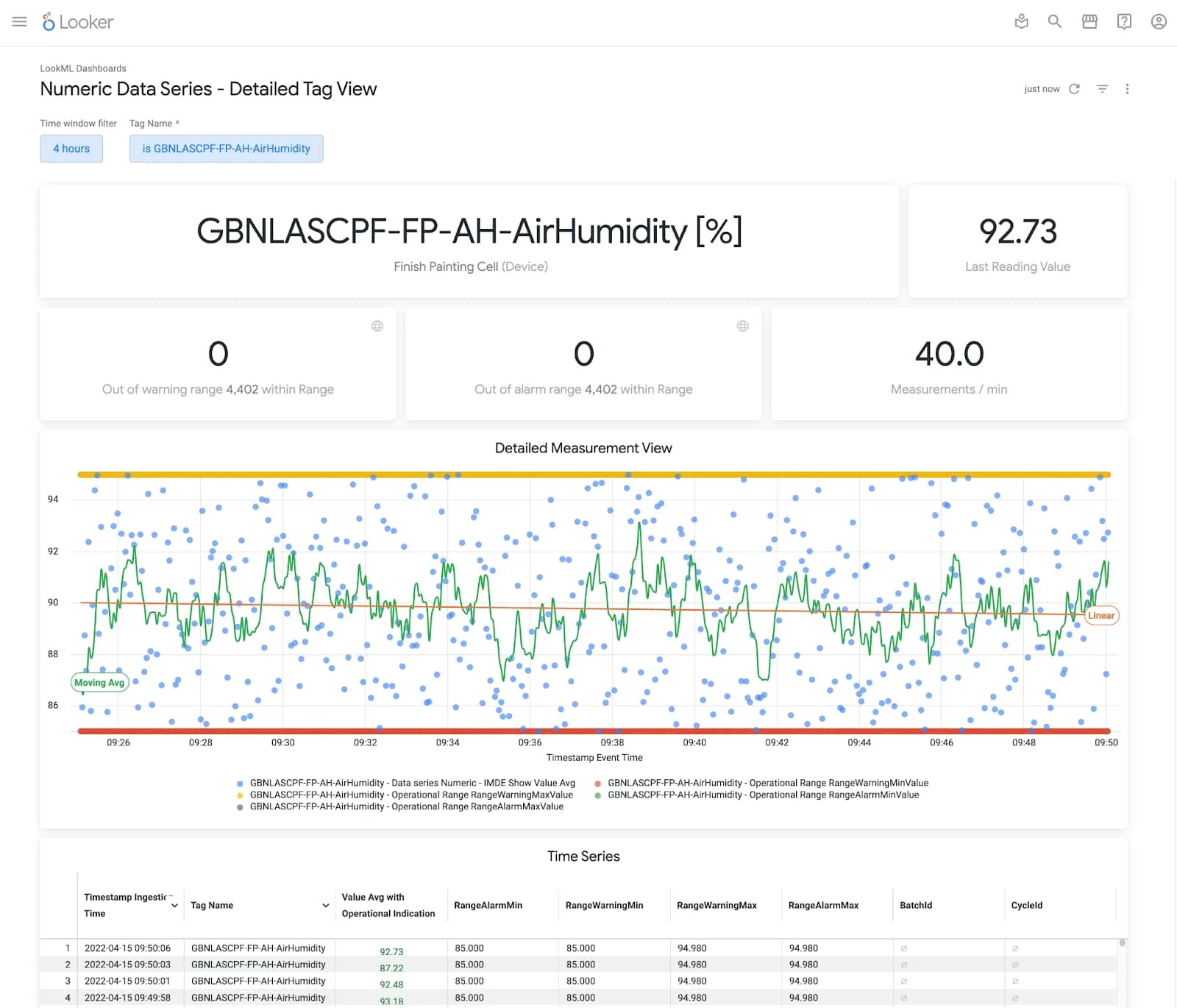
Google Cloud’s manufacturing offering centers on Manufacturing Data Engine (MDE). It delivers scalable connectivity between the factory floor and the cloud, working alongside Manufacturing Connect.
MDE provides a zero-code, pre-configured set of Google Cloud infrastructure that ingests, processes and stores data from industrial devices. Google positions it as a “factory abstraction layer” that augments existing SCADA and MES systems rather than replacing them.
Key features
MDE collects data from factory machines. The edge gateway speaks over 270 industrial protocols, so equipment from different automation vendors can be read without custom integration work for each one. It also makes that data usable by tagging every reading with what the machine was doing at the time, such as which product was running and on which line. Raw sensor values mean little without that context.
Google ships two ready-made:
- Anomaly detection that flags unusual sensor behaviour
- Visual inspection that spots defects from camera images.
Anything beyond those requires custom development with Google Cloud’s ML tools. MDE itself carries no license cost. Charges apply for the cloud resources it consumes, plus a separate fee for Manufacturing Connect.
3.) Microsoft Azure AI for Manufacturing
Microsoft Azure offers a suite of AI solutions designed specifically for the manufacturing sector. The platform integrates AI, IoT, and analytics to improve production efficiency, quality control, and supply chain management for manufacturers.
Key features
Microsoft Azure AI for Manufacturing provides tools for predictive maintenance, anomaly detection, and process optimization.
4.) Oracle Manufacturing Cloud
Oracle integrates AI across manufacturing processes (e.g. supply chain management or quality control) to enhance efficiency and market adaptability. As a module within Oracle Fusion Cloud SCM, the platform utilizes built-in AI to automate exception handling and accelerate decision-making.
Key features
Oracle’s AI applications enable manufacturers to gain real-time insights, optimize inventory management, and streamline production processes.
Pros
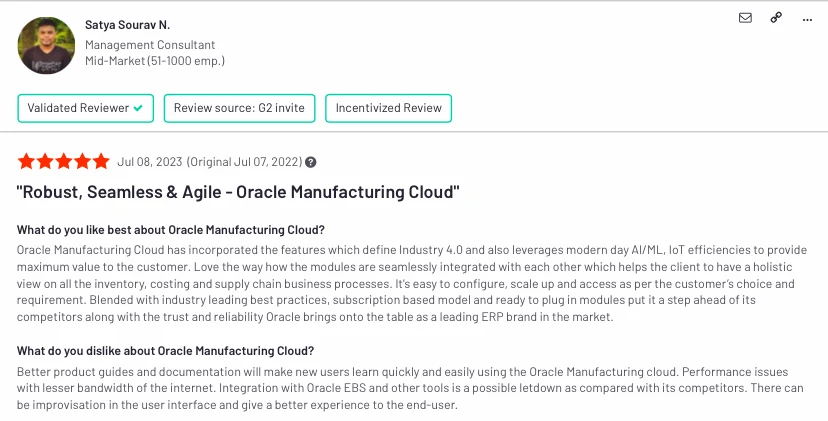
- AI/ML and IoT integration: Leverages modern AI/ML and IoT efficiencies, enhancing overall functionality and value.
- Configurability and scalability: Easy to configure, scale up, and customize according to customer preferences and requirements.
Cons:
- Documentation Improvement: Lack of comprehensive product guides and documentation for new users, hindering quick and easy learning.
- Performance Issues with low bandwidth: Faces performance issues when operating with limited internet bandwidth.
5.) Siemens & NVIDIA Industrial AI OS
Siemens and NVIDIA partnered to launch an industrial AI operating system powered by Siemens’ Digital Twin Composer and NVIDIA’s Omniverse. The platform enables manufacturers to build high-fidelity digital twins to simulate complex production environments.
Key features
Real-time physics-based simulation, integration of industrial automation with generative AI, and multi-agent AI orchestration for factory optimization.
Pros
- Multi-tool collaboration: Users praise the ability to integrate disparate 3D and CAD tools into a “single source of truth” without constant exporting/versioning.
- Photorealistic Physics Simulation: High ratings for the platform’s ability to simulate real-world physics and lighting, which is critical for accurate AI training and layout validation.
Cons
- Hardware Requirements: Significant investment in high-end NVIDIA GPUs and specialized computing infrastructure is mandatory for smooth performance.
- Steep Learning Curve: Professional users note that the system is complex and requires substantial training time, making it less accessible for smaller teams.
6.) Creatio
Creatio is a low-code/no-code, AI-native CRM and workflow automation platform that can be applied in manufacturing contexts to digitalize operational workflows, supply-chain, and production lifecycle processes. Creatio bridges front-office (CRM/sales) with back-office (production/operations).
Key features
- One unified platform: CRM, workflow automation, AI agents and manufacturing-specific workflows all in one, connecting sales pipelines, order management, service operations, and field teams without data silos.
- Manufacturing modules: It offers features like product lifecycle management, work-order and production-order management, resource allocation, inventory/supply-chain tracking, procurement workflows.
- Embedded AI capabilities: The platform includes AI/ML for predictive scoring, next-best-action recommendations, automation of routine decision-points (e.g., procurement triggers, quality alerts, distributor management, sales performance monitoring) and supports manufacturing administrative workflows via AI.
- Multi-region configuration: Centralized governance combined with no-code configuration allows regional teams to adapt workflows to local requirements, which can help manufacturers operating across multiple markets and plants maintain global consistency.
Pros
- Users praise Creatio’s low-code/no-code capabilities as it allows to build and maintain the system, leading to customization, improved efficiency, and autonomy.
- Creatio offers manufacturing-specific process support (order-to-cash, procurement, resource scheduling, inventory control) that gives credible value beyond generic automation tools.
- Creatio’s client success team is rated as highly collaborative, responsive, and solution-oriented, providing strong support for customization, cloud strategy execution, and system setup within Azure.
- Creatio uses an unlimited-user pricing model rather than per-seat licensing, which can help manufacturers roll out across large, distributed workforces without costs scaling with headcount.
Cons
- Users reported a learning curve with Creatio‘s extensive feature set, and the customization process as it was time-consuming and sometimes resulted in cluttered pages. Organizations without in-house implementation resources can work with one of Creatio’s certified partners, though this adds to the total cost of ownership.
- While it offers AI/ML features, it’s not a dedicated “heavy-tech” machine-learning platform, which requires other tools for heavy sensor-/image-/time-series or IoT layer modeling.
Creatio real-life example
Lohmann, a global adhesive tapes and bonding solutions manufacturer, ran on fragmented regional CRM systems that limited visibility across markets. The company used Creatio‘s no-code, agentic platform to unify its global sales and operations onto a single system across EMEA, the Americas, and APAC.
The provider achieved:
- Unified 27 international sites across EMEA, Americas, and APAC on one platform
- Full rollout completed in 18 months with Americas region in 3 months
- Integrated product, application, and customer data into a single source of truth for sales reporting. 3
7.) C3 AI
C3 AI provides a platform that integrates operational data from IoT sensors with machine learning models for predictive maintenance and supply chain forecasting.
Key features
C3 AI’s platform provides a comprehensive suite of tools for predictive analytics, process optimization, and quality control.
8.) DataRobot
DataRobot is an automated machine learning provider, building and deploying machine learning models at scale. In manufacturing, DataRobot’s AI solutions are applied to optimize processes, improve quality, and enhance decision-making.
Key features
DataRobot’s platform streamlines the machine learning model development process, making it accessible to a broader audience within manufacturing organizations. It facilitates predictive modeling, anomaly detection, and optimization, contributing to improved operational outcomes.
Pros:
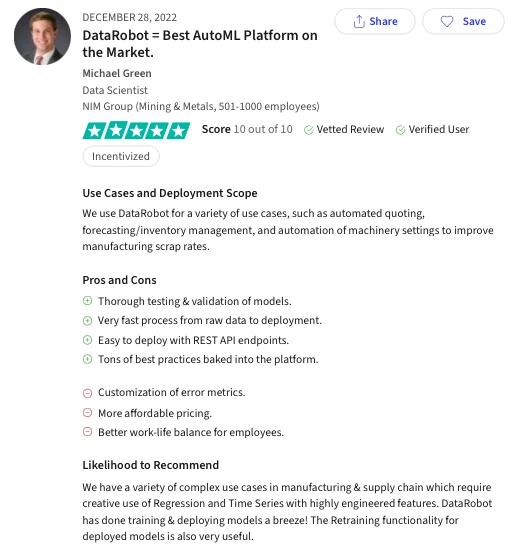
- Easy Deployment with REST API endpoints: Simplifies deployment through REST API endpoints, enhancing accessibility and integration capabilities.
- Versatility in use cases: Well-suited for a variety of complex use cases in manufacturing and supply chain, including automated quoting, forecasting, inventory management, and machinery settings automation.
Cons:
- Limited customization of error metrics: Users may find limitations in the customization of error metrics, potentially restricting the ability to tailor evaluations to specific needs.
9.) Rescale
Rescale focuses on high-performance computing (HPC) solutions for manufacturing, utilizing AI and simulation for product design, testing, and optimization. Their platform provides cloud-based HPC resources to accelerate complex simulations and analyses.
Key features
Rescale’s platform allows manufacturers to scale their computational resources dynamically, facilitating faster and more efficient simulations. This is particularly valuable for industries such as aerospace and automotive.
Industrial multi-sector AI tools
Below is the 12-month search market share breakdown for the leading manufacturing focused multi-sector AI tools:
10.) Cogniac Corporation
Cogniac Corporation specializes in visual-based AI solutions for manufacturing, offering computer vision applications to enhance quality control and inspection processes. The company’s platform utilizes advanced machine learning algorithms to analyze and interpret visual data, improving product quality and reducing defects.
Key features
Cogniac’s AI platform is designed to handle complex visual inspection tasks, enabling automated identification of defects and anomalies in real-time. Its customizable and adaptive algorithms make it well-suited for a variety of manufacturing environments.
11.) Falkonry
Falkonry focuses on predictive operations and machine learning for manufacturing, providing a platform that helps organizations predict and prevent operational disruptions. The platform utilizes machine learning models to analyze time-series data, enabling manufacturers to anticipate equipment failures and optimize maintenance schedules.
Key features
Falkonry’s platform enables manufacturers to monitor equipment health, predict failures, and proactively address maintenance needs. Its user-friendly interface allows to build and deploy predictive models without extensive data science expertise.
12.) NarrativeWave
NarrativeWave specializes in AI-driven solutions for supply chain optimization in manufacturing. The company’s platform leverages advanced analytics and machine learning to enhance demand forecasting, inventory management, and logistics planning.
Key features
NarrativeWave’s platform helps manufacturers optimize their supply chain by providing accurate demand forecasting, reducing excess inventory, and improving overall supply chain visibility. The AI-driven insights enable organizations to make data-driven decisions for improved efficiency.
13.) SKF Enlight AI
SKF Enlight AI is an industrial analytics solution based on automated machine learning and self-learning algorithms to detect anomalies and alert maintenance personnel. The technology came from Presenso, an Israeli AutoML company SKF acquired.
Key features
Enlight AI sits within the wider Enlight suite alongside Enlight Centre dashboards and Enlight Collect IMx-1 sensors, giving SKF coverage of both the hardware and software layers. SKF positions Enlight AI as complementary to its traditional condition monitoring software rather than as a replacement, with the pair providing visibility at sensor, asset and plant levels.
14.) IBM Maximo
IBM Maximo Application Suite is a unified asset and facilities management solution that brings maintenance, inspections and reliability together in one place for critical equipment and infrastructure. Manufacturers can use the tool to reduce downtime, improve quality and increase throughput.
Key features
Maximo’s asset performance management uses AI, analytics and sensor data to detect issues early, support condition-based maintenance and help prevent failures, while its inspection capability analyzes images and video from cameras, drones and mobile devices to detect defects, anomalies and critical conditions.
It also covers MRO inventory optimization with AI-enabled insights and asset investment planning that connects asset condition, risk and financial impact.
Manufacturing native AI tools
Below is the 12-month search market share map of the mfg-native manufacturing AI tools:
15.) Fero Labs
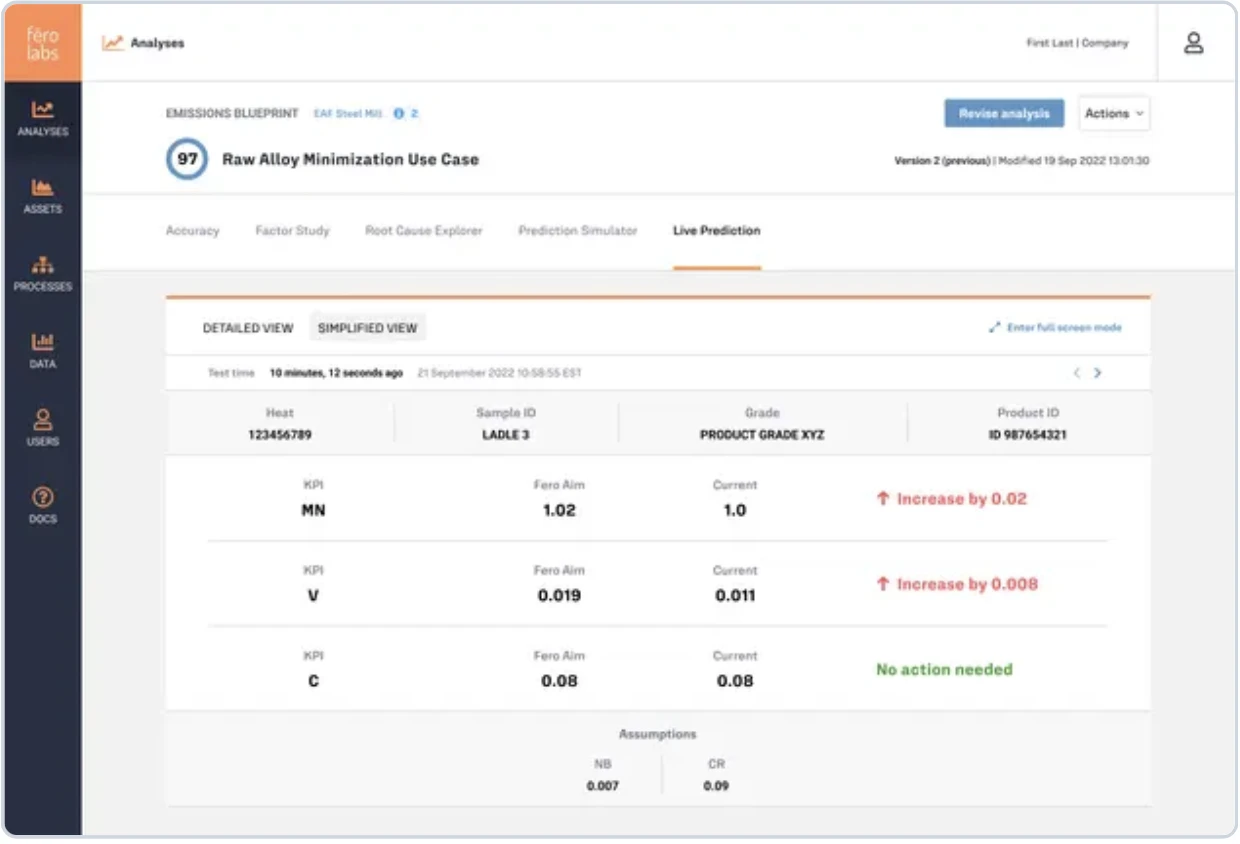
Ferolabs specializes in AI-driven solutions for process optimization in manufacturing. The company’s platform leverages machine learning algorithms to analyze and optimize complex manufacturing processes, enhancing efficiency and reducing operational costs.
Key features
Ferolabs’ AI applications provide manufacturers with insights into process bottlenecks, inefficiencies, and opportunities for improvement. The platform facilitates data-driven decision-making, allowing organizations to streamline operations and enhance overall productivity.
16.) Loopr AI
Loopr provides AI-powered visual inspection software for manufacturers to automate defect detection and assembly verification, improving inspection consistency and reducing quality costs.
Loopr AI raised $5.4 million for its AI software, Loopr Quality Control Platform, aimed at improving quality control in manufacturing.6
Key features
- AI-driven inspection of materials and finished products
- Real-time verification of complex assemblies against specs
- Supports aerospace, automotive, and general manufacturing sectors
- Tablet-compatible AI quality-inspection platform to detect defects
- Preserves inspection knowledge to mitigate workforce aging risks.
17.) MachineMetrics
MachineMetrics offers an industrial IoT platform with a focus on real-time data analytics for manufacturing. The platform collects and analyzes data from manufacturing equipment, providing manufacturers with insights into machine performance, production efficiency, and overall equipment effectiveness (OEE).
Key features
MachineMetrics’ platform enables manufacturers to monitor and optimize production processes in real-time. Its features include machine connectivity, performance analytics, and predictive maintenance capabilities, helping organizations maximize operational efficiency.
18.) Predictronics
Predictronics focuses on AI based predictive maintenance solutions for manufacturing to forecast equipment failures and optimize maintenance strategies. The company’s platform analyzes sensor data to predict potential issues, helping manufacturers reduce downtime and extend the lifespan of critical assets.
Key features
Predictronics’ predictive maintenance platform offers real-time monitoring, anomaly detection, and failure prediction, allowing manufacturers to implement proactive maintenance practices and enhance the reliability of their machinery.
19.) Sight Machine
Sight Machine specializes in AI-driven manufacturing analytics, enabling manufacturers to monitor production performance and optimize processes.
Key features
Sight Machine’s platform provides manufacturers with a comprehensive view of their operations, facilitating data-driven decision-making. The platform includes features for performance monitoring, quality control, and process optimization, empowering organizations to achieve operational excellence.
20.) Squint
Squint is a Manufacturing Intelligence Platform that helps manufacturers capture expert knowledge, improve operator performance, and analyze production insights. It combines spatial computing, large language models (LLMs), and human expertise to deliver AI-powered workflows that reduce errors and downtime on factory floors.
Squint addresses workforce knowledge gaps by turning expert procedures into interactive digital guides accessible via augmented reality. Squint raised $40M Series B funding to expand AI capabilities and enter new sectors like energy and logistics, serving major Fortune 500 customers.7
Key features
Squint’s platform uniquely recognizes machines without needing QR codes or CAD drawings, providing spatially pinned, step-by-step guidance. It automatically verifies work quality with AI, generates digital procedures from expert videos, and offers instant Q&A support for operators.
21.) Augury
Augury specializes in predictive maintenance and machine health monitoring for manufacturing. Their platform integrates AI and IoT to analyze machine data, enabling manufacturers to predict equipment failures, reduce downtime, and optimize maintenance schedules.
Key features
Augury’s platform offers continuous monitoring of machine health, leveraging AI algorithms to detect anomalies and predict potential issues. The real-time insights can enable manufacturers to implement maintenance strategies and improve overall equipment reliability.
Emerging manufacturing AI trends
Adaptive physical AI
A new class of Vision-Language-Action (VLA) models enables robots to reason and adapt to unstructured environments. Microsoft Rho-Alpha translates natural language instructions into direct motor control signals for complex two-handed tasks.8
Unlike previous models, it incorporates tactile sensing to perceive physical resistance and adjust grips in real time. This technology eliminates manual coding by allowing robots to learn from verbal commands. Automated systems can now handle messy real-world applications like varied assembly with minimal human intervention. This shift increases factory floor flexibility.
 Add as preferred source
FAQs
Manufacturing AI, or Artificial Intelligence in Manufacturing, refers to the application of data analytics and automation within the manufacturing sector.
Manufacturing AI solutions can be applied to various areas, including predictive maintenance, quality control, supply chain optimization, and process automation.
– Generative AI in product design: One transformative AI technology in manufacturing is generative AI. By leveraging a generative AI software, companies can optimize components for specific criteria such as weight, strength, or cost. This innovation in product design enhances efficiency and fosters continuous improvement in manufacturing processes.
– IoT for predictive maintenance: Internet of Things (IoT) devices form a critical component in manufacturing, collecting real-time data from machinery. Applied to predictive maintenance, IoT facilitates the analysis of equipment health, enabling proactive strategies to prevent breakdowns. This reduces downtime and extends the operational lifespan of crucial assets. Explore more on IoT in manufacturing.
–Computer vision for quality control: By employing machine learning algorithms, computer vision systems inspect products for defects in real-time, ensuring consistent and high-quality production. This application of machine vision technology significantly enhances product quality and reduces waste. Read more on computer vision applications in manufacturing.
– Natural Language Processing (NLP) for data analysis: In manufacturing AI, Natural Language Processing (NLP) contributes to efficient data analysis. By understanding and interpreting textual data, NLP enhances communication and provides valuable insights for data-driven decision-making. This application aids in optimizing workflows and identifying areas for process improvement.
–Predictive analytics for supply chain optimization: Predictive analytics, powered by machine learning, transforms supply chain management in manufacturing. This technology analyzes both historical data and real-time data to provide accurate demand forecasts. Manufacturers leverage this information to optimize inventory levels, minimize holding costs, and enhance overall supply chain efficiency.
– Robotic Process Automation (RPA) for streamlining operational processes: RPA emerges as a pivotal technology in manufacturing for automating routine operational processes. RPA in manufacturing ensures redirect their focus toward more strategic initiatives, thereby increasing overall productivity and operational agility.
Further reading
Explore more on AI use cases in any manufacturing process by exploring:
Cite this research
Pick the format that matches where you're publishing. Pasting the link version into your CMS preserves the backlink.
@misc{simsek2026,
  author = {Şimşek, Hazal},
  title  = {{Compare Top 21 Manufacturing AI Solutions & Software}},
  year   = {2026},
  month  = sep,
  howpublished    = {\url{https://aimultiple.com/manufacturing-ai-solutions}},
  note   = {AIMultiple. Retrieved September 25, 2026}
}Results and timestamps of 162 data points. Download the summary data shown in this article's charts and tables as a ZIP file containing 6 CSV files.
Want the granular data behind it? Join Premium
Changelog
8 updatesAdded SKF Enlight AI vendor entry to the manufacturing AI solutions list.
Removed the GE Additive and IBM Watson IoT for Manufacturing sections.
Added Lohmann customer case study to Creatio's manufacturing AI profile
Added a 12-month search market share chart for the leading manufacturing AI tools.
Removed complementary solutions from the Players section.
Added Siemens & NVIDIA Industrial AI OS to the list of manufacturing AI solutions.
Reference Links

























Be the first to comment
Your email address will not be published. All fields are required. Comments are left in their original language.