


40+ Internet of Things Examples & Applications

The Internet of Things (IoT) connects physical objects such as machines, vehicles, and home appliances to the internet so they can collect and exchange data. Forecasts indicate that worldwide IoT revenue will exceed $908 billion in 2034.1
Below are 40 Internet of Things examples, grouped by industry, from factory sensors to smart home devices:
Smart factories
1. Enterprise asset management
Enterprise asset management involves work management, asset maintenance, planning and scheduling, supply chain management, and environmental, health, and safety (EHS) initiatives.2 Businesses collect real-time data from an asset with IoT sensors.
Businesses are rapidly adopting smart asset management systems into their businesses. Due to their asset-intensive environments, we mostly encounter IoT asset monitoring in industries such as logistics, retail, and manufacturing.
Asset tracking shows where each asset is and how it is used, which supports:
- Increased operational efficiency
- Better control over the sales lifecycle
- More efficient safety and compliance checks
- More responsive smart environment.
2. Predictive maintenance
IoT sensors track signals such as vibration and temperature on a machine. Maintenance teams use this sensor data to estimate when a part will fail and replace it before it fails, rather than servicing every part on a fixed schedule.
For example, a robotics company working to reduce machine downtime with IoT technology uses sensors to predict when a component will fail.3
Aircraft engines are another example. Rolls-Royce’s advanced engine health monitoring service tracks more than 10,000 engine performance and health parameters during flight.4
3. Industrial process automation/optimization
Organizations can keep a real-time record of the metrics of all the machines inside a plant using IoT and IP networks. Manufacturers can use this data to automate workflows and optimize production systems. Automation and optimization support industrial companies to reduce costs and increase the quality and volume of output.
Factories installed 542,000 industrial robots in 2024, and 4.66 million were in operation worldwide, according to the International Federation of Robotics.5
4. Energy management
Energy can be a costly input for industrial businesses. With fluctuating energy costs and strict government requirements for efficiency, managing energy distribution becomes important.
IoT devices can help manufacturers manage energy consumption by collecting real-time data from devices. Intelligent energy management systems reduce energy bills, operational expenditures, and the factory’s carbon footprint while increasing energy efficiency. Some IoT platforms offer IoT applications, including energy management, to help businesses optimize their energy consumption.6
Smart cities
Kay Sharpington from Gartner states, “…Governments across the globe continue to use IoT technologies and solutions to improve citizen safety. At the same time, the falling endpoint and connectivity costs make smart city initiatives more viable”.7 Some of the use cases of IoT applications in smart cities are listed below:
5. Outdoor surveillance
Cities connect CCTV cameras to machine vision software that flags events on streets without a person watching every feed. Because the cameras record people, these systems need encryption, access controls, and rules on who can view the footage and for what purpose.
6. Smart lighting
Smart streetlights use motion sensors to detect traffic and pedestrians, and operators can dim or brighten each lamp remotely. In Switzerland, Chiasso cut daily lighting energy use in its city centre by 70% after moving to connected LED streetlights, and Bellinzona cut energy demand by 50% across more than 2,600 connected streetlights.8
Offices and warehouses use occupancy sensors in the same way to switch off lights in empty areas.
7. Electronic road toll collection and traffic management
Road sensors and cameras count vehicles at intersections, and traffic management centers use this data to adjust signal timing as traffic builds up. Electronic toll systems read a transponder or license plate as the vehicle passes, so drivers do not stop at a booth.
8. Public transport optimization
GPS units on buses, trains, and trams report each vehicle’s position, so passenger apps can show real-time arrival times and delays. Operators use the same data to adjust routes and schedules.
9. Smart parking
In cities like San Francisco, parking is a big problem. San Francisco’s SFpark pilot used parking sensors and demand-based meter prices. The city’s evaluation found that the time drivers spent searching for a space fell by 43% and vehicle miles travelled fell by 30% in pilot areas.9
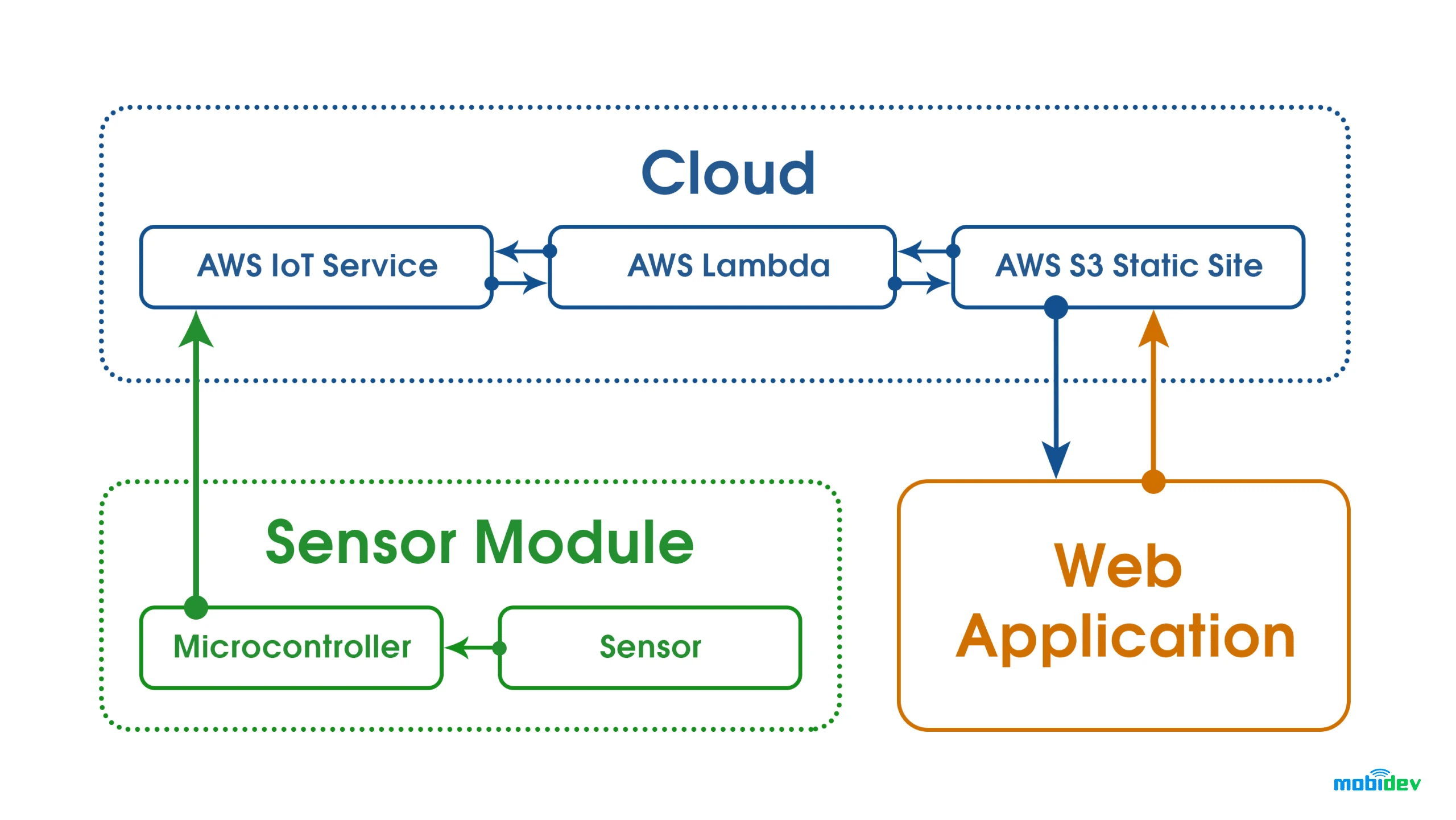
- The working principle of smart parking is:
- Drivers check mobile apps to identify vacant parking spaces close to the location they aim to go to.
- Sensors are attached to parking lots to detect parked cars
- Measurements are periodically sent to the cloud by microcontrollers
- Mobile Apps use cloud data to identify empty parking spaces,
Source: Mobidev10
10. Noise monitoring
Smart cities implement IoT devices for noise monitoring to maintain acceptable noise levels in urban areas. IoT systems continuously monitor sound levels, process data in real time, and alert organizations or businesses violating noise regulations. These connected devices help optimize urban environments and improve quality of life while ensuring compliance with local laws.
11. Structural health monitoring
Sensors on bridges, buildings, and tunnels measure vibration, strain, and crack width continuously. Engineers compare the readings with expected limits to decide where to inspect or repair before damage spreads.
12. Waste management
Traditional waste collections are complicated and costly since a fleet of trucks drives along busy streets using inefficient routes. Fill levels of garbage containers differ for each container, ranging from overflowing to partially filled to empty. IoT sensors can monitor fill levels for conventional bins and send the data to the relevant department of the city hall. With that information, the garbage truck routes can be optimized for trash collection.
Machine learning methods can also be implemented in IoT sensors (i.e. edge analytics) so that sensors can predict the fill levels of containers by learning from historical data.
Below the video, you can find how Proximus, an IoT solutions vendor, uses IoT to manage waste:
Smart agriculture
13. Earthquake early warning
Android phones act as earthquake sensors. When a stationary phone’s accelerometer picks up shaking, Google combines signals from nearby phones to detect the earthquake and warn users. A 2025 paper in Science reports that the system detected an average of 312 earthquakes a month and sent alerts in 98 countries.11
14. Precision spraying
Cameras on a sprayer boom detect weeds and trigger only the nozzles above them. John Deere reports that farmers used its See & Spray system on more than 5 million acres in 2025 and cut non-residual herbicide use by nearly 50% on average.12
Water management
Due to the drastic increase in urbanization levels and the importance of water quality in human health, water management is a key topic for cities. A water management system is based on real-time data collected from sensors. Water management can provide the following applications:
15. Water conservation
Sensors monitor tank water levels and alert when the level falls below the threshold. Some smart home water conservation systems use IoT sensors to monitor water usage.
16. Smart irrigation
IoT sensors measure weather conditions, soil moisture, and temperature to optimize the irrigation schedule and the appropriate amount of water the soil needs. The US EPA estimates that replacing a clock-based controller with a WaterSense labeled weather-based controller saves an average home nearly 7,600 gallons of water a year.13
17. Leakage management
Pressure and flow sensors on pipes and tanks detect the sudden pressure drop or unusual flow caused by a leak, so utilities can find it before it spreads.
18. Water quality management
Water quality sensors in pipes and reservoirs measure total dissolved solids (TDS), chlorine levels, and electrical conductivity, and send an alert when a reading leaves the safe range.
Digital health
19. Ultraviolet radiation monitoring
Sunlight consists of three major components:14
- Visible light: Wavelengths between 0.4 and 0.8 micrometers,
- Ultraviolet light: Wavelengths shorter than 0.4 micrometers,
- Infrared light: Wavelengths longer than 0.8 micrometers.
Ultraviolet (UV) rays are electromagnetic waves that account for about 10% of solar light. When overexposed, UV rays have harmful effects such as skin cancer, premature aging, cataracts, and immune system suppression. IoT sensors measure UV sun rays to warn people not to be exposed during certain hours.
20. Fall detection
Falling to the ground and not being able to get up or request help can be a scary experience for senior citizens. IoT sensors can detect falls using geolocation data and summon help so that it reduces the time the elderly remain on the floor after a fall which could lead to lethal consequences.
21. Companion robots
A companion robot is a robot that is designed to create companionship mostly for elderly and single children. IoT sensors are essential for robotics and it is the same for companion robots as well. Sensors detect objects that surround the robot and enable the robot to move.
People have become more receptive to companion robots during the pandemic.15 Social isolation may lead people to loneliness, anxiety, and frustration, especially the elderly.
22. Medical fridges
Medical fridges monitor the temperature of vaccines, medicines, and organic elements for clinics and health centers. Medical fridges provide an opportunity to follow all safety standards and national regulations of the pharmaceutical market using IoT sensors. They prevent medicines and vaccines from spoiling.
Efento is an IoT sensor and platform vendor offering a range of temperature measurement products and wireless temperature monitoring solutions for medical refrigerators.16
23. Patient surveillance/remote patient monitoring
Remote patient monitoring (RPM) systems use wearables to monitor the condition of patients who are resting at home after surgery. A 2022 meta-analysis of 38 randomized trials with 14,993 heart failure patients found that home telemonitoring lowered all-cause hospitalization by 13%.17
With RPM, doctors can observe patients’ data and provide early diagnoses without requiring patients to be physically present at the hospital.
Telit is an IoT solution vendor that offers its customers a remote patient monitoring (RPM) solution, enhancing patient monitoring capabilities and satisfaction.18 Telit’s offering can reduce:
- Patients’ hospital stay duration thanks to early diagnosis of complications
- Hospital readmissions
Smart retail
24. Supply chain control
IoT devices have transformed supply chain management. Sensors, which are attached to storage containers or products themselves,
- show the location of goods using GPS,
- track the speed of movement, providing an accurate estimated time of arrival (ETA) for goods,
- monitor warehouse conditions such as temperature, humidity, light intensity, and other environmental factors
25. Near-field communication (NFC) payment
NFC enables contactless payments. POS vendors include NFC support in their systems, and customers are adopting contactless payments via their smartphones.
26. Layout optimization
Sensors in the store collect data like voice, image, or video to better understand customer habits and preferences. Retailers can get insights to redesign the layout of their stores. The optimized layout can enhance sales.
27. Smart product management
IoT sensors enable retailers to control the rotation of products on shelves and in warehouses, automating merchandising decisions.
Smart workplace
28. Sociometric badges
Sociometric sensors are wearable IoT devices that measure the amount of face-to-face interaction, conversational time, physical proximity to other people, and physical activity levels using social signals derived from vocal features, body motion, and relative location.
For example, Humanyze is a vendor that uses sociometric sensors to perform people analytics.19 The company helps organizations understand how their teams interact to increase performance.
Smart homes
29. Remote control appliances
Smart plugs, lights, and appliances can be switched on and off from a smartphone app, for example to turn off an iron left on. They can also act on a schedule or sensor input, such as starting the coffee maker when the alarm goes off. Other examples of autonomous or remote-controlled actions include:
- Turning on lights,
- Starting the coffee maker,
- Setting temperature,
- Open up a music playlist,
- And locking doors.
Home intrusion detection systems
IoT-based home security applications give users capabilities such as smart locks and security cameras that detect motions and send alerts to their smartphones so that they can monitor the safety conditions of their homes from anywhere.
30. Smart locks
Smart locks enhance security by allowing remote access control and real-time monitoring through connected networks. EyeLock is a security provider that offers iris-based authentication for access control.20
31. Motion detection
Motion detection devices are also IoT applications used in security. Manything is another vendor in the IoT-based home security market.21 It streams home/office videos and lets users receive alerts when it detects any activity.
Smart logistics
32. Fleet tracking
IoT fleet tracking systems improve security and provide precise and complete reports that give the fleet managers full transparency regarding the fleet’s activities. Through GPS monitoring and geo-location tools, companies can track the location of their trucks, optimize routes, and monitor their fleet utilization in detail.
For instance, Canadian delivery service Sure Track Courier saved 6-10% per month on fuel costs by optimizing routes using IoT data from trucks.22 UPS reports that its ORION routing software, which plans each driver’s route from package and vehicle data, saves about 100 million miles and 10 million gallons of fuel a year.23
33. Platooning
Platooning involves a group of self-driving trucks that follow a lead truck at high speed safely and efficiently. Trucks use IoT sensors so that each truck communicates with the other trucks to adapt its speed and braking accordingly.
34. Connected vehicles
Sensors are enhancing vehicles along with AI and analytical capabilities. These sensors provide communication with the driver to supply useful information about other cars on the road and roadside infrastructure to the driver to help the driver make safer or more informed decisions. For example, these vehicles provide GPS-enabled location detection features that help them detect traffic congestion.
Autonomous trucks have moved from prototypes to commercial routes. In May 2025, Aurora launched driverless commercial freight runs between Dallas and Houston, with Uber Freight and Hirschbach Motor Lines as its first customers.24
 Add as preferred source
Smart Metering
35. Smart grid
With the increasing attention regarding climate change and carbon emissions, utilities focus on reducing energy consumption. For utility companies, IoT enables remote data management and monitoring capabilities to manage better power flows into and out of their grids, and give users the insights needed to understand their energy infrastructure investments.
Smart meters are the most common device on these grids. US electric utilities had about 119 million smart meter installations in 2022, equal to about 72% of all electric meters.25
36. Digital Twins
A digital twin is a virtual replica of physical entities such as devices, people, processes, or systems that help businesses make model-driven decisions. With the help of IoT sensors, businesses collect data that is needed to create a digital twin.
Digital twins enable businesses to gain a deeper understanding of real-world conditions so that they make necessary adjustments to their products & services.
Healthcare
37. IoT devices in healthcare
In healthcare, the ecosystem of IoT-enabled devices such as wearables (smartwatches, rings, vests, etc.), monitors (heart monitors, sleep monitors, temperature monitors, etc.), and trackers (medication refill reminder, drug effectiveness tracking, etc.) can be used for:
- Constant monitoring of patients’ vitals (blood pressure, heart rate, temperature rate, etc.),
- And more accurate diagnoses of patients, thanks to real-time data from IoT devices, thus reducing the possibility of readmission and rising hospital bills. In the Apple Heart Study, 419,297 Apple Watch users were monitored for irregular pulse. The watch notified 2,161 of them (0.52%), and 34% of those who then wore an ECG patch had atrial fibrillation confirmed.26
Payment rings, smartwatches, and fitness trackers with NFC chips work like a contactless card at a payment terminal. The 7 Ring from India, for example, has no battery: it draws power from the payment terminal and is linked to a prepaid digital wallet.
Banking industry
39. Connected ATMs
Modern ATMs leverage IoT technology to optimize customer service and reduce operational costs:
Connected ATMs report their cash levels and hardware faults to the bank, so refills and repairs are scheduled before the machine runs out or stops working. Some banks also run video ATMs, often called interactive teller machines, where the customer talks to a remote bank employee.
40. Queue management in bank branches
Source: PARTTEAM & OEMKIOSKS27
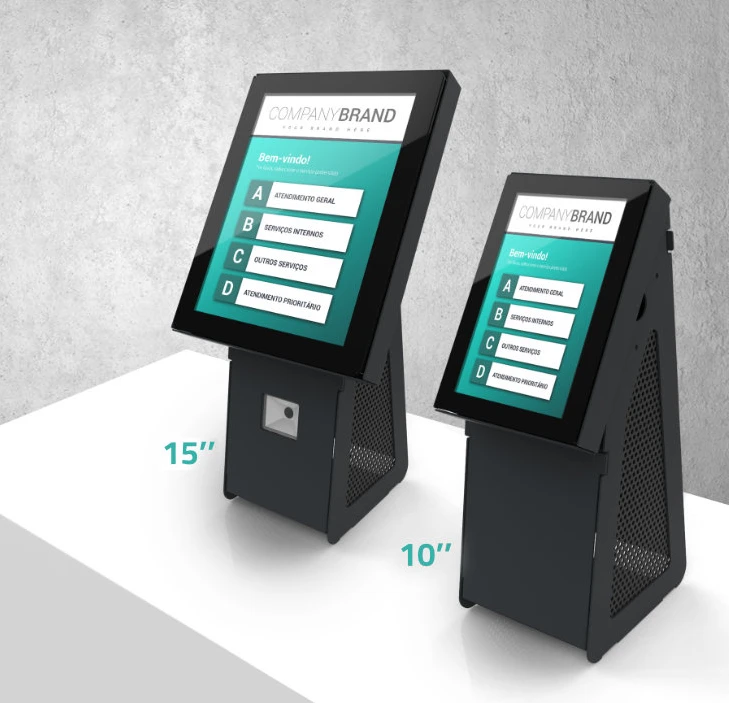
Queue management kiosks issue tickets, show estimated waiting times, and call each customer to a free counter. Branches can link these kiosks to an appointment app, so customers who booked ahead are served at their slot.
What is changing in IoT
IoT meant collecting data and sending it to people to act on. That is shifting. Three changes stand out.
Devices are starting to act on their own. When you pair AI agents with IoT sensors, the system can sense, decide, and act without waiting for a person. A plain IoT setup might flag a network anomaly and alert a human; an agent-based one can weigh the options and respond on its own. Some vendors call this “agentic IoT.” In a supply chain, for example, agents can reroute a shipment or adjust a production schedule the moment sensor data changes, instead of waiting for a manager to review a dashboard.28
More processing happens on the device. Instead of sending every reading to the cloud, newer devices run AI models locally, at the “edge.” This speeds up responses and keeps sensitive data on the device rather than sending it to a remote server. A factory machine can detect a fault and stop itself in milliseconds, even if its internet link drops.29
The scale keeps growing. IoT Analytics counted 18.5 billion connected IoT devices in 2024 and reported 21.1 billion at the end of 2025. It projects 39 billion by 2030 and more than 50 billion by 2035. Wi-Fi, Bluetooth, and cellular carry nearly 80% of these connections.30
FAQs
Consumer examples include smart thermostats, fitness trackers, security cameras, smart locks, and connected cars. Industrial IoT devices include temperature and vibration sensors on machines, air quality monitors, smart meters, and GPS trackers on trucks and containers.
There is not a single IoT architecture; however, the most basic and commonly agreed format is the three-layer architecture.
Perception Layer: It refers to the physical layer of the architecture. It involves sensors, actuators, and edge devices that are embedded in ‘things’. They collect data from the environment in which they operate.
Network Layer: It handles the transmission and processing of all collected data. Through routers and gateways, IoT devices could be connected to other smart devices, servers, and network devices.
Application Layer: It performs end-user services and consumer applications. It is the layer where consumers interact with the devices.
Security
As the number of IoT devices grows, security control over each device becomes harder. Also, many IoT devices do not share encrypted data with servers. This problem could be prevented with new machine learning approaches such as federated learning. This is especially important for healthcare applications since data privacy has greater importance in that industry.
Compatibility
Devices from different manufacturers often cannot talk to each other. The Connectivity Standards Alliance (CSA), the former Zigbee Alliance renamed in May 2021, maintains Matter, a smart home standard backed by Apple, Amazon, and Google31 so that smart home devices from different brands work together.
Further reading
- Digital Twin Applications/ Use Cases by Industry
- CRM AI Systems: Top 5 Vendors and Key Features
- SCADA Systems: Comparison of Top 10 SCADA Software
Cite this research
Pick the format that matches where you're publishing. Pasting the link version into your CMS preserves the backlink.
@misc{dilmegani2026,
  author = {Dilmegani, Cem and Arslan, Ezgi},
  title  = {{40+ Internet of Things Examples & Applications}},
  year   = {2026},
  month  = nov,
  howpublished    = {\url{https://aimultiple.com/iot-applications}},
  note   = {AIMultiple. Retrieved November 17, 2026}
}
Changelog
3 updatesAdded a "What is changing in IoT" section covering agentic IoT, edge processing, and device-count forecasts.
Reference Links
Cem's work at AIMultiple has been cited by leading global publications including Business Insider, Forbes, Morning Brew, and Washington Post, global firms like Deloitte and HPE, NGOs like World Economic Forum, and supranational organizations like European Commission. [1], [2], [3], [4], [5]
Throughout his career, Cem served as a tech consultant, tech buyer and tech entrepreneur. He advised enterprises on their technology decisions at McKinsey & Company and Altman Solon for more than a decade. He also published a McKinsey report on digitalization.
He led technology strategy and procurement of a telco while reporting to the CEO. He has also led commercial growth of deep tech company Hypatos that reached a 7 digit annual recurring revenue and a 9 digit valuation from 0 within 2 years. Cem's work in Hypatos was covered by leading technology publications like TechCrunch and Business Insider.
Cem regularly speaks at international technology conferences. He graduated from Bogazici University as a computer engineer and holds an MBA from Columbia Business School.



Be the first to comment
Your email address will not be published. All fields are required. Comments are left in their original language.