


Top 10 ERP AI Use Cases & Case Studies

Enterprise resource planning (ERP) systems help organizations manage core business processes such as finance, operations, and human resources within a single platform.
We provide the top 10 ERP AI use cases that focus on automating routine tasks, predictive forecasting, and intelligent analytics with real-life examples.
ERP AI use cases
1. Finance & accounting
AI brings speed and accuracy to financial tasks:
- It automates routine jobs like invoice processing and transaction recording.
- It helps check the accuracy of financial reports.
- It can reduce manual errors and improve cash flow management.
Most ERPs offer tools for financial management. However, the use of AI with native integrations can increase the capabilities of ERPs in areas such as document management & accounts payable process.
2. Advanced analytics & forecasting
AI sharpens forecasts across operations such as supply chain management. It reads historical and current data together to help companies prepare for what comes next. It analyzes both past and current data to help companies prepare for what’s next. Key examples include:
- Production: Avoid overproduction or running out of stock by predicting seasonal trends.
- Warehouse: Predict demand to manage inventory better and reduce waste.
- Sales: Forecast sales more accurately to set realistic goals and boost team performance.
For example, ADK Marketing Solutions replaced parts of its long-standing TV audience prediction workflow with dotData’s automated AI system to address rising variability in viewing patterns.
The previous approach relied on long-term averages and manual adjustments, which limited responsiveness to short-term trends. Using dotData, the team automated feature generation, tested multiple data configurations quickly, and refreshed prediction models on a monthly cycle. The results include:
- 20% reduction in prediction errors
- 30–40% faster prediction times
- Higher advertising effectiveness, supporting more accurate media purchasing decisions.1
3. Human resources
AI upgrades basic HR tools with smarter insights:
- It personalizes training and development for employees.
- It can screen resumes, rank applicants, and even answer applicant questions automatically.
- It supports performance reviews and salary planning with data-driven insights.
See how AI is used for automating recruitment:
4. Customer service
AI-powered chatbots, generative AI assistants, and virtual assistants help:
- Provide consistent AI service around the clock.
- Respond instantly to basic customer questions.
- Free up human agents to focus on complex issues.
Watch how Vodafone leverages AI to offer intelligent customer service:
5. Smart reporting and document handling
Generative AI tools can:
- Write reports using real-time ERP data.
- Summarize long documents, such as legal or compliance files.
- Help employees by drafting emails or messages.
These features reduce time spent on writing and reading, while also improving clarity and accuracy.
6. Supply chain logistics and inventory management
AI makes supply chain management more flexible and predictable:
- It predicts stock needs and reduces supply chain disruptions.
- It tracks order fulfillment, helping avoid delivery delays.
- It spots disruptions early, giving time to act.
For example, World Market’s use of an intelligent ERP system, powered by real-time inventory visibility and intelligent order routing, shows how AI-driven ERP solutions can optimize supply chain and inventory management by reducing shipping distances, enabling ship-from-store and BOPIS capabilities, and ensuring faster, more cost-effective fulfillment.2
7. Business process automation
AI can automate routine tasks in day-to-day business life:
- RPA (Robotic Process Automation) handles data entry and document transfers.
- NLP (Natural Language Processing) allows employees to ask the ERP system questions in plain language.
- AI can help with invoice processing, file organization, and report generation.
8. Predictive maintenance
Using data from sensors or digital twins, AI can:
- Predict when machines need maintenance.
- Prevent unexpected breakdowns.
- Reduce repair costs and downtime with predictive analytics from real-time insights.
9. Security and anomaly detection
AI-powered ERP systems can monitor systems to:
- Flag unusual activity (such as possible fraud).
- Alert compliance teams early.
- Protect sensitive data and transactions.
This is especially useful for banks and financial firms, but now benefits all industries with large data volumes.
10. Procurement and guided purchasing
AI helps companies buy smarter:
- It finds products or suppliers that match set rules like budget or sustainability.
- It recommends vendors based on past orders or performance.
For example, SAP’s Ariba platform suggests suppliers who meet ethical sourcing standards or specific pricing goals.3
Real-life examples from ERP AI companies
SAP Cloud ERP
SAP Cloud ERP is an enterprise resource planning solution delivered as software-as-a-service (SaaS). It runs on SAP’s cloud infrastructure and provides real-time access to data and applications.
The platform supports key functions such as finance, procurement, sales, manufacturing, and human resources within a unified system.
Pitney Bowes with SAP
Pitney Bowes, a global shipping and mailing technology provider, migrated from a legacy on-premise ERP system to SAP S/4HANA Cloud.
By integrating the solution with SAP Sales Cloud and other applications through SAP Business Technology Platform, the company standardized processes, simplified its IT landscape, and improved operational efficiency.
The new cloud environment enabled automated order-to-cash workflows, reduced system complexity, and supported the company’s shift from selling standalone products to delivering integrated service solutions.4
Oracle Enterprise Resource Planning
Oracle ERP is a cloud-based software suite that integrates and automates core business processes, such as finance, procurement, and project management, within a single platform.
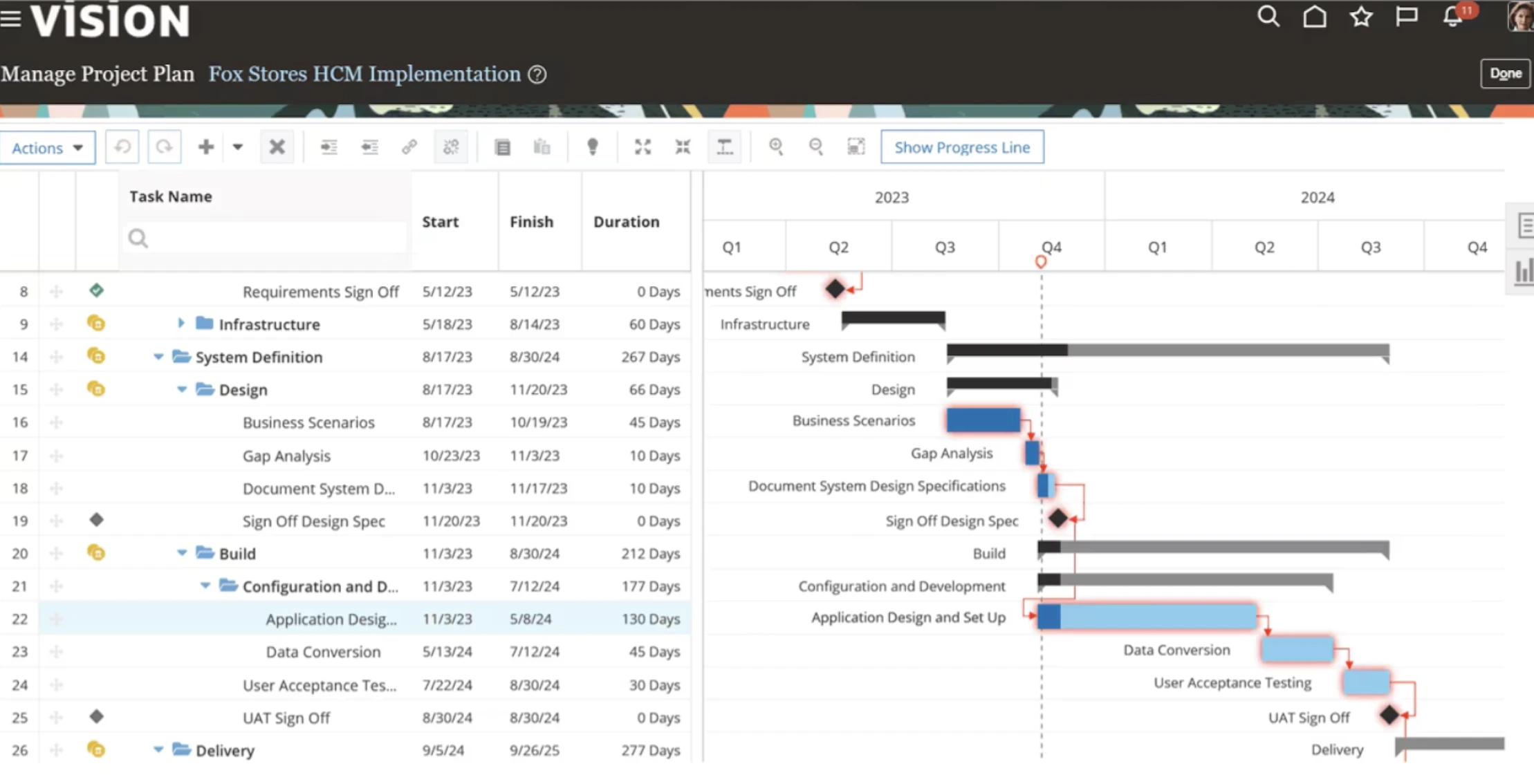
- Financial management: Manages accounting and financial operations, including general ledger, accounts payable and receivable, cash management, and financial reporting. It provides real-time insights into financial performance and supports forecasting and regulatory compliance.
- Project management: Enables organizations to plan, execute, and monitor projects from start to finish. It connects project tasks, budgets, and resources while providing visibility into project financial performance and progress.
- Procurement: Automates the source-to-pay process, helping companies manage supplier relationships and purchasing activities, and control spending. It also uses analytics and machine learning to improve supplier selection and compliance with purchasing policies.
- Risk management and compliance: Helps organizations detect risks, monitor user activities, and ensure compliance with regulations. Automated controls, auditing tools, and security features help protect financial data and reduce fraud or policy violations.
- Enterprise Performance Management (EPM): Supports strategic planning, budgeting, forecasting, and financial consolidation. It helps organizations understand profitability, align operational and financial plans, and improve long-term business performance.
- ERP analytics: Dashboards, reports, and data visualizations to analyze financial, procurement, and project data. These insights help businesses track key performance indicators and control costs.
Figure 1: Oracle ERP AI project management dashboard
Source: Oracle5
Microsoft Dynamics 365: Agentic CRM and ERP
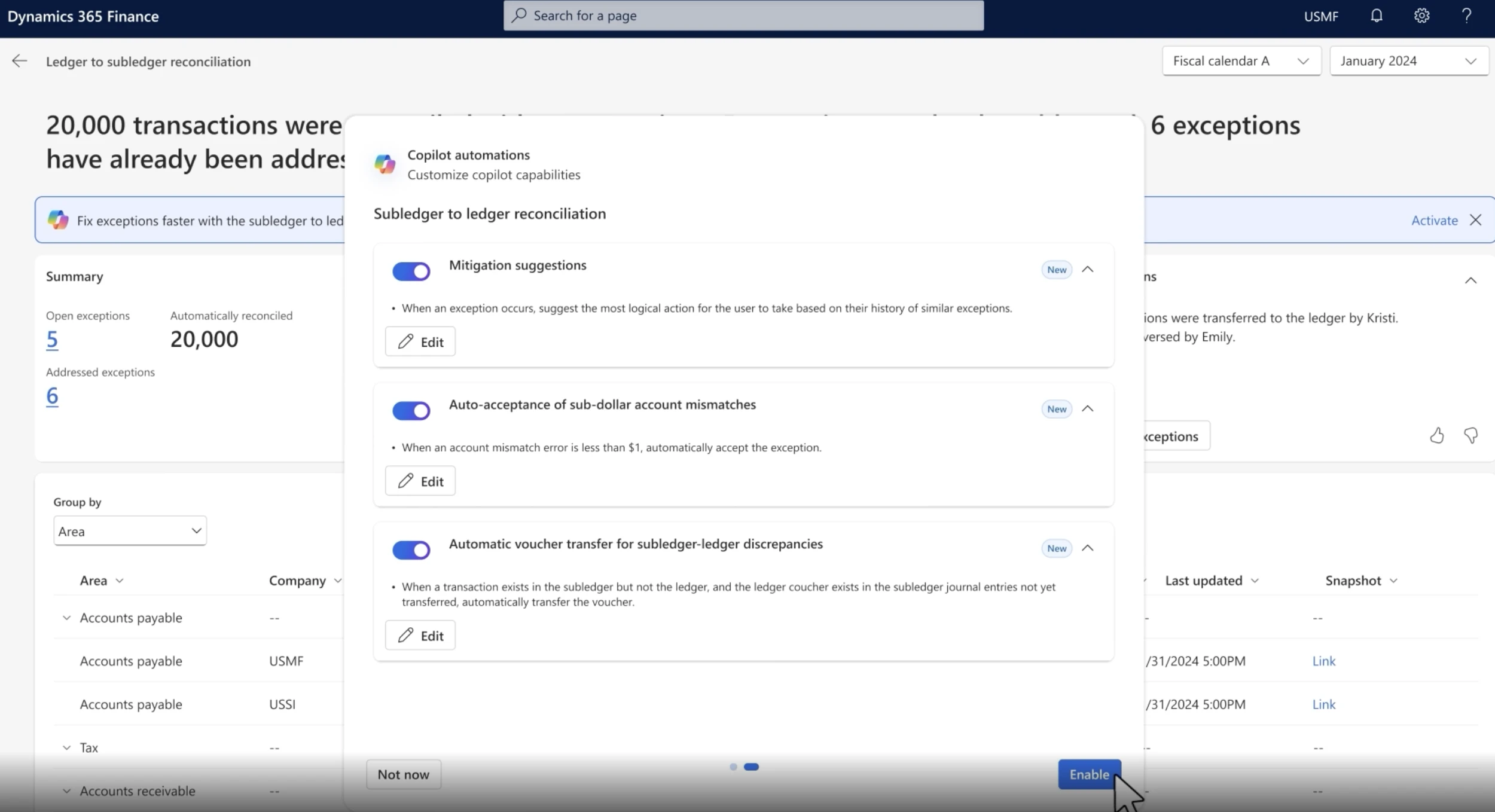
Microsoft Dynamics integrates AI agents and Copilot capabilities into its CRM and ERP systems to automate business decisions, workflows, and operations. Key features include:
- AI agents for autonomous workflows: AI agents monitor business data, analyze context, and perform tasks automatically, such as handling customer requests, forecasting cash flow, or optimizing supply chain operations.
- Unified CRM and ERP platform: Connects front-office CRM functions (sales, marketing, service) with back-office ERP functions (finance, operations, supply chain), allowing teams to work from shared data and collaborate across departments.
- Real-time data and analytics: Provides real-time dashboards and analytics, helping organizations monitor performance, track KPIs, and make data-driven decisions.
- Workflow automation and process optimization: Automates repetitive or complex processes such as scheduling, expense tracking, service workflows, and order management, reducing manual work and improving operational efficiency.
- Integration with Microsoft ecosystem: Integrates with Azure, Microsoft 365, Power Platform, and Copilot, enabling automation, natural-language interactions, and custom workflows across enterprise systems.
Figure 2: Dynamics 365 account reconciliation agent dashboard showing Copilot automation capabilities
Source: Microsoft6
Choosing AI-enabled ERP systems that fit daily operations
Machine learning capabilities are not the most important criteria in ERP selection. Companies should select ERP systems in line with how they will benefit them while running their daily business operations. However, the below factors are important to ensure that the ERP system is future proof when it comes to machine learning:
Effective data management
Companies rarely have a chance to modernize their ERP systems since these are critical production systems that have been deeply integrated into the companies’ operations. So companies need to make sure that when they switch to a new ERP system, it is flexible enough to store and provide company data in granular detail, in line with its operations.
As long as data is easy to access, companies could use the machine learning components of their ERP or other software to build machine learning models to solve their operational problems.
Agentic governance
Agents that act on their own raise a new question: how to keep them in bounds. The risk is concrete. Gartner expects more than 40% of agentic AI projects to be canceled by the end of 2027, citing rising costs, unclear value, and weak risk controls. A separate finding puts the share of organizations with a mature AI governance model at 21%.7
Vendors responded with control layers:
- SAP announced an AI Agent Hub, a central place to set rules for which agents may run and what data they may touch.8 SAP certified its agent platform against ISO/IEC 42001, the management standard for AI systems.
- Forrester expects about half of ERP vendors to add autonomous governance features during 2026, such as audit trails and policy enforcement.
Ease of integration
No single vendor can supply every machine learning capability a company needs, since machine learning touches every part of operations. An ERP system should therefore integrate easily with third-party providers. Ideal ERP software should be easy to integrate with 3rd-party providers.
Agentic ERP: from copilots to autonomous agents
Assistants that answered questions gave way to agents that take action. Gartner projects that by 2028, agentic AI will make at least 15% of day-to-day work decisions and that 33% of enterprise software will include agentic AI.7
Trends in ERP are shaped by this change as well. An agent reads business data, decides on the next step, and executes it within the ERP, pausing for human approval on high-stakes actions.
The major vendors moved together:
- SAP made Joule Studio available and now ships more than 50 domain assistants coordinating over 200 agents across finance, procurement, and supply chain.9
- Oracle introduced Fusion Agentic Applications, with agents that act inside a business process rather than in a separate chat window.10
- Microsoft added agentic features to Dynamics 365, including automated warehouse picking and inventory rebalancing.11
Shared standards let agents work across systems
Two protocols are shaping how ERP agents connect:
- The Model Context Protocol (MCP) gives agents a common way to reach tools and data
- The Agent-to-Agent protocol (A2A) lets agents from different vendors pass work to each other.
For more information, read the agent communication protocol.
The effect is cross-vendor workflows. SAP and Microsoft linked Joule and Microsoft 365 Copilot so the two can run steps together across both systems.12 An ERP agent is starting to reach past the walls of a single suite.
 Add as preferred source
Cite this research
Pick the format that matches where you're publishing. Pasting the link version into your CMS preserves the backlink.
@misc{dilmegani2026,
  author = {Dilmegani, Cem and Arslan, Ezgi},
  title  = {{Top 10 ERP AI Use Cases & Case Studies}},
  year   = {2026},
  month  = jul,
  howpublished    = {\url{https://aimultiple.com/erp-ai}},
  note   = {AIMultiple. Retrieved July 31, 2026}
}
Changelog
8 updatesAdded 'Agentic ERP: from copilots to autonomous agents' section.
Removed the PairSoft example from the Finance & accounting AI section.
Replaced the 'Case studies' section with 'Real-life examples from ERP AI companies'.
Reference Links
Cem's work at AIMultiple has been cited by leading global publications including Business Insider, Forbes, Morning Brew, and Washington Post, global firms like Deloitte and HPE, NGOs like World Economic Forum, and supranational organizations like European Commission. [1], [2], [3], [4], [5]
Throughout his career, Cem served as a tech consultant, tech buyer and tech entrepreneur. He advised enterprises on their technology decisions at McKinsey & Company and Altman Solon for more than a decade. He also published a McKinsey report on digitalization.
He led technology strategy and procurement of a telco while reporting to the CEO. He has also led commercial growth of deep tech company Hypatos that reached a 7 digit annual recurring revenue and a 9 digit valuation from 0 within 2 years. Cem's work in Hypatos was covered by leading technology publications like TechCrunch and Business Insider.
Cem regularly speaks at international technology conferences. He graduated from Bogazici University as a computer engineer and holds an MBA from Columbia Business School.





Be the first to comment
Your email address will not be published. All fields are required. Comments are left in their original language.