


Top LLMOps Tools & Compare them to MLOPs

LLMOps platforms handle the operational side of running large language models: deployment, monitoring, evaluation, and cost management.
We examined top LLMOps tools, their core features, pricing models, and how they differ from each other to help identify the best fit for various use cases.
LLMOps tools comparison
Tool | Evaluation | Cost Tracking | Fine Tuning | Prompt Eng. | Pipeline Cons. | BLEU / ROUGE | Data Storage & Versioning |
|---|---|---|---|---|---|---|---|
✓ | ✓ | ✓ | ✓ | ✓ | ✓ | ✓ | |
MLflow | ✓ | ✓ | ✓ | ✓ | ✓ | ✓ | ✓ |
Lamini AI | ✓ | ✓ | ✓ | ✓ | ✓ | ✓ | ✕ |
TrueFoundry | ✓ | ✓ | ✓ | ✕ | ✓ | ✓ | ✕ |
Deepset AI | ✕ | ✕ | ✓ | ✓ | ✓ | ✕ | ✓ |
Nemo by NVIDIA | ✓ | ✕ | ✓ | ✓ | ✕ | ✓ | ✕ |
Fine-Tuner AI | ✓ | ✕ | ✓ | ✓ | ✕ | ✕ | ✓ |
ZenML | ✓ | ✕ | ✕ | ✕ | ✓ | ✓ | ✕ |
Snorkel AI | ✕ | ✕ | ✕ | ✓ | ✓ | ✕ | ✓ |
Comet | ✓ | ✓ | ✕ | ✕ | ✕ | ✓ | ✕ |
A breakdown of each metric is provided below:
- Evaluation: Some LLMOps tools include built-in capabilities to assess model outputs against task-specific criteria, while others rely on external frameworks for more customized or in-depth analysis.
- Cost tracking: Detailed cost analysis and monitoring of resources used during training and inference are either directly supported by tools or achieved through integrations.
- Fine-tuning: Some LLMOps tools perform fine-tuning of large language models themselves, whereas others focus on managing or orchestrating the fine-tuning process.
- Prompt engineering: Designing and optimizing prompts is directly handled by some tools, but most provide infrastructure to support this rather than performing it themselves.
- Pipeline Construction: Certain tools automate end-to-end LLM workflows, including data preparation, training, and evaluation. Meanwhile, others enable pipeline building through integrations.
- BLEU / ROUGE: BLEU and ROUGE are common language evaluation metrics used to assess text quality; some tools support them natively, while others rely on external libraries.
- Data storage & versioning: Secure storage and version tracking of training data are handled directly by some tools, while others integrate with third-party storage/versioning solutions.
What are LLMOps platforms?
LLMOps platforms support the lifecycle of LLMs by enabling:
- Fine-tuning
- Versioning
- Deployment
- Monitoring
- Prompt and experiment management
LLMOps platforms vary in approach:
- No-code/Low-code platforms: easy to use but less flexible.
- Code-first/Engineering-oriented platforms: require technical skills but offer greater customization.
LLMOps tools can be grouped into three main categories:
1. MLOps platforms extending into LLMOps
Certain Machine Learning Operations (MLOps) platforms include specialized toolkits tailored for large language model operations (LLMOps).
MLOps is the discipline focused on orchestrating the full lifecycle of machine learning, from development through to deployment and maintenance. Since LLMs are also machine learning models, MLOps vendors are naturally expanding into this domain.
Weights & Biases
Weights & Biases (W&B) is an MLOps platform that expanded into LLMOps through W&B Weave. Originally focused on experiment tracking and model monitoring for traditional ML, W&B added LLM capabilities as these models became central to AI development.
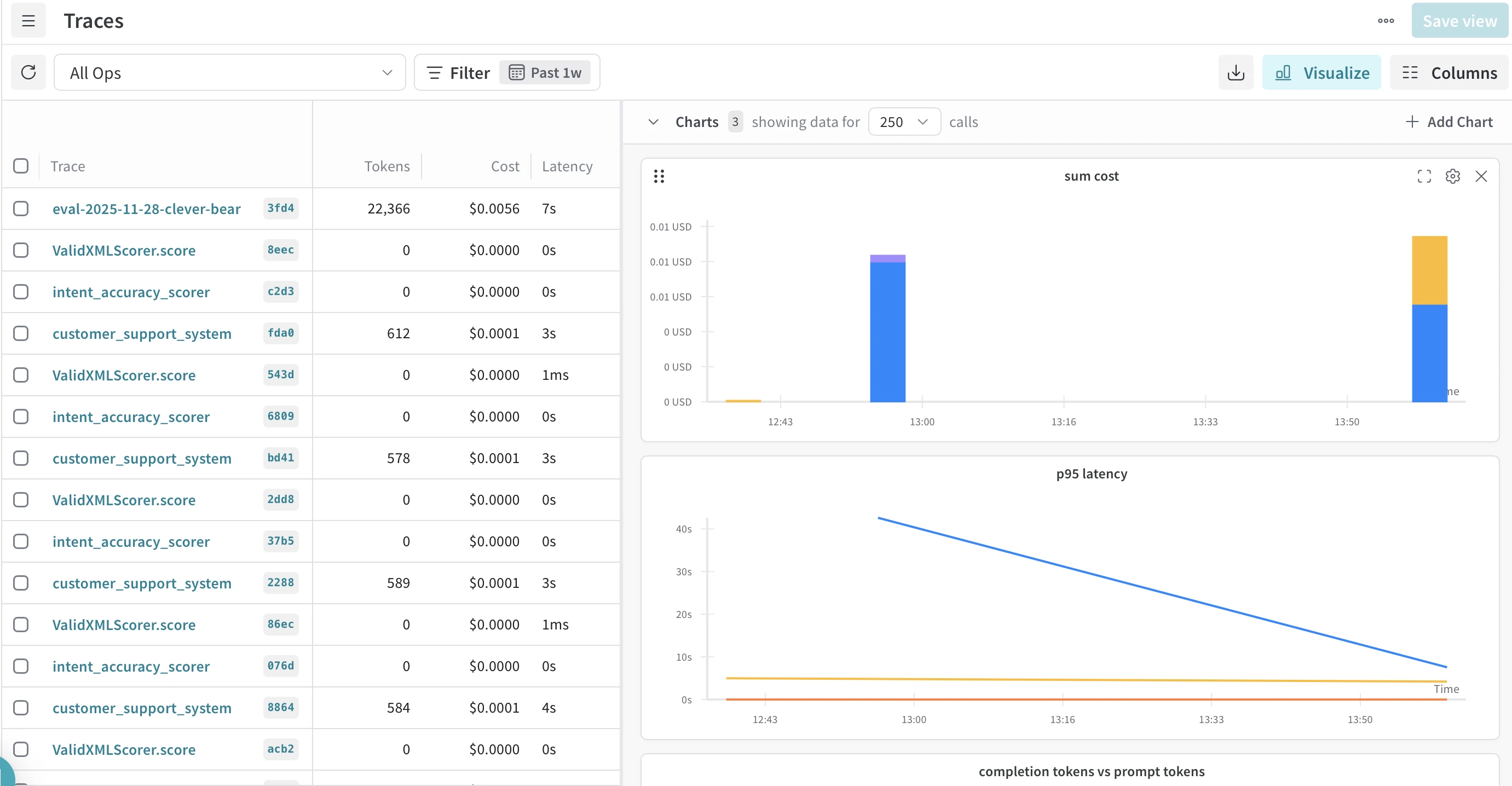
W&B Weave provides LLM observability with automatic tracing, prompt versioning, evaluation frameworks with built-in scorers, and multi agent workflow visualization. The platform tracks costs and latency at individual and aggregate levels, helping teams identify expensive queries and performance bottlenecks. For complex pipelines with multiple agents or tool calls, W&B Weave creates nested trace trees showing complete execution flow, enabling debugging of multi-step workflows and optimization of each component.
W&B enables teams to use the same platform for fine-tuning LLMs (W&B Experiments and Sweeps), versioning data and models (W&B Artifacts), and monitoring production applications (W&B Weave).
Figure 1: Weights & Biases traces dashboard.
MLflow
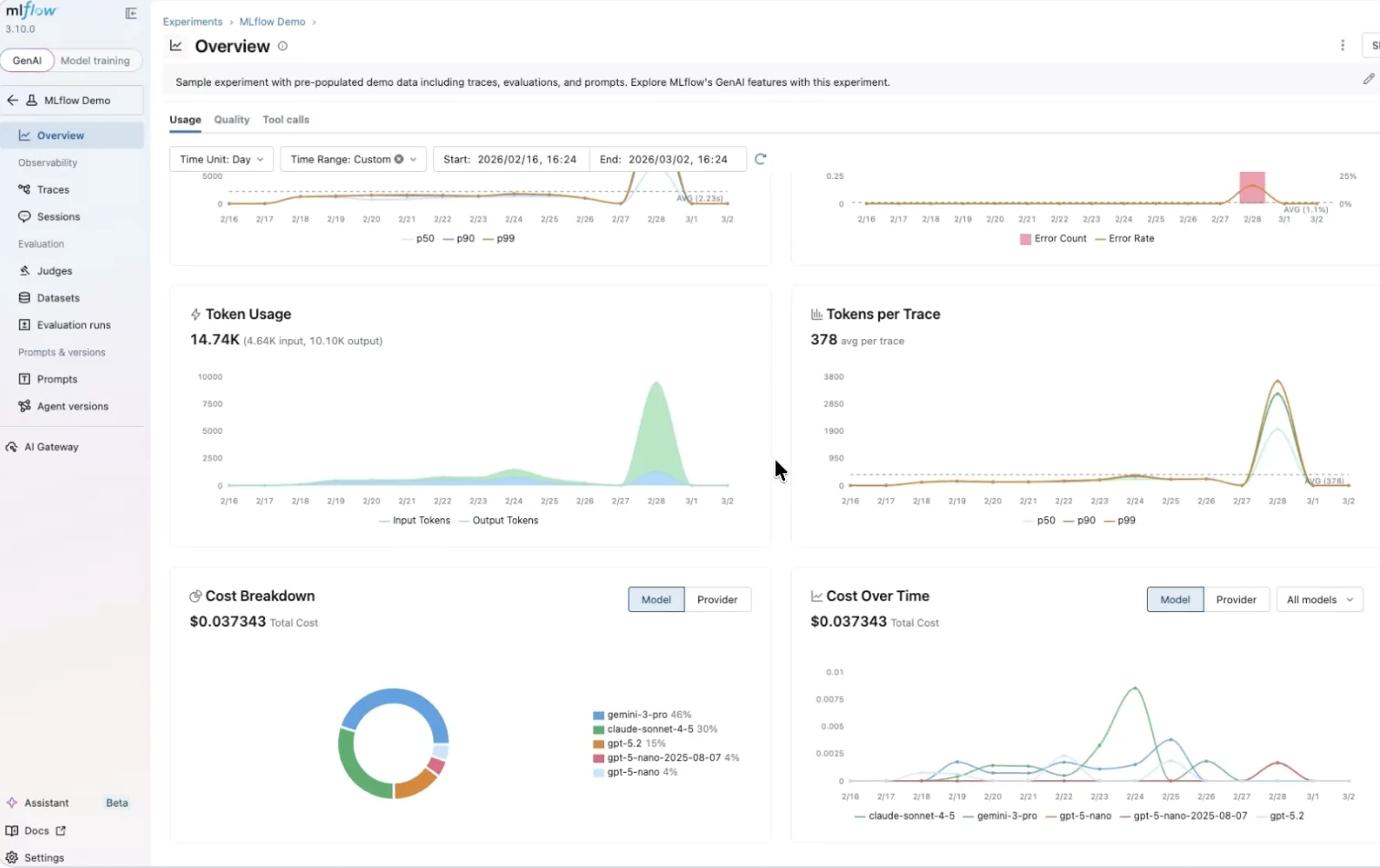
MLflow is an open-source platform for managing the LLM and agent lifecycle. Key LLMOps capabilities include:
- Tracing: captures prompts, retrievals, and tool calls across agent workflows
- Evaluation: LLM-as-a-judge scoring with pre-built metrics for hallucination and relevance
- Prompt management: versioning, optimization, and lineage tracking
- AI Gateway: centralized model access and cost control
MLflow is OpenTelemetry-compatible and integrates with major LLM providers and agent frameworks.
1Comet
Comet is an experiment-tracking and model-observability platform. It also supports LLM experiment tracking, prompt versioning, and LLM evaluation, making it suitable for teams building and optimizing LLM applications.
Valohai
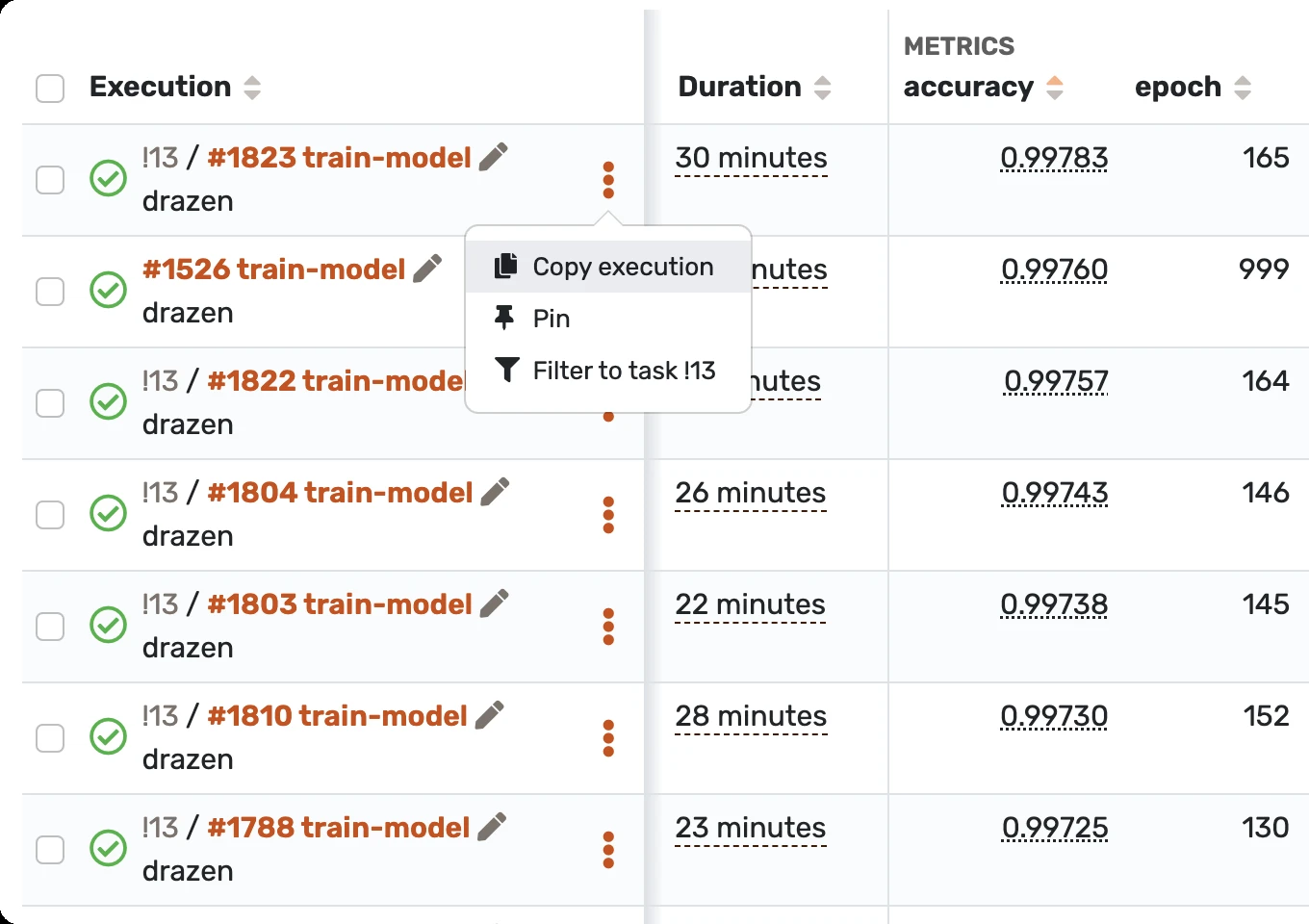
Valohai is an MLOps platform that supports reproducible pipelines for data processing, training, and deployment. It recently added LLMOps-friendly capabilities such as metadata tracking, artifact versioning, and large-scale training orchestration.
Figure 2: Valohai knowledge repository.2
TrueFoundry
TrueFoundry is an end-to-end ML/LLM platform that simplifies model deployment, finetuning, and monitoring. It offers GPU-optimized infra, model registry, prompt management, and enterprise-grade governance.
Zen ML
ZenML provides a production-ready pipeline framework for MLOps and LLMOps. It allows users to build reproducible pipelines, connect orchestrators (Airflow, Kubeflow), and integrate LLM workflows such as RAG, finetuning, and evaluation.
2. Data, cloud & infrastructure platforms offering LLMOps
Data, cloud, and infrastructure platforms are increasingly offering LLMOps capabilities that enable users to leverage their own data to build and fine-tune LLMs.
For example, Databricks provides LLM training, fine-tuning, and model hosting (expanded following the MosaicML acquisition).
Cloud leaders Amazon, Azure, and Google have all launched their LLMOps offering, which allows users to deploy models from different providers.
3. LLM-Focused frameworks & platforms
This category includes tools that exclusively focus on optimizing and managing LLM operations. Here’s a breakdown of the tools and their core LLMOps functions:
DeepLake
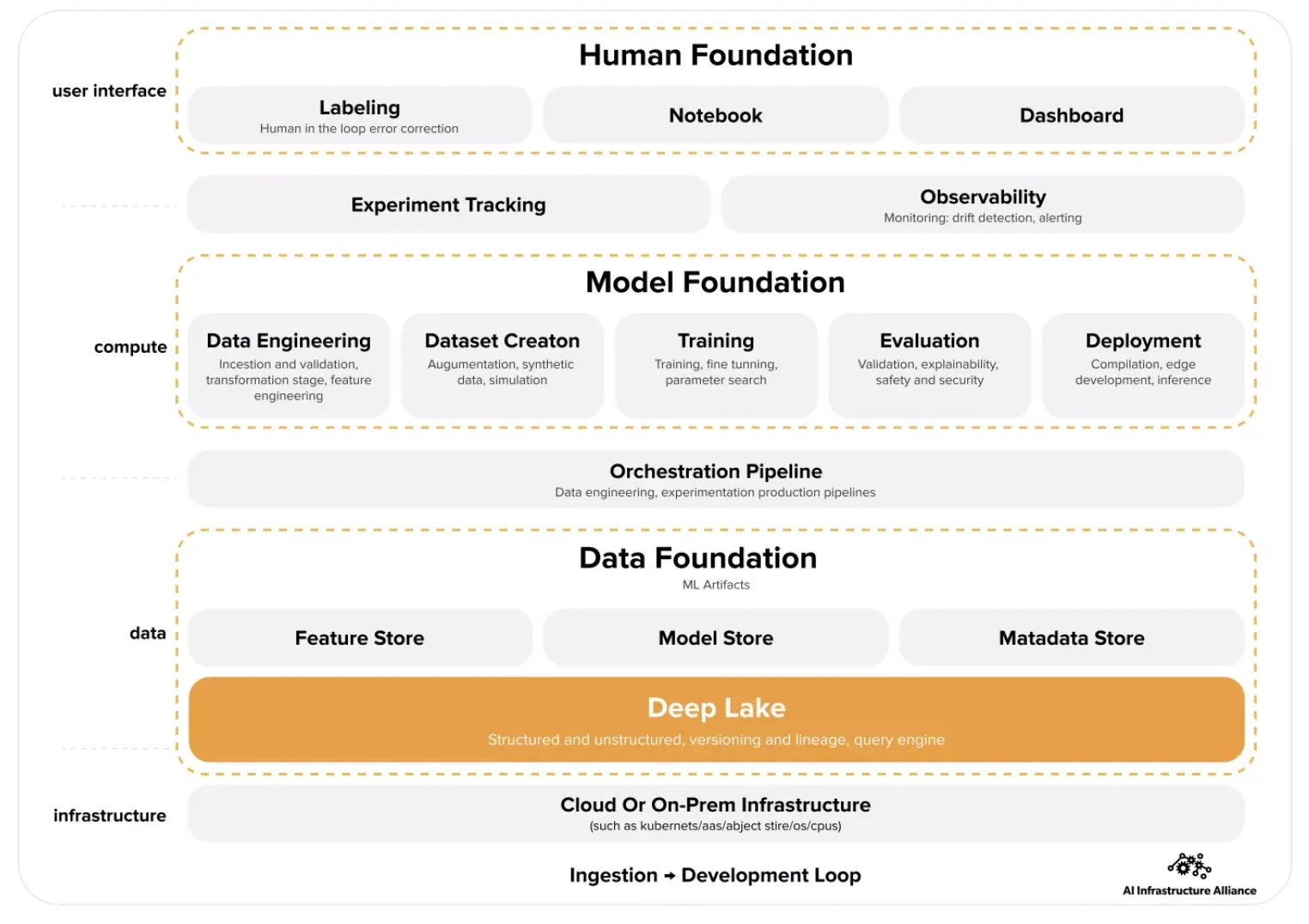
Deep Lake provides a data lake designed for AI, offering storage, versioning, and a vector database. It supports workflows for LLM dataset creation, inspection, and retrieval, working seamlessly with PyTorch and TensorFlow.
Figure 3: The image shows the role of Deep Lake in an MLOps architecture3
Deepset AI
Deepset’s Haystack is a RAG and search framework that enables enterprises to build LLM-powered applications by combining document stores, retrievers, and large language models. It supports multi-modal RAG pipelines, model evaluation, and production deployment.
Lamini AI
Lamini offers a platform for building custom LLMs, supporting both full finetuning and lightweight tuning. It is built for enterprises needing domain-specific LLMs and provides APIs and SDKs for integrating organizational data.
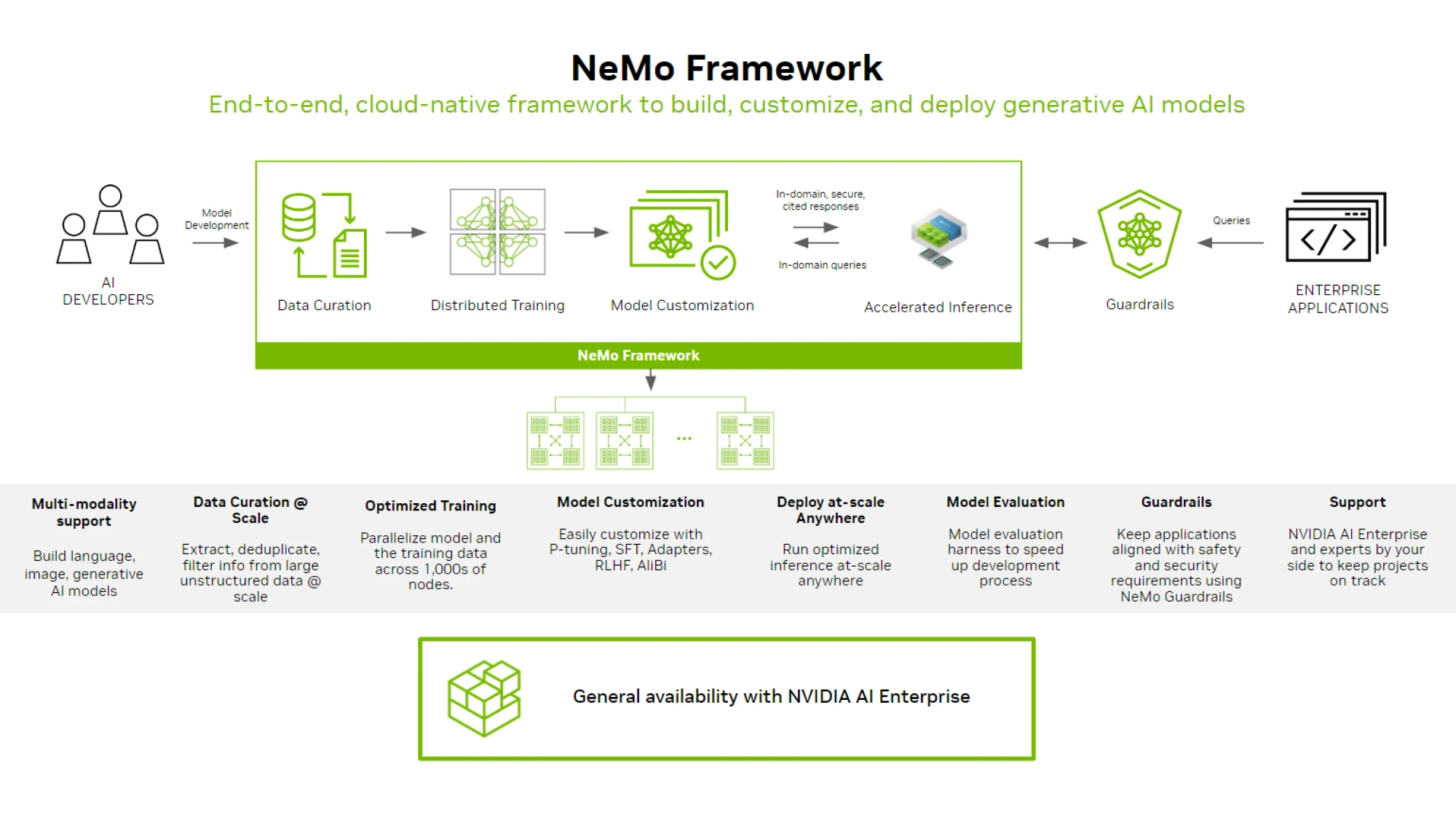
Nemo by NVIDIA
NeMo is a framework for building, training, and customizing foundation models, including LLMs. It provides components for supervised finetuning, instruction tuning, RAG, model evaluation, and deployment on NVIDIA GPUs.
Figure 4: NeMo framework architecture.4
Snorkel AI
Snorkel AI provides a data-centric development platform for programmatically labeling and curating training data. It now extends into foundation model customization, enabling organizations to adapt LLMs with high-quality, automatically labeled datasets.
Titan ML
TitanML focuses on efficient LLM inference. Its Titan Takeoff Server helps teams run LLMs on-premise with optimized performance, reduced GPU requirements, and improved latency. It also provides quantization and compression features.
LLMOps supporting technologies
LLMs
Some LLM providers, such as OpenAI, Anthropic, and Google, offer partial LLM lifecycle features (e.g., fine-tuning on select models, monitoring dashboards, and evaluation tooling).
Note: LLM providers offer tools for fine-tuning and integration, but they are not full LLMOps platforms. LLMOps typically requires additional components such as monitoring, governance, lineage, evaluation systems, and pipeline management.
Integration frameworks
These tools are built to facilitate the development of LLM applications, such as document and code analyzers, chatbots, etc.
Vector databases
VDs store high-dimensional vector embeddings generated from text, images, or other data. They do not store raw, sensitive records such as medical test results; instead, they index embeddings to enable semantic search and retrieval.
Fine-tuning tools
Fine-tuning tools range from low-level libraries to no-code platforms, depending on the level of control and technical expertise required.
Libraries and frameworks
Hugging Face Transformers and PEFT/LoRA-based frameworks are the most widely used options for fine-tuning. For large-scale workloads, training engines such as DeepSpeed and Megatron-LM handle distributed training efficiently.
No-code platforms
Unsloth Studio and Hugging Face AutoTrain provide web interfaces for fine-tuning LLMs without writing code.
Unsloth Studio is open-source and supports LoRA and QLoRA methods with direct Hugging Face integration. Hugging Face AutoTrain allows users to fine-tune models by uploading data directly through the Hugging Face ecosystem.
RLHF tools
RLHF, short for reinforcement learning from human feedback, enables AI systems to refine their decisions by incorporating human guidance.
In reinforcement learning, an agent improves its behavior through trial and error, guided by feedback from the environment in the form of rewards or punishments.
In contrast, RLHF helps improve model behavior by integrating human preference data into the training loop. It does not replace large-scale labeling but relies on human-generated comparison data. RLHF supports alignment, safety, quality improvement, and better adherence to user intent.
LLM testing tools
LLM testing tools evaluate LLMs by assessing model performance, capabilities, and potential biases across language-related tasks such as natural language understanding and generation. Testing tools may include:
- Testing frameworks
- Benchmark datasets
- Evaluation metrics.
For example, Promptfoo is an open-source CLI and library that automatically scores outputs using custom metrics, runs side-by-side comparisons across multiple models and providers, and performs automated red-teaming to identify vulnerabilities. It integrates with CI/CD pipelines and runs completely locally.
LLM monitoring and observability
LLM monitoring and observability tools ensure proper functioning, user safety, and brand protection. Unlike traditional ML, LLM outputs are inherently non-deterministic, meaning the same input can yield different results, which requires tracing full context to detect hallucinations.5 In practice, improvements come through iterative prompt and context updates rather than retraining.
LLM monitoring includes activities like:
- Functional monitoring: Keeping track of factors like response time, token usage, number of requests, costs, and error rates.
- Prompt monitoring: Checking user inputs and prompts to evaluate toxic content in responses, measure embedding distances, and identify malicious prompt injections.
- Response monitoring: Analyzing to discover hallucinatory behavior, topic divergence, tone, and sentiment in the responses.
OpenLLMetry is an example of an open-source observability library for LLM applications built on OpenTelemetry. It traces LLM calls at runtime across workflows, tasks, agents, and tool invocations, capturing prompts and API responses. Traces can be exported to the Traceloop platform or any existing OpenTelemetry-compatible observability stack.6
Managed platforms vs CPU-only setup benchmark
We benchmarked TrueFoundry and Amazon SageMaker against a CPU-only setup to measure the performance impact of managed platforms on training and evaluation time.
Both platforms reduced training from 2,572 seconds to under 570, and evaluation from 174 seconds to around 40. While SageMaker was slightly faster during training and TrueFoundry was slightly faster during evaluation, the overall difference was negligible; both delivered major improvements over manual setup.
See our benchmark methodology.
For LLMOps use cases such as iterative prompt testing, frequent model updates, and production monitoring, the overhead of a CPU-only setup compounds quickly, managed platforms reduce this friction by handling infrastructure automatically.
Agentic workflow observability in LLMOps
LLM applications are no longer limited to simple prompt-response cycles. In agentic workflows, an LLM can invoke multiple tools, make autonomous decisions, and complete multi-step tasks independently. This creates new observability challenges for LLMOps teams:
Key challenges:
- Tool call tracing: Monitoring input/output parameters, duration, and success status of each tool invocation
- Decision point logging: Recording why the agent chose a specific tool at each decision point
- Loop detection: Automatically identifying and terminating agents stuck in infinite loops
- Multi-step cost attribution: Understanding which step consumed how many tokens across a 10-step workflow
LLMOps platforms address these challenges by providing end-to-end tracing that captures every tool invocation, visualizes agent decision trees, and automatically flags anomalies like infinite loops or unexpected latency spikes.
These platforms also enable granular cost breakdowns per step, helping organizations optimize both performance and spend across complex agentic pipelines.
Guardrails & safety layers for LLM observability
Production LLM deployments require safety layers that filter, monitor, and block harmful inputs and outputs in real-time. From an LLMOps perspective, observability of these guardrail systems is critical for maintaining security and compliance:
Core safety layers:
- Input guardrails: Detecting prompt injection attempts, jailbreak techniques, and malicious content before processing
- Output guardrails: Scoring for hallucinations, masking PII (personally identifiable information), and filtering toxic responses
- Policy enforcement: Blocking responses that violate company policies or regulatory requirements
Effective guardrail monitoring requires tracking blocked requests and their causes, measuring false positive rates to protect user experience, identifying frequently triggered rules, and analyzing time-based security trends to detect emerging threats.
Guardrails tools for LLMOps:
- Guardrails AI: Pydantic-based output validation with structured output enforcement and schema compliance
- Lakera Guard: Real-time prompt injection protection with threat detection and classification
- Rebuff: Self-hardening defense system that learns from attempted prompt injections
- Protect AI: ML model security scanning with vulnerability detection across the deployment pipeline
- Invariant Guardrails: Runtime enforcement system for LLM agents that intercepts agent outputs and tool calls, blocking API secret exposure, filtering sensitive content, and enforcing tool call policies as the agent executes.7
What is LLMOps?
LLMOps stands for Large Language Model Operations. It refers to the practices, tools, and infrastructure used to manage the lifecycle of LLMs, such as fine-tuning, deployment, monitoring, evaluation, governance, and ongoing model improvement.
LLMOps does not automate the entire AI pipeline but focuses specifically on operationalizing LLM-based systems.
Key components of LLMOps:
- Selection of a foundation model: A starting point dictates subsequent refinements and fine-tuning to make foundation models cater to specific application domains.
- Data management: Managing extensive volumes of data becomes pivotal for accurate language model operation.
- Deployment and monitoring model: Ensuring the efficient deployment of language models and their continuous monitoring ensures consistent performance.
- Prompt engineering: Creating effective prompt templates for improved model performance.
- Model monitoring: Continuous tracking of model outcomes, detection of accuracy degradation, and addressing model drift.
- Evaluation and benchmarking: Rigorous evaluation of refined models against standardized benchmarks helps gauge the effectiveness of language models.
- Model fine-tuning: Fine-tuning LLMs to specific tasks and refining models for optimal performance.
How is LLMOps different from MLOps?
LLMOps is specialized and centred around utilising large language models. At the same time, MLOps has a broader scope encompassing various machine learning models and techniques.
In this sense, LLMOps are known as MLOps for LLMs. Therefore, these two diverge in their specific focus on foundational models and methodologies:
LLMOps focuses on prompt-driven, non-deterministic systems rather than static train-and-deploy pipelines. Unlike conventional ML, where improvements come through retraining, LLMOps optimization occurs by refining prompts or retrieval data and adjusting external systems.
Core operational concerns include:
- Hallucination detection and evaluation
- Prompt versioning and management
- Retrieval pipeline tracking
- Per-query token cost monitoring
Transfer learning
Unlike conventional ML models built from the ground up, LLMs often start with a base model, which is fine-tuned with fresh data to optimize performance for specific domains. This fine-tuning facilitates state-of-the-art outcomes for particular applications while utilizing less data and computational resources.
Human feedback
Advancements in training large language models are attributed to reinforcement learning from human feedback (RLHF). Given the open-ended nature of LLM tasks, human input from end users holds considerable value for evaluating model performance. Integrating this feedback loop within LLMOps pipelines simplifies assessment and gathers data for future model refinement.
Hyperparameter tuning
While conventional ML primarily focuses on hyperparameter tuning to enhance accuracy, LLMs introduce an additional dimension by reducing training and inference costs. Adjusting parameters like batch sizes and learning rates can substantially influence training speed and cost. Consequently, meticulous tuning process tracking and optimisation remain pertinent for both classical ML models and LLMs, albeit with varying focuses.
Performance metrics
Traditional ML models rely on well-defined metrics such as accuracy, AUC, and F1 score, which are relatively straightforward to compute. In contrast, evaluating LLMs entails an array of distinct standard metrics and scoring systems, like bilingual evaluation understudy (BLEU) and Recall-Oriented Understudy for Gisting Evaluation (ROUGE) that necessitate specialized attention during implementation.
Prompt engineering
Models that follow instructions can handle intricate prompts or instruction sets. Crafting these prompt templates is critical for securing accurate and dependable responses from LLMs. Effective, prompt engineering mitigates the risks of model hallucination, prompt manipulation, data leakage, and security vulnerabilities.
Constructing LLM pipelines
LLM pipelines string together multiple LLM invocations and may interface with external systems such as vector databases or web searches. These pipelines empower LLMs to tackle intricate tasks like knowledge base Q&A or responding to user queries based on a document set. In LLM application development, the emphasis often shifts towards constructing and optimizing these pipelines instead of creating novel LLMs.
Additionally, large multimodal models extend these capabilities by incorporating diverse data types, such as images and text, enhancing the flexibility and utility of LLM pipelines.
Here is a categorized overview of key tools across the LLMOps and MLOps landscape:
 Add as preferred source
LLMOps or MLOps: Which one fits your project?
The two are not mutually exclusive. Many production systems combine both, and the right choice depends on what you are building.
LLMOps is the better fit when your application is built on a pretrained model from OpenAI, Anthropic, Google, or open-source alternatives such as Llama, and your work centers on prompt engineering, RAG pipelines, or agent orchestration. It is also more relevant when you need to monitor token costs, hallucinations, and response quality in production.
MLOps is more appropriate when you are training or fine-tuning custom models on domain-specific data, or when your application requires deterministic and auditable outputs, such as fraud detection or medical classification.
If you are fine-tuning a foundation model and deploying it in production, both apply: MLOps handles the training pipeline, LLMOps handles inference and monitoring.
Managed platforms vs CPU-only setup benchmark methodology
We benchmarked the training and evaluation times of a DistilBERT-based sentiment classification model across three environments: a manual setup (CPU-only), TrueFoundry, and Amazon SageMaker. To ensure consistency, we used the same codebase, pretrained model (distilbert-base-uncased), and the first 5,000 samples from the Amazon Reviews dataset across all runs.
The dataset was filtered to include ratings from 1 to 5, relabeled into five classes (0–4), and split into stratified 80/20 training and validation sets. Tokenization was performed with a fixed maximum sequence length of 128.
The model was trained for one epoch using identical batch sizes (16 for training, 32 for evaluation). Both TrueFoundry and SageMaker used the same GPU instance type, while the manual setup was intentionally run on CPU to reflect a typical local or non-specialized environment.
This setup highlights not only the platform-level optimizations offered by modern LLMOps tools but also the substantial performance gains from seamless GPU access. The benchmark illustrates how using managed platforms like TrueFoundry and SageMaker can reduce training and evaluation time compared to running the same code manually on a CPU, especially in real-world, resource-limited scenarios.
FAQs
LLMOps delivers significant advantages to machine learning projects leveraging large language models:
1. Increased accuracy: Ensuring high-quality data for training and reliable deployment enhances model accuracy.
2. Reduced latency: Efficient deployment strategies lead to reduced latency in LLMs, enabling faster data retrieval.
Note: Impact on accuracy or latency depends on model size, infrastructure, and tooling; LLMOps improves the manageability and reliability of LLMs rather than their inherent model performance.
3. Fairness promotion: Promoting fairness in AI means actively reducing AI biases in algorithms to uphold equity and prevent AI ethics violations.
Challenges in large language model operations require robust solutions to maintain optimal performance:
1.) Data Management Challenges: Handling vast datasets and sensitive data necessitates efficient data collection and versioning.
2.) Scalable Deployment: Deploying scalable infrastructure and utilizing cloud-native technologies to meet computational power requirements.
3.) Optimizing Models: Employing model compression techniques and refining models to enhance overall efficiency.
LLMOps tools are pivotal in overcoming challenges and delivering higher-quality models in the dynamic landscape of large language models.
In practical applications, LLMOps is shaping various industries:
Content Generation: Leveraging language models to automate content creation, including summarization, sentiment analysis, and more.
Customer Support: Enhancing chatbots and virtual assistants with the prowess of language models.
Data Analysis: Extracting insights from textual data, enriching decision-making processes.
Cite this research
Pick the format that matches where you're publishing. Pasting the link version into your CMS preserves the backlink.
@misc{dilmegani2026,
  author = {Dilmegani, Cem and Şipi, Nazlı},
  title  = {{Top LLMOps Tools & Compare them to MLOPs}},
  year   = {2026},
  month  = may,
  howpublished    = {\url{https://aimultiple.com/llmops-tools}},
  note   = {AIMultiple. Retrieved May 18, 2026}
}Results and timestamps of 78 data points. Download the summary data shown in this article's charts and tables as a ZIP file containing 5 CSV files.
Want the granular data behind it? Join Premium
Changelog
15 updatesAdded MLflow, Promptfoo, OpenLLMetry, and Invariant Guardrails to the LLMOps tool sections.
Added a section on Agentic workflow observability in LLMOps.
Reference Links
Cem's work at AIMultiple has been cited by leading global publications including Business Insider, Forbes, Morning Brew, and Washington Post, global firms like Deloitte and HPE, NGOs like World Economic Forum, and supranational organizations like European Commission. [1], [2], [3], [4], [5]
Throughout his career, Cem served as a tech consultant, tech buyer and tech entrepreneur. He advised enterprises on their technology decisions at McKinsey & Company and Altman Solon for more than a decade. He also published a McKinsey report on digitalization.
He led technology strategy and procurement of a telco while reporting to the CEO. He has also led commercial growth of deep tech company Hypatos that reached a 7 digit annual recurring revenue and a 9 digit valuation from 0 within 2 years. Cem's work in Hypatos was covered by leading technology publications like TechCrunch and Business Insider.
Cem regularly speaks at international technology conferences. He graduated from Bogazici University as a computer engineer and holds an MBA from Columbia Business School.



Comments 1
Share Your Thoughts
Your email address will not be published. All fields are required. Comments are left in their original language.
This is a fantastic MLops overview and full of insight and immediate application to DevOps , Ai development at scale and how to implement design tools . Many thanks to Mr . Cem Dilmegani for his work .