


Top 12 Endpoint Privilege Management (EPM) Software

Endpoint privilege management (EPM) is the practice of removing standing local administrative rights from endpoint users and replacing them with temporary, policy-based elevation for specific applications and tasks. This approach addresses the ransomware and lateral-movement risks associated with over-privileged accounts.
We summarize 12 endpoint privilege management solutions with features and pricing.
Differentiating features across endpoint privilege management tools
Product | macOS agent | Linux agent | On-premises deployment | Native SIEM integration |
|---|---|---|---|---|
✓ | ✓ | ✓ | ✓ | |
Admin By Request | ✓ | ✓ | ✕ | ✓ |
ARCON Endpoint Privilege Management | ✓ | ✓ | ✓ | ✓ |
BeyondTrust Endpoint Privilege Management | ✓ | ✓ | ✓ | ✓ |
Delinea Privilege Manager | ✓ | ✕ | ✓ | ✓ |
Idira Endpoint Privilege Manager (Palo Alto Networks) | ✓ | ✓ | ✕ | ✓ |
Ivanti Application Control | ✕ | ✓ | ✓ | ✕ |
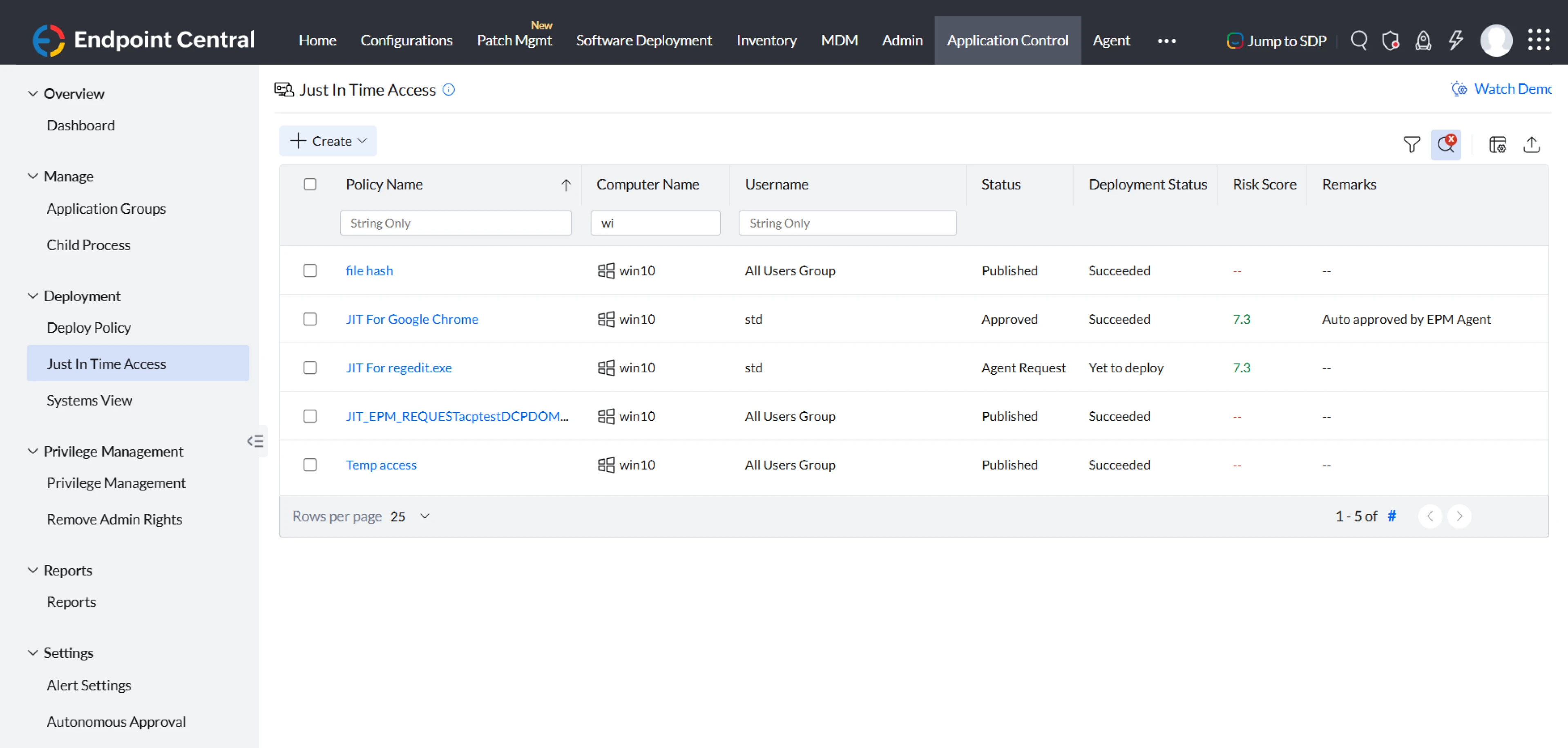
ManageEngine Application Control Plus | ✓ | ✕ | ✓ | ✕ |
Microsoft Intune Endpoint Privilege Management | ✕ | ✕ | ✕ | ✓ |
Netwrix Endpoint Privilege Manager | ✓ | ✕ | ✓ | ✕ |
Products are in alphabetical order, with subscribers to AIMultiple’s benchmarking services at the top.
The table above compares features that vary across the twelve products evaluated.
- Native SIEM integration indicates documented, vendor-supported connectors or APIs for Splunk, Microsoft Sentinel, or equivalent platforms rather than manual log forwarding.
- Not documented marks cases where the vendor publishes no connector documentation for the specific product under review; it does not confirm the absence of a capability.
Every product in this comparison elevates rights per application rather than per session, logs each elevation with user, host, and timestamp, and supports some approval path between automatic and manual. Those capabilities do not separate the tools.
The differences that matter are where elevation is enforced when a device is offline, whether an elevated process can reach other programs, and which operating systems the agent actually covers.
Pricing comparison of EPM solutions
Not disclosed indicates the vendor does not publish list rates for that tier.
Vendor and products
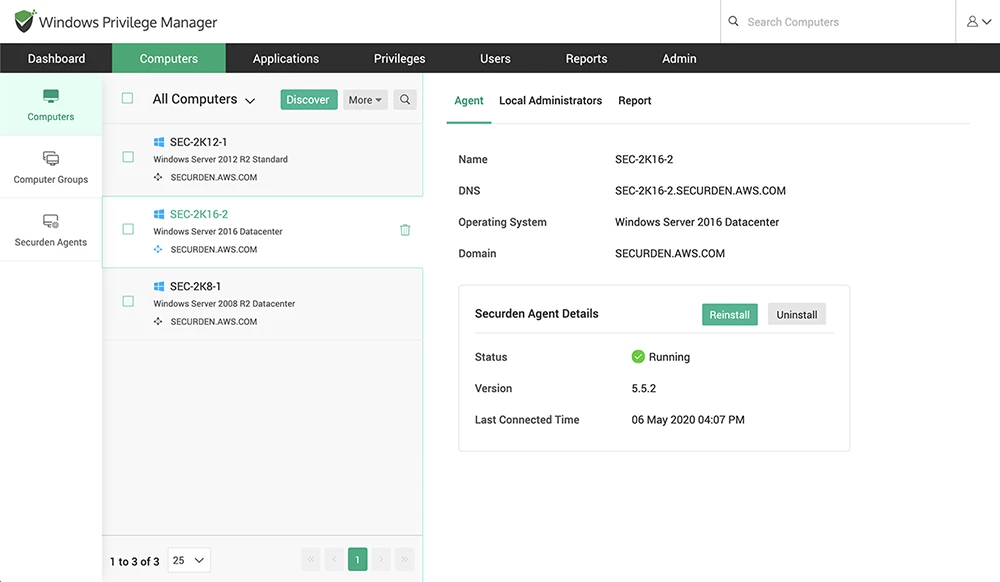
Securden Endpoint Privilege Manager
Securden Endpoint Privilege Manager enforces least privilege with just-in-time elevation, granular application control, and continuous endpoint monitoring.1
Policies keep enforcing when an endpoint loses its network path, so field laptops stay under least-privilege rules offline. Standard users elevate approved applications themselves. Technicians get temporary rights for remote assistance instead of a permanent admin account.
Pros:
- Both on-premises and SaaS deployment options.
Cons:
- Offline enforcement and remote assistance are configured separately from core elevation policy, adding setup steps.
Idira Endpoint Privilege Manager (Palo Alto Networks)
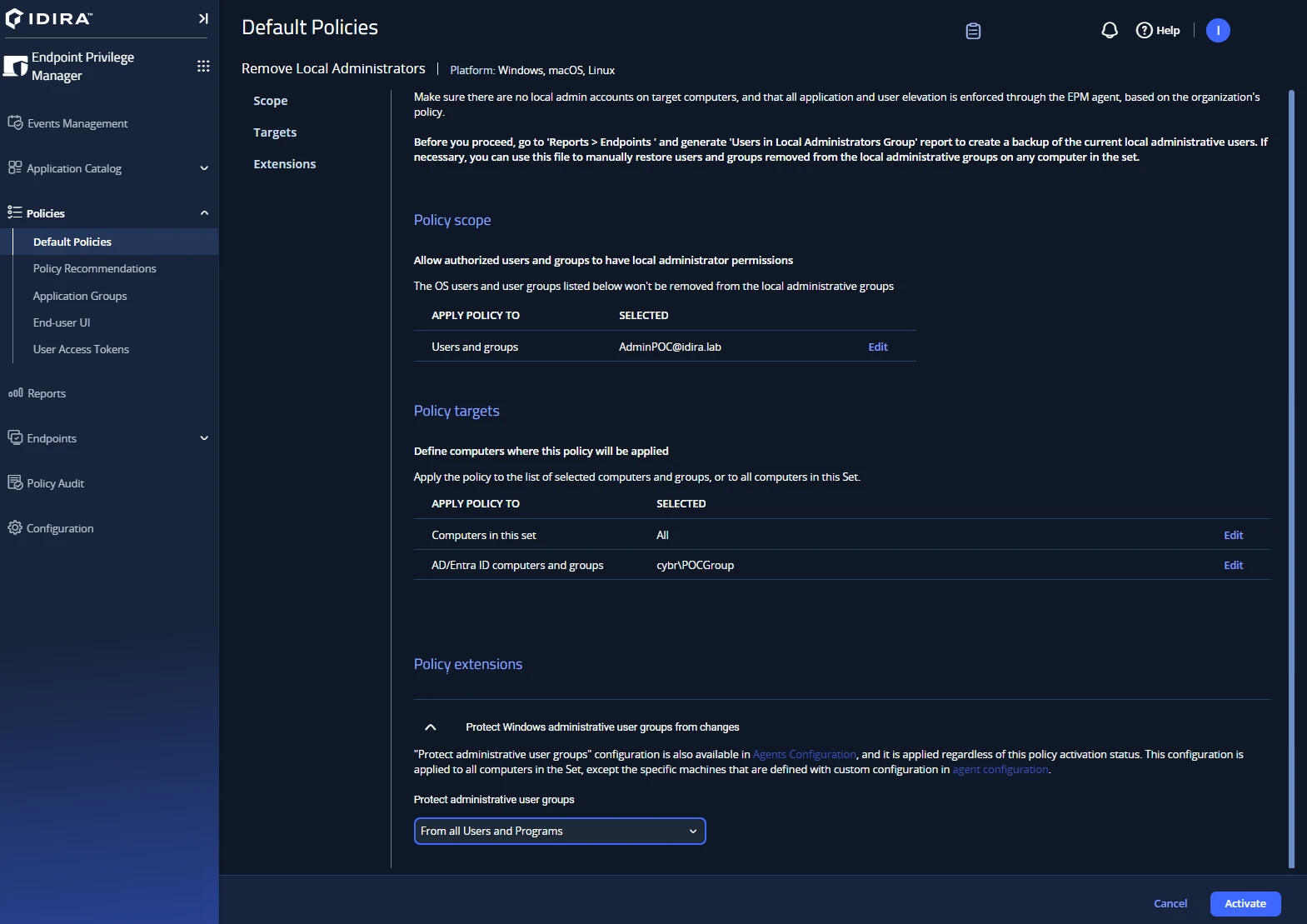
Idira Endpoint Privilege Manager is the rebranded successor to CyberArk Endpoint Privilege Manager, integrated into Palo Alto Networks’ Idira Identity Security Platform. Palo Alto Networks completed its acquisition of CyberArk in February 2026 and launched the Idira brand in May 2026.2 Existing CyberArk customers continue on the same platform under the new branding.
There is no on-premises management server. One agent covers Windows, Windows Server, macOS, and Linux, and elevation data feeds Cortex XDR and XSIAM directly. A dedicated Linux Identity Bridge provides Active Directory bridging and centralized sudo rule management. Application ringfencing restricts what elevated applications can do beyond simple allow and block decisions.
Pros:
- Native Linux privilege management with directory-agnostic authentication and centralized sudo management.
Cons:
- Pricing is not published, preventing cost comparison without sales engagement.
The trade-off is platform commitment: Linux depth and XDR integration arrive bundled with the wider Palo Alto Networks stack.
BeyondTrust Endpoint Privilege Management
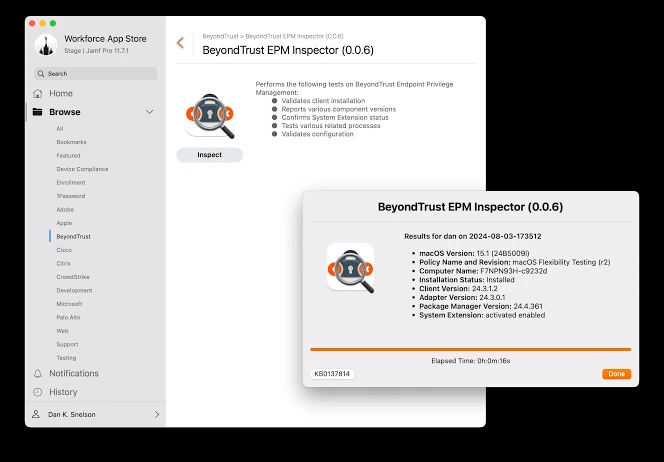
BeyondTrust Endpoint Privilege Management extends privilege control beyond traditional workstations and servers to IoT/OT devices and network infrastructure, with REST API architecture enabling automation and SIEM integration.3
Session recording and keystroke logging run alongside elevation, so a privileged session leaves a replayable record rather than a log line. QuickStart templates draw on deployments above 100,000 endpoints.
Pros:
- Native ServiceNow integration allows privileged access requests to be managed through existing ticketing workflows.
- Broader device scope than most competitors, including IoT/OT and network devices.
Cons:
- Policy configuration spans Windows, macOS, Linux, and network device workstyles, adding administrative overhead in mixed environments.
Few competitors reach network gear and OT devices, which is the main reason to look here rather than at a workstation-only tool.
Delinea Privilege Manager
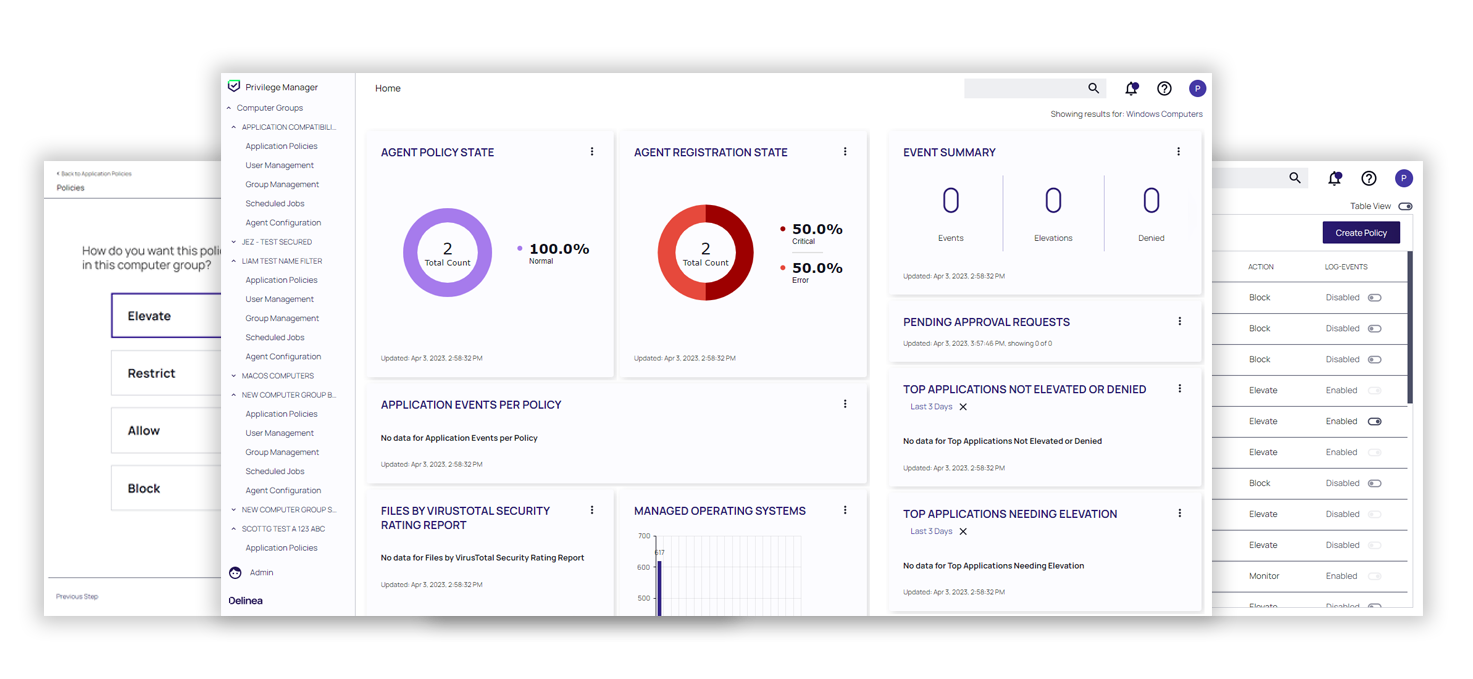
Delinea Privilege Manager provides endpoint privilege management and application control through a single agent supporting both domain-joined and non-domain machines.4
Service account credentials rotate automatically. Elevated applications run under child process control and sandboxing. Application elevation integrates Microsoft Entra ID-based MFA at the point of elevation.
Delinea no longer supports Linux. Privilege Manager for Unix/Linux reached End of Renewal in August 2025 and End of Life in August 2026. The Linux agent remains downloadable, but Delinea has stated it will receive no further updates.5 Current product documentation describes Privilege Manager as a Windows and macOS solution.
Pros:
- Single agent covers domain-joined and non-domain endpoints without an Active Directory dependency.
- Learning Mode discovers applications requiring administrator rights before policies are enforced.
Cons:
- Linux and Unix support ended in August 2026; coverage is now limited to Windows and macOS.
- Server privilege management requires the separate Cloud Suite product.
Since the Linux agent reached end of life in August 2026, mixed estates need a second tool for Unix and Linux hosts.
Microsoft Intune Endpoint Privilege Management
Microsoft Intune Endpoint Privilege Management is a native add-on to Microsoft Intune that installs a lightweight client-side agent automatically through existing Intune policy assignment, limited to Windows endpoints.6
Two elevation modes are available: fully automatic and user-confirmed with a justification prompt. Elevation uses an isolated virtual account rather than adding users to the local administrators group.
Pros:
- Included at no additional cost for Microsoft 365 E5 and E7 licensees.
- No separate management console for organizations running Intune, though a lightweight EPM agent installs automatically on managed devices.
Cons:
- Not included in Microsoft 365 E3, which received Intune Plan 2, Remote Help, and Advanced Analytics in the July 2026 packaging change.
- Requires enrollment in Intune or Configuration Manager co-management, unusable as a standalone product outside the Microsoft ecosystem.
ManageEngine Application Control Plus
ManageEngine Application Control Plus combines application allowlisting and blocklisting with endpoint privilege management in a single console, with automated allowlist creation based on configured control rules.
A “Flexibility Regulator” setting controls how strictly allowlisting is enforced. Audit mode records application behavior before any policy starts blocking.7
Pros:
- The free edition is fully functional for up to 25 devices and is not time-limited.
Cons:
- Official documentation covers macOS support for versions 11 through 14, including Apple Silicon devices, but does not document Linux support.
Admin By Request
Admin By Request is a SaaS privileged access management product that intercepts privilege requests with just-in-time elevation and full audit trails.8
The endpoint agent is under 3MB. Requests can be approved offline with a PIN code when a device has no path to the portal. Break Glass creates time-limited emergency local admin accounts as a LAPS alternative. Every file passing through elevation or download approval is scanned by 37 or more anti-malware engines through OPSWAT MetaDefender.9
Pros:
- Free plan covers 25 workstation seats and 10 Windows Server seats with no time limit and a single feature restriction.
- Native compatibility with SCCM, Microsoft Intune, and Jamf for deployment alongside existing tools.
Cons:
- Mobile app supports approvals and audit log viewing, but full administration and configuration require the desktop portal.
The application-scoped model fits teams running allowlisting who want elevation governed by the same policy object.
ThreatLocker Elevation Control
ThreatLocker Elevation Control grants local administrator rights to designated applications for specific users without conferring standing local admin privileges.10
Rights attach to the application, not the session, so the user never holds admin outside that process. Time-based policies revoke rights when an installation window closes. Ringfencing stops an elevated application from reaching other programs. High-risk application policies specifically target PowerShell, Command Prompt, and scripting engines.
Pros:
- Automatic initial approval list generation by learning existing applications.
Cons:
- Elevation Control manages local administrators on Windows and macOS endpoints; Linux is not covered.11
ThreatLocker Elevation Control serves security-focused organizations prioritizing application containment and zero-standing-privilege architectures.
ARCON Endpoint Privilege Management
ARCON Endpoint Privilege Management enforces just-in-time privileged access under Zero Trust and least-privilege principles across Windows, macOS, Linux, and Unix endpoints.12
File integrity monitoring is bundled rather than sold separately, with change detection, rollback, and historical tracking. Machine-learning analytics profile privileged behavior against a baseline.
Pros:
- Flexible deployment across on-premises, SaaS, and IaaS models.
Cons:
- Product value depends substantially on adopting the wider ARCON PAM suite rather than EPM alone.
Unix coverage is rare in this category and is the clearest reason to shortlist ARCON over a workstation-focused competitor.
Netwrix Endpoint Privilege Manager
Netwrix Endpoint Privilege Manager, formerly Least Privilege Manager, removes standing local administrator rights and allowlists approved applications, installers, scripts, and processes.
One policy engine covers domain-joined, non-domain, MDM-enrolled, and virtual devices. Delivery runs through Group Policy, Intune, SCCM, or the Endpoint Policy Manager cloud service, so existing channels can be reused.13
Pros:
- Both on-premises and cloud delivery options, plus multiple third-party deployment channels.
Cons:
- Coverage is limited to Windows and macOS, with no native Linux endpoint support.
One Identity Safeguard Privilege Manager for Windows
One Identity Safeguard Privilege Manager for Windows enables end users to elevate their own administrative rights for approved tasks without administrator contact.14
Policies deploy as Group Policy Objects, with no separate management server. Validation Logic Targeting Technology narrows which machines and users a rule applies to. A pre-packaged and community-contributed rule library covers common elevation cases.
Pros:
- Library of community elevation rules reduces initial policy-authoring effort.
Cons:
- Windows-only scope; no macOS or Linux support documented.
Ivanti Application Control
Ivanti Application Control, formerly AppSense, enforces least-privilege access by limiting execution to approved software with context-aware self-elevation.
Trusted Ownership checking uses NTFS file ownership to decide what runs, so files written by a standard user are blocked without maintaining a hash or path list. Reporting runs through the Ivanti UWM Management Center or Ivanti Xtraction rather than a dedicated EPM console.
Pros:
- Automated elevation requests and approvals route through integrated helpdesk systems.
Cons:
- Windows-focused scope; macOS support is not documented for Application Control.
Application Control is licensed inside the User Workspace Manager suite, so it rarely makes sense as a first EPM purchase.
Endpoint privilege management trends
Two trends reshaped the endpoint privilege management landscape in 2026: vendor consolidation and platform-native integration.
Market consolidation among identity and privilege vendors
Palo Alto Networks completed its acquisition of CyberArk on February 11.2 On May 12, 2026, Palo Alto Networks introduced Idira as its next-generation identity security platform, consolidating privileged access management, identity governance and administration, machine identity security, and agentic identity security.
The acquisition signals a broader market shift in which endpoint privilege management is increasingly being integrated into unified identity security platforms, reducing the role of standalone privilege-management products.
EPM built natively into device management platforms
On July 1, 2026, Microsoft moved Endpoint Privilege Management, Enterprise Application Management, and Cloud PKI into Microsoft 365 E5 at no additional cost, alongside a list price increase from $57 to $60 per user per month.15 Microsoft 365 E3 received a narrower set covering Intune Plan 2, Remote Help, and Advanced Analytics, leaving EPM exclusive to E5 and E7.
The change reduces agent sprawl for Windows-centric organizations, though it limits EPM coverage to Intune-enrolled Windows endpoints and requires Intune infrastructure as a prerequisite.
Further readings
 Add as preferred source
Cite this research
Pick the format that matches where you're publishing. Pasting the link version into your CMS preserves the backlink.
@misc{dilmegani2026,
  author = {Dilmegani, Cem and Arslan, Ezgi},
  title  = {{Top 12 Endpoint Privilege Management (EPM) Software}},
  year   = {2026},
  month  = sep,
  howpublished    = {\url{https://aimultiple.com/endpoint-privilege-management}},
  note   = {AIMultiple. Retrieved September 1, 2026}
}Results and timestamps of 24 data points. Download the summary data shown in this article's charts and tables as a ZIP file containing 2 CSV files.
Want the granular data behind it? Join Premium
Reference Links
Cem's work at AIMultiple has been cited by leading global publications including Business Insider, Forbes, Morning Brew, and Washington Post, global firms like Deloitte and HPE, NGOs like World Economic Forum, and supranational organizations like European Commission. [1], [2], [3], [4], [5]
Throughout his career, Cem served as a tech consultant, tech buyer and tech entrepreneur. He advised enterprises on their technology decisions at McKinsey & Company and Altman Solon for more than a decade. He also published a McKinsey report on digitalization.
He led technology strategy and procurement of a telco while reporting to the CEO. He has also led commercial growth of deep tech company Hypatos that reached a 7 digit annual recurring revenue and a 9 digit valuation from 0 within 2 years. Cem's work in Hypatos was covered by leading technology publications like TechCrunch and Business Insider.
Cem regularly speaks at international technology conferences. He graduated from Bogazici University as a computer engineer and holds an MBA from Columbia Business School.



Be the first to comment
Your email address will not be published. All fields are required. Comments are left in their original language.