


AI Hallucination Detection Tools: W&B Weave & Comet

We benchmarked three hallucination detection tools: W&B Weave HallucinationFree Scorer (part of CoreWeave Forge, formerly Weights & Biases), Arize Phoenix HallucinationEvaluator, and Comet Opik Hallucination Metric, across 100 test cases.
Each tool was evaluated on accuracy, precision, recall, and latency.
AI hallucination detection tools benchmark
We tested 100 responses (50 correct, 50 hallucinated) from factual Q&A scenarios against their source context.
Accuracy and latency comparison
See the benchmark methodology. section for more details on the testing process.
W&B Weave and Arize Phoenix delivered nearly identical accuracy at 91% and 90% respectively. Both tools demonstrated reliable performance across the dataset. Comet Opik lagged at 72% accuracy, correctly classifying only 72 of 100 tests, a significant gap driven by its conservative approach.
In terms of speed, Arize Phoenix was the winner at 2 seconds per test, making it suitable for real-time applications. W&B Weave processed tests in 4 seconds, which is reasonable for most production use cases. Comet Opik was notably slower at 8.5 seconds per test, which could impact user experience in latency-sensitive applications.
F1 score, precision, and recall
The F1 scores (harmonic mean of precision and recall) confirmed these patterns: W&B Weave at 90.5% and Phoenix at 89.4% both achieved strong, balanced performance. In comparison, Opik’s 61.1% reflected the trade-off between perfect precision and weak recall. Opik’s zero false positives came at the cost of 28 false negatives, making it suitable only for scenarios where false alarms are more costly than missed detections.
Recall (ability to catch actual hallucinations) revealed distinct strategies. W&B Weave led with 86% recall, catching 43 of 50 hallucinations and missing only 7. Phoenix followed closely at 84%, detecting 42 hallucinations and missing 8. Comet Opik’s recall was substantially lower at 44%, catching only 22 hallucinations while missing 28; more than half of all actual hallucinations went undetected.
Precision (alert reliability) showed significant variation. Comet Opik achieved perfect 100% precision with zero false positives, when it flagged something as hallucination, it was always correct. Both Phoenix (95.5%) and Weave (95.6%) showed nearly identical precision, each producing only 2 false positives out of 50 legitimate responses, demonstrating strong reliability without being overly conservative.
Factors that might affect the differences in performance
The observed performance differences are possibly driven by design philosophy, threshold selection, and the interpretation of grounding.
Differences in detection strategy and optimization goals
- The tools appear to be optimized for different error trade-offs rather than the same objective.
- W&B Weave and Arize Phoenix aim for balanced performance, maintaining high precision while still capturing most hallucinations.
- Comet Opik adopts a highly conservative strategy, prioritizing zero false positives even if many hallucinations are missed.
- This strategic choice directly explains Opik’s perfect precision and substantially lower recall.
Precision–recall trade-offs embedded in tool design
- Comet Opik’s zero false positives indicate a strict decision threshold, flagging hallucinations only when confidence is very high.
- W&B Weave and Phoenix use less restrictive thresholds, allowing some false positives in exchange for much higher recall.
- These threshold differences may lead to:
- Similar precision across Weave and Phoenix
- Large recall gaps between Opik and the other two tools
- Corresponding differences in F1 score and overall accuracy
Variations in LLM-as-a-judge implementation
- Although all three tools use an LLM-as-a-judge approach, their implementations differ.
- W&B Weave emphasizes chain-of-thought reasoning, which may improve sensitivity to subtle unsupported claims.
- Arize Phoenix incorporates label-based outputs with confidence scores, supporting more nuanced judgments.
- Comet Opik focuses on high-confidence binary decisions, which reduces false alarms but limits sensitivity to borderline hallucinations.
Latency differences driven by evaluation depth
- Arize Phoenix’s lower latency suggests a lighter or more streamlined evaluation pipeline, suitable for real-time use.
- W&B Weave’s moderate latency is consistent with richer reasoning and trace logging.
- Comet Opik’s higher latency likely reflects more extensive internal reasoning or verification steps, reinforcing its conservative design.
AI hallucination detection tools
W&B Weave’s HallucinationFree Scorer
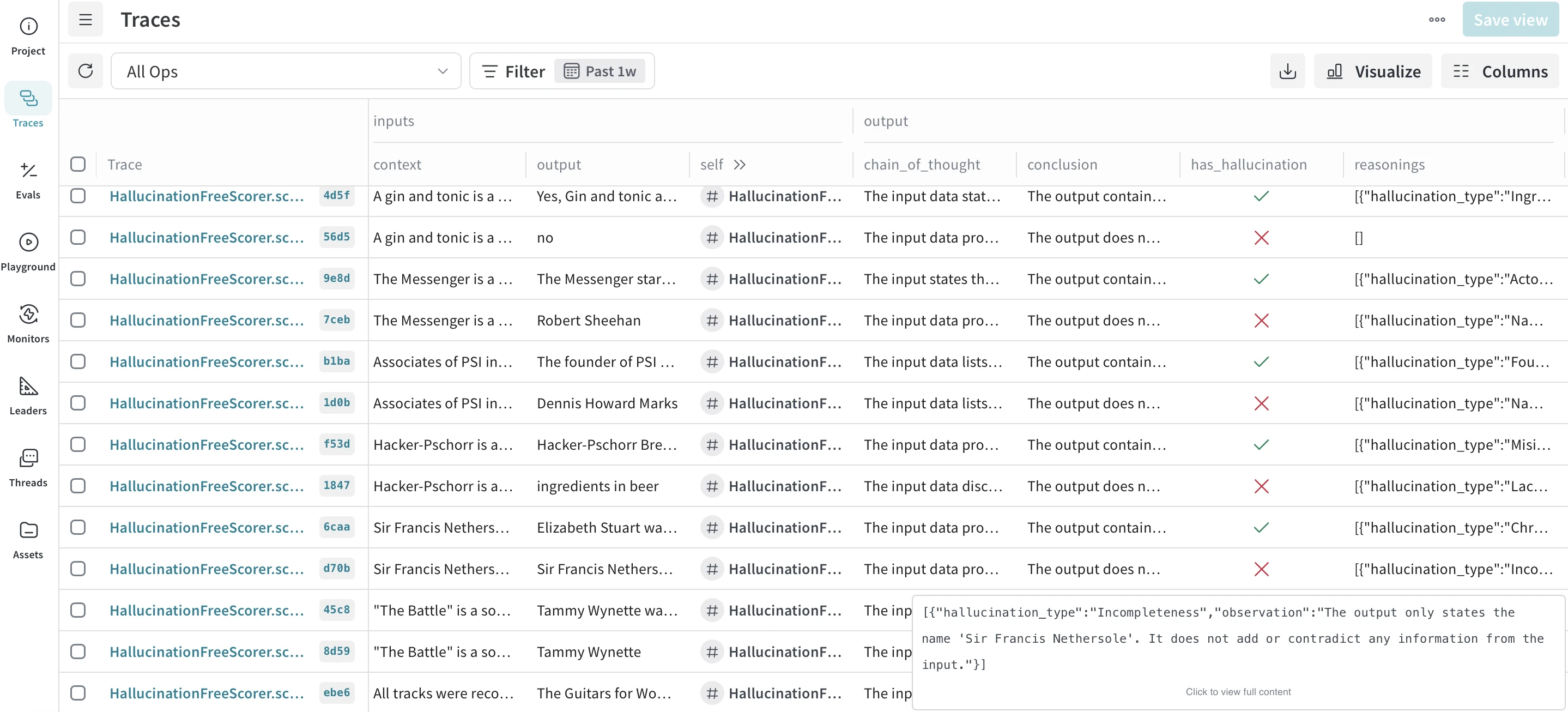
Figure 1: W&B Weave’s traces dashboard.
CoreWeave Forge ships with a HallucinationFree Scorer that flags LLM outputs introducing claims not found in the source context. It runs an LLM judge over each response and returns a grounded/ungrounded verdict alongside the reasoning behind it.
The scorer takes two inputs: the context (source material) and the output (LLM-generated response). It then uses a language model to analyze whether the output introduces information not present in the context. The result includes a boolean has_hallucination flag and reasoning explaining the decision.
Key features:
- Chain-of-thought reasoning: Each evaluation includes an explanation of why the output was flagged as hallucination or not.
- Binary classification: Returns clear true/false decisions with supporting evidence.
- Integration with Weave tracing: Results are automatically logged to the Weave dashboard for visualization.
- Customizable model: Supports different LLM judges, including OpenAI, Anthropic, and other providers.
Arize Phoenix’s HallucinationEvaluator
Arize Phoenix bundles a HallucinationEvaluator that flags responses drifting from their reference material. For each output, an LLM judge decides whether the answer is grounded in the supplied context and attaches a confidence score to its verdict.
The evaluator takes three inputs: the user query (input), the reference text (context), and the model’s response (output). It analyzes whether the response contains information that cannot be derived from the context, returning a labeled result (“factual” or “hallucinated”) along with an explanation and confidence score.
Key features:
- Balanced performance: Gives results across both precision and recall metrics
- Label-based output: Returns categorical labels (“factual” or “hallucinated”) rather than numeric scores alone
- Detailed explanations: Provides reasoning for each evaluation decision
Comet Opik’s Hallucination Metric
Comet Opik’s Hallucination Metric scores each LLM response against its source context and returns a binary judgment on whether the output is faithful to that context. The check runs through an LLM judge tuned to flag only high-confidence cases of unsupported claims.
The metric accepts three inputs: the user query (input), the source material (context), and the model’s response (output). It evaluates whether the output introduces claims not supported by the context.
The result includes a binary score (0 for no hallucination, 1 for hallucination detected) and a detailed reasoning explaining the evaluation.
Key features:
- Detailed explanations: Each evaluation provides comprehensive reasoning about why the content was flagged or approved
- Three-input analysis: Considers the query, context, and response together for evaluation
- Experiment tracking: Results are automatically logged to Opik’s experiment tracking system
- Conservative approach: Designed to minimize false positives by only flagging high-confidence hallucinations
Galileo Luna-2
Galileo Luna-2 is a hallucination detection and runtime guardrail layer built into Galileo’s broader AI observability platform. 1
The system is designed to run inline on production inference paths, blocking ungrounded content before it reaches the user, while Signals, Galileo’s automated failure analysis layer, surfaces root causes of production errors without manual log review.
Key features:
Multi-method detection: Combines embedding similarity, Chain-of-Thought analysis, and G-Eval factuality scoring rather than depending on a single judging strategy.
Runtime guardrails: Luna-2 can block or rewrite ungrounded outputs inline on the inference path, not just flag them after the fact.
End-to-end observability: Captures inputs, outputs, and internal reasoning traces across multi-step agent workflows, with Signals automating root cause analysis.
DeepEval
DeepEval is an open-source LLM evaluation framework from Confident AI, designed to feel like Pytest but for LLM applications. Its HallucinationMetric uses an LLM-as-a-judge to decide whether the model’s output is factually consistent with the provided context, and the framework is built to run inside any CI/CD pipeline.23
The metric takes three required inputs: the user query (input), the model response (actual_output), and the reference material (context). It scores each output using the formula Hallucination = (Number of Contradicted Contexts) / (Total Number of Contexts), where lower scores indicate better grounding. An output passes when its score is at or below the configured threshold.
Key features:
- Familiar testing workflow: Hallucination checks are written and run like regular unit tests, so teams already using Pytest do not need to learn a new tool.
- Adjustable strictness: Teams can loosen or tighten the passing threshold, or switch to a strict pass/fail mode for high-stakes content.
- Explanations for every result: Each verdict comes with a reason, so it is clear why an output was flagged.
What is AI hallucination?
AI hallucinations are outputs that read as coherent but are not factual. The model produces these claims confidently even when the source context or training data does not support them. A survey on the topic attributes this to models leaning on linguistic priors instead of verifiable evidence from the provided context.4 The problem shows up across high-stakes domains such as healthcare, legal services, enterprise search, and customer support, which is why grounded-output detection has become a standard part ofLLM deployment.
Sources and taxonomy of hallucinations
Hallucinations stem from two broad sources. Model-internal factors include over reliance on statistical patterns, gaps in training data, and the probabilistic nature of sequence generation; one analysis on hallucination detection and mitigation notes that LLMs often infer likely continuations rather than retrieve verifiable evidence, which produces confident but incorrect output.5
Contextual factors cover retrieval failures in RAG systems, ambiguous prompts, incomplete grounding, and in multimodal models, object confusions or invented scene details.
Hallucination detection in agentic workflows
Multi-step agents introduce hallucination risks that single-turn LLMs do not: a fabricated claim in an early step propagates into later tool calls, retrievals, and final outputs.
Key challenges in agentic hallucination detection:
- Error propagation: A fabricated fact in the planning phase may influence tool selection, data retrieval, and final responses
- Tool call hallucinations: Agents may invoke tools with incorrect parameters or misinterpret tool outputs
- State corruption: Hallucinated information stored in agent memory affects future reasoning steps
- Attribution complexity: Identifying which step introduced the hallucination requires end-to-end tracing
Detection approaches for agentic systems:
- Step-level verification: Validating each intermediate output before the agent proceeds to the next action
- Tool output validation: Cross-checking tool responses against expected formats and known constraints
- Trajectory analysis: Reviewing the full sequence of agent decisions to identify where reasoning diverged from grounded information
- Consistency checks across steps: Comparing claims made at different stages to detect contradictions
W&B Weave’s HallucinationFree Scorer and Arize Phoenix’s HallucinationEvaluator can be applied at each agent step, while their integrated dashboards display the full execution trace for root cause analysis.
 Add as preferred source
Real-time hallucination prevention
Post-generation detection surfaces problems but does not stop bad outputs from reaching users. Real-time prevention runs the check inline, before the response is delivered.
Prevention mechanisms:
- Output guardrails: Filters that analyze generated content against factuality criteria before returning it to the user.
- Confidence thresholds: Blocking or flagging responses when the model’s internal confidence falls below acceptable levels.
- Retrieval validation gates: Verifying that generated claims are supported by retrieved documents before finalizing the response.
- Fallback strategies: Returning a safe default response or escalating to review queues when hallucination risk is high.
Tool capabilities for real-time prevention:
- W&B Weave integrates hallucination scoring into production pipelines, enabling automated checks before responses are served.
- Arize Phoenix provides real-time monitoring with alerting capabilities that flag high-risk outputs for immediate review.
- Comet Opik offers experiment tracking with automated evaluation, allowing teams to set quality gates that block responses exceeding hallucination thresholds.
Approaches to hallucination detection
Three approaches are directly relevant to how Weave, Phoenix, and Opik operate:
1. Consistency-based methods
Consistency-based methods evaluate an answer by comparing it to several alternative generations using semantic similarity, n-gram overlap, or question-answer verification. When responses contradict each other or contain logical inconsistencies, hallucination likelihood rises. A related technique, semantic entropy, clusters responses by meaning rather than phrasing and uses conceptual instability as the hallucination signal.
2. Probability and confidence-based detection
Token-level probabilities, entropy values, calibration curves, and margin-based confidence estimates surface the model’s internal belief about its own output. Low-confidence segments often correlate with higher hallucination rates. Raw entropy can be misleading due to variable phrasing, but confidence signals remain useful when combined with consistency-based indicators. Arize Phoenix exposes a confidence score alongside its label, which fits this category.
3. Reference or context-based detection
Reference-based evaluation compares the model’s output to the provided context or external sources, and is the core mechanism behind RAG quality checks. Typical techniques include entailment models that check whether retrieved documents support the answer, alignment and grounding methods that validate evidence support, and factuality metrics that measure whether claims match supporting text. All three benchmarked tools operate primarily in this mode: they take a context input and judge whether the output stays within it.
AI hallucination detection techniques and algorithms
Detection methods operate at three granularities:
- Token-level: Marks suspicious spans inside an output. Uses human-annotated hallucination datasets, divergence between prior and posterior token probabilities given context, or sequence-labeling classifiers.
- Sentence-level: Judges whole statements. Sampling-based self-consistency checks compare multiple generations for instability, semantic entropy flags conceptual uncertainty without labels, and entailment classifiers catch unsupported or contradictory claims.
- Workflow-level: Tracks multi-step pipelines using provenance graphs, step-level entailment checks, intermediate reasoning validation, and dependency tracing for multi-hop tasks.
The three tools we benchmarked operate primarily at the sentence level, with Weave and Phoenix extending into workflow-level use via their tracing dashboards.
Industrial patterns and best practices
Production teams rarely rely on a single method. Common patterns include:
- Layered detection: Consistency checks, probability scoring, and entailment validation run in the same pipeline.
- Real-time monitoring: Dashboards track drift and confidence shifts over time.
- Prompt tuning: Prompts are refined to reduce ambiguity that leads to ungrounded outputs.
- Expert review: Reserved for legal, medical, or financial content where errors carry real cost.
- CI/CD integration: Automated quality checks run before deployment so regressions surface early.
- Agent monitoring: Plugins observe tool calls and intermediate reasoning steps to catch anomalies as they appear.
AI hallucination detection tools benchmark methodology
The benchmark used a controlled dataset of 50 knowledge items drawn from factual question-answering scenarios. Each item included a source context, a question, a correct answer grounded in that context, and a hallucinated answer that contained fabricated information. For example, a test asked about The Oberoi Group’s headquarters location, where the correct answer “Delhi” was tested against the hallucinated response “Mumbai.”
Each knowledge item generated two test cases: one using the correct answer (expected: no hallucination) and one using the hallucinated answer (expected: hallucination detected). This created a balanced 50/50 split totaling 100 test cases. All three tools processed the same test cases sequentially, with each receiving identical inputs (context, question, and output).
We measured latency for each test case individually to ensure a fair comparison, avoiding the pitfalls of parallel processing or batch evaluation that could skew results. Ground truth labels were manually verified to ensure accuracy in calculating true positives, false positives, true negatives, and false negatives.
Cite this benchmark
Pick the format that matches where you're publishing. Pasting the link version into your CMS preserves the backlink.
@misc{ermut2026,
  author = {Ermut, Sıla and Şipi, Nazlı},
  title  = {{AI Hallucination Detection Tools: W&B Weave & Comet}},
  year   = {2026},
  month  = jun,
  howpublished    = {\url{https://aimultiple.com/ai-hallucination-detection}},
  note   = {AIMultiple. Retrieved June 18, 2026}
}Results and timestamps of 0 data points. Download the summary data shown in this article's charts and tables as a ZIP file containing 0 CSV files.
Want the granular data behind it? Join Premium
Changelog
3 updatesAdded Galileo Luna-2 and DeepEval as new tool sections alongside the benchmarked hallucination detection tools.
Added "Hallucination detection in agentic workflows" to the "What is AI hallucination?" section.
Reference Links
She previously worked as a recruiter in project management and consulting firms. Sıla holds a Master of Science degree in Social Psychology and a Bachelor of Arts degree in International Relations.







Be the first to comment
Your email address will not be published. All fields are required. Comments are left in their original language.