


Top 12+ Data as a Service Companies

Data as a Service (DaaS) is a cloud model that delivers data on demand, usually on a subscription. It lets a business buy the datasets it needs without collecting and storing the data itself.
See the top data as a service companies and data types they provide, the key features such as data analytics, and the benefits of the DaaS model:
Top 13 DaaS providers
Vendors | Basic Pricing** | Free Trial | Free Version | Data Types |
|---|---|---|---|---|
$250 per 100K records | ✓ (7-days) | ✕ | Web datasets and data feeds | |
ZoomInfo | N/A | ✓ | ✕ | Business data and profiles |
Coresignal | $49 | ✕ | ✕ | Company, employee, and job posting data |
Clearbit | N/A | ✕ | ✕ | B2B company and contact enrichment data |
Crunchbase | $49 | ✓ (7-days) | ✕ | Business and market data |
D&B Connect | N/A | ✕ | ✕ | Financial and business data |
Factiva | N/A | ✕ | ✕ | Business news and profiles |
FactSet | N/A | ✓ | ✕ | Financial and business data |
S&P Global Market Intelligence | N/A | ✕ | ✕ | Financial and business data |
PitchBook | N/A | ✓ | ✕ | Private market and investment data |
Ranking: Products are ranked by total reviews, except for AIMultiple’s benchmarking services subscribers ranked at the top.
*The data was gathered from vendor websites as well as review platforms.
**Per month, per user. N/A means that the vendor doesn’t publicly share its pricing.
Key data as a service vendor features
Data as a Service companies specialize in collecting, managing, and delivering data to users, enabling them to access and utilize the data without the need for internal cloud infrastructure.
DaaS companies offer various functions, such as:
1. Data Provisioning
Data as a Service (DaaS) providers offer access to a diverse range of datasets, often sourced from various channels such as public databases, proprietary sources, or data aggregators. This addresses specific data needs that may be challenging to fulfill independently. When a business lacks the tools, expertise, or direct access to the data it needs, a DaaS provider handles collection and delivery.
These services eliminate the complexities of permissions and data collection, allowing businesses to focus on deriving insights and value from the acquired datasets.
2. Data Management
Data as a Service companies excel in managing data by handling the storage, organization, and maintenance of large datasets. Beyond these fundamental aspects, they navigate the complex landscape of data permissions, ensuring compliance with regulations and addressing the nuances of data access rights. This includes securing necessary permissions and managing data in a way that aligns with legal requirements.
DaaS platform also handles the data security risks of sensitive data in a more efficient way.
3. Data Analytics
Some DaaS providers offer data analytical tools and services, allowing users to derive insights from the organization’s data they access. This may include tools for business intelligence, predictive analytics, and machine learning.
4. Application Programming Interfaces (APIs)
Data as a Service companies often provide APIs that allow users to integrate business data directly into their applications, workflows, or systems. An API lets a business pull data straight into its own applications and workflows. It keeps data current in the systems that use it, with no manual imports.
5. Scalability
DaaS platforms are scalable. A business can adjust data usage as needs change. This flexibility is particularly beneficial for businesses with changing data requirements. Moreover, unlike other data collection methods such as web scraping tools, DaaS eliminates the need for a dedicated IT team to manage the process of obtaining the required data.
These services save time by supplying the exact data a business needs.
6. Subscription-Based Model
DaaS is typically offered through a subscription-based model, allowing users to pay for the data services they use. Businesses may negotiate with DaaS provider for the data that fits their needs, rather than investing in and maintaining their own data infrastructure. This enables users to pay for the specific data services they utilize and offers cost savings.
Benefits of Data as a Service companies
DaaS lowers the cost of acquiring data and shortens the time to access it. A business reaches ready-to-use datasets without building collection and storage systems in-house.
1. Efficient data storage and delivery
DaaS leverages cloud infrastructure to store and deliver data, eliminating the need for organizations to invest in and maintain extensive internal data storage systems. This service spares businesses from the hassle of dealing with concerns such as available cloud space.
2. Data democratization
DaaS makes data easier to reach for non-technical staff. Teams across a company can query datasets through simple tools and APIs, rather than routing every request through a data engineering team.
3. Monetization opportunities
DaaS opens up avenues for organizations to monetize their data assets.
- Direct monetization involves earning revenue by selling data to third parties.
- Indirect monetization is the usage of the data to extract valuable business insights.
This dual approach allows businesses to diversify revenue streams and capitalize on the intrinsic value of their data.
4. Automated maintenance
Data as a Service companies take on the responsibility of automated data maintenance, ensuring that data sets remain current, accurate, and reliable. Automation of maintenance enhances the efficiency of data management processes and also frees up resources within organizations to focus on core business activities.
5. Personalized services
The abundance of data available through DaaS enables organizations to create more personalized and targeted services. By analyzing consumer behavior and preferences, businesses may strategically tailor their marketing approaches, fostering increased customer engagement and satisfaction.
Understanding individual purchase histories and preferences, for instance, enables companies to provide custom recommendations, creating a more personalized and satisfying shopping experience for customers.
6. Cost-Effective data acquisition
DaaS offers a cost-effective alternative to traditional data acquisition methods. Instead of investing in large datasets with excessive information, organizations can selectively purchase the specific data they need. This targeted approach minimizes costs associated with data processing and analysis, making data-driven initiatives more budget-friendly.
Eliminating the need for organizations to invest in and maintain extensive internal data storage also reduces costs associated with hardware and maintenance.
DaaS model challenges
Data security
As the number of data breaches is increasing each year, cybersecurity measures should be taken seriously. If DaaS vendor’s security measures are not enough to prevent potential data breaches, your organization may lose millions and have its reputation harmed. Before deciding on a DaaS vendor, it is best to understand the vendors’ approach to data security.
Data privacy
Data shared may include confidential/personal information. Organizations need to ensure that DaaS companies are providing the necessary measures to ensure confidentiality of personal data.
Data set hygiene
When an organization works with a DaaS vendor, they may combine their internal data with the provider’s data set but vendors’ and the organization’s set of rules during data preparation may not match and this leads to dirty data. Organizations should ensure that the vendor understands how to cleanly sync with other data sets.
How data as a service companies help B2B and B2C sectors
Data-as-a-Service (DaaS) platforms give businesses access to ready-to-use data from many sources, such as social media, enterprise systems, or public databases. They make it easier for companies to use high-quality, on-demand data without managing complex infrastructure.
B2B sector
Businesses use DaaS platforms to improve their data and make better decisions. These platforms help with:
- Market segmentation: by adding firmographic data like company size, funding rounds, and new branch openings.
- Real-time insights: through automatic updates from public records and verified databases.
- Better analytics: by combining different data sources for more accurate forecasting and strategy planning.
B2C sector
In consumer markets, DaaS tools help companies understand and engage customers better.
- They deliver fresh, timely insights that improve personalization and customer experience.
- Marketers use them to refine targeting, improve engagement, and create more meaningful interactions with customers.
DaaS as a source of AI training data
Training and fine-tuning an AI model requires large, clean, labeled datasets. For most organizations, building that dataset internally takes too long and costs too much. DaaS platforms have become a practical alternative. They cover two distinct needs.
- Training and fine-tuning data: Some providers supply curated, pre-labeled datasets for specific domains: legal documents, financial filings, and healthcare data. Healthcare datasets are typically anonymized or synthetic rather than raw patient records, given how tightly that data is regulated.
- The retrieval data: Many DaaS providers now offer continuously updated data feeds for RAG pipelines. RAG (Retrieval-Augmented Generation) is a method where an AI model pulls in fresh external data at the moment a question is asked, rather than relying on what it learned during training. For this to work, the external data has to stay current. Static datasets are not enough.
Both uses raise the same practical question: where did this data come from, and is it properly documented?
This matters more now than it did a year ago. The EU AI Act’s obligations for providers of general-purpose AI models became applicable on 2 August 2025.1 Providers must maintain technical documentation and publish a summary of the training content used to develop their models. DaaS vendors face growing commercial pressure to provide provenance, licensing, and update history information alongside the data itself, so their customers can meet those requirements.
How to Choose the Best Data as a Service Software for Your Business
When evaluating Data as a Service (DaaS) software solutions for enterprise adoption, industry analysts emphasize several critical factors that contribute to the overall suitability and efficacy of the platform within a business environment.
1. Define your needs
Before embarking on the search for a data solutions provider, it’s essential to define your specific data needs and business goals. Identify the type of data you want to work with, understand key challenges, and establish the objectives you aim to achieve through data solutions. This clarity will streamline the selection process, enabling you to identify Data-as-a-Service companies that align with your unique requirements.
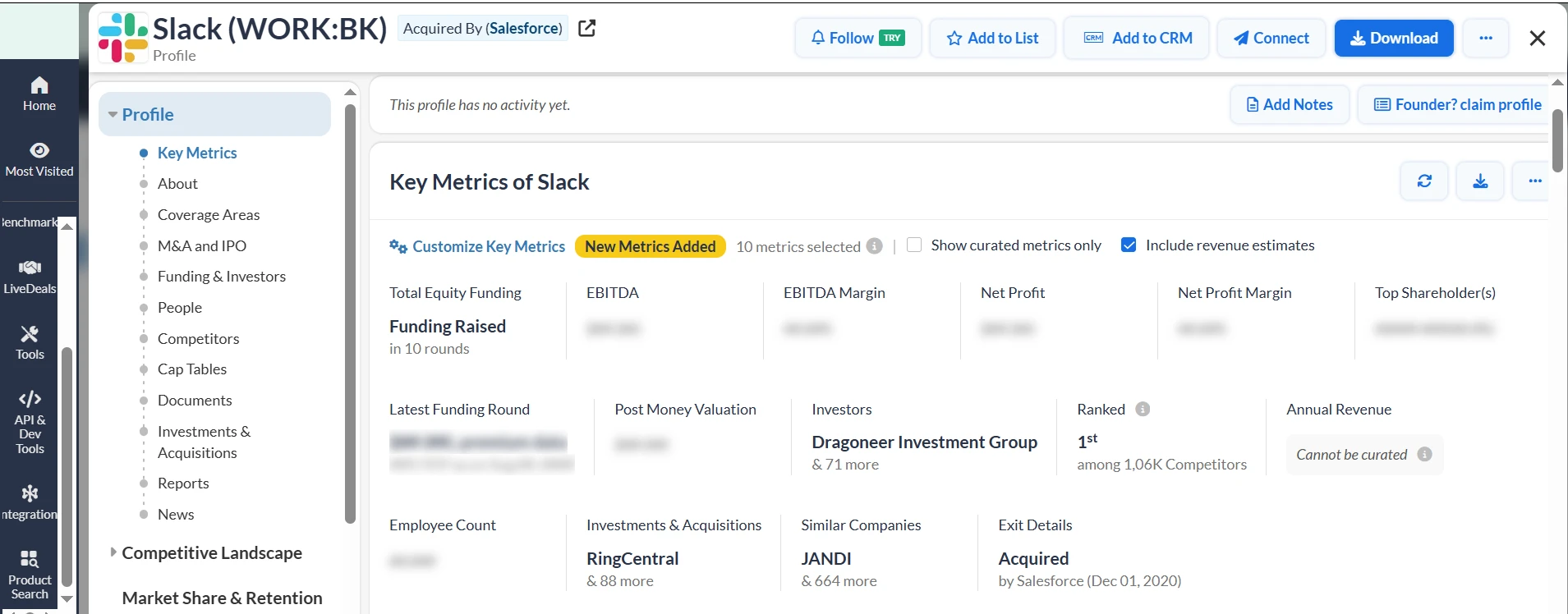
Figure 1. Example business data Tracxn provides
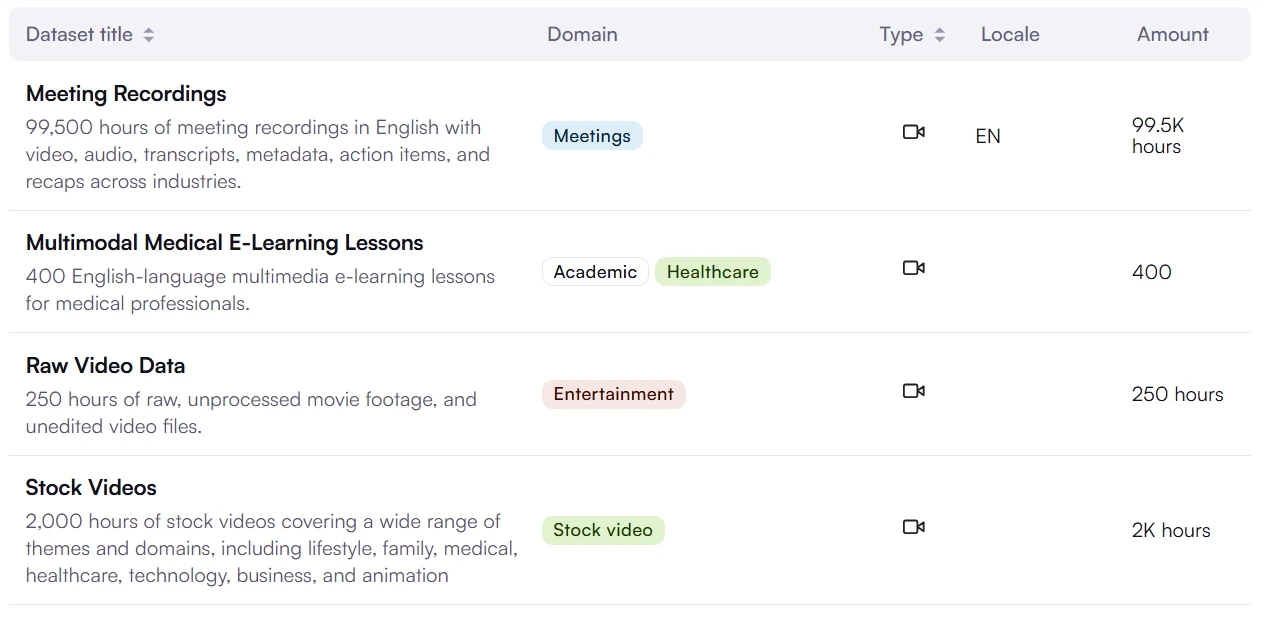
Although some DaaS companies, such as Tracxn, provide business data, others, such as Defined.ai, may sell training data for AI.
Figure 2. Example AI training data Defined.ai provides
For more information on financial research data, read AI Financial Research Platforms for Investors.
2. Examine user experience
Another important step of deciding the best DaaS for your business is examining user experiences. User experience and ratings play an important role in assessing the overall usability and effectiveness of DaaS solutions. Assessing the overall usability, performance, and flexibility of the DaaS software helps determine how well it integrates with your existing workflows.
3. Check the simplicity and ease of the product
When choosing a Data as a Service (DaaS) solution, prioritize simplicity, seeking a fully managed platform that alleviates concerns about systems, applications, and user interfaces. One factor determining the best DaaS for your business is choosing a user-friendly interface that is intuitive and easy to use for a diverse range of users.
4. Evaluate the customer service
Effective customer service is a crucial factor while deciding the best DaaS platform for your business. It ensures timely technical support, aids in customization and integration, provides training and onboarding assistance, resolves issues promptly, and values customer feedback for continuous improvement.
A strong customer service system enhances the overall experience of using DaaS, offering vital support for seamless implementation and optimal utilization.
 Add as preferred source
DaaS providers by data type
DaaS providers tend to specialize by the kind of data they sell. Grouping the market by data type makes it easier to match a provider to a specific need.
Web data. Providers collect public information from websites and deliver it as ready-to-use datasets or live feeds. The data covers listings, prices, reviews, and other pages that change often.
B2B company and contact data. This data describes companies and the people who work at them: firmographics (company size, industry, location), job titles, and business contact details. Some providers also enrich records a business holds, filling in missing fields on companies and contacts, and can add employee profiles and job postings.
Startup, funding, and private-market data. These datasets track private companies, funding rounds, valuations, and investor activity. Analysts and investors use them to find deals and study markets that are hard to research from public filings.
Financial and market data. This group supplies pricing, company financials, and business credit information across stocks, bonds, and other assets. Trading, risk, and research teams rely on it for analysis and reporting. Read also AI Financial Research Platforms for Investors.
Business news data. These providers gather articles and company profiles from many publications into one searchable source. Teams use it to track markets, competitors, and specific firms.
Digital and web intelligence. This data measures website traffic, visitor engagement, and digital market share. Marketing and strategy teams use it to compare their reach against competitors.
Consumer and marketing data. This data covers demographics, interests, and buying behavior for individuals. Marketers use it to build audience segments and target campaigns.
Consumer and credit data. This data covers credit history and financial identity. Lenders and risk teams use it for credit decisions and fraud checks.
Compensation data. These datasets hold salary benchmarks and pay ranges by role, industry, and location. HR teams use them to set pay and stay competitive.
Healthcare and pharmaceutical data. This data includes prescription volumes, sales figures, and clinical information for the life sciences sector. Patient-level records are tightly regulated, so the data is usually anonymized.
AI training data. These are curated datasets, often labeled (tagged so a model can learn from them), built to train and fine-tune machine learning models. Common formats include speech, text, and image data prepared for a set task.
Nonprofit data. This data covers nonprofit organizations, foundations, and grants, including finances and public filings. Researchers and funders use it to study the sector and track grant activity.
What is Data-as-a-Service (DaaS)?
DaaS is a cloud-based model that delivers data on demand through machine-to-machine (M2M) connections or APIs. It removes the need for local software or manual data management.
There are two main types of DaaS providers:
- Data Providers: Offer specific datasets to other businesses via APIs.
- Technology Providers: Enable other companies to deliver their own data as a service.
DaaS makes it possible to access, integrate, and analyze data from many sources in one place. Common technologies include:
- Data modeling, quality, and transformation tools
- Content management systems
- Information lifecycle management solutions
Most DaaS platforms use volume-based pricing, though some charge based on data type or subscription level.
FAQs
As a technology used internally at a company, data-as-a-Service platform is an end-to-end solution and can be considered as an enabler between various data sources and tools such as self-service reporting, BI, microservices, and applications. Once the platform is deployed, end-users can access data whenever they want using standard SQL over ODBC, JDBC, or REST.
Companies can also use external DaaS services to access data. Numerous companies provide DaaS services via simple APIs.
Cite this research
Pick the format that matches where you're publishing. Pasting the link version into your CMS preserves the backlink.
@misc{dilmegani2026,
  author = {Dilmegani, Cem and Arslan, Ezgi},
  title  = {{Top 12+ Data as a Service Companies}},
  year   = {2026},
  month  = sep,
  howpublished    = {\url{https://aimultiple.com/data-as-a-service-companies}},
  note   = {AIMultiple. Retrieved September 10, 2026}
}Results and timestamps of 13 data points. Download the summary data shown in this article's charts and tables as a ZIP file containing one CSV file.
Want the granular data behind it? Join Premium
Changelog
5 updatesAdded a section listing DaaS providers by data type.
Added two figures showing example data from Tracxn and Defined.ai in the "Define your needs" section.
Added a "DaaS as a source of AI training data" section covering training, fine-tuning, RAG retrieval data and EU AI Act provenance requirements.
Added FAQs to the end of the article.
Reference Links
Cem's work at AIMultiple has been cited by leading global publications including Business Insider, Forbes, Morning Brew, and Washington Post, global firms like Deloitte and HPE, NGOs like World Economic Forum, and supranational organizations like European Commission. [1], [2], [3], [4], [5]
Throughout his career, Cem served as a tech consultant, tech buyer and tech entrepreneur. He advised enterprises on their technology decisions at McKinsey & Company and Altman Solon for more than a decade. He also published a McKinsey report on digitalization.
He led technology strategy and procurement of a telco while reporting to the CEO. He has also led commercial growth of deep tech company Hypatos that reached a 7 digit annual recurring revenue and a 9 digit valuation from 0 within 2 years. Cem's work in Hypatos was covered by leading technology publications like TechCrunch and Business Insider.
Cem regularly speaks at international technology conferences. He graduated from Bogazici University as a computer engineer and holds an MBA from Columbia Business School.



Be the first to comment
Your email address will not be published. All fields are required. Comments are left in their original language.