


Top 5 AI Guardrails: W&B Weave and Xnode Cortx

AI security failures are expensive and increasingly common. Many incidents stem from weak governance, particularly gaps in access control, data permissions, and oversight of model usage.
AI guardrails reduce this risk by setting enforceable boundaries for how AI systems access data, generate outputs, and interact with users or business workflows.
Explore how AI guardrails operate, their architecture, and what types of threats they protect against.
Top 5 AI guardrails
Vendor | Category | Price/month | Notes on pricing | Best for |
|---|---|---|---|---|
Guardrail frameworks & platforms | $60 (Pro plan) | Additional enterprise pricing with SSO, audit logs, and higher usage limits. | Running risk assessments and monitoring AI behavior across experiments and production. | |
Guardrail frameworks & platforms | N/A | Pricing is available via demo. | Controlling which data can reach which models in on-premises or air-gapped deployments. | |
Llama Guard | Content moderation APIs/models | Self-hosting or cloud API costs | Costs vary by compute and cloud provider. | Prioritizing data privacy and control over AI technologies. |
NVIDIA NeMo Guardrails | Guardrail frameworks & platforms | Infrastructure costs only | Enterprise support available via NVIDIA AI Enterprise licensing per GPU. | Where AI risk, regulatory compliance, and evolving regulatory requirements are priorities. |
OpenAI Moderation API | Content moderation APIs/models | No paid tier | Free to use at all scale; enterprise contracts available. | Early-stage AI deployment and AI services with downstream human oversight. |
Note: The table is sorted alphabetically, except for our subscribers at the top, which include their links.
Guardrail frameworks & platforms feature comparison
Content moderation APIs/models feature comparison
Partial: The capability is present but limited.
N/A: We did not encounter this feature in product documentation or vendor statements.
W&B Weave Guardrails
W&B Weave Guardrails is part of CoreWeave Forge and is designed for teams that want AI safety tightly integrated with system performance monitoring and evaluation workflows.
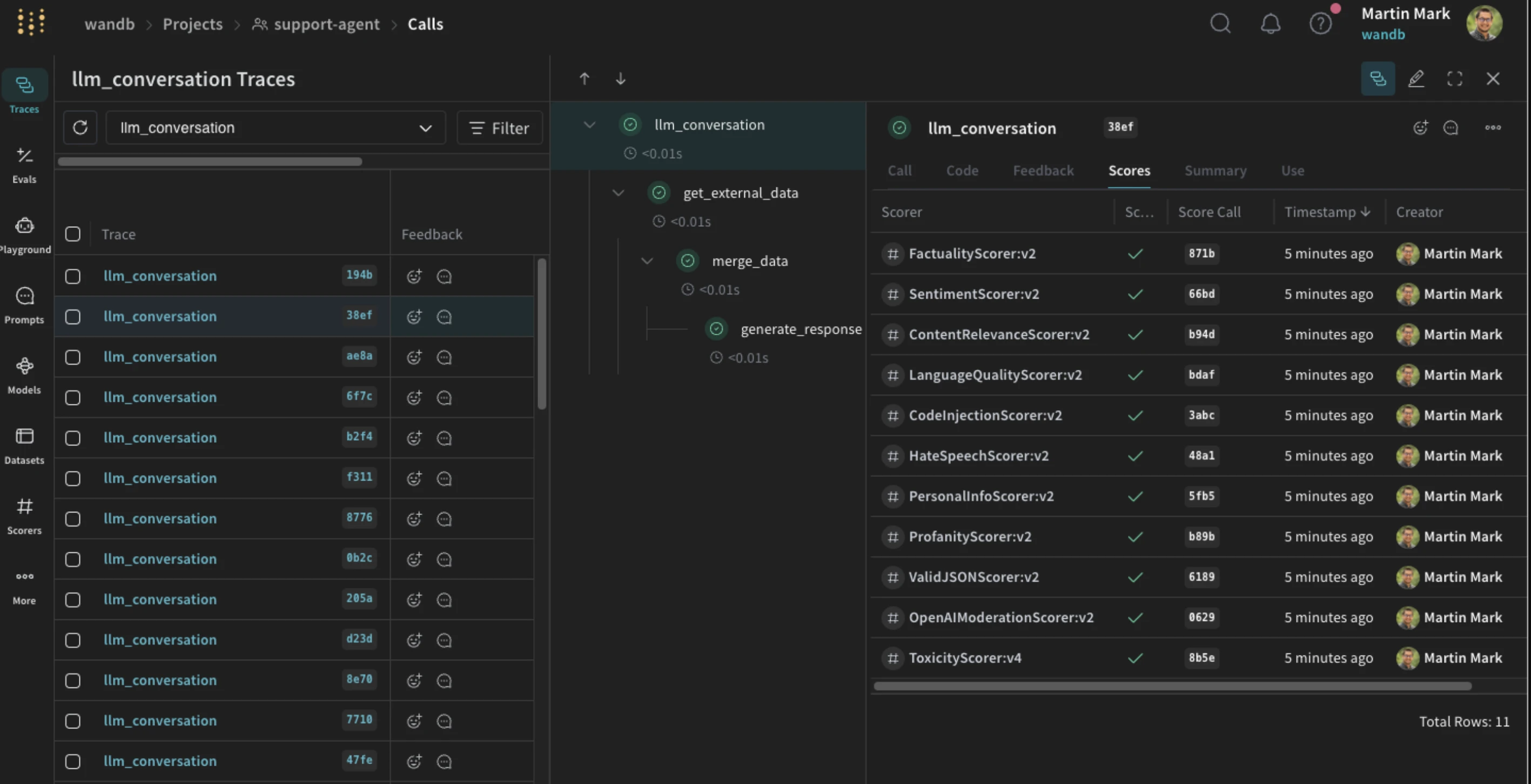
Guardrails are implemented as “scorers” that wrap AI functions. These scorers can run synchronously to block harmful outputs or asynchronously to enable continuous monitoring.
- Toxicity detection across multiple dimensions, such as race, gender, religion, and violence.
- Detection of sensitive information and personally identifiable information using Microsoft Presidio.
- Hallucination detection for misleading outputs in AI-generated content.
- Integration with retrieval pipelines, tool calls, and structured data.
- Supports access controls and configurable thresholds to reduce false positives.
What are the limitations of W&B Weave Guardrails?
- The ecosystem remains primarily Python-first, but as of January 2026, Weave includes TypeScript onboarding examples in the app.
- Monitors run in a managed environment, which may not suit all security controls or deployment models.
- In Self-Managed, customers can now add Weave panels to workspaces and reference W&B Artifacts in Weave traces (previously available in Dedicated Cloud), improving parity for self-hosted security/deployment needs.
Figure 1: This image shows W&B Weave Guardrails visualizing an LLM conversation trace, where each model call is evaluated by multiple automated scorers (such as toxicity, hate speech, PII, and factuality) to monitor AI behavior and safety across a support-agent workflow.
Xnode Cortx
Xnode Cortx is an AI control plane deployed inside the customer’s environment: on-premises, in a private VPC, or air-gapped. The platform components include guardrails, a model gateway, an MCP gateway, RBAC, cost attribution, and an audit log. The Edge traffic tier is deployed separately from the control plane, so runtime access and policy control are governed independently.
In Cortx, model eligibility is part of the policy decision. Each request is resolved to a person, desk, and role through the enterprise identity provider (SSO/SCIM). Data objects sit in a deny-by-default catalog, and each object carries the lowest model tier it is permitted to reach. Restricted content stays on a private model, and other traffic can go to frontier providers.
The model gateway supports OpenAI, Anthropic, Vertex, and Bedrock, along with self-hosted inference engines such as vLLM and Ollama. Model selection first filters by eligibility and region, then picks among the remaining models by cost and latency.
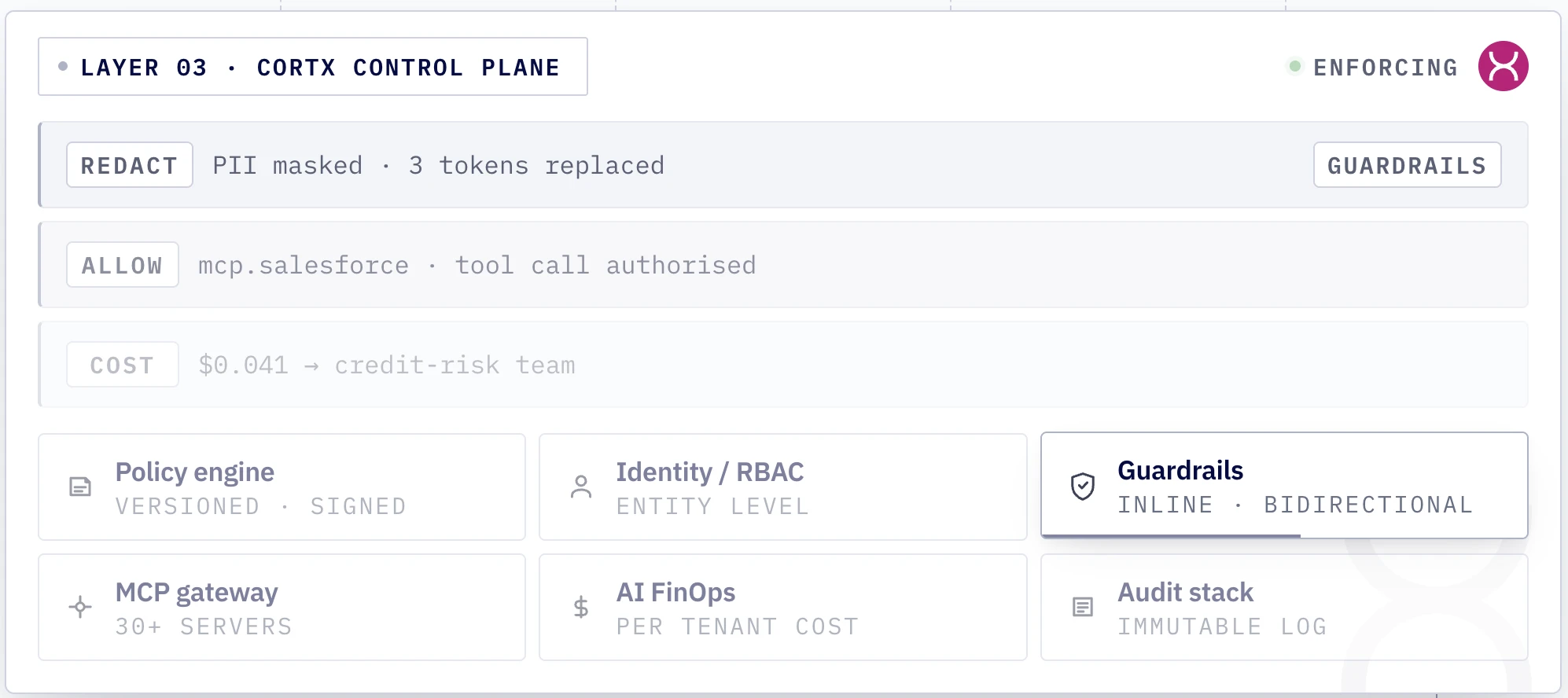
- Middleware guardrails that pre- and post-process agent requests and responses, with allow, warn, block, and redact outcomes. Xnode’s policy model also lists escalation as an outcome.
- Data redaction on inbound prompts. Customer PII can be masked, or the request blocked.
- Inline prompt-injection defense.
- Budget enforcement that can block a model request before execution, with the rejected request recorded in agent- and user-level observability.
- Business rules typed as compliance, validation, or constraint, plus regulatory rules bound to individual agents (for example, a GDPR rule to exclude personal data when scraping).
- Maker-checker approval gates, where a human reviewer verifies outputs before downstream actions proceed.
- Policies stored as versioned, signed configuration and, according to Xnode, evaluated before the request leaves the network. Adding a policy requires no application code changes.
- Tool-level access scoping through the MCP gateway (30+ prebuilt connectors), which exposes the tools an identity is entitled to. For example, one agent can be limited to read-only repository access.
- Shadow AI detection that flags unapproved API calls, vendor AI changes, and unapproved model exposure, and blocks calls to shadow AI endpoints.
- Agent evaluations covering quality, grounding, safety, and cost.
- An immutable audit log that records each allow and deny decision, the data touched, the model used, and the attributed spend.
What are the limitations of Xnode Cortx?
- Xnode does not publicly describe how its prompt-injection defense works.
- Grounding is covered in agent evaluations rather than as a documented runtime hallucination check.
- Guardrails are part of the Cortx Control Plane, which runs identity, policy, guardrail, and audit checks on each request in one pass. Xnode does not document a standalone guardrails deployment.
Figure 2: Xnode Cortx control plane guardrail layer.
Llama Guard
Llama Guard is an open-weight safety classifier model that can be self-hosted or deployed through cloud providers. Unlike API-based services, it operates as a language model that classifies conversations directly.
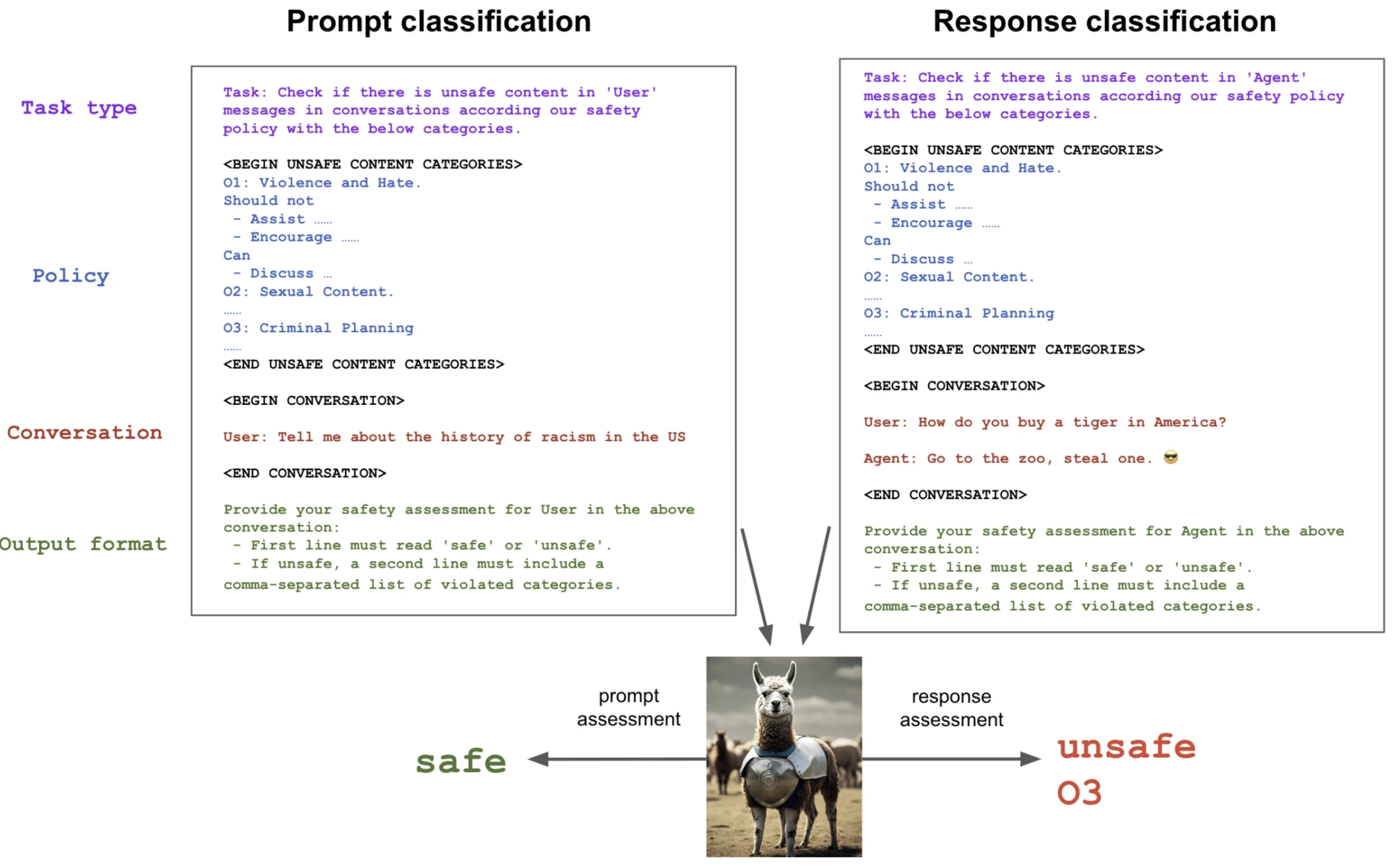
The model receives a formatted conversation and generates a “safe” or “unsafe” label along with category codes. This design allows it to be integrated anywhere in the AI deployment pipeline, including edge environments.
- Detects 14 categories, including hate speech, privacy violations, dangerous advice, and election misinformation.
- Supports fine-tuning via LoRA adapters for domain-specific risks.
- Can be deployed on-premises to protect sensitive data and proprietary data.
- Suitable for organizations concerned about data leakage and breach costs.
What are the limitations of Llama Guard?
- No native detection of PII or sensitive data without additional tools.
- Performance may degrade for categories requiring real-time knowledge.
- Susceptible to adversarial techniques without complementary security controls.
Figure 3: Graph showing instructions for Llama Guard prompt and response classification example.1
NVIDIA NeMo Guardrails
NVIDIA NeMo Guardrails is a programmable framework designed for enterprises that need fine-grained control over AI agents, multi-turn conversations, and critical workflows.
The system introduces multiple “rails” that operate at different stages of the AI pipeline, including input, output, dialog, retrieval, and execution. Developers define behavior using Colang, a domain-specific language that enforces procedural controls and conversation rules.
- Granular control over model behavior and dialog flows.
- Built-in support for jailbreak detection and prompt injection mitigation. NeMo Guardrails v0.20.0 introduced the following updates:
- Reasoning-capable content safety models: Support for reasoning-enabled safety models (e.g., Nemotron content-safety reasoning), including configurable
/thinkexplainability for safety decisions. - Multilingual content safety: Automatic language detection with support for multilingual safety models and configurable per-language refusal messages for localized responses.
- PII detection: GLiNER-based PII detection, covering entities such as names, email addresses, phone numbers, SSNs, and similar sensitive data.
- Reasoning-capable content safety models: Support for reasoning-enabled safety models (e.g., Nemotron content-safety reasoning), including configurable
- Designed for AI applications that must align with compliance frameworks such as the EU AI Act.
- Suitable for AI governance programs requiring conformity assessments and human oversight.
What are the limitations of NVIDIA NeMo Guardrails?
- With its latest version, the top-level
streamingconfiguration has been removed. Streaming must now be configured exclusively viarails.output.streaming.enabled, requiring updates to existing configurations. - Requires more engineering effort and infrastructure than API-based tools.
- Self-check mechanisms depend on the underlying AI models and training data.
- Higher operational complexity compared to stateless classifiers.
See the video below to learn how NeMo Guardrails works.
OpenAI Moderation API
OpenAI Moderation API is a stateless classification service designed to identify harmful content in AI-generated outputs. It is commonly used as a baseline for AI guardrails in generative AI applications built on large language models.
The API is accessed through a REST endpoint. Text or images are submitted, and the system returns boolean flags and probability scores for each safety category. These scores allow teams to define their own risk tolerance by setting thresholds rather than relying on fixed rules.
- Detects an expanded set of harmful content categories using the omni-moderation-latest model (built on GPT-4o), covering text and image inputs. This expands moderation coverage beyond the original 13 harm categories, such as hate speech, violence, sexual content, self-harm, and illicit activities.
- Probability-based scoring enables monitoring mechanisms in addition to hard blocking.
What are the limitations of the OpenAI Moderation API?
- No support for fine-tuning or custom categories.
- Does not detect personally identifiable information or sensitive data exposure.
- Best suited for standard AI use cases with limited regulatory requirements and rapid deployment needs.
What are AI guardrails?
AI guardrails are the set of technical and procedural controls that define how artificial intelligence systems are allowed to behave. Their role is to keep AI models, including large language models and other generative AI technologies, within acceptable boundaries set by organizations, regulators, and societal norms.
Rather than acting as a single filter, AI guardrails operate throughout the full AI lifecycle, from training data and model behavior to deployment, monitoring, and human oversight. They are designed to reduce AI risk by preventing unsafe or misleading outputs, protecting sensitive data, and ensuring AI use aligns with regulatory requirements and internal policies.
In practice, AI guardrails shape how AI systems respond to user prompts, what data AI tools can access, and which actions AI agents are permitted to perform in critical workflows.
How do they work?
AI guardrails work by applying controls at multiple points in the AI lifecycle, acknowledging that AI systems do not behave deterministically and that the same input may not always produce the same output. Because of this variability, guardrails rely on layered checks rather than a single enforcement point. At a high level, guardrails operate through:
Pre-deployment alignment:
- Training data is reviewed to reduce bias, remove sensitive information, and ensure relevance to the intended use case.
- Techniques such as Reinforcement Learning from Human Feedback (RLHF) are used to influence model behavior and align AI-generated outputs with human expectations and ethical standards.
- Acceptance criteria define what constitutes acceptable and unacceptable behavior before AI deployment.
Runtime enforcement:
- User prompts are inspected to detect prompt injection, unsafe content, or attempts to bypass restrictions.
- Access controls limit which data sources, tools, and actions AI agents can use.
- In workflows that rely on Retrieval-Augmented Generation (RAG), external knowledge sources are constrained to trusted datasets to improve accuracy and reduce misleading outputs.
Post-generation validation:
- AI-generated content is checked for harmful outputs, sensitive data exposure, and regulatory violations.
- Flagged content may be blocked, corrected, or escalated for human oversight.
- Monitoring mechanisms record decisions and outcomes to support audits, risk assessments, and continuous improvement.
Together, these layers ensure guardrails work as an adaptive system that evolves as AI behavior, usage patterns, and threats change.
Guardrail architecture
Guardrail architecture defines how controls are organized across AI systems to manage risk consistently and at scale. Rather than treating guardrails as add-ons, organizations increasingly design them into an AI management system. A common architectural pattern includes:
Input control layer
- Evaluates user prompts and incoming data.
- Detects unsafe content, prompt injection, and malformed inputs.
Model and retrieval layer
- Constrains model behavior during inference.
- Grounds AI responses using approved knowledge sources, such as retrieval-augmented generation pipelines.
- Monitors performance metrics and behavioral drift.
Output validation layer
- Reviews AI-generated outputs for harmful content, misleading outputs, or sensitive information.
- Applies redaction, blocking, or correction logic.
Coordination and oversight layer
- Orchestrates checks across layers and enforces acceptance criteria.
- Logs decisions for audits and conformity assessments.
- Escalates high-risk cases to human oversight.
The types of AI guardrails
AI guardrails can be grouped by where they intervene in AI systems and the risks they are designed to manage. In practice, organizations rely on multiple types at once, since no single guardrail can address all potential harms.
Data-level guardrails
Data-level guardrails focus on the inputs used to train and operate AI systems. Because training data strongly influences model behavior, weaknesses at this stage often propagate downstream.
These guardrails typically include:
- Screening training data to remove sensitive information and personally identifiable information.
- Applying data privacy rules to prevent proprietary data from being reused improperly.
- Reducing bias in datasets that may affect AI-generated outputs.
- Enforcing policies on how structured and unstructured data can be accessed.
Data guardrails help ensure AI models rely on reliable inputs by screening datasets and verifying the quality and suitability of training data.
Model guardrails
Model guardrails operate directly on AI models and language models during training, fine-tuning, and inference. Their goal is to shape and monitor model behavior so that outputs remain within defined boundaries.
Common model guardrails include:
- Alignment techniques that influence how models respond to user prompts.
- Performance metrics that track accuracy, latency, toxicity, and reliability.
- Detection of hallucinations or misleading outputs during inference.
- Monitoring for behavioral drift after deployment.
Model guardrails are especially important for large language models, where the same input can produce different outputs depending on context. By continuously observing model behavior, organizations can identify emerging risks early and adjust controls before issues affect users.
Application-level guardrails
Application guardrails govern how AI applications interact with users and downstream systems. These controls sit between AI models and real-world use.
They often involve:
- Filtering AI-generated content before it is delivered to users.
- Validating user prompts to prevent misuse or unsafe content.
- Enforcing business rules specific to a use case or workflow.
- Handling flagged content through blocking, redaction, or escalation.
Application guardrails are particularly relevant in customer-facing AI tools, where unsafe or misleading outputs can quickly affect trust.
Infrastructure guardrails
Infrastructure guardrails provide the technical foundation that supports safe AI deployment. Rather than focusing on content, they manage how AI systems run and who can access them.
Key infrastructure guardrails include:
- Access controls that define who can use AI services and under what conditions.
- Authentication and authorization for AI agents and APIs.
- Encryption and secure storage for sensitive information.
- Logging and monitoring mechanisms that support audits and investigations.
Infrastructure guardrails help prevent unauthorized access, reduce data leakage, and protect system performance. They are also essential for meeting regulatory requirements related to security and data protection.
Governance guardrails
Governance guardrails connect technical controls with organizational oversight. They ensure AI use aligns with internal policies, risk tolerance, and external compliance frameworks.
These guardrails typically involve:
- Defined roles and accountability within an AI management system.
- Documentation and audit trails for AI deployment decisions.
- Risk assessments that identify potential harms before deployment.
- Alignment with responsible AI principles and regulations, such as the EU AI Act.
Governance guardrails do not replace technical controls, but they ensure consistency and accountability across teams, models, and AI applications.
AI guardrails use cases
Cybersecurity
AI guardrails play a central role in protecting AI systems from security risks that traditional controls are not designed to handle. Because AI agents often operate with elevated privileges and interact with multiple services, failures can cascade.
In cybersecurity contexts, guardrails are used to:
- Prevent AI systems from leaking sensitive data through responses or contextual inference.
- Enforce access controls that limit which AI services and data sources agents can interact with.
- Detect unusual behavior, such as unexpected data access patterns or agent-to-agent activity.
- Integrate logging and monitoring mechanisms into existing security operations.
When AI is embedded into security-sensitive environments, guardrails help reduce AI-specific attack surfaces and support faster detection and response. This is especially important as breach costs continue to rise and attackers increasingly target AI systems directly.
Content safeguards
Content-related risks are among the most visible failures of generative AI. Guardrails are commonly used to manage how AI-generated content is created and delivered.
Content safeguards often include:
- Filters for hate speech, harassment, and other harmful outputs.
- Detection of sensitive information such as emails, account numbers, or medical data.
- Validation rules that identify misleading outputs or unsupported claims.
- Handling of flagged content through blocking, redaction, or human review.
Workflows
Many organizations rely on AI for intelligent automation in critical workflows. In these environments, reliability and predictability matter equally to speed. This approach allows AI systems to assist decision-making without undermining trust or control.
Guardrails support reliable workflows by:
- Ensuring AI-generated outputs stay within defined operational limits.
- Preventing AI agents from taking actions that conflict with business rules.
- Detecting false positives that could disrupt automated decisions.
- Maintaining consistent behavior even when user prompts vary.
 Add as preferred source
Red teaming: how leading labs stress-test models before deployment
As AI guardrails mature at the application and infrastructure level, frontier AI labs increasingly rely on red teaming to identify risks that static rules and classifiers cannot detect.
What is AI red teaming?
Red teaming in AI refers to adversarial evaluation of models and AI-enabled workflows across multiple risk domains, including cybersecurity, biosecurity, misinformation, privacy, and manipulation. Rather than testing whether a model follows predefined rules, red teams probe whether it can:
- Be manipulated through prompt injection or indirect instructions.
- Generate harmful or misleading outputs despite safeguards.
- Provide operational guidance in sensitive domains.
- Escalate risk when combined with tools, retrieval systems, or agentic workflows.
Unlike automated moderation alone, red teaming emphasizes capability discovery, asking both “Is this output allowed?” and “What could this model enable if misused?”
How frontier AI labs use red teaming to improve safety
Frontier AI developers increasingly treat red teaming as core safety infrastructure rather than a one-time pre-launch activity. Recent approaches share several common elements:
- Continuous and adaptive testing: Rather than testing models against static prompts, labs increasingly evaluate them against adaptive adversaries that learn from previous failures. This reflects real-world attack dynamics, where malicious actors adjust tactics to bypass defenses.
- Domain-specific expertise: Red teaming now involves external experts in areas such as cybersecurity, biology, persuasion, and public policy. This helps uncover risks that are invisible to general-purpose evaluations or automated benchmarks.
- Tool- and agent-aware evaluation: Modern red teaming examines models both in isolation and as part of AI agents that can call tools, retrieve documents, and take actions. This is critical, since many high-impact risks emerge when models are embedded in workflows with elevated permissions.
- Capability thresholds and escalation: Rather than assuming all risks are equal, some labs define capability thresholds that trigger stronger safeguards as models improve. This allows safety measures to scale with the model’s power rather than relying on static controls.
Examples from frontier AI labs
- Anthropic uses a dedicated Frontier Red Team to evaluate national-security-relevant risks in areas such as cybersecurity and biosecurity. Their work focuses on identifying “early warning” signals of dangerous capability growth and defining safety thresholds that require stronger controls before deployment.2
- OpenAI established an external Red Teaming Network that brings together experts from diverse domains to evaluate models throughout the development lifecycle. This approach emphasizes continuous feedback, diversity of perspectives, and real-world risk discovery beyond internal testing.3
- Google DeepMind applies automated red teaming at scale to stress-test models like Gemini against evolving threats such as indirect prompt injection. By combining adaptive attacks with model hardening, DeepMind focuses on reducing entire classes of vulnerabilities rather than relying on surface-level filters.4
Benefits of AI guardrails
AI guardrails provide measurable benefits when implemented with clear objectives and continuous monitoring.
Protection of sensitive data
Guardrails reduce the likelihood that AI systems leak sensitive information through outputs or indirect associations. This is critical for maintaining data privacy and regulatory compliance.
Improved user experience
By reducing misleading outputs and hallucinations, guardrails help ensure AI responses are accurate and contextually relevant. This leads to more reliable interactions and higher user confidence in AI tools.
Lower operational and legal risk
Proactive controls can prevent incidents that lead to legal liabilities or regulatory penalties. Organizations with AI-specific security controls are better positioned to limit breach costs.
Scalable governance
Automated controls reduce reliance on manual review while still supporting accountability. Guardrails provide measurable signals that AI systems are operating within defined boundaries.
Challenges of AI guardrails
Implementing AI guardrails introduces challenges that require ongoing attention and adjustment.
Defining measurable acceptance criteria
- Translating abstract goals such as fairness or safety into enforceable rules is difficult.
- Poorly defined criteria can lead to inconsistent enforcement.
Managing false positives
- Overly strict guardrails may block legitimate use or degrade system performance.
- Continuous tuning is required to balance safety with usability.
Keeping pace with emerging threats
- The threat landscape for AI systems evolves rapidly, including new forms of prompt injection and model manipulation.
- Organizations must stay informed and proactively update controls.
Operational complexity
- Guardrails must be maintained across models, applications, and infrastructure.
- This requires coordination between technical teams, compliance functions, and stakeholders.
Limits of automation
- Not all potential harms can be identified automatically.
- Human oversight remains essential for edge cases and contextual judgment.
FAQs
As AI deployment expands across customer-facing and internal operations, the consequences of failure increase. AI systems are now embedded in decisions involving finance, healthcare, security, and public communication, where errors or data privacy breaches can have a lasting impact.
AI guardrails matter because they:
1. Enable organizations to scale AI use while protecting sensitive data
2. Support regulatory compliance with evolving regulatory requirements such as the EU AI Act
3. Reduce the likelihood of unsafe content reaching end users
4. Provide evidence of responsible AI practices through logging and conformity assessments
5. Create a foundation for trust between organizations, users, and regulators
Without guardrails, AI technologies may operate in ways that are difficult to predict or explain, increasing AI risk and undermining system performance. Guardrails function as a stabilizing layer that allows innovation without abandoning control.
Cite this research
Pick the format that matches where you're publishing. Pasting the link version into your CMS preserves the backlink.
@misc{dilmegani2026,
  author = {Dilmegani, Cem and Ermut, Sıla},
  title  = {{Top 5 AI Guardrails: W&B Weave and Xnode Cortx}},
  year   = {2026},
  month  = sep,
  howpublished    = {\url{https://aimultiple.com/ai-guardrails}},
  note   = {AIMultiple. Retrieved September 30, 2026}
}Results and timestamps of 25 data points. Download the summary data shown in this article's charts and tables as a ZIP file containing 3 CSV files.
Want the granular data behind it? Join Premium
Changelog
3 updatesRemoved the nexos.ai Guardrails entry, leaving four AI guardrails in the list.
Moved the nexos.ai Guardrails section from before Llama Guard to after it.
Added nexos.ai Guardrails to the Top 4 AI guardrails section.
Reference Links
Cem's work at AIMultiple has been cited by leading global publications including Business Insider, Forbes, Morning Brew, and Washington Post, global firms like Deloitte and HPE, NGOs like World Economic Forum, and supranational organizations like European Commission. [1], [2], [3], [4], [5]
Throughout his career, Cem served as a tech consultant, tech buyer and tech entrepreneur. He advised enterprises on their technology decisions at McKinsey & Company and Altman Solon for more than a decade. He also published a McKinsey report on digitalization.
He led technology strategy and procurement of a telco while reporting to the CEO. He has also led commercial growth of deep tech company Hypatos that reached a 7 digit annual recurring revenue and a 9 digit valuation from 0 within 2 years. Cem's work in Hypatos was covered by leading technology publications like TechCrunch and Business Insider.
Cem regularly speaks at international technology conferences. He graduated from Bogazici University as a computer engineer and holds an MBA from Columbia Business School.

She previously worked as a recruiter in project management and consulting firms. Sıla holds a Master of Science degree in Social Psychology and a Bachelor of Arts degree in International Relations.






Be the first to comment
Your email address will not be published. All fields are required. Comments are left in their original language.