


Agentic Search API Benchmark: Parallel, Exa, Perplexity & More

We benchmarked 24 configurations from six search APIs on 120 English questions. The benchmark compares a fixed AI agent’s answer accuracy, cost and API latency, alongside retrieval quality, freshness and source support.
Accuracy and cost
Answer accuracy is the share of evaluated answers judged correct by at least two of three models. Partial answers receive no credit. Scores and 95% confidence intervals are listed in the agentic search benchmark methodology.
Parallel Fast cost $0.0063 per correct answer
Cost per correct answer combines search, content retrieval and agent token charges, then divides that total by correct answers. We valued recorded usage at the captured public pricing for 100,000 monthly requests. Benchmark judging charges are excluded.
Parallel Fast cost $0.0063 per correct answer, compared with $0.0121 for Parallel Advanced and $0.0193 for Exa Fast. Parallel Advanced’s total comprised $0.00833 for search, $0.00035 for content retrieval and $0.00340 for agent tokens per correct answer.
Perplexity Fast Low had the lowest cost at $0.0058 per correct answer. Its overall accuracy was 71.6%.
Answer accuracy uses all answers with a resolved grade. Cost per correct answer uses answers with both a resolved grade and a usable cost record.
Answer accuracy
Parallel Advanced achieved 87.0% answer accuracy
Parallel Advanced achieved 87.0% answer accuracy. Exa Fast followed at 82.6%, and Parallel Fast reached 79.7%.
The 95% confidence intervals were 78.3–94.2% for Parallel Advanced and 73.9–91.3% for Exa Fast. These intervals overlap, and each configuration was tested once. The observed ranking therefore describes this question set, with uncertainty around the size of the difference.
Parallel Advanced also ranked above Exa Fast when the comparison was limited to questions with results for every configuration.
Larger context budgets and deeper modes did not consistently improve accuracy
Brave’s 8,192-token configuration recorded 77.9% accuracy, compared with 76.5% at 16,384 tokens and 68.7% at 32,768. These settings controlled the total context budget. The per-URL cap remained 4,096 tokens.
Exa Fast recorded 82.6% accuracy. Deep Lite, Deep and Deep Reasoning recorded 77.9%, 76.5% and 76.8%, respectively. Their median API response times were 3.20, 8.69 and 13.19 seconds, compared with 0.47 seconds for Fast.
Brave’s larger token-budget settings had lower observed accuracy. Exa’s deeper modes also had lower accuracy and longer API response times than Fast. These comparisons apply to the tested configurations.
Accuracy and API latency
Exa Fast paired 82.6% accuracy with 0.47-second API latency
API latency p50 is the median time from sending a request to receiving its complete response. It covers recorded search and content calls from Ashburn. Accuracy is calculated per evaluated answer, while latency is calculated per API call.
Exa Fast recorded 82.6% answer accuracy with a median API response time of 0.47 seconds. Parallel Advanced’s accuracy was 87.0% and its API p50 was 2.62 seconds. Parallel Fast combined 79.7% accuracy with 0.78-second API p50.
Perplexity Fast Low had the lowest API p50 at 0.18 seconds, with p95 at 0.28 seconds. Parallel Turbo’s median was 0.38 seconds. Exa Deep Reasoning’s was 13.19 seconds.
Complete agent tasks took longer than individual API calls. Median time from question delivery to final answer was 33.52 seconds for Perplexity Fast Low, 36.11 for Parallel Fast, 37.75 for Exa Fast and 39.55 for Parallel Advanced. This duration includes tool argument generation, result processing and the final answer. Component medians cannot be added to recover the median task duration.
Retrieval quality
nDCG@10 measures the ordering of relevant sources in the first ten results. Three judges graded each question and URL pair from 0 to 3. The metric gives more weight to highly relevant sources and to results near the top. A score of 1 matches the ideal ordering in the graded pool.
Parallel Advanced scored 0.689. Parallel Basic scored 0.663, Perplexity Web High 0.660, and Exa Fast 0.658.
The order reversed on the small common-query subset. Exa Fast scored 0.754 and Parallel Advanced scored 0.710. These rankings depend on the comparison set.
Retrieval quality and answer accuracy use separate question sets. A question-by-question relationship between source ranking and answer correctness cannot be inferred from these aggregate scores. Our RAG evaluation tools benchmark examines how evaluation tools score supplied passages.
Freshness of answers
Freshness answer accuracy measures correctness against reference facts for each question’s collection date. This metric uses the same strict two-vote rule as overall answer accuracy. Answers matching superseded facts receive no strict credit.
Exa Deep Lite and Parallel Advanced each achieved 78.9% freshness answer accuracy. Brave’s 8,192-token configuration scored 73.7%, and Tavily Ultra Fast scored 26.3%.
The 95% confidence interval for each 78.9% result is 57.9–94.7%.
Source-supported excerpts
Source-supported excerpts are returned content units whose material assertions are supported by an independently captured source. This measure, also called excerpt fidelity, evaluates the text supplied to the agent. Final-answer correctness is evaluated separately.
Source support was 96.8% for Brave’s 8,192-token configuration, 93.5% for Parallel Advanced and 93.1% for Perplexity Fast High. Firecrawl and Tavily Advanced each scored 64.0%.
A not-entailed judgment identifies a material assertion without support in the admitted source copy. Page changes, source identity and extraction can affect that comparison, so the judgment alone cannot establish fabrication.
 Add as preferred source
Agentic search benchmark methodology
Dataset and test design
AIMultiple’s organic search query data from Google Search Console and topics in our published research guided question development. We used these sources to identify reader needs, then wrote questions with explicit constraints and reference answers supported by independent primary sources.
The benchmark covers Brave, Exa, Firecrawl, Parallel, Perplexity and Tavily, with every configuration reported separately. The dataset contains 50 retrieval queries and 70 answer questions, including 20 that require current facts. Fifty questions were selected for public release. Seventy remain private.
For the topic overview, we grouped the 120 questions into 15 areas. Each question appears in one primary topic group.
We selected the private questions using previous performance evidence and source availability. This selection favors known challenges and limits generalization to routine search workloads.
Reference answers specify the facts and constraints required by each question. Independent primary sources must have separate organizations or maintainers and evidence chains. Repeated copies of an announcement do not establish independence. AIMultiple pages were excluded from reference verification and the agent’s reachable domains.
Each configuration has one observation per question. All configurations use the same agent, English questions and client location. The results apply to this selected workload and these configurations.
How the agent used the search APIs
OpenCode started a fresh session for each answer question. The requested model was openai/gpt-5.6-luna-20260709, with low reasoning effort, a fixed OpenAI provider route and a 2,048-token output cap. Temperature was omitted. Requested and returned model identifiers were retained.
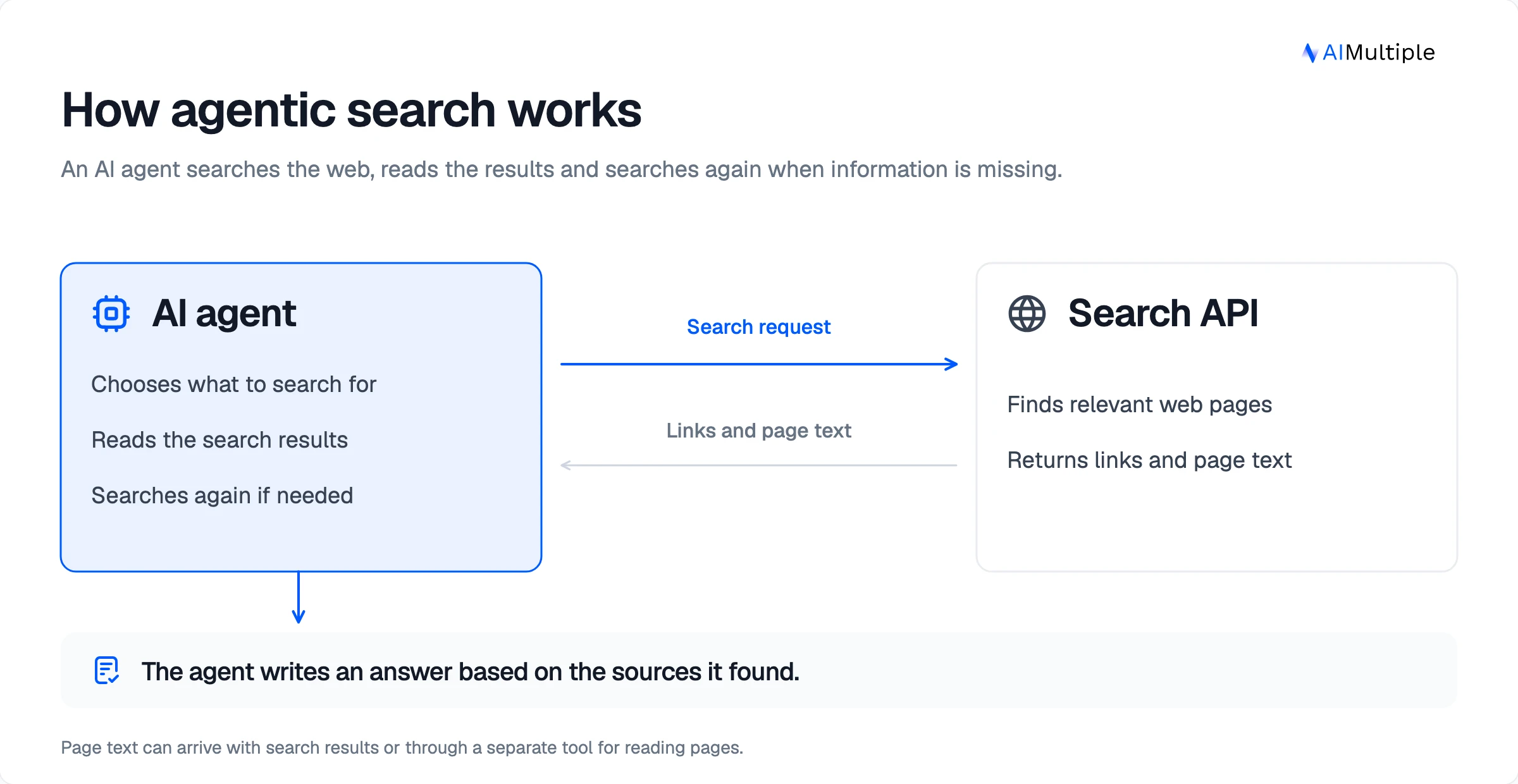
Single-call questions allowed one participant request. Other answer questions allowed 25, with search, content retrieval and retries sharing the budget. Calls within a question were sequential. The common task template was combined with provider-specific tool guidance and schemas.
Retrieval ranks were scored in the order returned by each API. Equivalent relevance-ordering guarantees were not verified for the other APIs.
Judging and source evidence
Gemini 4 Argon, Claude Sonnet 5.5 and Qwen3.8-27B evaluated answers and evidence. Their fixed routes were Google AI Studio, Anthropic and DeepInfra BF16, respectively, with an 8,192-token output cap and provider fallback disabled.
Judges received the task rubric and relevant evidence. Participant identity, price, running order and competitors’ answers were withheld. Relevance used a deterministic passage selector capped at 6,000 Unicode characters. Answer and fidelity evidence remained complete.
At least two correct votes were required for strict answer accuracy. Relevance used the unrounded mean of three valid grades from 0 to 3. Fidelity used entailed/not-entailed votes, with two matching valid votes sufficient to determine a majority. Unresolved cases stayed unscored.
The panel was used under a documented calibration exception. Twelve short/long answer control pairs passed, and the researcher completed a qualitative review of 25 questions.
Fidelity compared each returned content unit with an independently captured source inside its campaign’s acquisition window. PDF sources required two independent extractions and human adjudication when they disagreed. Units awaiting source or extraction acceptance remained unresolved.
Metrics, costs and uncertainty
For each configuration, more than 90% of answer questions received a resolved grade. Eligible samples differ across metrics and configurations. Scores exclude unresolved cases. Blank estimates indicate unavailable or undefined results.
nDCG uses gain 2^grade - 1, logarithmic rank discount and the available graded ideal for each question. Each canonical URL appears once in the ideal ranking. A score remains unresolved when required grades are missing.
Cost per correct answer includes participant search and content charges, agent tokens, and applicable billable failures and retries. The headline scenario uses captured public tariffs at 100,000 monthly requests, excluding free credits and promotions. The values price recorded usage under those assumptions.
API p50 and p95 measure request-to-complete-response time in seconds from Hetzner’s Ashburn location. Search and content calls are included. Question latency measures the time from question delivery to final answer emission. Call-level latency and answer accuracy have separate measurement populations.
Confidence intervals use a bootstrap that resamples questions and retains their associated measurements. Combined scores pool numerators and denominators across public and private questions. The intervals describe uncertainty within the evaluated sample. Variation between repeated runs and the effects of challenge-set selection are outside that estimate.
Search APIs supply evidence to an agent whose complete answer depends on retrieval, tool use and generation. A retrieval-augmented generation system therefore needs evaluation on its own questions and sources. Our SERP scraper API comparison covers a separate search-results collection workload.
Scores and confidence intervals
Scores and 95% confidence intervals use the combined public and private dataset.
Answer accuracy
Retrieval quality
Freshness answer accuracy
Source-supported excerpts
Further reading
- Best RAG Tools, Frameworks, and Libraries
- RAG Evaluation Tools: W&B Weave vs Ragas vs TruLens
- We Tested the Best SERP Scraper APIs in 2026
Cite this benchmark
Pick the format that matches where you're publishing. Pasting the link version into your CMS preserves the backlink.
@misc{sari2026,
  author = {Sarı, Ekrem},
  title  = {{Agentic Search API Benchmark: Parallel, Exa, Perplexity & More}},
  year   = {2026},
  month  = nov,
  howpublished    = {\url{https://aimultiple.com/agentic-search}},
  note   = {AIMultiple. Retrieved November 10, 2026}
}Results and timestamps of 142 data points. Download the summary data shown in this article's charts and tables as a ZIP file containing 7 CSV files and a README.
Want the granular data behind it? Join Premium
Changelog
5 updatesReplaced Brave Search's pricing tiers with the new Search, Answers and Enterprise plans.
Replaced results and analysis in the Key findings section.
Updated the number of datasets in the Statistical Methodology section.
Added benchmark results and key findings to the introduction.
Added the "Benchmark methodology" section, detailing query selection, APIs evaluated, evaluation protocol, LLM judge criteria, statistical methodology, and limitations.







Be the first to comment
Your email address will not be published. All fields are required. Comments are left in their original language.