


AI Data Quality: Challenges & Best Practices

Poor data quality delays the successful deployment of AI and ML projects. 1 Even the most advanced AI algorithms can yield flawed results if the underlying data is of low quality.
Explore the importance of data quality in AI, the challenges organizations encounter, and the best practices for ensuring high-quality data:
What is the importance of data quality in AI?
In a SnapLogic and Vanson Bourne survey of 500 IT decision-makers in the US and UK, 82% said they had to rework data analytics projects because of poor data quality.2 Figure 1 shows the business impact they reported.
Figure 1: Impact of poor quality data and analytics

Source: SnapLogic2
Unrepresentative data is a quality problem too. The 2018 Gender Shades study found that two widely used facial analysis benchmarks consisted of 79.6% and 86.2% lighter-skinned subjects. Three commercial gender classifiers it tested misclassified darker-skinned women at error rates of up to 34.7%, against at most 0.8% for lighter-skinned men.3
As Andrew Ng, Professor of AI at Stanford University and founder of DeepLearning.AI, states, “If 80 percent of our work is data preparation, then ensuring data quality is the most critical task for a machine learning team.”
Why is avoiding the ‘garbage in, garbage out’ problem crucial for data quality?
“Garbage in, garbage out” (GIGO) means a system’s output can be no better than its input. If the data an AI model learns from is inaccurate, incomplete or biased, its predictions will be too.
Figure 2: Data quality and standards: “garbage in” data, “garbage out” results.
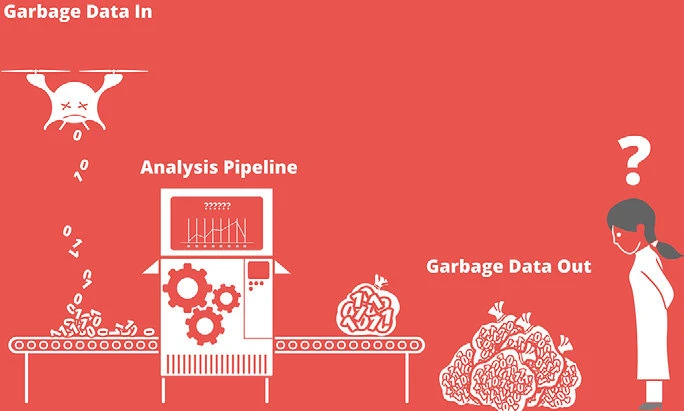
Source: Shakoor et al. 4
Avoiding GIGO takes cleaning and preprocessing data before training, then testing on held-out data to measure AI model performance.
What are the key components of quality data in AI?
Accuracy: Values and labels match the real-world facts they describe. A model trained on mislabeled images learns the wrong classes.
Consistency: The same fact is recorded the same way in every source, with one date format, one unit and one spelling per name. Mixed formats split a single customer or product into multiple records.
Completeness: Required fields are filled, and the cases the model must handle appear in the data. A fraud model trained without examples of a new scam type cannot learn to flag it.
Timeliness: Data reflects current conditions. A pricing model trained on last year’s costs misprices products after supplier prices change.
Relevance: Data contains the variables the problem depends on. Irrelevant columns add noise and training cost without improving predictions.
What are the challenges of ensuring data quality in AI?
1-Data collection
As developments in AI benefit industries such as finance, healthcare, manufacturing, and entertainment, organizations face the challenge of collecting data from various sources while maintaining quality. Many turn to web scrapers to automate and ensure all data points follow the same standards.
2-Data labeling
AI algorithms rely on labelled data for training, but manual labelling is slow and error-prone. Errors survive even in widely used datasets: a 2021 study estimated label errors averaging at least 3.3% across the test sets of 10 popular datasets, including at least 6% of the ImageNet validation set.5
3-Data storage and security
Data that unauthorized users change, or that is corrupted in storage or lost during a migration, is no longer reliable training input. Access controls, backups and integrity checks protect it.
4-Data governance
Without a named owner for each dataset, errors go unfixed at the source and teams keep conflicting copies of the same data. The Mayo Clinic case study below shows how one organization assigned owners.
5- Data poisoning
In data poisoning, attackers insert malicious or misleading samples into training data so the model learns wrong or harmful behavior. Datasets collected from the web are exposed: researchers showed in 2023 that an attacker could have poisoned 0.01% of the LAION-400M image dataset for $60.6 Regular audits and anomaly detection on incoming data reduce the risk.
6-Synthetic data feedback loops
Training models on AI-generated data can degrade them. A 2024 Nature study found that indiscriminate use of model-generated content in training causes irreversible defects, as the rare cases in the original data disappear. The authors call this “model collapse.” In their experiments, keeping 10% of the original human data in each training round led to only minor degradation.7
Real-world case studies
Case Study 1: Mayo Clinic – Data stewardship before AI
Mayo Clinic, with about 76,000 staff across three campuses, treats data readiness as the first step of any AI project.8
The Challenge: Responsibility for data is spread across many clinical and business units. Chief data and analytics officer Ajai Sehgal says that when no one is responsible for stewarding the data, data problems follow, and AI in health care cannot afford low-quality outputs.
The Solution: Mayo made the clinical and business teams that know the data best its stewards, responsible for getting their data ready for analysis. A central team maintains a data library that links each data element to its metadata and related clinical rules. Mayo’s surgery practice, for example, is starting its AI work by getting its data ready and has proposed a self-funded data and analytics team.
Case Study 2: JPMorgan Chase – Fraud detection on verified internal data
JPMorgan Chase uses large language models to detect fraud such as business email compromise.9
The Challenge: Ryan Schmiedl, who runs the bank’s fraud detection, sanctions screening and know-your-customer checks, warned in 2023 that models trained on internet-wide data, as ChatGPT is, can present unverified claims as facts.
The Solution: The bank trains its LLMs only on data from its own ecosystem and first makes sure that data has been audited and validated. It also uses AI to extract company and people names from unstructured data and screen them for fraud risk.
Case Study 3: Walmart – Cleaning product catalog data with LLMs
Walmart used generative AI to improve the product catalog data behind its search and product pages.10
The Challenge: Keeping catalog data complete and accurate at Walmart’s scale is labor-intensive. CEO Doug McMillon said that without generative AI, the work would have required “nearly 100 times the current headcount.”
The Solution: Walmart used multiple large language models to create or improve more than 850 million pieces of catalog data, McMillon said on the company’s August 15, 2024 earnings call. Walmart U.S. CEO John Furner said the improved data helps the company match the catalog to what customers are searching for.
Best practices for ensuring data quality in AI
1-Implement data governance policies
A data governance framework names an owner for each dataset, sets the quality standards the data must meet and defines who fixes errors.
Real-life example: Airbnb
Airbnb launched “Data University” to enhance data literacy across its workforce by offering customized courses that integrate Airbnb’s specific data and tools. At the start of Q3 2016, before the program, about 30% of Airbnb employees used the company’s data platform each week. By May 2017, 45% did.11
With more than 500 employees took at least one class in the program’s first six months,11 and each took more than four classes on average. By 2017, many ad hoc data requests that used to go to Airbnb’s data scientists and analysts were handled by employees themselves or by other Data University graduates.11
2-Utilize data quality tools
Data quality tools can automate data cleansing, validation, and monitoring processes, ensuring that AI models have consistent access to high-quality data.
Real-life example: General Electric
General Electric used Tamr, a machine learning tool for data unification, to clean supplier data spread across its business units. The software processed hundreds of thousands of GE supplier records and identified several records that belonged to the same supplier, Emily Galt, a vice president at GE Digital Thread, told Fortune in 2017.12
Galt said the project, run across a few GE divisions, helped save $80 million over a few years. When the software stumbled on nuances in the data, GE’s business experts stepped in to correct it, and the best results came when they gave feedback early in the process.
Examples of data quality solutions
Pandada AI, which launched in early 2026, is an AI-driven platform for automated data cleaning and analysis. It can ingest data files (CSVs, Excel spreadsheets, PDFs, and even images) and generate structured, shareable analytics reports and presentations.13 The platform includes smart data-cleaning features (duplicate removal, format standardization, missing-value detection) that automatically fix data issues, reducing manual data-preparation work.14
Sieve is a data-cleaning platform from a Y Combinator Spring 2025 startup that combines AI-driven processing with optional human review.15 It provides an API and an Excel add-in for automated data cleansing, automatically routing any flagged issues to human operators for validation.15
3-Develop a data quality team
A dedicated data quality team tracks quality metrics, traces recurring errors to the systems that create them and trains the people who enter data.
4-Collaborate with data providers
Write quality requirements into contracts with external data providers: an accepted error rate, how labels are checked, and the right to reject a batch that fails.
5-Continuously monitor data quality metrics
Check every new data batch against a few metrics, such as missing-value rate, duplicate rate and the share of values outside expected ranges, and alert when one moves. This catches problems before they reach model training.
 Add as preferred source
What Is AI Data?
AI data is an informal term for any data used to build or run AI systems: training datasets, the live inputs a model makes predictions on, and synthetic data generated to add examples.
FAQs
According to Gartner, poor data quality costs organizations at least $12.9 million a year on average.16 Poor data quality leads to failed AI projects; in RAND’s 2024 interviews with experienced AI practitioners, data problems were the second most common reason AI projects failed, after leadership problems, and 30 of the 50 industry interviewees described persistent data quality issues.17 Additional costs include wasted time as data scientists spend much of their time cleaning data rather than building models, lost revenue opportunities from inaccurate predictions and poor customer experiences, and compliance risks, particularly in regulated industries where data quality failures can result in significant fines.
Gartner predicted that, through 2026, organizations would abandon 60% of AI projects that lack AI-ready data. A Gartner survey found that 63% of organizations either do not have or are unsure whether they have the right data management practices for AI.18 VentureBeat reported that 87% of data science projects never make it into production. Speakers at its Transform 2019 conference gave three reasons: weak leadership support, siloed data that has to be collected and cleaned before work can start, and poor collaboration between teams.19 A Dimensional Research survey of 227 people working on enterprise AI and ML projects, commissioned by Alegion, found that 96% of enterprises had run into problems with training data quality, data labeling and model confidence.20
Data quality describes the data itself: whether it is accurate, complete, consistent, timely and relevant. It is measured with metrics such as error rates, completeness percentages and duplicate counts.
Data governance is the set of policies, roles and responsibilities for managing data across an organization. It defines who owns data, who can access it, how it may be used and what standards it must meet.
Cite this research
Pick the format that matches where you're publishing. Pasting the link version into your CMS preserves the backlink.
@misc{dilmegani2026,
  author = {Dilmegani, Cem and Arslan, Ezgi},
  title  = {{AI Data Quality: Challenges & Best Practices}},
  year   = {2026},
  month  = nov,
  howpublished    = {\url{https://aimultiple.com/data-quality-ai}},
  note   = {AIMultiple. Retrieved November 18, 2026}
}
Changelog
6 updatesAdded Pandada AI and Sieve to the "Examples of data quality solutions" section.
Added the FAQs section.
Reference Links
Cem's work at AIMultiple has been cited by leading global publications including Business Insider, Forbes, Morning Brew, and Washington Post, global firms like Deloitte and HPE, NGOs like World Economic Forum, and supranational organizations like European Commission. [1], [2], [3], [4], [5]
Throughout his career, Cem served as a tech consultant, tech buyer and tech entrepreneur. He advised enterprises on their technology decisions at McKinsey & Company and Altman Solon for more than a decade. He also published a McKinsey report on digitalization.
He led technology strategy and procurement of a telco while reporting to the CEO. He has also led commercial growth of deep tech company Hypatos that reached a 7 digit annual recurring revenue and a 9 digit valuation from 0 within 2 years. Cem's work in Hypatos was covered by leading technology publications like TechCrunch and Business Insider.
Cem regularly speaks at international technology conferences. He graduated from Bogazici University as a computer engineer and holds an MBA from Columbia Business School.




Be the first to comment
Your email address will not be published. All fields are required. Comments are left in their original language.