


Compare 20+ Responsible AI Platforms & Libraries

Responsible AI platform market includes two types of software:
enterprise responsible AI platforms and open-source responsible AI frameworks and libraries. We listed some of the most recognized tools based on metrics such as review volume, feature sets, GitHub scores, and Fortune 500 references.
Here are some of these leading tools:
Enterprise responsible AI platforms
Data governance
Data governance refers to the overarching framework that aligns data practices with business goals and accountability structures. A broad application of data governance is in ML applications, called as machine learning data governance.
Databricks
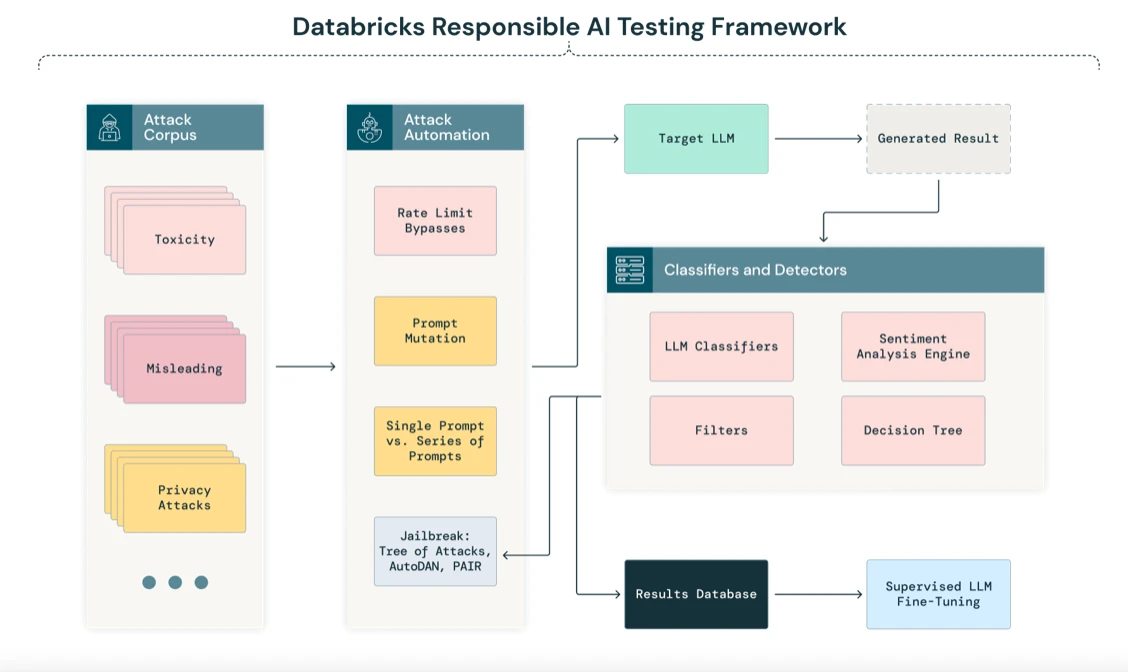
Databricks is a unified data and AI platform that ensures data ownership and control for AI models through comprehensive monitoring, privacy controls, and governance. Databricks delivers responsible AI through its Responsible AI Testing Framework, which includes:
- AI red teaming to identify vulnerabilities
- Automated and manual probing for bias and ethical issues
- Jailbreak testing to understand model behavior under attacks
- Model supply chain security to safeguard AI systems throughout their lifecycle.
IBM watsonx.data
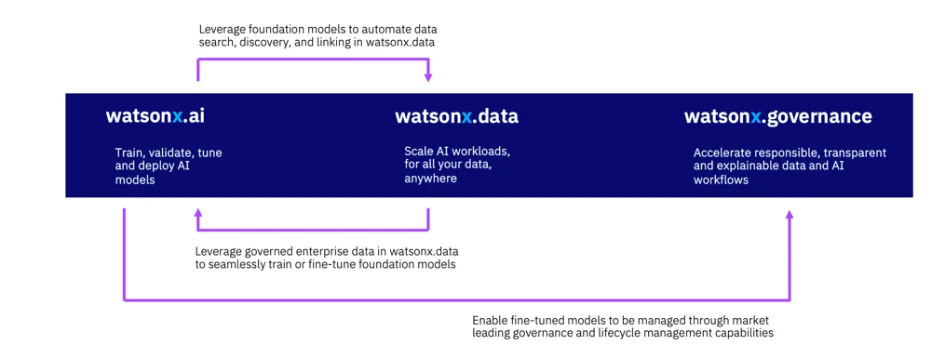
Watsonx.data intelligence is a data governance and intelligence platform that ensures high-quality, compliant, and business-ready data for AI models. It delivers responsible AI through its AI-driven data intelligence capabilities, which include:
- Natural language access for users of all skill levels to search and leverage data efficiently
- Automated data discovery and cataloging across structured and unstructured sources
- Data governance and quality controls including lineage, classification, and impact analysis
- AI-powered data enrichment and standardization for consistent, usable datasets.
- AI data sovereignty and security via IBM Sovereign Core, providing enterprises and governments with on-premise and cloud control over sensitive data in regulated environments
Snowflake
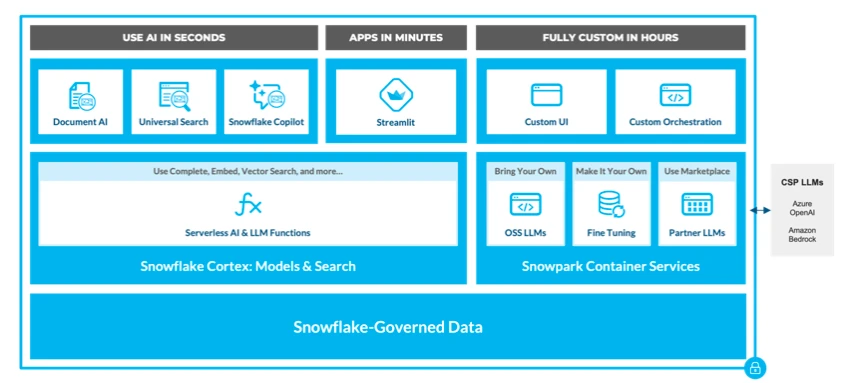
Snowflake is a cloud-based data platform for data storage, processing, and analytics, helping businesses manage and use their data efficiently. Its responsible AI approach emphasizes data security, diversity, and organizational maturity, ensuring AI applications are built on a secure, diverse, and well-governed data foundation. Additionally, Snowflake promotes data literacy and cross-functional collaboration to drive responsible AI use across organizations.
Agentic extensions in data platforms
Databricks LakeWatch
LakeWatch is an AI-driven Lakehouse Security Information and Event Management (SIEM) platform that extends data governance into real-time security operations.
- Agentic threat detection: Deploys autonomous detection and response agents powered by Anthropic’s Claude models to identify emerging AI-driven cyber risks.
- Unified telemetry ingestion: Leverages the open lakehouse architecture to store and analyze extensive security data, including logs, chat sessions, and video data.
Snowflake Project SnowWork
Project SnowWork is an autonomous AI platform that allows business users to orchestrate multi-step workflows using enterprise data.
- Outcome-based execution: Connects data assets to AI agents that can automatically interpret natural language requests and execute complex back-end workflows.
- Governed environment execution: Executes all agent actions entirely within the Snowflake environment, keeping data actions subject to existing role-based access controls.
AI governance platforms
AI governance tools assist business units in deploying AI systems that adhere to industry standards.
Claude
Claude is an advanced AI assistant and governance platform that enables enterprises to build responsible AI systems with transparency and safety. It delivers responsible AI through:
- Advanced reasoning and analysis capabilities to evaluate AI model outputs and identify potential risks
- Constitutional AI principles that guide safe and ethical behavior aligned with organizational values
- Integration with enterprise AI workflows for monitoring, auditing, and governance of AI systems
- Explainability and transparency features to understand AI decision-making and ensure accountability
- Continuous evaluation and red-teaming support to identify vulnerabilities and improve AI robustness
Credo AI
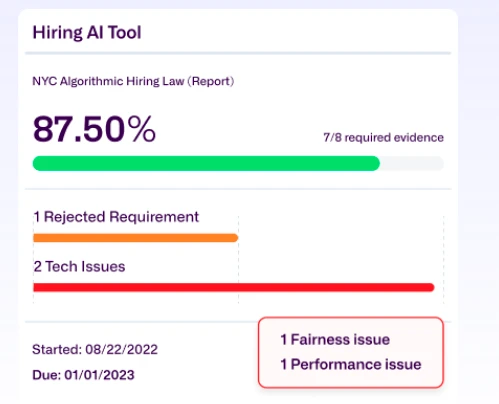
Credo AI, a Responsible AI governance platform, can help businesses:
- Collaborate with tools like evidence gathering, accountability tracking, and simplifying third-party procurement.
- Evaluate AI systems for operational, regulatory, and reputational risks throughout their lifecycle
- Build governance artifacts by translating technical evidence into user-friendly documents, creating model cards, audit reports, risk and compliance reports, and disclosures.
- Ensure compliance with global regulations like the EU AI Act and Canada Data and AI Act, internal policies, and industry standards.
Holistic AI
Holistic AI provides AI risk management, compliance and governance frameworks to help companies implement AI responsibly.
- Bias assessment by identifying and mitigating biases in AI systems, offering actionable strategies, continuous support, and comprehensive auditing reports that can be shared with stakeholders.
- Conformity assessment by cataloging and validating high-risk AI systems against AI Act requirements, conducting risk assessments with mitigation strategies, and ensuring technical documentation aligns with legal standards.
- Proactive risk management by receiving regular reports and conducting self-audits for adverse impacts, while using data-driven insights to optimize AI use and inform strategic decisions.
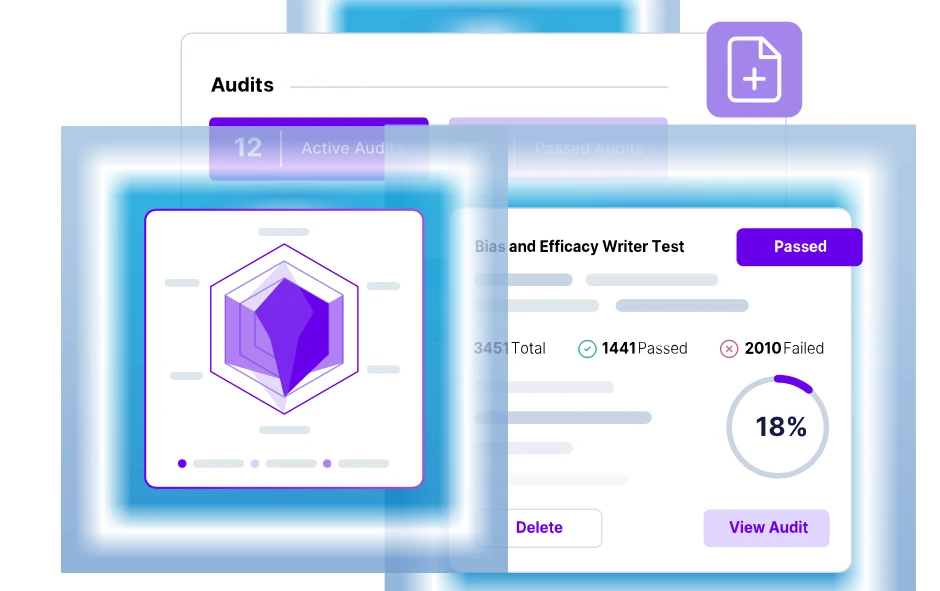
IBM watsonx.governance
IBM Watsonx.governance can enhance AI trust and transparency by providing enterprise-grade visibility, tracking of AI assets, and compliance of data and AI workflows across various deployment environments, including IBM Cloud and AWS.
Watsonx.governance users can integrate to other IBM watsonx studio tools like watsonx.ai and watson.data to train, validate, tune and deploy AI.
MLOps
Amazon SageMaker and Amazon Bedrock
Amazon provides tools designed to support compliance teams in delivering Responsible AI systems, such as:
- On Amazon Bedrock: A fully managed service that simplifies the development of generative AI applications by providing access to high-performing foundation models without requiring data preparation, model building, or infrastructure management.
- Guardrails: Implements safeguards in generative AI by specifying topics to avoid and automatically detecting and preventing restricted queries and responses.
- Model Evaluation: Evaluates and compares Foundation Models based on custom metrics like accuracy and safety to help select the best model for specific use cases.
- On Amazon SageMaker: A machine learning platform that offers the model creation, training, and deployment processes, making it ideal for customized ML tasks like predictive analytics, recommendation systems, and anomaly detection.
- Clarify: Detects potential bias and provides explanations of model predictions, offering transparency and insights to ensure fair and informed AI decisions.
- Model Monitor: Monitors deployed models by automatically detecting and alerting on inaccurate predictions to maintain model quality.
- ML Governance: Enhances governance by offering tools for controlling and monitoring ML models, including capturing and sharing model information to ensure responsible AI deployment.
- Amazon Augmented AI: Facilitates human review of ML predictions, enabling oversight where human judgment is required.
Explore how Amazon Bedrock delivers responsible AI:
Azure Machine Learning
Azure Machine Learning is a comprehensive cloud-based platform for building, training, and deploying machine learning models with enterprise-grade security and governance. It delivers responsible AI through its integrated responsible AI capabilities, which include:
- Fairness dashboards and bias detection tools to identify and mitigate algorithmic bias
- Model interpretability and explainability features for transparent decision-making
- Differential privacy and federated learning for data protection and privacy preservation
- Automated ML monitoring and governance dashboards for continuous model oversight
- Compliance and audit trails for regulatory requirements and organizational accountability.
Google Cloud Vertex AI
Google Cloud Vertex AI is a unified machine learning platform that enables enterprises to build, deploy, and govern AI models responsibly at scale. It delivers responsible AI through integrated governance and safety features, which include:
- Model evaluation and testing frameworks for bias detection and fairness assessment
- Explainability tools to interpret model predictions and understand decision-making processes
- Model monitoring and drift detection to ensure performance and safety in production
- Access controls and audit logging for comprehensive governance and compliance tracking
- Integration with Google’s AI Principles to ensure ethical AI development and deployment
Dataiku
Dataiku is an ML and data science platform that build, deploy, and manage data, analytics, and AI projects. It can support Responsible AI in those projects through several key capabilities:
- Advanced statistical analysis: Facilitates thorough data analysis to identify and address potential biases.
- Model fairness reports: Provides metrics like Demographic Parity and Equalized Odds to measure and mitigate bias.
- Explainable AI: Offers row-level explanations and what-if analysis to ensure transparency and accountability.
- Data privacy compliance: Ensures adherence to regulations such as GDPR and CCPA.
- Model documentation: Automates the creation of detailed model documentation for regulatory and internal purposes.
- Governance tools: Implements standard project plans and workflow blueprints to align with Responsible AI practices and regulatory requirements.
AI agent governance and security
AI agent governance platforms manage, audit, and secure the lifecycle of autonomous AI agents. These tools address the security and compliance challenges of non-deterministic, multi-step agent workflows.
Arthur AI
Arthur AI is an AI governance and observability platform that monitors and protects autonomous AI systems throughout their operational lifecycle. It delivers responsible AI through:
- Real-time monitoring of model performance, bias, and drift across production environments
- Explainability and transparency tools to understand and audit AI decision-making
- Automated detection of fairness issues, adversarial attacks, and model degradation
- Governance dashboards and audit trails for compliance and organizational accountability.
Coralogix
Coralogix is an AI-powered observability and monitoring platform that provides real-time insights into application and AI system performance. It delivers responsible AI oversight through:
- Autonomous anomaly detection agents that identify unusual patterns and potential issues in real-time
- Comprehensive AI model monitoring and performance tracking across production environments
- Alert correlation and root cause analysis to quickly resolve AI system issues
- Integration with enterprise data platforms for end-to-end visibility into AI operations
Galileo by Cisco
Galileo is an AI quality and observability platform designed to identify and resolve issues in large language models and generative AI systems. It delivers responsible AI through:
- Automated quality scoring and testing to evaluate model outputs for hallucinations, bias, and harmful content
- Data drift and model performance monitoring to ensure consistent, safe AI behavior
- Root cause analysis for identifying and addressing AI system failures and degradation
- Continuous evaluation frameworks for detecting emerging risks and governance violations.
W&B Weave (CoreWeave Forge)
W&B Weave is an observability and evaluation platform for LLM applications and production AI agents, now part of CoreWeave’s Forge development suite. Weave uses the same scorers for pre-release evaluations, runtime guardrails and production monitoring. Its responsible AI capabilities include:
- Infrastructure independence: The SDK works with any framework and any LLM, and connects to workloads on other clouds and on-premises.
- Agent-native tracing: Logs sessions, turns, steps, tool calls and sub-agents as separate objects. A multi-agent run can be reviewed in the order it executed.
- Safety and quality scorers: Built-in checks for toxicity, bias, PII and hallucination, with support for custom scorers and third-party guardrails such as NeMo and Bedrock.
- Runtime guardrails: Scorers check inputs for prompt injection and check outputs before they are returned. A failed check triggers developer-defined fallback code.
- Regression evaluations: New versions are scored against the current one on production traces before release, with a rollback record in CoreWeave Registry.
WitnessAI
WitnessAI is an enterprise AI security and governance platform that provides network-level visibility and intent-based policy control over autonomous agent activity.
- Data flow control: Regulates what data enters internal AI tools and monitors how agents navigate corporate environments.
- Behavioral policy enforcement: Understands agent intent to block advanced threats like prompt injection and multi-turn attacks at runtime.
- Explainability records: Captures agent states and execution commands to provide an audit trail for autonomous actions.
Open-source responsible AI tools and libraries
Please note that GitHub libraries that are not up to date are excluded from the list below.
AI privacy
These libraries focus on the use of AI for legitimate purposes while avoiding unethical applications. Organizations adhering to ethical AI standards implement strict guidelines, thorough review processes, and clear objectives to ensure compliance.
| Name | X | GitHub Stars |
|---|---|---|
| tensorflow-federated | 2018-12-13 | 1 |
| tensorflow-federated | 2019-02-26 | 100 |
| tensorflow-federated | 2019-05-29 | 400 |
| tensorflow-federated | 2019-11-04 | 700 |
| tensorflow-federated | 2020-03-17 | 900 |
| tensorflow-federated | 2020-10-06 | 1200 |
| tensorflow-federated | 2021-03-31 | 1400 |
| tensorflow-federated | 2022-03-15 | 1700 |
| tensorflow-federated | 2022-11-16 | 1900 |
| tensorflow-federated | 2024-03-29 | 2200 |
| tensorflow-federated | 2026-06-09 | 2441 |
| tensorflow/privacy | 2018-12-22 | 100 |
| tensorflow/privacy | 2019-01-17 | 300 |
| tensorflow/privacy | 2019-03-08 | 500 |
| tensorflow/privacy | 2019-06-08 | 700 |
| tensorflow/privacy | 2020-04-13 | 1000 |
| tensorflow/privacy | 2020-11-30 | 1200 |
| tensorflow/privacy | 2021-09-04 | 1400 |
| tensorflow/privacy | 2022-09-28 | 1600 |
| tensorflow/privacy | 2024-01-15 | 1800 |
| tensorflow/privacy | 2026-06-09 | 2014 |
| deon | 2018-09-06 | 1 |
| deon | 2019-07-12 | 96 |
| deon | 2020-06-04 | 127 |
| deon | 2021-04-02 | 189 |
| deon | 2022-02-14 | 216 |
| deon | 2022-12-20 | 237 |
| deon | 2023-10-31 | 254 |
| deon | 2024-09-11 | 280 |
| deon | 2025-07-12 | 293 |
| deon | 2026-06-09 | 309 |
| opendp | 2021-03-16 | 1 |
| opendp | 2021-10-14 | 47 |
| opendp | 2022-05-14 | 98 |
| opendp | 2022-12-12 | 164 |
| opendp | 2023-07-04 | 205 |
| opendp | 2024-02-07 | 251 |
| opendp | 2024-09-05 | 303 |
| opendp | 2025-04-03 | 343 |
| opendp | 2025-10-30 | 388 |
| opendp | 2026-06-09 | 423 |
- TensorFlow Privacy: A Python library offering implementations of TensorFlow optimizers for training machine learning models with differential privacy.
- TensorFlow Federated (TFF): Designed to support open research and experimentation in Federated Learning (FL), where a global model is trained across multiple clients without sharing their local data.
- Deon: A command-line tool enabling the addition of an ethics checklist to data science projects, promoting ethical considerations and providing actionable reminders for developers.
- Opendp: A community-driven, modular library written in Rust (with Python and R bindings) that provides vetted statistical algorithms for building privacy-preserving computations and differential privacy applications.
AI Fairness
Fairness in AI involves protecting individuals and groups from discrimination, bias, and mistreatment. Models should be evaluated for fairness to prevent biases against specific groups, factors, or variables.
| Name | X | GitHub Stars |
|---|---|---|
| AIF360 | 2018-08-22 | 0 |
| AIF360 | 2018-09-12 | 1 |
| AIF360 | 2018-09-18 | 100 |
| AIF360 | 2019-05-16 | 500 |
| AIF360 | 2020-02-26 | 800 |
| AIF360 | 2020-12-07 | 1100 |
| AIF360 | 2021-08-05 | 1400 |
| AIF360 | 2022-03-02 | 1600 |
| AIF360 | 2023-01-28 | 1900 |
| AIF360 | 2024-01-19 | 2200 |
| AIF360 | 2025-02-24 | 2500 |
| AIF360 | 2026-06-09 | 2821 |
| fairlearn | 2018-05-15 | 0 |
| fairlearn | 2018-05-21 | 1 |
| fairlearn | 2019-09-23 | 100 |
| fairlearn | 2020-08-02 | 400 |
| fairlearn | 2020-12-17 | 600 |
| fairlearn | 2021-05-19 | 800 |
| fairlearn | 2021-12-14 | 1100 |
| fairlearn | 2022-08-09 | 1300 |
| fairlearn | 2023-04-05 | 1500 |
| fairlearn | 2024-01-26 | 1700 |
| fairlearn | 2025-03-04 | 2000 |
| fairlearn | 2026-06-09 | 2248 |
| responsible-ai-toolbox | 2020-07-06 | 0 |
| responsible-ai-toolbox | 2020-07-07 | 1 |
| responsible-ai-toolbox | 2021-03-22 | 100 |
| responsible-ai-toolbox | 2021-10-29 | 300 |
| responsible-ai-toolbox | 2022-02-10 | 400 |
| responsible-ai-toolbox | 2022-11-29 | 600 |
| responsible-ai-toolbox | 2023-05-22 | 800 |
| responsible-ai-toolbox | 2023-11-14 | 1000 |
| responsible-ai-toolbox | 2024-05-03 | 1200 |
| responsible-ai-toolbox | 2024-08-19 | 1300 |
| responsible-ai-toolbox | 2025-04-14 | 1500 |
| responsible-ai-toolbox | 2026-06-09 | 1781 |
| aequitas | 2018-04-25 | 1 |
| aequitas | 2019-03-21 | 91 |
| aequitas | 2020-02-11 | 183 |
| aequitas | 2020-12-28 | 315 |
| aequitas | 2021-11-23 | 412 |
| aequitas | 2022-10-29 | 483 |
| aequitas | 2023-09-12 | 551 |
| aequitas | 2024-08-06 | 648 |
| aequitas | 2025-06-24 | 718 |
| aequitas | 2026-06-09 | 760 |
- AI Fairness 360: An open-source toolkit from IBM offering techniques to detect and mitigate bias in machine learning models across the AI lifecycle.
- Fairlearn: A Python package that helps developers assess the fairness of their AI systems and mitigate any identified biases, offering both mitigation algorithms and metrics for model evaluation.
- Responsible AI Toolbox: A suite of tools from Microsoft that provides interfaces for exploring and assessing AI models and data, facilitating the development and deployment of AI systems in a safe and ethical manner.
- Aequitas: An open-source bias auditing and fair machine learning toolkit designed to detect, visualize, and mitigate algorithmic discrimination across demographic sub-groups.
Data integrity
Data integrity helps identifying data drift, anomalies, and corrupted inputs to ensure that AI system remain reliable and unbiased.
| Name | X | GitHub Stars |
|---|---|---|
| data-validation | 2018-08-09 | 1 |
| data-validation | 2019-06-24 | 323 |
| data-validation | 2020-05-03 | 421 |
| data-validation | 2021-03-19 | 510 |
| data-validation | 2022-02-01 | 583 |
| data-validation | 2022-12-13 | 671 |
| data-validation | 2023-10-27 | 718 |
| data-validation | 2024-09-06 | 744 |
| data-validation | 2025-07-19 | 766 |
| data-validation | 2026-06-09 | 780 |
| evidently | 2020-11-30 | 1 |
| evidently | 2020-12-10 | 100 |
| evidently | 2021-10-15 | 1400 |
| evidently | 2022-04-23 | 2200 |
| evidently | 2022-12-21 | 2900 |
| evidently | 2023-08-26 | 3700 |
| evidently | 2024-04-17 | 4500 |
| evidently | 2024-10-28 | 5200 |
| evidently | 2025-04-28 | 6000 |
| evidently | 2025-10-28 | 6700 |
| evidently | 2026-06-09 | 7586 |
| fg-data-profiling | 2016-01-14 | 1 |
| fg-data-profiling | 2016-02-02 | 100 |
| fg-data-profiling | 2019-08-16 | 2600 |
| fg-data-profiling | 2020-01-30 | 4000 |
| fg-data-profiling | 2020-08-11 | 5300 |
| fg-data-profiling | 2021-04-05 | 6700 |
| fg-data-profiling | 2022-02-05 | 8100 |
| fg-data-profiling | 2022-10-28 | 9400 |
| fg-data-profiling | 2023-09-15 | 10800 |
| fg-data-profiling | 2024-08-22 | 12100 |
| fg-data-profiling | 2026-06-09 | 13592 |
| cleanlab | 2018-05-29 | 1 |
| cleanlab | 2019-08-25 | 100 |
| cleanlab | 2021-10-22 | 2200 |
| cleanlab | 2022-06-25 | 3400 |
| cleanlab | 2023-01-18 | 4500 |
| cleanlab | 2023-05-17 | 5700 |
| cleanlab | 2023-11-22 | 6900 |
| cleanlab | 2024-04-03 | 8000 |
| cleanlab | 2024-08-30 | 9200 |
| cleanlab | 2025-03-31 | 10300 |
| cleanlab | 2026-06-09 | 11502 |
- TensorFlow Data Validation (TFDV): A library for exploring and validating machine learning data, optimized for scalability and integration with TensorFlow and TensorFlow Extended (TFX).
- Evidently: An open-source Python library tos evaluate, test, and monitor ML models and data quality by detecting data drift, target drift, and performance degradation.
- FG Data Profiling: An open-source tool (managed by the Data-Centric AI Community, formerly pandas-profiling) that generates one-line-of-code exploratory analysis and data quality reports for Pandas and Spark DataFrames.
- Clean Lab: A data-centric AI library that automatically detects and corrects label errors, outliers, and noise in datasets to improve ML model performance and robustness.
Model robustness
Model robustness ensures that AI systems perform reliably under unexpected conditions, intentional manipulation, or adversarial attacks.
| Name | X | GitHub Stars |
|---|---|---|
| TextAttack | 2020-04-17 | 1 |
| TextAttack | 2020-05-30 | 100 |
| TextAttack | 2020-07-23 | 600 |
| TextAttack | 2020-11-23 | 1000 |
| TextAttack | 2021-04-21 | 1300 |
| TextAttack | 2021-12-19 | 1700 |
| TextAttack | 2022-08-16 | 2000 |
| TextAttack | 2023-08-08 | 2400 |
| TextAttack | 2024-04-17 | 2700 |
| TextAttack | 2025-04-07 | 3100 |
| TextAttack | 2026-06-09 | 3430 |
| adversarial-robustness-toolbox | 2018-03-23 | 1 |
| adversarial-robustness-toolbox | 2018-04-26 | 100 |
| adversarial-robustness-toolbox | 2020-01-05 | 1100 |
| adversarial-robustness-toolbox | 2020-11-01 | 1700 |
| adversarial-robustness-toolbox | 2021-08-23 | 2300 |
| adversarial-robustness-toolbox | 2022-08-02 | 3000 |
| adversarial-robustness-toolbox | 2023-05-24 | 3600 |
| adversarial-robustness-toolbox | 2024-02-13 | 4200 |
| adversarial-robustness-toolbox | 2024-11-19 | 4800 |
| adversarial-robustness-toolbox | 2025-08-12 | 5400 |
| adversarial-robustness-toolbox | 2026-06-09 | 6028 |
| garak | 2023-05-10 | 0 |
| garak | 2023-06-23 | 100 |
| garak | 2024-11-19 | 2300 |
| garak | 2024-12-28 | 3100 |
| garak | 2025-03-18 | 4000 |
| garak | 2025-08-03 | 4800 |
| garak | 2025-09-14 | 5600 |
| garak | 2025-12-03 | 6400 |
| garak | 2026-03-15 | 7200 |
| garak | 2026-06-09 | 8063 |
| promptfoo | 2023-04-29 | 1 |
| promptfoo | 2023-05-15 | 100 |
| promptfoo | 2024-10-15 | 4300 |
| promptfoo | 2025-05-25 | 6500 |
| promptfoo | 2025-10-28 | 8700 |
| promptfoo | 2026-03-20 | 17600 |
| promptfoo | 2026-04-12 | 19800 |
| promptfoo | 2026-06-09 | 22043 |
- TextAttack: A Python framework for adversarial attacks, training, and data augmentation in NLP, streamlining the process of testing and enhancing the robustness of NLP models.
- Adversarial Robustness Toolbox (ART): A Python library providing tools for developers and researchers to evaluate, defend, and certify machine learning models against adversarial threats like evasion, poisoning, and extraction.
- Garak: An open-source, Nvidia-supported generative AI vulnerability scanner that acts as a automated red-teaming tool to find security holes and prompt injection flaws in LLMs.
- Promptfoo: An open-source testing and evaluation framework designed specifically for application builders to red-team, benchmark, and secure LLM inputs, prompts, and outputs.
AI agent governance
AI agent governance manages and monitors autonomous AI agents to ensure they operate within predefined boundaries, comply with organizational policies, and do not execute malicious actions.
| Name | X | GitHub Stars |
|---|---|---|
| agent-governance-toolkit | 2026-03-14 | 100 |
| agent-governance-toolkit | 2026-04-24 | 1200 |
| agent-governance-toolkit | 2026-05-29 | 3300 |
| agent-governance-toolkit | 2026-06-02 | 3700 |
| agent-governance-toolkit | 2026-06-09 | 4153 |
| Adrian | 2026-05-31 | 128 |
| Adrian | 2026-06-09 | 259 |
| verifywise | 2024-09-19 | 1 |
| verifywise | 2024-11-16 | 18 |
| verifywise | 2025-01-31 | 34 |
| verifywise | 2025-04-15 | 47 |
| verifywise | 2025-06-21 | 73 |
| verifywise | 2025-08-31 | 109 |
| verifywise | 2025-11-10 | 140 |
| verifywise | 2026-01-19 | 202 |
| verifywise | 2026-04-01 | 247 |
| verifywise | 2026-06-09 | 302 |
- Agent Governance Toolkit (Microsoft): It is an open-source runtime security framework designed to address the OWASP Top 10 risks for agentic AI applications. It features deterministic, sub-millisecond policy enforcement to evaluate actions before execution, privilege isolation rings to protect sensitive system tools from unauthorized agent calls, and an automated decision bill of materials (SBOM) to track audit chains and token budgets.
- Adrian: An open-source runtime security monitor that analyzes agent logs and reasoning traces in real time to catch malicious tool use, policy drift, or out-of-bounds behavior before the agent acts.
- VerifyWise: An open-source AI governance platform that provides centralized model inventories, compliance tracking (such as for the EU AI Act), and comprehensive audit trails for enterprise AI systems.
System safety & security
System safety and security establishes infrastructure-level filters and real-time guardrails around AI models to intercept hazardous content, prevent data leaks, and block exploitation.
| Name | X | GitHub Stars |
|---|---|---|
| PurpleLlama | 2023-12-09 | 100 |
| PurpleLlama | 2024-04-22 | 1600 |
| PurpleLlama | 2024-07-15 | 2100 |
| PurpleLlama | 2024-09-30 | 2500 |
| PurpleLlama | 2025-03-12 | 2900 |
| PurpleLlama | 2025-05-22 | 3300 |
| PurpleLlama | 2025-10-24 | 3800 |
| PurpleLlama | 2026-06-09 | 4213 |
| guardrails | 2023-03-13 | 100 |
| guardrails | 2023-05-19 | 1300 |
| guardrails | 2023-08-22 | 2000 |
| guardrails | 2024-01-30 | 2700 |
| guardrails | 2024-06-04 | 3400 |
| guardrails | 2024-11-27 | 4100 |
| guardrails | 2025-04-28 | 4800 |
| guardrails | 2025-09-02 | 5500 |
| guardrails | 2026-01-11 | 6200 |
| guardrails | 2026-06-09 | 6986 |
| NeMo-Guardrails | 2023-04-25 | 100 |
| NeMo-Guardrails | 2023-05-10 | 1200 |
| NeMo-Guardrails | 2023-07-28 | 1800 |
| NeMo-Guardrails | 2023-11-28 | 2500 |
| NeMo-Guardrails | 2024-03-21 | 3100 |
| NeMo-Guardrails | 2024-07-18 | 3700 |
| NeMo-Guardrails | 2025-02-28 | 4400 |
| NeMo-Guardrails | 2025-09-11 | 5000 |
| NeMo-Guardrails | 2026-03-06 | 5700 |
| NeMo-Guardrails | 2026-06-09 | 6389 |
- Llama Guard (Meta): A family of open-weight LLM-based safeguarding classifiers designed to filter content by detecting toxic, unsafe, or policy-violating prompts and completions.
- Guardrails AI: An open-source framework that implements structural and quality validation layers to assure structured outputs, scrub personal data, and eliminate hallucinations.
- NeMo Guardrails (NVIDIA): An open-source toolkit that enables developers to add programmable conversational constraints (“rails”) to guide dialog flow, enforce topical boundaries, and block prompt injections.
What is responsible AI?
4 Guiding principles of AI, also known as responsible artificial intelligence (AI), refer to building trust in AI solutions by applying a set of principles which are:
- Fairness
- Privacy
- Safety and security
- Transparency
These principles help guide the design, development, deployment and use of AI.
Why is responsible AI important?
As latest stats show:
- 90% of commercial enterprise applications will feature AI capabilities by next year.
- 9 in 10 leading companies are investing in AI technologies. Following ChatGPT‘s 2022 launch, businesses reported a
- 97% rise in generative AI development interest.
- 72% increase observed in machine learning pipeline adoption to support generative AI strategies.
The rapid adoption of generative AI and LLMs has risen concerns and precautions about:
- Security & ethical risks: Growing vulnerability to LLM security flaws, generative AI risks, and documented AI biases (racism, sexism, ableism, and ageism).
- Regulatory compliance: Strict data privacy laws like GDPR and CCPA forcing 77% of companies to prioritize AI compliance.
- Financial commitment: Over 80% of organizations are allocating at least 10% of their AI budgets to compliance, while 31% are fully implementing responsible AI principles across their enterprise.6
FAQs
Data governance encompasses the frameworks and tools organizations use to protect and properly utilize their data. Some of the methods, processes and technologies in data governance include:
1- Data collection
2- Data storage and processing
3- Data cleaning and stewardship
4- Data sharing in a controlled way to:
4.a- Protect data privacy
4.b- Maintain data quality
4.c- Support compliance with relevant regulations.
5- Insider threat management (ITM).
Reliable AI refers to AI systems that consistently perform as expected: accurately, robustly, and safely under different conditions.
Reliable AI is a relevant term for responsible AI since trust, fairness, and compliance depend on systems that behave predictably. Responsible AI tools ensure reliability through model monitoring, bias testing, explainability, and regulatory alignment.
 Add as preferred source
Further reading
Learn other tools and practices to mitigate generative AI risks, such as:
Cite this research
Pick the format that matches where you're publishing. Pasting the link version into your CMS preserves the backlink.
@misc{simsek2026,
  author = {Şimşek, Hazal},
  title  = {{Compare 20+ Responsible AI Platforms & Libraries}},
  year   = {2026},
  month  = oct,
  howpublished    = {\url{https://aimultiple.com/responsible-ai-platform}},
  note   = {AIMultiple. Retrieved October 20, 2026}
}Results and timestamps of 215 data points. Download the summary data shown in this article's charts and tables as a ZIP file containing 6 CSV files.
Want the granular data behind it? Join Premium
Changelog
5 updatesAdded Azure Machine Learning, Google Vertex AI, Claude, Arthur AI, Coralogix and Galileo to the platform sections.
Expanded the open-source responsible AI tools section with new data integrity, model robustness, and system safety categories.
Added agentic extensions and AI agent governance sections covering Databricks LakeWatch, Snowflake Project SnowWork, and WitnessAI.
Reference Links






Be the first to comment
Your email address will not be published. All fields are required. Comments are left in their original language.