


Answer Engine Optimization (AEO): Tips & Best Practices

With ~60% of Google searches resulting in zero clicks, users are becoming accustomed to receiving answers without visiting sources. 1 Answers engines like Perplexity.ai that provide answers rather than links, are growing in popularity.
Explore the top answer engine optimization best practices, 6-key-components of AEO strategies, and AEO performance metrics:
Quick tips to shape answer engine’s responses
- Use clear, engaging, and consistent but variant language.
Real-life example: Rand Fishkin, the cofounder of SparkToro, introduces himself as “makers of fine audience research software” in his bio, which results in SparkToro appearing in searches for “fine audience research software,” but not for “fine audience research tools.2
- Add simple but unique terms to your text.
- Use long-tail question.
- Implement schema markup, include FAQs in your content.
- Include facts and figures.
- Update your content every 13 weeks.3
For more details, read best practices for answer engine optimization section.
What is Answer Engine Optimization (AEO)?
Answer Engine Optimization (AEO) (also called generative engine optimization (GEO)) helps content appear as direct answers in search results. It focuses on answering user questions quickly and clearly.
AEO works by understanding search intent, like “Know” (general info) or “Know Simple” (brief answers). Well-structured content helps search engines display relevant results.
To optimize for answer engine:
- Lead with value by answering questions upfront.
- Use bullet points, headings, and clear formatting.
- Establish authority through reliable and well-organized information.
AEO is key as AI, keyword research, and voice search grow. It ensures content matches how people ask questions online.
How an answer engine works
Answer engines use AI and natural language processing (NLP) to provide direct answers to user queries. Instead of showing links, they deliver precise responses, like weather updates or facts, making information easier to access.4
- Search engines need answer engines: Search engines rely on answer engines to stay competitive. They offer lists of links, but answer engines give direct answers in answer boxes, saving time.
Learn more on search engines, read AI Search Engine Comparison.
- Answer engines need search engines: Answer engines use large language models (LLMs) that require up-to-date information. They rely on search engines to provide references and sources for their answers. For example, Microsoft combines search results with AI to offer accurate, referenced responses.5
Types of answer engines
Answer engines help target audience find quick, direct answers to specific questions. They work through generative AI chatbots or voice assistants.
Generative AI bots are great for in-depth conversations. Voice assistants offer hands-free, instant answers. Both types enhance how users interact with digital content. Here are the main types:
Generative AI chatbots
These bots generate human-like responses using artificial intelligence. They can hold conversations and create content.
Over 300 million people worldwide have used ChatGPT since it is launched first.6
- Answers a wide range of questions.
- Writes essays, poems, and more.
- Used in education, customer service, and content creation.
- Uses large language models to answer queries with cited sources.
- Functions as a conversational search engine.
- Designed for research, fact-checking, and knowledge discovery.
Perplexity has shifted from a search engine to a “browsing surface” with the release of the Comet Browser and Model Council as of March 2026. Model Council lets users view parallel responses from multiple frontier models.7
- Creates text and voice-based responses.
- Helps with journalism, marketing, and research.
DeepSeek launch in the middle of January 2025.8
- An open source large language model
- Ideal for research, coding, and data analysis.
- Generates summarized answers directly in Google Search.
- Synthesizes information from multiple web sources.
As of January 2026, Google confirmed AI Overviews as a core layer of search. AI Overviews are no longer experimental and now incorporate visual signals (images/videos), necessitating “multimodal AEO” rather than text-based answers.9
Generative AI voice assistants
These assistants use voice recognition technology and respond to voice commands, helping users with tasks and providing quick answers.
- Built into Apple devices.
- Helps with reminders, messages, and navigation.
- Works on Amazon Echo and smart devices.
- Controls smart home features and plays music.
- Available on phones, speakers, and smart displays.
- Manages schedules and provides real-time translations.
Best practices for generative engine optimization
Optimizing for both Answer Engine Optimization (AEO) and search engine optimization (SEO) can be challenging, but it is essential for improving visibility in search engines and voice search. Here are some best practices to strike the right balance:
1. Understand user intent
User intent drives search behavior. It’s essential to know whether users are looking for information, making a purchase, or exploring options. Tools like Google Keyword Planner help you understand search intent. Tailor your content to match this intent and provide the most relevant answers.
2. Answer search queries directly
Structure your content around answering common questions in your field. Use simple headers like “What is,” “How to,” and “Why” to guide users to clear, concise answers. Focus on giving direct responses that satisfy search queries right away.
3. Use long-tail keywords and question-based phrases
Long-tail keywords reflect natural search language. For example, instead of “California weather”, use “What is the weather like in California?”
These are especially useful for voice searches. Tools like AnswerThePublic and Google’s “People Also Ask” feature help you identify questions users are searching for. These phrases will help your content match user queries more effectively.
4. Implement schema markup
Schema markup is essential for improving how search engines understand your content. This structured data markup makes it more likely for your content to appear in featured snippets or voice responses. Using formats like FAQ pages or HowTo schema can improve your chances of appearing in AEO features.
5. Optimize for featured snippets and knowledge panels
Position key answers within the first 100–200 words of your content. This increases your chances of appearing in featured snippets. Use bullet points, lists, and tables to improve readability and help search engines easily identify the most relevant information.
6. Incorporate visual content and summaries
Images, infographics, and charts enhance your content and increase the likelihood of it being chosen for answer boxes. Summarize key points at the beginning of articles and within headers to improve both readability and AEO/GEO optimization.
7. Create high-quality, authoritative content
Google values content that demonstrates experience, expertise, authoritativeness and trustworthiness (E-E-A-T). Make sure your content is factual, well-researched, and reviewed by experts. High-quality content is more likely to rank well for both SEO and AEO.
By consistently offering high-quality, accurate answers, you can become a trusted voice in your field. This helps build brand loyalty and increases your visibility in AEO and SEO rankings.
Key components of GEO strategies
Answer Engine Optimization (AEO) helps your content appear in search engine features like Featured Snippets, Knowledge Panels, and Voice Search answers. Here are the key elements to focus on:
1. Structured data
Structured data helps search engines understand your content. By using schema markup, you label parts of your content, making it easier for search engines to display relevant information in rich snippets. For example, mark up FAQs, recipes, or product details.
2. Featured snippets
Featured snippets are quick answers shown at the top of search results. To optimize for them, answer questions clearly and concisely. Structure your relevant content in a way that allows search engines to pull short, direct answers.
3. Voice search optimization
With more people using voice assistants, optimizing for spoken queries is crucial. Voice queries are longer and more conversational. Focus on natural language and long-tail keywords, such as “What are the best yoga poses for beginners?”
4. User intent
Understanding user intent means knowing what people are searching for and optimizing content that answers their questions. Align your content with the searcher’s needs for better visibility.
5. Content strategy focused on expertise
Content for AEO should be clear and focused. Answer one specific question per page and provide detailed, relevant information. Use straightforward language and break up text for easy reading.
6. Local search relevance
If you run a local business, appearing in local search results is essential. Use tools like Google Ads, Google My Business and Apple Maps listings, and include location-based keywords in your content.
How to track AEO performance metrics
Key metrics to track
Use tools like Google Analytics and Google Search Console dashboard to monitor these important metrics:
- Snippet appearances: Check how often your content appears in featured snippets.
- Rankings: Track where your content appears in search results for relevant queries.
- User engagement: Measure how users interact with your content to gauge its relevance and quality.
Analyzing user engagement
User engagement tells you if your content is meeting user needs. Focus on these metrics:
- Time on page: The longer users stay, the more relevant your content is.
- Bounce rate: A high bounce rate may indicate users didn’t find what they were looking for.
- Click-through rate (CTR): A higher CTR means users find your content appealing.
- Conversion rate: Measures how well your content leads to desired actions, like signing up or buying.
AEO vs SEO strategies
Search Engine Optimization (SEO) and Answer/Generative Engine Optimization (AEO/GEO) focus on different goals. Here’s how to succeed in each:
1. Which approach to attract users
AEO/GEO:
- Use full questions people actually ask
- Write in a clear, natural, conversational tone
- Focus on being helpful and easy to understand
SEO:
- Use keywords in titles and headers
- Add related terms to improve ranking
- Focus on keyword density and variations
Example:
SEO: “Answer Engine Optimization (AEO): Definition & Tips”
GEO: “What is Answer Engine Optimization (AEO)?”
2. How to write answers
AEO/GEO:
- Provide early direct and concise answers
- Focus on depth, not length – one precise answer beats ten weak ones
- Use bullets, summaries, and direct answers near the top
SEO:
- Spread answers across the article to increase time on page
- Use long-form articles with multiple keywords
- Place key points in subheadings and meta descriptions
3. What to include
AEO/GEO:
- Mixed content: text, images, short videos, audio
- Focus on being helpful and multi-format
- Optimized for AI systems and human understanding
SEO:
- Blog posts, guides, landing pages
- Focus on getting backlinks
- Optimized for bots and humans
 Add as preferred source
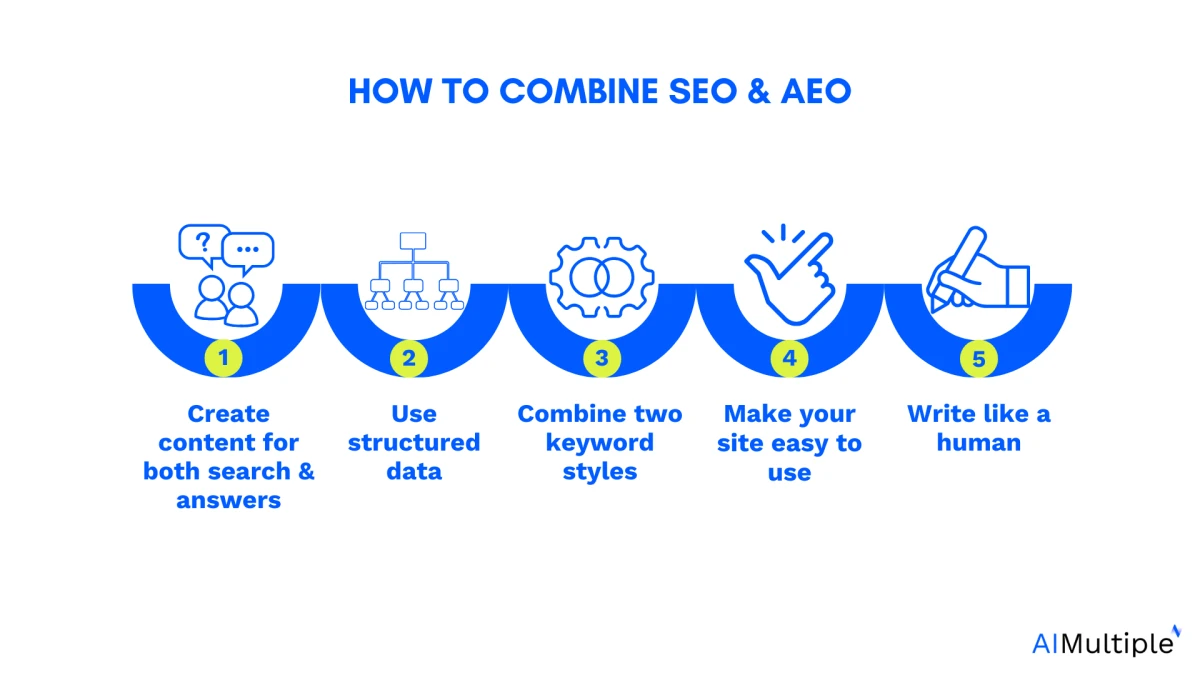
How to combine SEO and AEO for better search results
SEO and AEO/GEO don’t need to compete. They work better together. Websites using also AEO strategies gain about 23% more search visibility than those using traditional SEO. This shows that AEO can help more people find your content.10 Instead of choosing one, you can use both together. Here’s how:
1. Create content for both search and answers
SEO likes long articles with keywords and detailed info.
AEO likes short answers, FAQs, and simple summaries.
Do this:
- Write full blog posts (SEO).
- Add short questions and answers in each post (AEO).
- Use bullet points and clear headings.
2. Use structured data (Schema Markup)
Search engines and AI tools need help understanding your content.
Structured data tells them what your page is about.
Do this:
- Use FAQ, How-To, and Product schema.
- Mark up key info: opening hours, prices, reviews.
- This helps you show up in featured snippets and voice search results.
3. Combine two keyword optimization
SEO uses short keywords like “top social listening platforms”
AEO uses longer, natural questions, such as “What are the top social listening platforms?”
Do this:
- Mix both in your content.
- Think how people type (SEO) and how they speak (AEO).
4. Make your site easy to use
A fast, mobile-friendly site helps with both SEO and AEO.
Do this:
- Use clear headings and short paragraphs.
- Make sure pages load quickly.
- Test your site on mobile devices.
5. Write like a human
People using voice search ask questions the way they speak.
Do this:
- Use a friendly, natural tone.
- Write like you’re answering a real person.
The future trends of AEO
1. Voice search will keep growing
More people are using voice assistants like Alexa and Google Assistant. Businesses must create content that answers questions clearly and quickly. If your content is easy to read out loud, it’s easier to be found.
2. AI will do more than answer
Future search engines won’t solely respond, they’ll predict what users want. AI engines will learn from user behavior and offer suggestions before questions are even asked. This means businesses need to provide clear, helpful content that AI platforms can easily understand and use.
3. Structured data will be a must
To keep up with these changes, businesses must use structured data like FAQ and How-To schema. This helps AI assistants and search engines understand and present content better, especially in voice search and featured answers.
4. Visual and voice search will combine
People will soon use both voice and images to search. For example, someone might snap a photo and ask, “Where can I buy this?” Businesses should prepare content for both types of search to stay competitive.
5. Hyper-personalized results
Search results will become more personal. AI will adjust answers based on a user’s location, past behavior, and preferences. The same question could get different answers for different people. Businesses need to be ready to meet these unique needs.
Further Readings
- Top Answer Engine Optimization Tools
- Top 10 Emotion AI Tools Tested
- Sentiment Analysis Benchmark Testing
- Top 4 AI Search Engine Comparison
FAQs
An answer engine is an AI-driven system designed to provide direct, concise responses to user queries by extracting relevant information from structured and unstructured data. Perplexity acts as a response engine when identifying and synthesizing reliable information in a clear, current way.
Structured data plays a crucial role in AEO by providing clear context to search engines and AI, helping them accurately interpret content. This improves the chances of appearing in answer boxes and other quick response formats, enhancing visibility and engagement.
While SEO emphasizes keyword optimization and backlinks, AEO prioritizes structured data and schema markup, ensuring search engines can accurately interpret and directly present information in answer-based results.
Cite this research
Pick the format that matches where you're publishing. Pasting the link version into your CMS preserves the backlink.
@misc{arslan2026,
  author = {Arslan, Ezgi},
  title  = {{Answer Engine Optimization (AEO): Tips & Best Practices}},
  year   = {2026},
  month  = may,
  howpublished    = {\url{https://aimultiple.com/answer-engine-optimization}},
  note   = {AIMultiple. Retrieved May 11, 2026}
}
Changelog
3 updatesRemoved product entries for Perplexity, Gemini, AI Overview, Siri, Alexa, and Google Assistant from tool lists.
Updated the "Further Readings" section with "Top Answer Engine Optimization Tools".
Reference Links












Be the first to comment
Your email address will not be published. All fields are required. Comments are left in their original language.