


We benchmarked top AI web scraping tools with 25,000 requests, 5,000 per tool, across 500 URLs on each of 10 of the most visited domains to see their performance, and also compared how each one leverages AI.
AI web scraping benchmark
See the benchmark methodology section for more details on the testing process.
Completeness & accuracy comparison
For each domain we asked for the fields that matter on that page type: price and currency on e-commerce pages, post text, likes and author on social ones. To measure how well these tools perform, we used three metrics: success, completeness and accuracy. Three are needed because a tool can return something without returning everything, and everything without any of it being correct.
Success: the share of requests that came back with at least one of the fields we asked for.
Completeness: the share of the fields we asked for that actually came back, averaged across requests.
Accuracy: the share of checkable fields that came back with a correct value, checked against a reference or against what the other tools agreed on. A field that never came back counts as wrong.
Statistical methodology
Confidence intervals were calculated using bootstrap percentile resampling:
Resamples: 10,000
Confidence level: 95%
Resampling unit: URL, with all five providers resampled on the same draw
Metrics: success rate, completeness, accuracy and completion time
Sample size: N = 5,000 URLs per provider (500 on each of 10 domains)
Domain scores are computed first, then averaged across the ten domains
AI web scraping benchmark results
Across 5,000 URLs on the 10 domains, we called each tool the way its own API is built. Bright Data, Apify and Firecrawl accept a list of URLs in one request, so we sent 100 URLs per request. Oxylabs and ScrapingBee accept one URL per request, so we sent them one at a time. Concurrency was the same for every tool, five parallel requests, so the only difference is what each API supports.
- Bright Data scored highest on all three quality measures: 85% success, 76% completeness, 60% accuracy.
- The highest accuracy in the field was 60%. Two in five checkable fields came back missing or wrong.
- Completeness ranged from Bright Data’s 76% down to Apify’s 32%, with Oxylabs at 59%, Firecrawl at 53% and Scraping Bee at 41%.
- Firecrawl was fastest at under half a second per URL against Bright Data’s 4.6 seconds, and 22 points lower on accuracy. Oxylabs was slowest at 35 seconds.
Each vendor takes a different approach to AI, and our goal was to compare those approaches and the trade-offs they bring.
Key findings about AI web scraping tools from the benchmark
- Failures can look like data. When a tool cannot read a price, often because the page hit an anti-bot wall, it can return 0 instead of a failure. A null can be retried or skipped, but a 0 passes validation unnoticed. Apify and Oxylabs returned null in these cases. Firecrawl’s documentation recommends adding “Return null if not found on the page” to each schema field so the model does not guess a value.
- Extra fields: a prompt that asks for price and currency can also return brand, description or image URLs. A schema limits the response to the fields you name. Bright Data locks the output schema at build time, so every call returns the same fields.
- Wrong element: on pages that show a discounted and an original price, prices with and without tax, or regional price options, a tool can extract the wrong number.
- Changed numbers: prompt-to-JSON tools can add decimals, cut off values, or return currency-converted approximations that do not appear on the page.
- Location changes the price: some sites set prices by the visitor’s IP location, so a tool on US proxies sees a different price than a European user.
Schema and proxy region are the parameters that let you catch most of this before it reaches your data.
AI web scraping tools pricing
Kadoa is not in the pricing chart because it publishes no rates. Kadoa offers a consumption-based Flex tier and an Enterprise tier priced through sales.
AI web scraping tools comparison
Time to first scraper: For tools that build a scraper you then call by ID, how long the setup takes. “Single HTTP call” means there is no build step at all.
User-defined output schema: Whether you can set the output fields and their types yourself before the scrape runs, instead of describing them in a prompt and letting the LLM decide the structure at runtime.
Build-once, call-many endpoint: Whether the scraper is built once, stored on the vendor’s side, and then called with nothing but a URL. Here the LLM (or, for recording-based tools, your click-through) runs at build time and its output is frozen into a scraper you own and can change in place, which is what schedules, webhooks and integrations bind to. Where this is missing, the extraction is worked out again on every call and the full definition travels with each request.
Self-healing saved scraper: Whether a saved scraper is repaired when the target site changes, without rebuilding it from scratch. The fix applies to the same stored scraper under its existing identifier, so triggers, schedules and integrations keep working.
* Kadoa stores the scraper and calls it by ID, but target URLs are bound when the workflow is created. Pointing it at a new URL takes a separate metadata update before the run.
Tools that run an LLM over the page on every call are not counted here: there is no persisted extraction logic to repair, which makes them tolerant of layout changes but also means there is no artifact to inspect, version or approve. Neither are internal caches with no identifier you can point at, since there is again nothing to inspect, version or approve.
Beyond things like pages changing constantly, in agentic pipelines you often need a simple API you can call: give a URL, get structured data back. But you can’t always find a ready scraper API for every domain you need to scrape regularly; and when you do, the fields you want may not be there, or you need to customize the schema to your own needs. There are different approaches that address these problems.
Build-once, call-many AI web scraping platforms
If you build your own scraper, you have to write the crawler, wire up proxies, run headless browsers, and handle queues, retries and anti-bot on your own.
AI web scraping tools reduce that work. Build-once, call-many platforms such as Bright Data Scraper Studio, Browse AI and Kadoa build a scraper once, from a prompt or a click-through recording, and store it so you can call it with a URL.
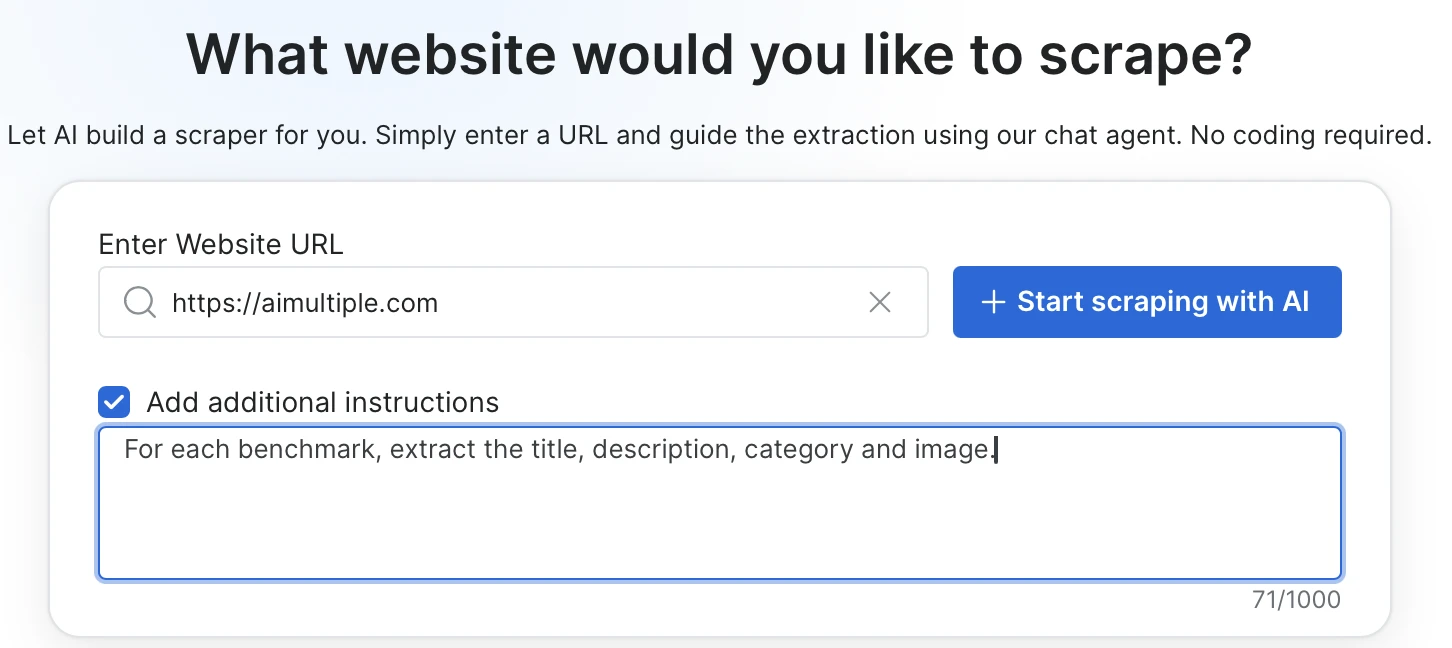
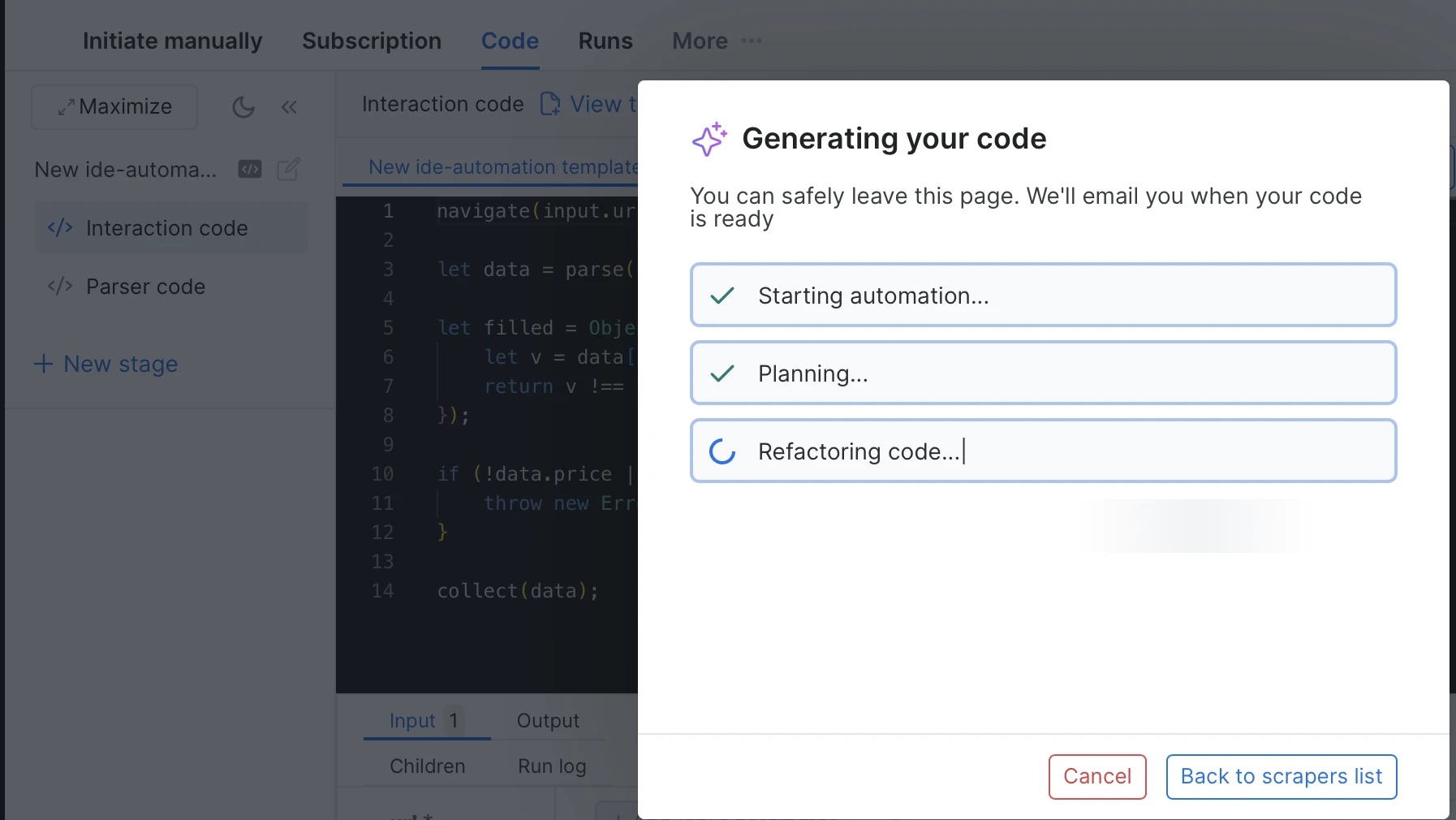
Bright Data Scraper Studio builds a scraper from a prompt and then serves it as a stable API. After the one-time setup, each call takes only a URL.
You describe the fields you want to extract in plain language, and you can optionally add CSS selectors, required on-page actions, or page-load behavior.
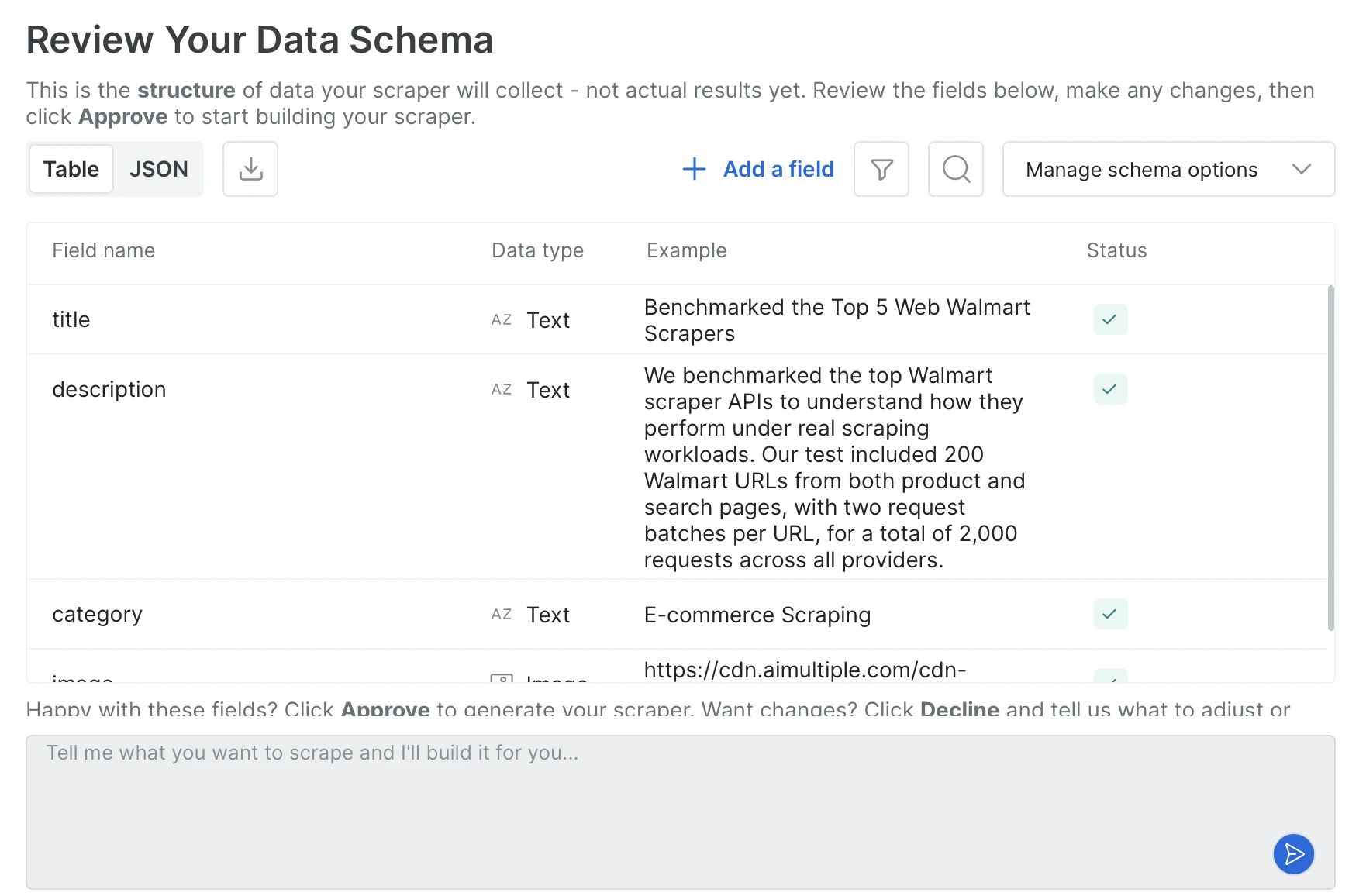
The Scraper Studio agent generates the output schema from the prompt. You review the schema, add or remove fields or change types, and the agent then writes the scraper code.
- Build-once, call-many endpoint: Once you approve the schema, the scraper is registered as a long-lived endpoint with a fixed identifier. Every call hits the same endpoint with just a URL, and the output schema stays the same across calls. In our tests, building a dedicated scraper took around 10 minutes on average.
- Two build methods: You can chat with the Agent in the browser, or use the Bright Data CLI to build the scraper from your terminal with a single command that takes a URL and a prompt. Both produce the same scraper.
- Coding-agent workflow: The terminal commands run unchanged inside Claude Code, Cursor and Codex, so the agent can build, run or self-heal a scraper without leaving the editor. You can also pin the scraper’s identifier in the agent’s rules file so future sessions reuse it.
- Delivery: API, SDK, CLI, webhooks, or direct delivery to cloud storage on S3, GCS, Azure or OSS.
- Combined with pre-built scrapers: Bright Data maintains a library of ready scrapers for popular sites like Amazon, LinkedIn and Zillow.
Automated self-healing
Bright Data’s Scraper Studio can repair a saved scraper on its own. We tested it on product pages we host, asking for title, price, currency, seller and availability. The first run returned records at 100% success.
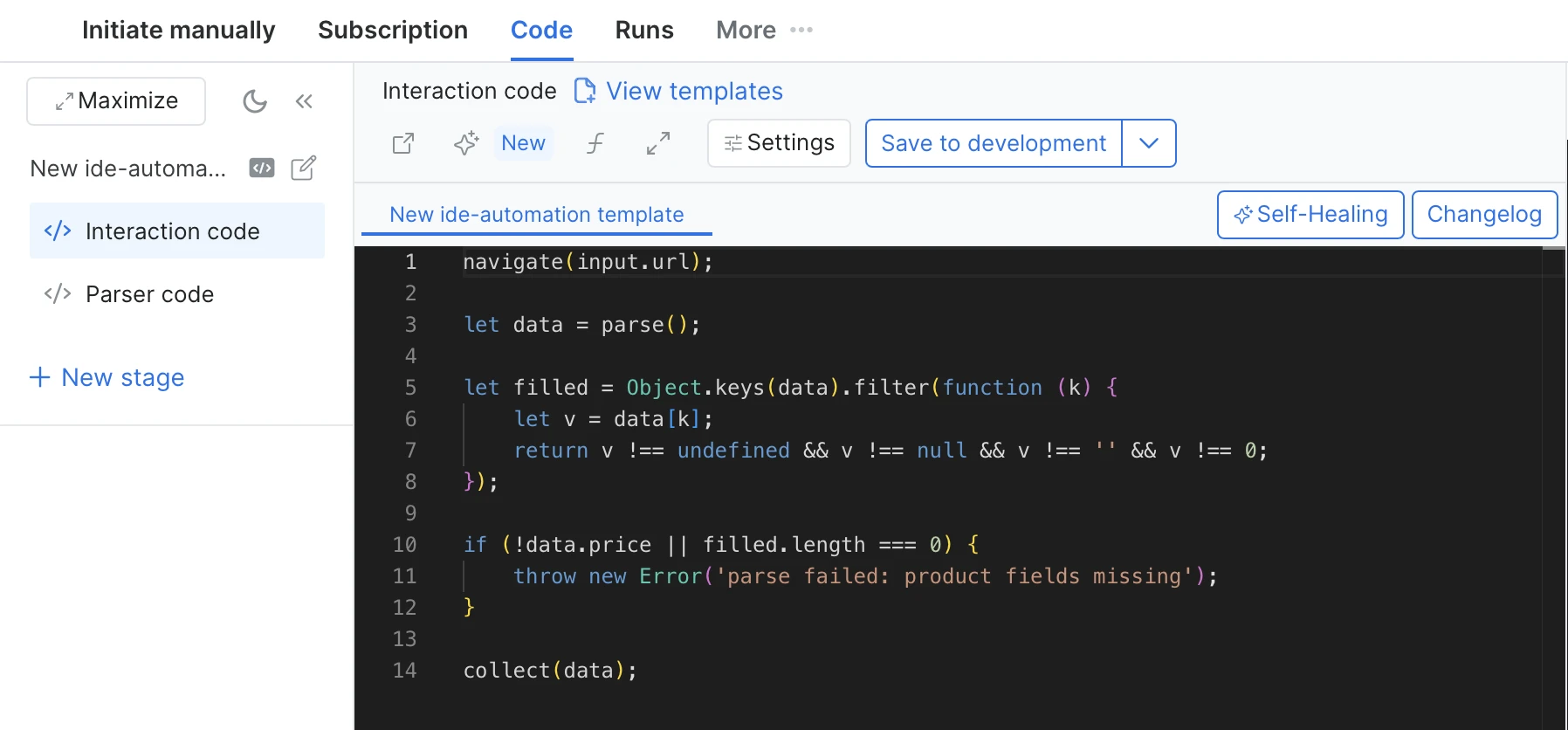
We added one check to the generated code. If the price is missing, or no field comes back at all, the run throws instead of collecting an empty record.
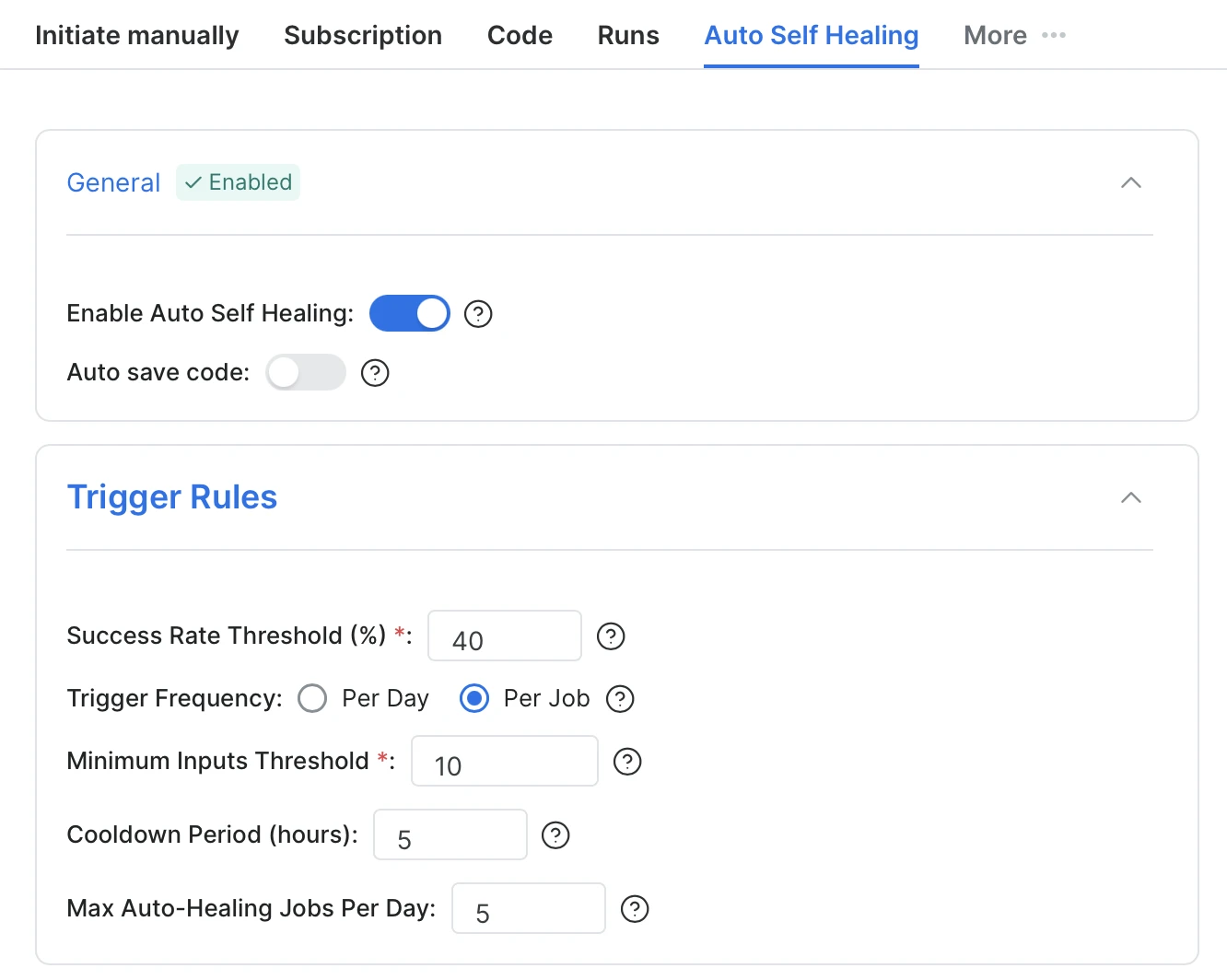
We enabled Auto Self-Healing with the default trigger rules: healing starts when the success rate falls below 40%, checked after every job, on runs with at least 10 inputs. We left automatic code saving off, so any rewrite would wait for approval.
We then redesigned the pages behind the same URLs, changing tags and class names while leaving every value in the HTML as plain text. The next run reported 12 failed crawls and 0% success, and healing started without us asking.
The healed version returned all records at 100% on the same URLs.
The same URLs scored 100% on the original layout, 0% after the redesign, and 100% again after Auto Self-Healing rewrote the collector.
This matters for scrapers you keep in a pipeline: when the site changes its layout, the scraper you built repairs itself and resumes, as long as the failure drops the success rate below the threshold you set.
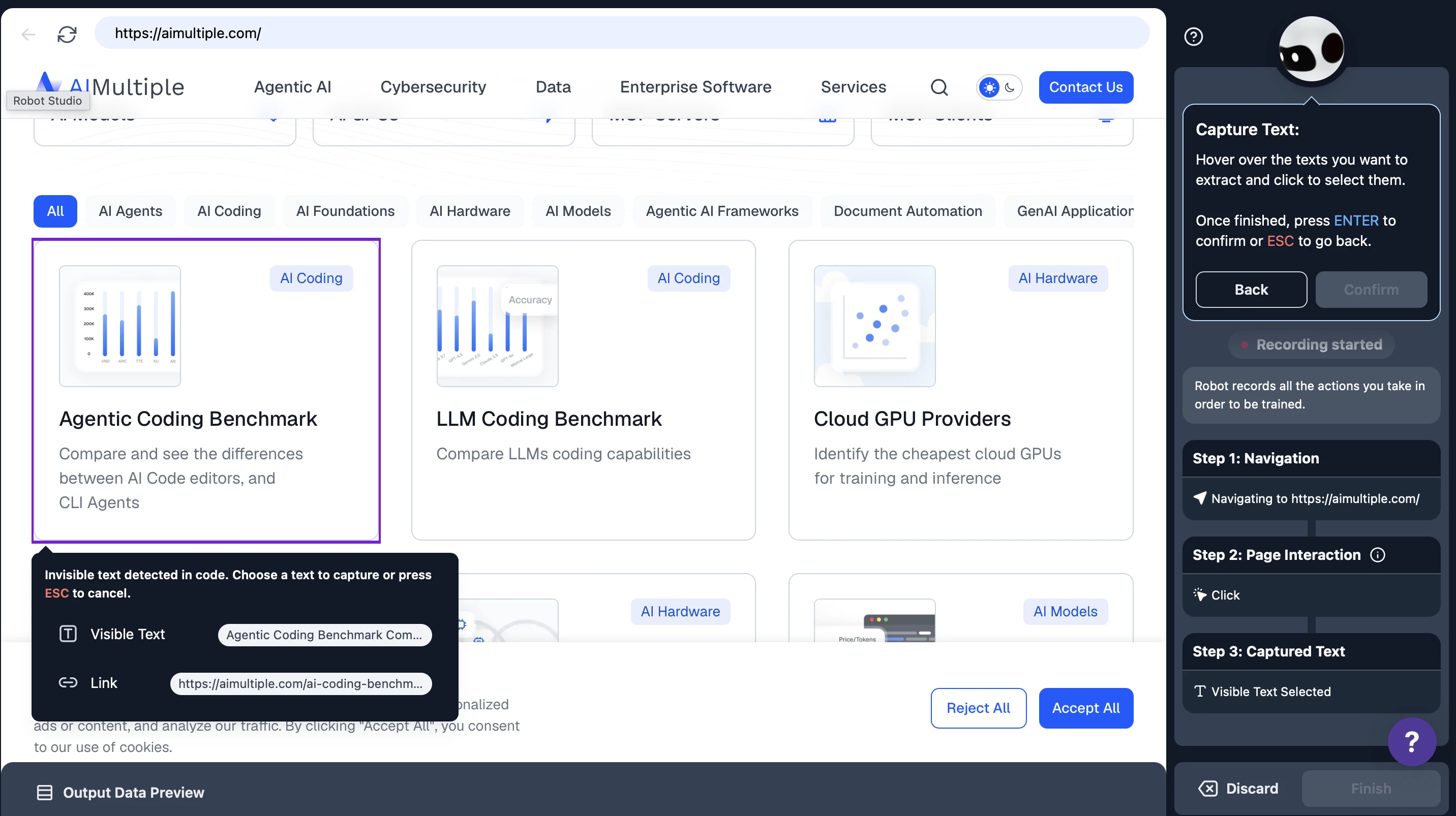
Browse AI builds scrapers, called robots, from a visual recording. You open the target page and click the fields to capture. The robot saves the navigation steps and the selected fields as a recording and replays it on every run.
- Visual setup with Robot Studio: Scrapers are built with a click → capture field → save flow.
- Built-in monitoring and alerting: Hourly, daily or weekly schedules, change detection, and email or webhook alerts in the same product.
- Schema is formed from the captured fields: A separate capture step is added for each field; no prompt-to-schema.
- Automatic adaptation: Browse AI’s engine adapts the scraping code when a site changes, and most robots keep running without intervention. When adaptation is not enough you retrain the robot, which preserves its history, runs and workflows.
Kadoa builds a scraper, called a workflow, from a prompt and stores it as generated code, so there is a concrete artifact to monitor and repair.
- Build-once, call-many endpoint: A saved workflow gets a persistent ID and is called with
PUT /v4/workflows/{id}/run. The request carries only variables and a row limit; the schema and the extraction code stay on Kadoa’s side. Pointing the same workflow at a different URL means updating its metadata first, so it is not a single call with a URL in it. - Prompt to typed schema: You describe the data in the setup prompt and Kadoa proposes a schema you edit in a visual or JSON view. Fields carry types such as STRING, NUMBER, MONEY, DATE and LINK, and can be marked as keys.
- Self-healing saved scraper: Repair is triggered by a failed run rather than a schedule. Kadoa regenerates the extraction code and validates it against previously extracted data, under the same workflow ID, so schedules and integrations keep working. There is no approval step before the fix goes live. When automatic recovery fails, a ticket goes to Kadoa’s ops team.
- Coding-agent workflow: A hosted MCP server with 40+ tools, plus first-party Node and Python SDKs and a CLI (
kadoa create,kadoa run,kadoa export). - Delivery: API, SDK, CLI, MCP and Google Sheets for pull; S3, GCS, Azure Blob, webhooks, WebSockets, email and Slack for push; Snowflake and Databricks for sharing. Cloud storage connectors are set up through support rather than self-serve.
One-shot AI extraction APIs
One-shot AI extraction APIs store no scraper. Each call sends a URL with a prompt or a schema, and the tool fetches the page and runs LLM extraction at request time. Oxylabs AI Studio, Apify’s AI Web Scraper Actor, Firecrawl and ScrapingBee work this way.
Oxylabs AI Studio is a suite of five separate AI applications under a single SDK (pip install oxylabs-ai-studio): AiScraper, AiCrawler, BrowserAgent, AiSearch, and AiMap. Nothing is persisted on the server side, every scrape call runs a fresh fetch plus LLM extraction.
- AiScraper flow: generate_schema(prompt=…) optionally calls the LLM to produce a JSON schema, then scrape(url, schema) fetches the page and runs LLM extraction. You can keep and reuse the schema on your side, but the server does not register a long-lived scraper.
- Five applications, one SDK: AiScraper for single-URL structured extraction, AiCrawler for prompt-driven site traversal, BrowserAgent for on-page actions, AiSearch for natural-language search plus extraction, and AiMap for filtered URL maps of a site.
- Output formats: markdown (default), json, csv, toon (a token-optimized format), screenshot, and html (browser agent only).
- Hand-written schemas:
generate_schemais optional. Theschemaparameter takes any JSON Schema you write, and Oxylabs’ own examples pass a hand-written Pydantic model. A schema is mandatory for JSON, CSV and TOON output. - Notable parameters: render_javascript=”auto” lets the service decide whether JS rendering is needed, geo_location takes an ISO country code or name for proxy location, and max_credits sets a per-request spending cap.
Apify offers an open developer ecosystem where “Actors”, executable scraping and automation programs, are built and run on its platform. You can write your own Actor from scratch, start from a ready template, or use Actors that others have published in the Apify Store.
- AI extraction actor: Apify also has a ready-made apify/ai-web-scraper Actor that takes a natural-language prompt and returns structured JSON from any URL. You re-enter the prompt every run, and the JSON output is not guaranteed to stay consistent between calls, which is common behavior for prompt-driven tools.
- Prompt only: The Actor’s input has five fields:
startUrls,extractionMode,prompt,maxPagesToVisitandmaxCrawlDepth. There is no parameter for a user-defined output schema. - Build your own actor: If no ready scraper exists for your target site or none of them scrapes the data fields you want, you write your own Actor and decide which fields to extract, where they live on the page, and how to handle the rest. How long this takes depends on your coding skills and the complexity of the site. If you prefer not to build it on your own, you can also get help from Apify professional services.
- Combined with pre-built scrapers: the Apify Store lists Actors that developers publish. Most scrapers for popular sites are published and maintained by third-party developers.
- Platform services: Actors come with scheduling, monitoring, dataset storage, proxy pool and API access out of the box.
- Agent access: Apify’s MCP server lets a coding agent search and run Actors, but it has no built-in flow for building or maintaining an Actor from inside the agent.
- Maintenance ownership: If you built the Actor yourself, you fix it when the site changes. If you’re using one from the Store, you wait for the Actor’s owner to ship the fix on their timeline.
Firecrawl turns a URL plus a prompt or a JSON schema into JSON in a single synchronous call. Each request runs the extraction pipeline at the moment the call is made.
- Prompt or schema: A schema fixes the field names and types before the call, so the response only contains the fields you named. A prompt leaves the structure to the model, which is quicker to write but can vary between calls.
- Page-type formats:
product,menu,branding,audioandvideoreturn a fixed structure set by Firecrawl.productcovers title, price, availability, variants and sale price. They take no parameters and run without an LLM. deterministicJson: Takes a schema and caches a generated extractor per site, so repeat scrapes skip the LLM. Cannot be combined with thejsonformat.- Per-request execution: Every call carries its own prompt or schema and runs at request time, so the output reflects the page as it looks at that moment and there is nothing to register upfront.
- Coding-agent support: Official MCP server and CLI, with quickstarts for Claude Code, Cursor, Codex CLI and Gemini CLI, plus an official Claude plugin.
- Agent: Firecrawl also offers an Agent product where the URL is optional. You describe what you want and the agent navigates the web to find it.
ScrapingBee is a one-shot extraction API like Firecrawl: each call is independent and stores nothing. ScrapingBee differs in how you describe the data you want.
- Three extraction modes: ai_query for a single field in natural language (returns a string), ai_extract_rules for a JSON schema where each field has its own description, and an advanced form of the same with types, enums, and nested output.
- ai_selector: Pass a CSS selector to focus the LLM on a specific part of the page. Faster and more accurate than letting it read the full DOM.
- Classic scraping in the same call: render_js for JS-heavy sites, screenshot, extract_rules for CSS/XPath extraction without AI, and json_response to get HTML, cookies, XHRs, and iframes in one envelope.
How to choose the right tool for your pipeline?
The right tool depends on how often your pipeline scrapes the same sites and who maintains the scraper:
One-off or occasional scraping
For one-off or occasional scraping, one-shot AI extraction APIs such as Firecrawl, ScrapingBee and Oxylabs AI Studio are the fastest option. You send a prompt or a schema with each call, and there is no scraper to build.
Repeated scraping in a pipeline
For repeated scraping, or when you need custom data fields, a build-once, call-many platform such as Bright Data Scraper Studio, Browse AI or Kadoa fits better. The stored scraper returns the same schema on every call, and your pipeline passes in only URLs.
How long setup takes
Build time varies by approach. Writing a scraper or actor from scratch typically takes days to weeks, since the crawler, proxy wiring and retries are on you. Prompt-based platforms generate the schema and code in minutes. Recording-based tools also land in minutes, with point-and-click setup instead of a prompt. One-shot AI extraction APIs skip the build step; the first response comes back in a single HTTP call.
Site already covered by a ready scraper
A ready scraper for a popular site is usually faster than building your own, but who keeps it working depends on where it comes from. A vendor-maintained library, such as Bright Data’s, is updated by the vendor when the site changes. A third-party scraper, such as most popular-site Actors in the Apify Store, is fixed on its owner’s schedule.
Site not covered by anything ready
For sites without a ready scraper, the question is who fixes the scraper when the layout changes. If you build your own, you maintain it. With a recording-based tool such as Browse AI, the robot adapts to most changes on its own, and you retrain it when it cannot. With AI self-healing, the tool repairs your stored scraper under the same ID: Bright Data shows the fix for your approval before it goes live, while Kadoa applies it automatically.
Building with coding agents
If your workflow runs through Claude Code, Cursor or Codex, it matters whether the tool exposes a CLI or MCP integration the agent can drive end to end, or whether the agent can only call a plain HTTP API.
 Add as preferred source
AI web scraping benchmark methodology
Benchmark domains:
Ten domains in AI web scraping benchmark come from Semrush’s ranking of the most visited sites. Five are e-commerce (amazon, ebay, etsy, aliexpress, walmart) and five are social (facebook, instagram, reddit, tiktok, x). We collected 500 URLs from each, 5,000 in total, and sent every one to all five tools, which is 25,000 requests.
Prompts:
Every tool received exactly the same prompt for a given page type, with no tool-specific tuning:
- E-commerce: Extract price and the currency of the product and return json
- Social: Extract the post text, the number of likes and the author username of the post and return json
Bright Data takes the prompt one step earlier than the others. Rather than scraping from a prompt on every call, you give it the prompt once and it builds a scraper, returning a collector ID you then call repeatedly. That build step is not scraping, it is the tool generating an API, and it happens once per domain before any benchmarking starts, so it is not included in the timings. We measured from the collector ID onwards, where the process matches the other four. To keep it zero shot, the schema Bright Data generated was accepted automatically as it came back from the API, with no review and no correction.
Each tool was called the way its own API is built. Bright Data, Apify and Firecrawl are designed to take a list of URLs in one request, so we sent 100 URLs per request. Oxylabs and ScrapingBee are not built that way, their APIs take one URL at a time, so that is how we called them. Concurrency was the same for every tool, five parallel requests.
Metrics:
Success is the share of requests that came back with at least one of the requested fields. Empty strings, zeros in place of a number, and answers that repeat the prompt back do not count as a field.
Completeness is how many of the requested fields came back, averaged over requests. A social page where only the author arrives scores one out of three.
Accuracy is the share of checkable values that were correct. A field the tool never returned counts as wrong, because downstream a missing value and a wrong value cost the same.
Each measure is computed per domain, then averaged across the ten.
Establishing the correct answer
We used two methods. Where ground truth was available, we scored against it: some answers sit in the URL itself, such as the author handle in an x.com or tiktok.com link, and for others we collected an independent reference outside the five tools, such as product prices and Reddit vote counts.
Where no ground truth existed, we scored by consensus. A field is only settled this way when at least four of the five tools answered it. We then set aside the tool being scored and look at the rest: if the same value appears in more than half of them, and in at least two, that value becomes the reference. A tool never votes on its own answer, and a field the others could not agree on is left out of the accuracy score.
Numbers do not have to match exactly. A value counts as correct within 10% of the reference, with a small absolute floor on top of that, so a post with 5 likes does not fail over a difference of one while a post with 90,000 is still judged on the percentage.
Confidence intervals
All figures carry 95% confidence intervals from 10,000 bootstrap resamples at the URL level. The per-request data behind every number is published with the results.
FAQs
Yes. Open-source libraries such as Crawl4AI, Skyvern, and Browser Use are free to self-host, and most commercial tools, including Browse AI, Firecrawl, and Thunderbit, offer a free tier with usage limits.
Cite this research
Pick the format that matches where you're publishing. Pasting the link version into your CMS preserves the backlink.
@misc{sipi2026,
  author = {Şipi, Nazlı},
  title  = {{Best AI Web Scraping Tools Benchmarked}},
  year   = {2026},
  month  = oct,
  howpublished    = {\url{https://aimultiple.com/ai-web-scraping}},
  note   = {AIMultiple. Retrieved October 2, 2026}
}Results and timestamps of 25.1 thousand data points. Download the summary data shown in this article's charts and tables as a ZIP file containing 7 CSV files and a README.
Want the granular data behind it? Join Premium
Changelog
5 updatesAdded a benchmark section comparing AI web scraping tools across top e-commerce sites.
Replaced the tool list with named entries for Browse AI, Firecrawl, ScrapeGraphAI, Diffbot, Kadoa, Skyvern and others, and added an FAQ section.
Replaced the introduction to AI web scraping tools with a description of Autonomous AI Agents, Vision-based Scraping (VLM), and Self-healing scrapers.











Be the first to comment
Your email address will not be published. All fields are required. Comments are left in their original language.