

50+ ChatGPT Use Cases with Real Life Examples
ChatGPT can support diverse commercial tasks involving text, images or data. Though It is a powerful data processor, it typically requires human supervision due to its hallucinations.

ChatGPT reached approximately 1 billion weekly active users in early 2026 roughly 10% of the world’s population.1 OpenAI surpassed $20 billion in annual revenue for 2025, confirmed by CFO Sarah Friar.2
The Anthropic Economic Index distinguishes two modes of use: augmentation, in which a human interacts with AI, and automation, in which AI completes tasks independently. Consumer usage splits 52% augmentation / 45% automation. API traffic flips this automation dominates, reflecting programmatic enterprise deployments.
If you need to use your company’s data with generative AI, consider RAG implementations before fine-tuning the cost and complexity differences are significant.
General ChatGPT Use Cases
Structured Tasks
Structured tasks are where ChatGPT produces the most reliable output: the goal is well-defined, the format is consistent, and errors are easy to catch.
1. Data Entry and Management ChatGPT converts raw inputs into structured formats: tables, spreadsheets, standardized customer records, or e-commerce product listings. It works best when the input format is predictable, and the output schema is explicit in the prompt.
2. Template-Based Responses In customer support or communications, ChatGPT fills predefined templates with context-specific content. Teams that define templates first and use ChatGPT to populate them get significantly more consistent results than those prompting for finished copy directly.
3. Document Generation Reports, contracts, and professional documents can be drafted by providing ChatGPT with a template and the required data points. The output needs human review, particularly for anything with legal or compliance implications.
4. Workflow Automation ChatGPT can walk users through structured sequences: onboarding checklists, compliance forms, step-by-step processes. It works well when the steps are known and the branching logic is simple.
5. Content Structuring For articles, reports, and presentations, ChatGPT organizes material into logical sections. Most writers find this useful for first-pass structure, then rewrite the prose.
Textual Applications-Content creation
1. Blog Posts and Articles
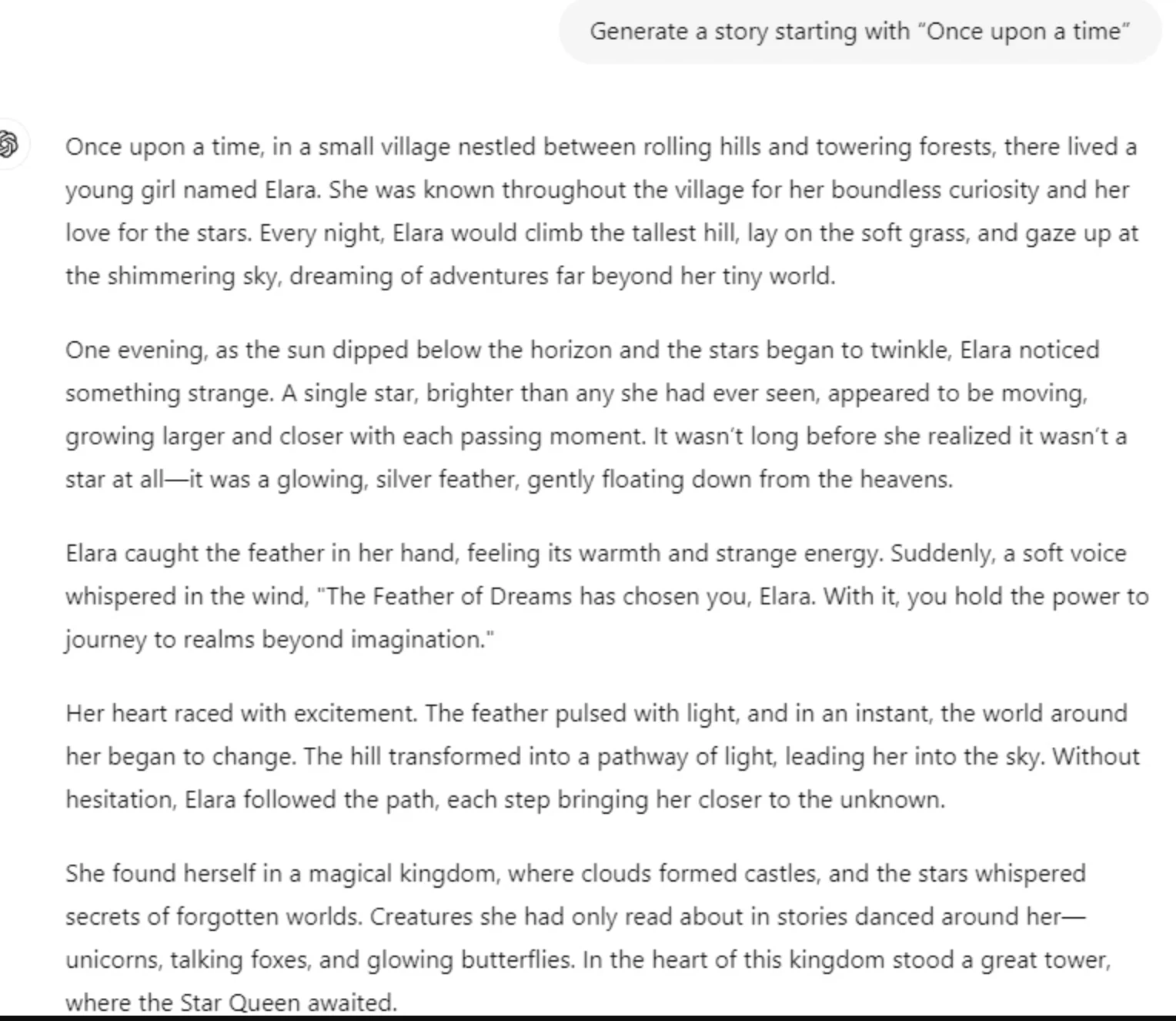
ChatGPT generates drafts, outlines, and complete articles. Most teams use it as a starting point and edit heavily for voice and accuracy. Publishing raw output produces generic, forgettable content.
Figure 1. Example of a content creation using ChatGPT with the prompt “Once upon a time”
2. Product Descriptions
E-commerce teams use ChatGPT to write product descriptions at scale by feeding it product specifications.
- Works well for: Standardized products with clear specs (electronics, appliances, basic apparel)
- Falls short on: Products requiring nuance or brand voice (luxury goods, artisanal items, complex B2B solutions)
3. Social Media Posts
ChatGPT drafts tweets, LinkedIn updates, and Instagram captions. Companies like Koo have integrated it directly into their platforms. The most common use is repurposing long-form content into shorter formats.
4. Business Ideas and Drafts
“Give me 10 business ideas for [industry/problem]” is one of the most frequently used prompt patterns. It is useful for brainstorming and getting unstuck. It is not suitable for assessing actual market viability.
5. Creative Writing
ChatGPT helps writers brainstorm plots, develop characters, and write scenes. Runway uses GPT models to generate video scripts for social media marketers. The creative ceiling is real: AI writing is technically competent but rarely takes risks, and it does not develop a distinctive voice.
6. Translation and Multilingual Support
ChatGPT translates text between languages with reasonable accuracy for common language pairs.
Real examples:
Spotify uses ChatGPT to provide customer support in 60+ languages. Customers ask about playlists, features, and account issues. ChatGPT translates and responds in their preferred language.3 .
Duolingo leverages ChatGPT to answer customer inquiries in 30+ languages. Users worldwide communicate about courses and app settings without language barriers.
Where it works: Customer support, basic communication, informal translation.
Where it fails: Legal documents, medical information, literary translation (nuance gets lost).
Conversational AI and Chatbots
7. Intelligent Chatbots
ChatGPT powers customer service, sales, and support chatbots across industries.
Intercom Fin reaches a 67% average resolution rate across more than 7,000 customers, handling almost 2 million support queries per week equivalent to roughly 6,500 human agents.4 The system supports 45+ languages and escalates to human agents with full conversation context when it cannot resolve an issue.
Octopus Energy uses GPT-powered chatbots to handle 44% of customer inquiries across billing and account management.
The failure mode is consistent across all deployments: chatbots fall apart when situations require empathy, judgment, or reading between the lines. The 30% of conversations that escape automation typically involve complaints with emotional stakes, complex policy exceptions, or ambiguous intent that automated routing cannot resolve.
8. Knowledge Discovery with RAG
Organizations feed internal data to ChatGPT using retrieval-augmented generation (RAG), enabling employees to query private information through natural language. For example: “What was our Q3 revenue in EMEA?” pulling from internal databases.
OpenAI’s Company Knowledge feature lets ChatGPT Enterprise reason across Slack, SharePoint, Google Drive, GitHub, and other connected tools using a version of GPT-5 optimized for tool use and citation. The feature gives employees a single interface for querying scattered organizational knowledge without switching systems.5
Salesforce integrated the Agentforce Sales app directly into ChatGPT, enabling sales reps to query CRM records, update opportunities, and delegate prospecting tasks from within a ChatGPT conversation. The Agentforce Trust Layer governs data handling within the ChatGPT environment, so enterprise security controls remain intact, and data flows through Salesforce’s infrastructure rather than transiting directly to OpenAI.6
RAG systems require real setup: properly structured data, vector databases, and integration work. The Salesforce model is the exception rather than the rule for off-the-shelf readiness.
Coding Applications
Coding dominates real-world AI usage. The Anthropic Economic Index finds that computer and mathematical tasks account for 36% of all usage. The single most common task, modifying software to correct errors, represents 6% of conversations alone.7
- Cisco uses Codex to review complex pull requests and reason across large, interconnected repositories, reducing review times by up to 50%.8
- Virgin Atlantic uses it to increase test coverage and reduce technical debt, improving team velocity.
- Ramp uses it to accelerate code review cycles.
- Notion uses it to build new features faster.
- Harvey reports cutting early iteration time by 30–50%, freeing engineers for system design.9
AI coding agents are moving from assistant to autonomous: Entire, a startup launched in February 2026 by former GitHub CEO Nat Friedman, received $60 million in funding specifically for AI agents that write code autonomously.10
9. Writing Code
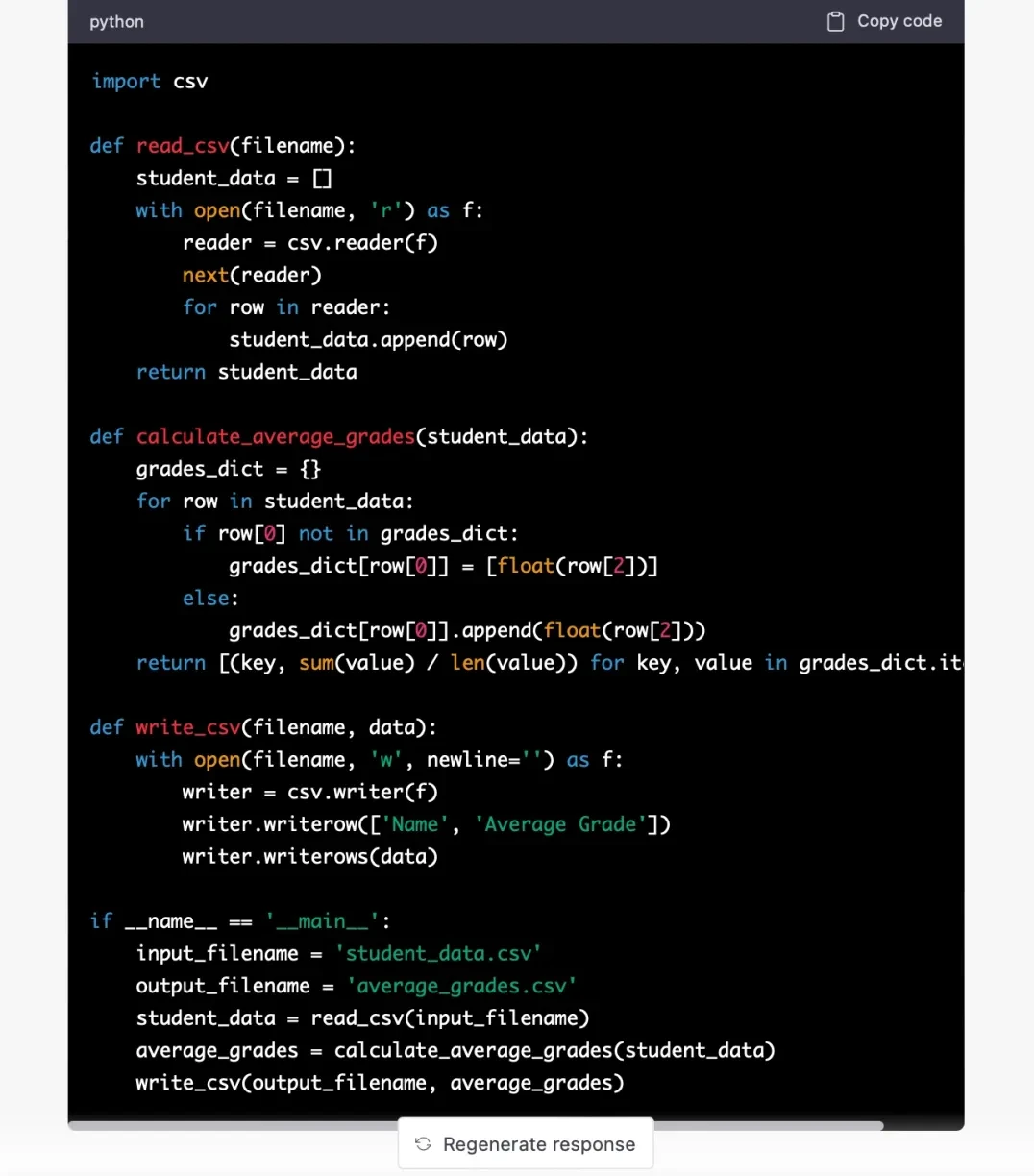
ChatGPT writes code for simple or repetitive tasks: file I/O, data manipulation, database queries. It handles boilerplate and common patterns well. For complex logic, the generated code frequently contains subtle bugs or misses edge cases.
10. Debugging
ChatGPT proposes possible causes of errors and suggests solutions.
Where it helps: Syntax errors, common mistakes, and suggesting debugging approaches
Where it doesn’t: Complex logical errors, performance issues, architecture problems
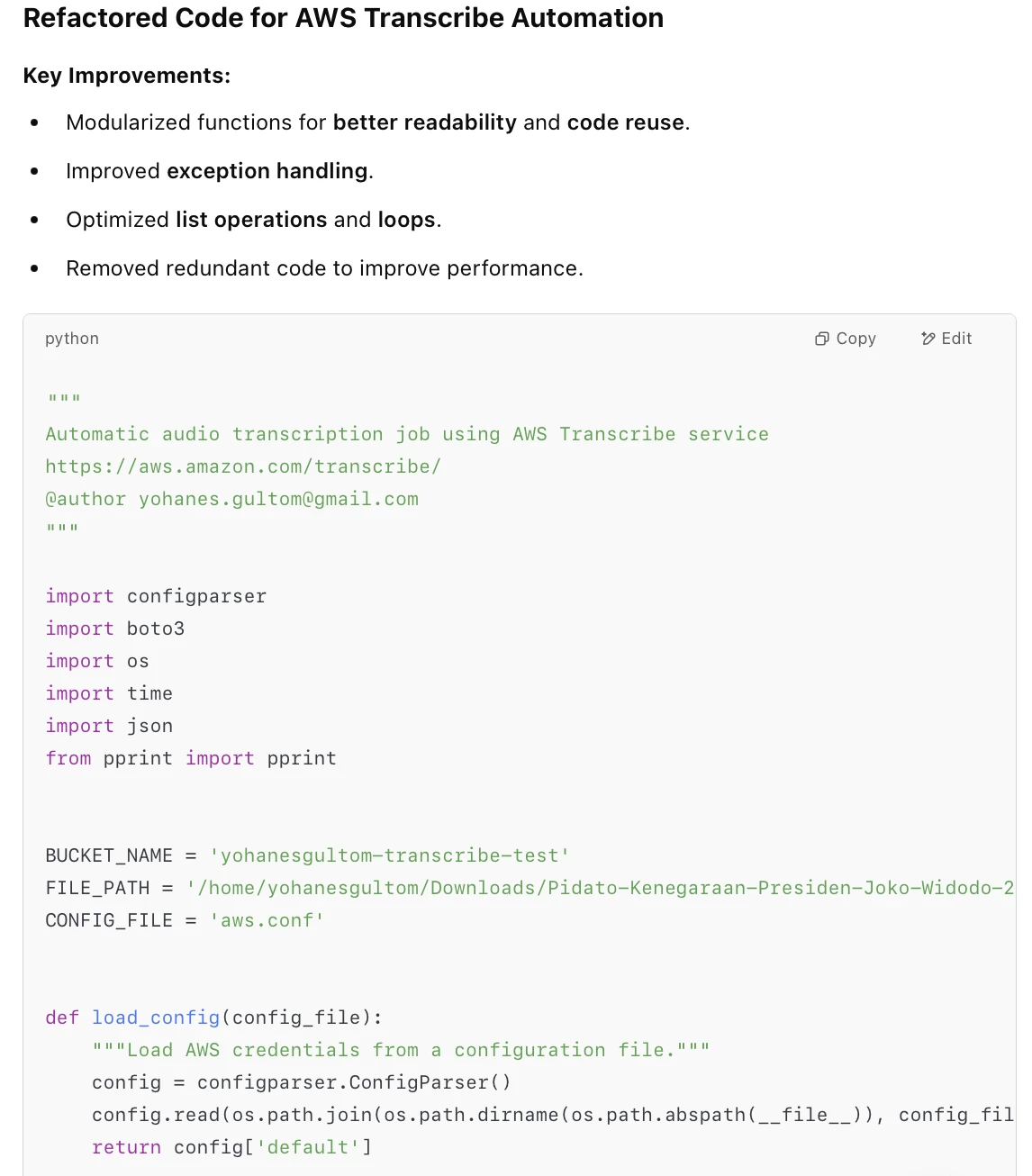
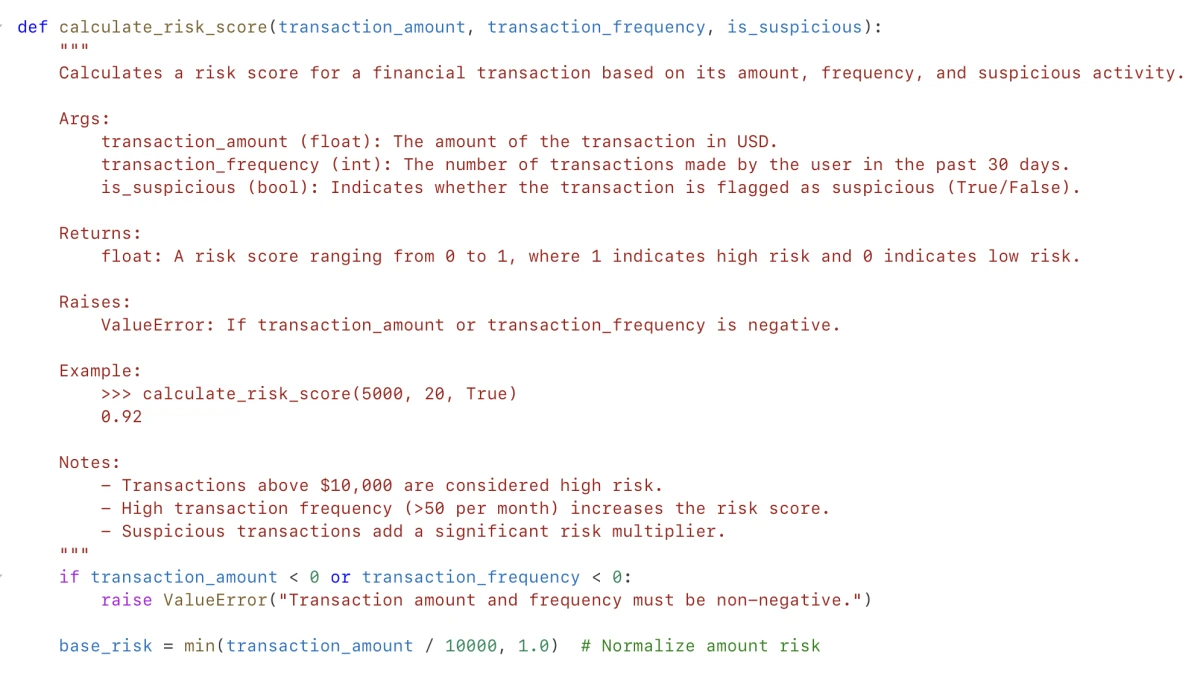
11-14. Code Completion, Refactoring, Documentation, Snippets
ChatGPT suggests completions, recommends structural improvements, generates documentation templates, and produces reusable snippets. 79% of developers still review and modify AI-generated code before using it. The review step is not optional.
Developer adoption: By the end of 2025, roughly 85% of developers will regularly use AI tools for coding. However, 79% still review and modify AI-generated code before using it.
Figure 4. ChatGPT refactors the code it provides as an example
Figure 5. ChatGPT provides example code documentation for a Python function that sorts a list of numbers in ascending order
Figure 6. ChatGPT provides an example code snippet
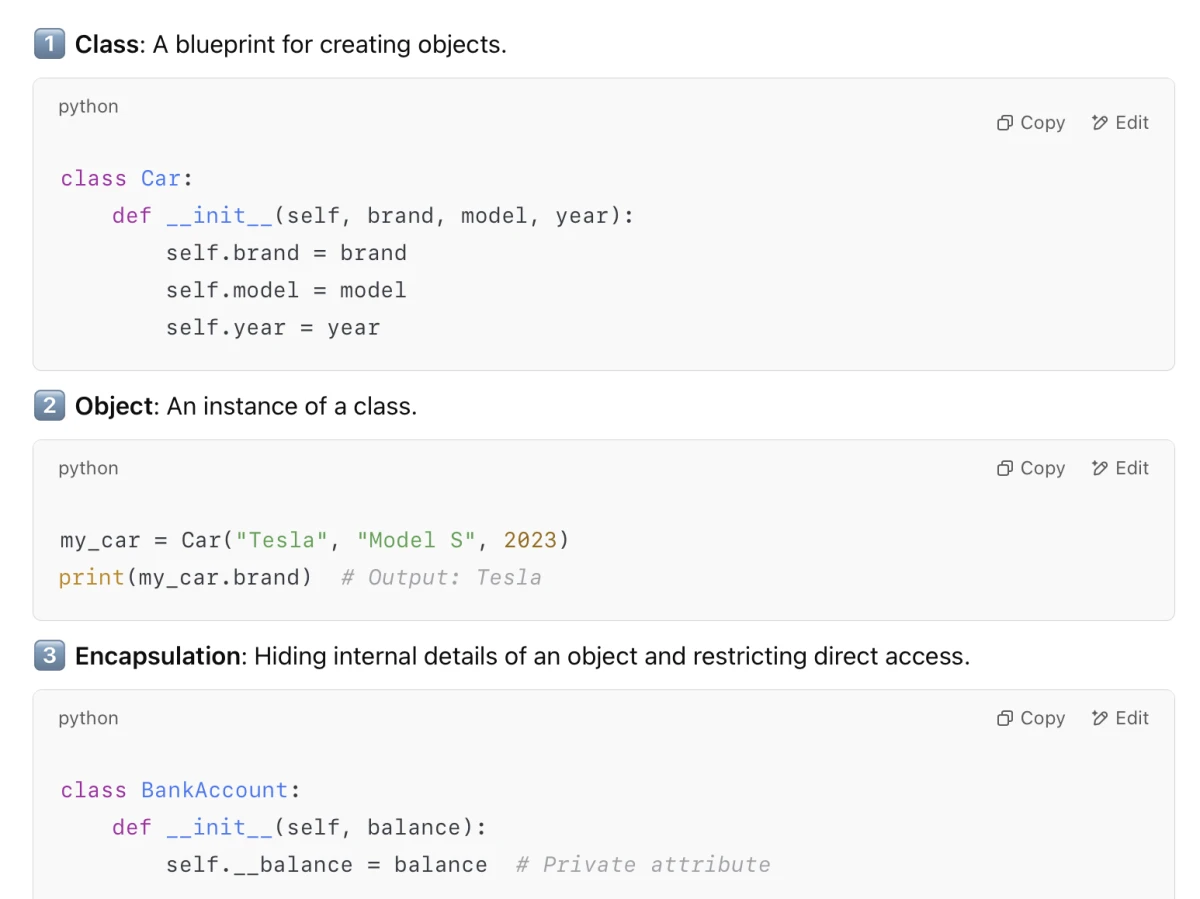
15. Explaining Programming Concepts
ChatGPT explains syntax, functions, and programming concepts in accessible terms. The advantage over static documentation is interactive follow-up: you can ask “why” repeatedly until you actually understand.
Figure 7. ChatGPT explains the question, “What is object-oriented programming, and how does it work?”
Visual and Audio Applications
OpenAI expanded multimodal capabilities in September 2023. ChatGPT can process images, audio, and video.11 Advanced voice with video now allows users to show objects visually to the AI while speaking, enabling live visual troubleshooting and inspection tasks.12
The o3 reasoning model extends beyond basic image classification to enable visual reasoning: interpreting charts, screenshots, and diagrams; accessing account memory for personalized responses; reading files; and browsing the web within the same session. It is the first frontier reasoning model with full multimodal tool access rather than text-only reasoning.13
16. Image Classification
ChatGPT classifies images into categories. Deployed in: medical imaging (X-ray classification), e-commerce (product image categorization), and content moderation pipelines.
17. Object Identification
Recognizes specific objects within images. Used in security (access control), autonomous vehicle systems (pedestrian detection), and retail (shelf inventory analysis).
18-20. Transcription, Text-to-Speech, Speech-to-Speech
ChatGPT converts:
- Spoken words to text (meeting transcriptions, podcast indexing)
- Text to natural-sounding speech (accessibility tools, virtual assistants)
- Spoken language to different spoken languages in real-time (international business, travel)
Limitation: Accuracy drops with accents, technical jargon, and cross-talk.
Business-function-specific ChatGPT Use Cases
Customer Service
21. Multilingual Customer Support
ChatGPT generates customer responses in the recipient’s language without routing to separate regional teams. Two of the earliest large-scale deployments remain the benchmark examples:
- Spotify provides customer support in 60+ languages for queries about playlists, features, and account issues.14
- Duolingo handles inquiries in 30+ languages about courses and app settings.15
Zendesk’s AI agents support over 80 languages and handle mid-conversation language switches without losing context. A customer can start in German and shift to English for technical details within the same session. Zendesk’s Resolution Platform targets 80%+ autonomous resolution across channels.16
The practical ceiling: ChatGPT occasionally misses cultural nuance or produces awkward phrasing in less common languages. For high-volume support in major languages, the tradeoff is generally acceptable. For sensitive communications in minority languages, a human review step is still warranted.
22. Personalized Responses
ChatGPT uses purchase history, chat history, and feedback data to tailor communication. HubSpot’s ChatGPT connector, launched in June 2025, allows agents to query a customer’s full CRM history, purchase records, past tickets, and last touchpoint directly through ChatGPT and push results back as actions, without switching between tabs. Over 250,000 HubSpot customers can run these natural language queries.17
Falls short when the customer’s actual need differs from what they stated, a structural limitation that no amount of personalization data resolves.
23. Quick Response to Complaints
ChatGPT handles routine complaints (product quality, shipping delays, billing errors) consistently across standard categories. Complex cases involving policy exceptions, account disputes, or escalating emotional states still require human judgment.
24. Email Generation
ChatGPT generates outbound emails personalized to individual customer data and context: follow-ups, order confirmations, apology messages, and proactive delay notifications sent before customers have to ask.
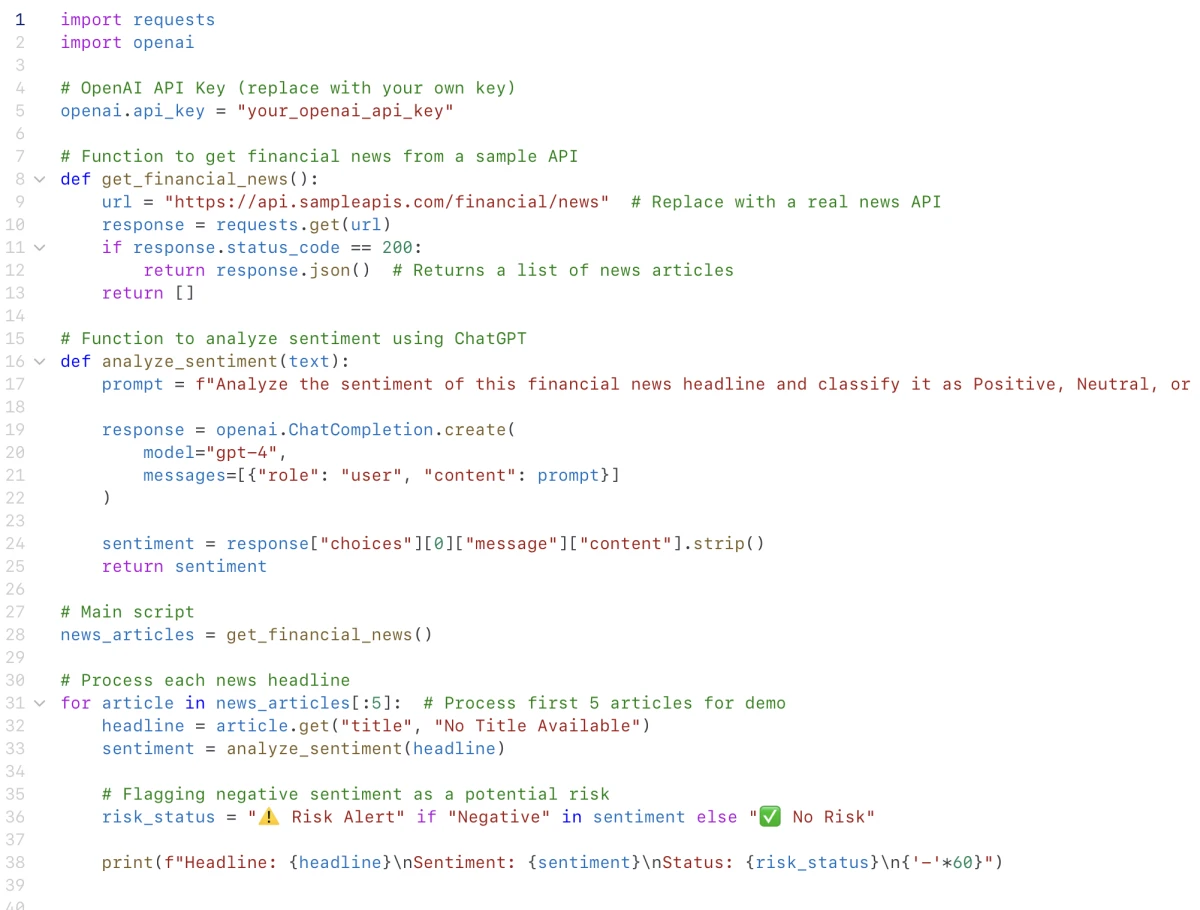
25. Sentiment Analysis
ChatGPT identifies customer emotional state (satisfaction, frustration, confusion), adjusting response tone accordingly and flagging high-risk conversations for human review before they escalate.
26-27. Replying to Reviews and Answering FAQs
In blind tests conducted by BrightLocal across 2024 and 2025 (with different business types each year), 58% of consumers preferred the AI-generated review response over the human-written one without knowing which was which. The result was consistent across both test scenarios. 18 At the same time, BrightLocal’s 2026 survey found that 89% of consumers are more likely to use a business that responds to all reviews, with 32% expecting a reply within a day, up from 18% the previous year.19 At that volume and response speed expectation, manual responses do not scale for most businesses. Human review before posting remains standard practice, particularly for negative reviews that involve specific factual disputes.
Financial Automation
The ChatGPT Excel add-on enables financial modeling at a pace that was not previously possible. Users have reported generating complete three-year cash flow models, including all necessary supporting sheets and formulas, in a single operation, compressing tasks that previously required two days of manual spreadsheet work into minutes.20
 Add as preferred source
Data Collection and Web Scraping
Web contains the largest dataset, and ChatGPT facilitates web data collection. Use cases include:
28. Generate Scraping Code
ChatGPT writes Python code for scraping websites using BeautifulSoup, Scrapy, or Selenium. Makes it easier for non-developers to gather web data.
29-30. Clean and Process Data
ChatGPT handles data cleaning and processing tasks.
Where it helps: Standardizing formats, removing duplicates, basic transformations
Where it doesn’t: Complex data validation, understanding domain-specific data quality issues
Education
Index data from March 2026 shows coursework declining as a share of AI usage while personal conversations grow. Education remains relevant but is losing ground to personal productivity use cases.
For Teachers:
31. Course Content Creation
ChatGPT develops lesson plans, activities, and projects aligned with curriculum guidelines. Creates presentations, worksheets, and quizzes.
The concern: Teachers worry about over-reliance. ChatGPT should supplement, not replace, pedagogical expertise.
32. Grammar and Writing Check
ChatGPT proofreads, edits, and provides feedback on written work.
Limitation: It catches grammar and structure issues, but doesn’t understand sophisticated argumentation or subject-specific writing conventions.
33. Grading Assistance
ChatGPT evaluates essay content, structure, and coherence. Offers feedback on grammar, spelling, and syntax.
Critical caveat: Should NEVER be the sole grading mechanism. Use it to create rubrics or provide initial feedback, not final grades.
34. Syllabus Design
ChatGPT aids in course content creation, organization, and structure:
- Developing course objectives
- Generating topic lists
- Planning lessons
- Identifying relevant resources
For Students:
35. Homework Help
ChatGPT answers questions, helps with problem-solving, reinforces concepts, and improves writing skills.
Academic integrity concern: Schools are split on ChatGPT use. Some ban it, others teach responsible usage.
Student adoption: 60% of college students use ChatGPT as of 2025.
36. Research Assistance
ChatGPT supports research by:
- Suggesting topics
- Providing background information
- Identifying relevant resources
- Organizing research
- Assisting with citations
Important: Always verify information. ChatGPT sometimes fabricates citations that look real but don’t exist.
37. Language Learning
ChatGPT offers translations, grammar explanations, vocabulary practice, and conversation simulations.
Advantage over traditional tools: Interactive practice with instant feedback.
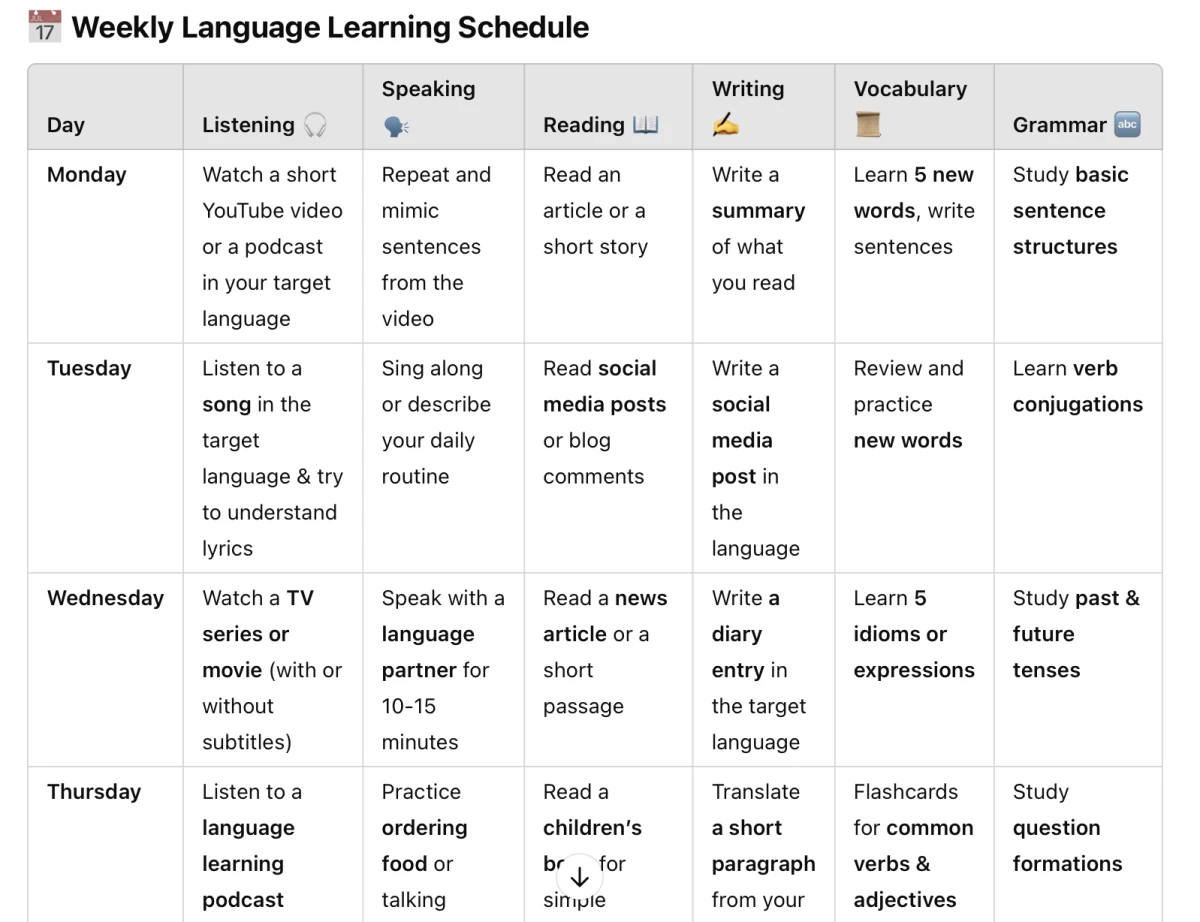
Figure: ChatGPT creates a weekly schedule for language learning practices
Marketing and SEO
38. Content Marketing
AI-generated texts for content marketing: emails, social posts, blog articles, scripts for advertising.
Effectiveness: Content marketers report 2-3x output increase but note that AI content requires significant editing for brand voice.
39. Personalization
ChatGPT generates personalized content considering customer preferences, past behavior, and demographics.
Result: Higher engagement and conversion rates when properly implemented.
40. Audience Research
ChatGPT analyzes customer data (search queries, social media interactions, past purchases) to identify patterns and trends.
Use case: Understanding customer segments before launching campaigns.
41. Product Descriptions (Marketing-Focused)
ChatGPT crafts engaging product descriptions aligned with the target audience’s interests.
E-commerce adoption: Widespread for products with clear specifications. Less effective for products requiring emotional selling.
42. Customer Support Chatbots
ChatGPT incorporated into chatbots delivers prompt, personalized support. Addresses inquiries, offers technical support, troubleshoots issues.
43. Survey Creation
ChatGPT helps with:
- Question generation
- Organizing survey structure
- Making surveys multilingual
- Survey analysis
44-50. SEO Applications
Topic Ideas: Generates relevant keywords, analyzes competitor content, suggests topics based on trends
Keyword Research: Generates keywords, identifies trends
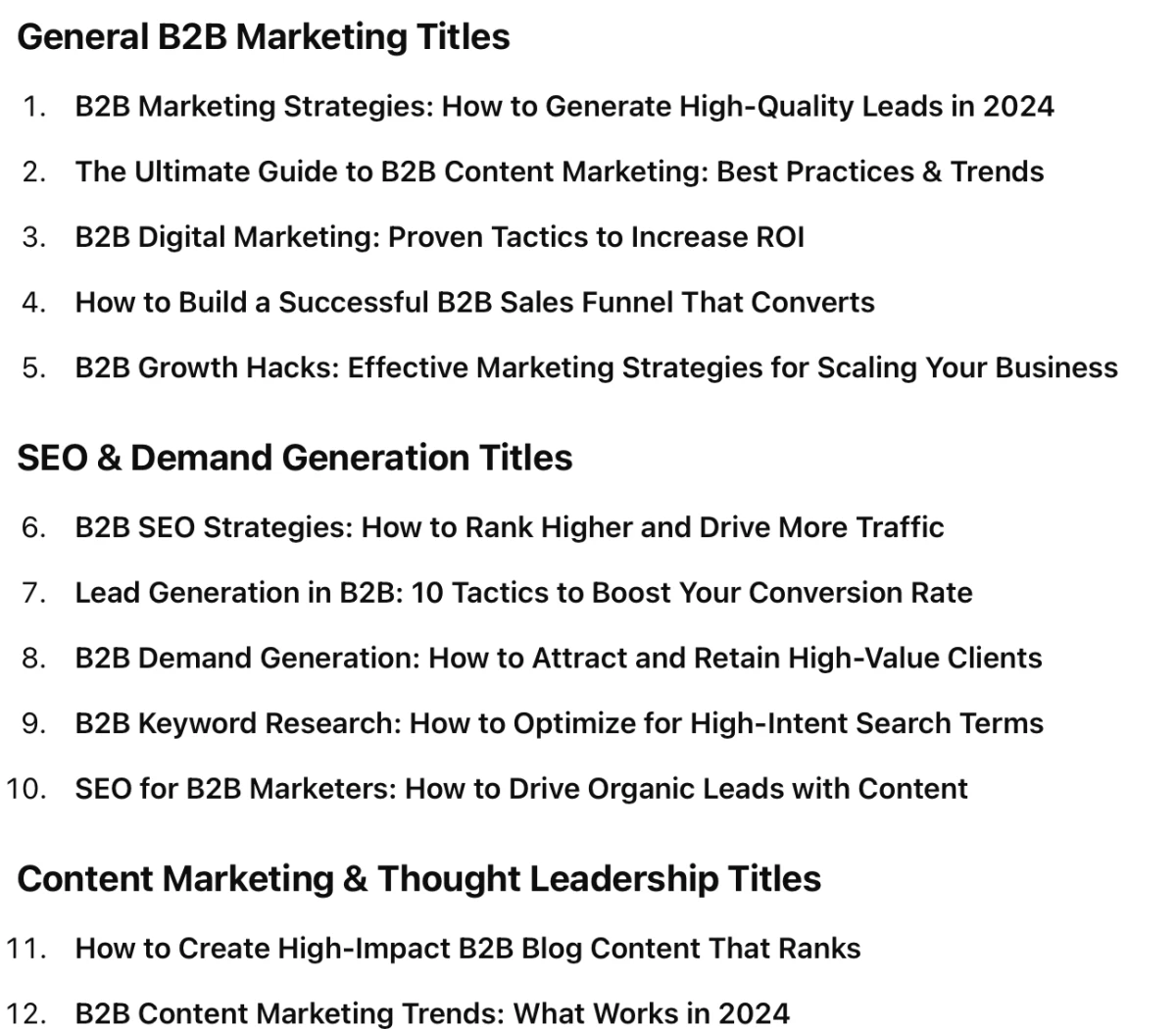
Titles: Creates SEO-friendly titles (60-70 characters, incorporating keywords, attention-grabbing)
Search Intent Grouping: Analyzes search queries and categorizes by user intent
Content Structure: Produces outlines and organization methods
Meta Descriptions: Generates concise page summaries for search results
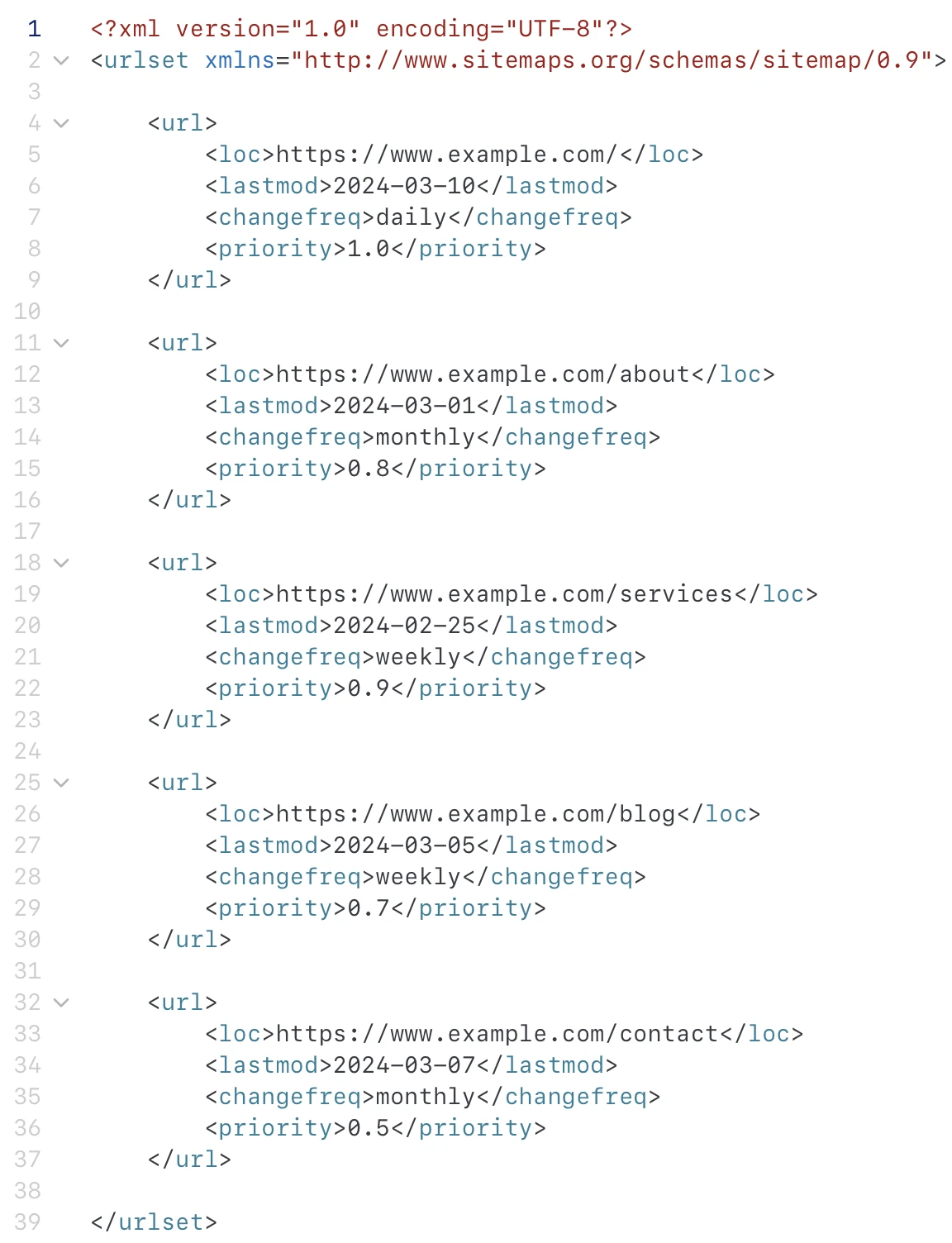
Sitemap Codes: Generates XML files listing website pages
Reality check: SEO professionals report that 86% integrate AI into their strategy, but they emphasize that AI-generated content still requires human editing for quality and originality.
HR Applications
51. Job Interview Questions
HR departments use ChatGPT to generate interview questions about job positions, evaluating qualifications, skills, and experience.
Where it helps: Creating diverse question sets, avoiding repetitive questions
Where it doesn’t: Nuanced behavioral questions requiring a deep understanding of company culture
52. Onboarding Materials
ChatGPT generates onboarding materials: training videos, scripts, handbook content, and documentation.
53. Job Descriptions
ChatGPT generates job descriptions that reflect required skills and qualifications.
Common use: Drafting initial JD, then HR refines for company-specific needs.
54. Employee Questions
Fine-tune ChatGPT with company policies, and it can answer employees’ HR policy questions.
Implementation note: Requires careful setup to ensure accuracy. Wrong answers to policy questions can create legal issues.
What ChatGPT Doesn’t Do Well
Despite reaching millions of users, ChatGPT has clear limitations:
- Long multi-step processes typically lead to context rot and failure.
- Complex judgment calls: It fails in situations that require empathy, nuance, or understanding of unspoken context.
- Factual accuracy: Still hallucinates citations, statistics, and facts. Always verify important information.
- Current events: Knowledge cutoff means it doesn’t know about very recent developments (unless using the web search feature).
- Originality: generates competent but generic content. Doesn’t take creative risks or develop a unique voice. However, with the right prompts, it can make surprising connections.
- Deep domain expertise: Broad but shallow knowledge. Struggles with specialized technical, medical, or legal questions.
- Emotional intelligence: May not read between the lines or understand the difference between what people say and what they mean. Can lead users to harmful acts due to its lack of empathy.21
- Strategic thinking: Executes tactics but doesn’t question underlying assumptions or develop novel strategic approaches.
Conclusion
ChatGPT offers businesses a versatile tool for enhancing operations in customer service, content creation, internal communication, and more. However, when adopting AI tools like ChatGPT, organizations must consider potential challenges, such as data privacy, accuracy, and integration requirements.
Cite this research
Pick the format that matches where you're publishing. Pasting the link version into your CMS preserves the backlink.
@misc{dilmegani2026,
  author = {Dilmegani, Cem and Sezer, Sena},
  title  = {{50+ ChatGPT Use Cases with Real Life Examples}},
  year   = {2026},
  month  = may,
  howpublished    = {\url{https://aimultiple.com/chatgpt-use-cases}},
  note   = {AIMultiple. Retrieved May 22, 2026}
}
Reference Links
Cem's work has been cited by leading global publications including Business Insider, Forbes, Washington Post, global firms like Deloitte, HPE and NGOs like World Economic Forum and supranational organizations like European Commission. You can see more reputable companies and resources that referenced AIMultiple.
Throughout his career, Cem served as a tech consultant, tech buyer and tech entrepreneur. He advised enterprises on their technology decisions at McKinsey & Company and Altman Solon for more than a decade. He also published a McKinsey report on digitalization.
He led technology strategy and procurement of a telco while reporting to the CEO. He has also led commercial growth of deep tech company Hypatos that reached a 7 digit annual recurring revenue and a 9 digit valuation from 0 within 2 years. Cem's work in Hypatos was covered by leading technology publications like TechCrunch and Business Insider.
Cem regularly speaks at international technology conferences. He graduated from Bogazici University as a computer engineer and holds an MBA from Columbia Business School.





Comments 1
Share Your Thoughts
Your email address will not be published. All fields are required. Comments are left in their original language.
Cem Thank you for the ideas. I retired from software QA and now mentor young people in software and IT. I am new to ChatGPT and was casting about for ways to integrate it into my work. Somehow I never thought of using ChatGPT to suggest debugging. I am teaching a jr. high student Python and will work it into our sessions. Another person was laid off from a management position in manufacturing and is looking at career changes. I have been funneling ideas and information to him, encouraging him to get on board with ChatGPT. Best wishes. Joel
Sounds great Joel!