


ChatGPT for Customer Service: Top 10 Use Cases

ChatGPT has moved from novelty to infrastructure in customer service. Companies are using it to cut response times, handle volume their teams can’t absorb, and reduce the cost of routine interactions. But results vary sharply depending on how it’s implemented.
OpenAI launched GPT-5.6, a materially more capable model that is better at instruction-following, reasoning across long contexts, and producing accurate, on-brand responses.
10 Use Cases of ChatGPT for Customer Service
1- Automated 24/7 Customer Support
ChatGPT can answer customer questions at 3 AM just as easily as at 3 PM, which matters for businesses with international customers or anyone who’s gotten a support request at midnight.
The AI handles common questions, password resets, order status checks, and return policies without human intervention. This frees your support team to focus on issues that require human judgment.
Real-Life Example
Intercom’s Fin AI agent is one of the clearest examples of this working at scale. Fin 3 handles over 80% of support volume across Intercom’s customer base, resolving around 1 million customer issues per week. At Lightspeed Commerce, Fin participates in 99% of conversations and autonomously resolves up to 65% of them. Intercom prices Fin at $0.99 per resolved issue, backed by up to a $1M performance guarantee, figures confirmed by Intercom’s President.1
2- Multilingual support
ChatGPT can switch between languages mid-conversation. A customer writes in Spanish, gets an answer in Spanish, then switches to English, and the AI keeps up without losing context.
This is cheaper than hiring multilingual support staff and faster than routing through human translators. It isn’t perfect; the AI sometimes misses cultural nuances or produces awkward phrasing in less common languages, but for high-volume support in major languages, it’s a practical solution.
Zendesk offers Voice AI Agents through its AI Agents Advanced add-on, extending automation beyond text channels to phone support. The system handles the full call flow, greetings, triage, resolution, and handoff to human agents with generative AI managing each stage.
Real-Life Example
Zendesk’s AI agents detect the language of incoming messages and respond accordingly. Zendesk upgraded its Knowledge Agent to run on a new RAG (retrieval-augmented generation) engine, improving response latency and answer accuracy. Conversation logs now display the reasoning and knowledge sources behind each AI response, giving agents visibility into how answers were generated. Zendesk currently supports 40+ languages for AI-assisted responses.2
3- Sentiment analysis
ChatGPT can read the tone of messages and flag frustrated customers before situations escalate. When someone writes “I’ve been waiting THREE WEEKS for a response,” the AI reads the urgency and can either route the conversation immediately or adjust how it replies.
For example, if 50 customers mention shipping delays in the same week, that pattern surfaces automatically before it becomes a visible problem on social media.
Real-Life Example
Instacart integrated OpenAI’s ChatGPT to handle questions about product availability, nutritional information, and meal-planning suggestions. The AI’s speed reduced the load on human agents and helped the company manage high inquiry volumes during peak periods.3
4- Personalized responses
Rather than treating every customer identically, ChatGPT can draw on past interactions, purchase history, and stated preferences to tailor its responses. Someone who bought running shoes three months ago gets different recommendations than a first-time visitor.
A customer who has contacted support five times about the same issue is routed to a senior agent rather than the standard queue. This requires integrating ChatGPT with your CRM, order management system, and support database not a trivial setup, but one that pays off at scale once it’s in place.
Real-Life Example
Octane AI applies this in e-commerce, helping Shopify stores run personalized shopping quizzes powered by ChatGPT. When a customer answers questions about their skin type or fitness goals, the AI recommends products based on those answers combined with their browsing history.
5- Quick responses to customer inquiries & complaints
When someone’s upset, a 24-hour wait makes things worse. ChatGPT can acknowledge complaints immediately, provide status updates, and offer initial solutions while a human agent reviews the underlying case.
Real-Life Example
HubSpot’s ChatGPT connector shows how this works in practice. When a complaint comes in, agents can query the customer’s full CRM history directly through ChatGPT purchase records, past tickets, segment, last touchpoint and get a context-aware response drafted without switching between tabs. HubSpot launched this connector in June 2025, enabling over 250,000 customers to run natural language queries against their CRM data and push the results back into HubSpot as actions. 4
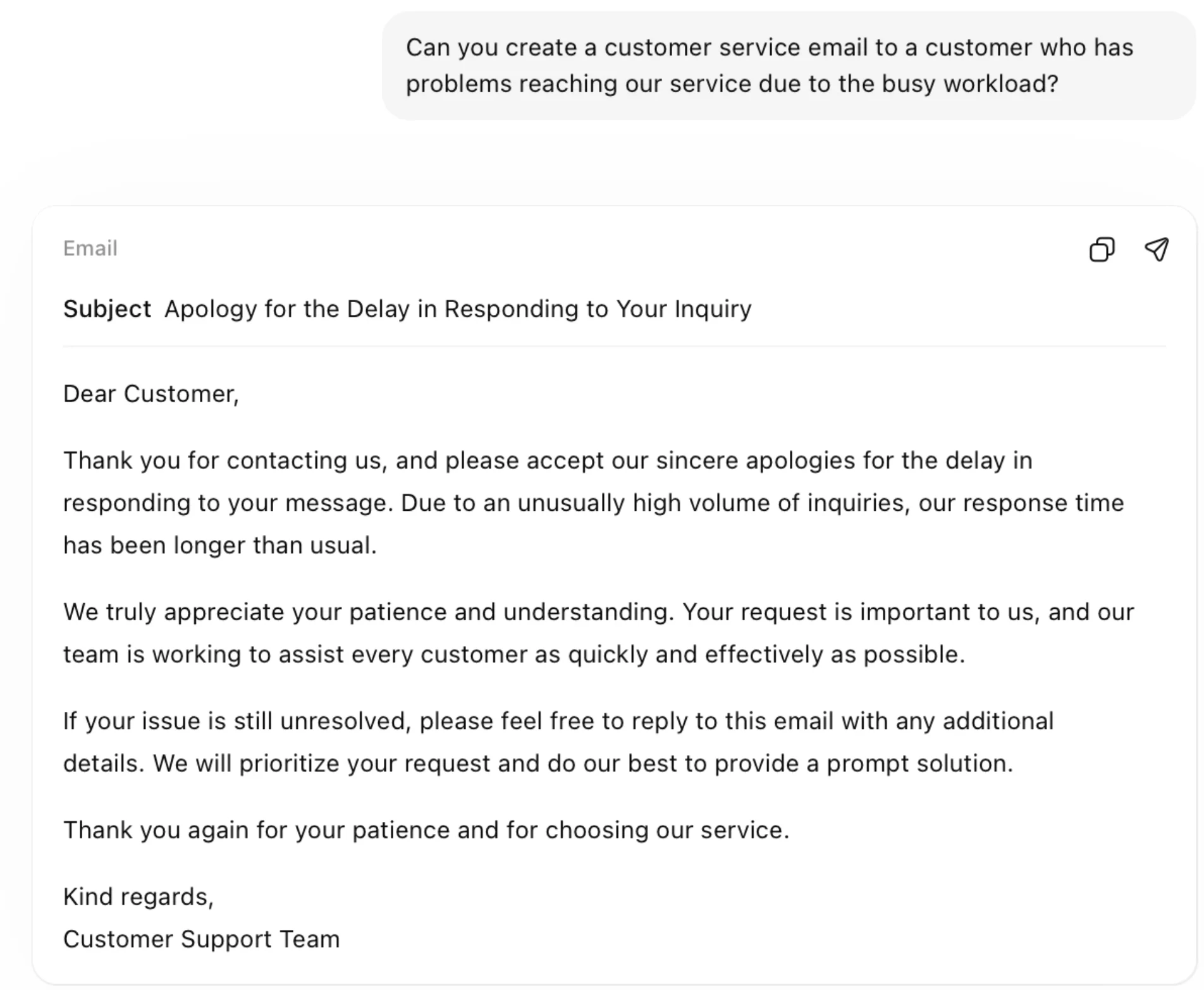
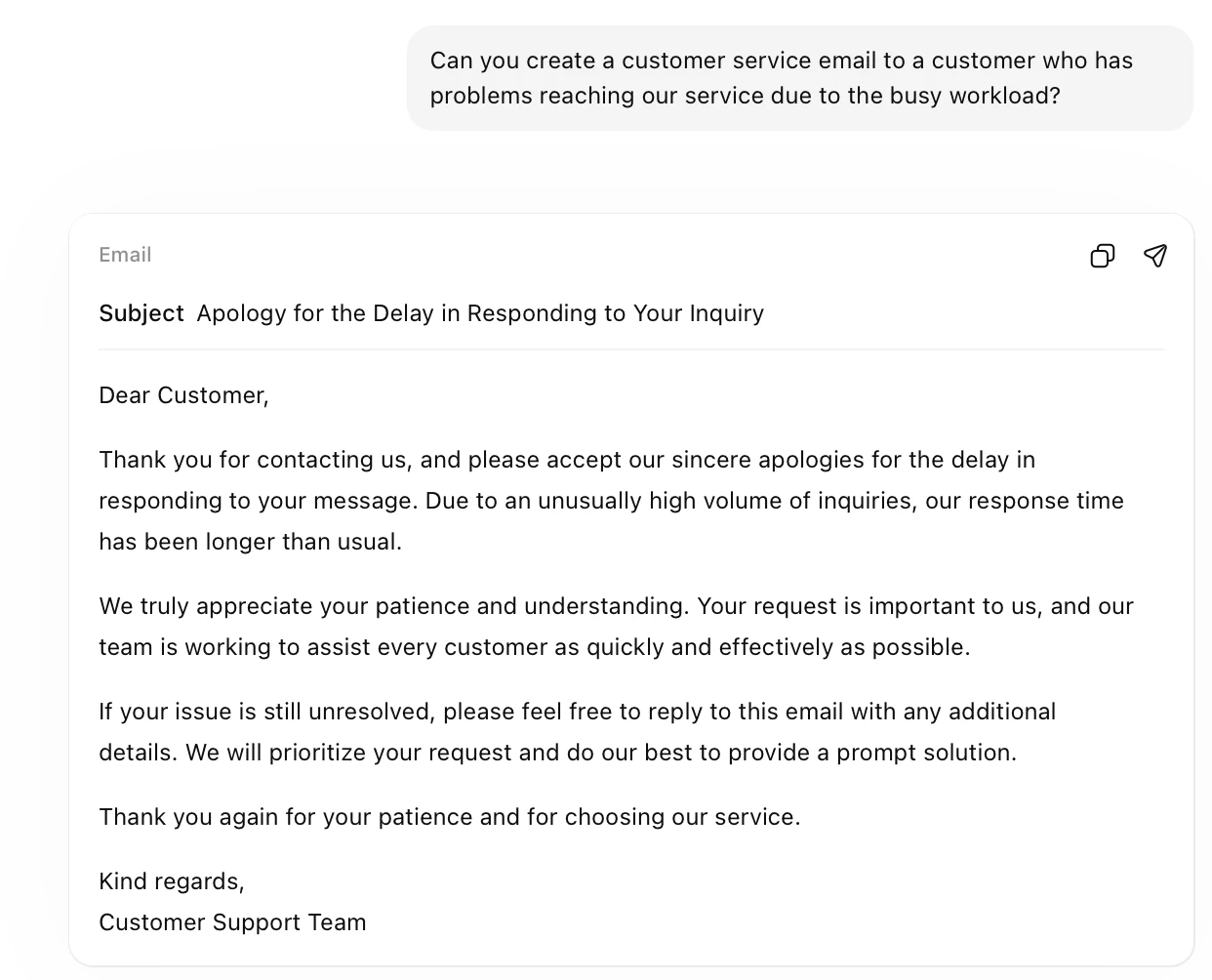
6- Creating customer emails
ChatGPT can draft follow-up emails, order confirmations, apology messages, and proactive delay notifications. Provide the customer context and situation, and it generates appropriate text, including outbound updates sent before customers have to ask.
7- Replying to customer reviews
Writing individual responses to hundreds of reviews takes time that most teams don’t have. ChatGPT can generate replies that address specific complaints while staying consistent with your brand voice.
Real-Life Example
BrightLocal’s consumer research quantifies why this matters. In blind tests conducted in 2024 and 2025, consumers were shown two responses to the same review, one written by a human business owner and one generated by ChatGPT, without being told which was which. In both years, 58% of consumers preferred the AI-generated response. The 2025 test used a veterinary clinic scenario, and the results were nearly identical to those from the prior year’s restaurant test. Separately, BrightLocal’s 2026 survey found that 89% of consumers expect businesses to respond to their reviews, with 32% expecting a reply within a da,y up from 18% the previous year. At that volume and speed expectation, manual responses don’t scale.5
8- Answering FAQs
Every business field asks the same questions repeatedly. ChatGPT handles these by pulling directly from your knowledge base, help docs, or FAQ database, no human needed for questions that have already been answered somewhere in your documentation.
Real-Life Example
Klarna’s OpenAI-powered assistant does this at scale for payment plan questions, return policies, and account FAQs. The results were significant: by Q1 2025, Klarna’s customer service cost per transaction had dropped 40% over two years (from $0.32 to $0.19), and average resolution time fell from 11 minutes to under 2 minutes. However, 2025 also produced an important counterlesson. Klarna CEO Sebastian Siemiatkowski publicly acknowledged that relying too heavily on full automation had degraded quality. The company reversed course and moved to a human-AI hybrid model. AI handles the routine FAQ volume, and human agents take over for emotionally complex or high-stakes situations.6
9- Internal Support for Customer Service Teams
ChatGPT helps agents with support work, not just customers receiving it.
Support staff can use it to quickly find policy information, summarize lengthy customer histories, draft response templates, or translate technical issues into plain language. New agents get up to speed faster, and response quality stays more consistent without heavy supervision.
Real-Life Examples
- Salesforce’s Agentforce (formerly Einstein GPT) demonstrates this in Service Cloud. When an agent gets a complex ticket, they can ask the AI for a policy explanation or a summary of the customer’s last ten interactions. The AI immediately pulls from their knowledge base, case history, and policy documents, without the agent having to navigate multiple systems. Salesforce and OpenAI formalized a deeper partnership: the Agentforce Sales app is now embedded directly within ChatGPT, enabling agents to query Salesforce CRM data, review customer conversations, and build Tableau visualizations by typing into ChatGPT without leaving the conversation.
- Zendesk’s Agent Copilot works similarly. It surfaces relevant procedures in real time as agents handle conversations, suggests accurate responses based on previously resolved tickets, and flags when procedures need updating. As of January 2026, admins can set group-level permissions to control which agents access which AI features.7
10- Feedback Collection and Analysis
After resolving an issue, ChatGPT can follow up with conversational surveys that feel less mechanical than traditional rating forms.
Instead of “Rate your experience 1-10,” it asks “How did we do?” and continues based on the response. If someone says, “It was okay but took too long,” they might ask, “What would have made it faster?” The AI then analyzes responses across conversations to identify patterns if 30 customers mention the same confusing checkout step in a week, which surfaces automatically rather than waiting for a quarterly survey review.
Benefits of Using ChatGPT in Customer Service
- Handles repetitive work automatically: Password resets, order tracking, basic troubleshooting, these don’t require human judgment, and accurate information is delivered quickly. If each simple inquiry takes five minutes and you receive 100 per day, that’s over eight hours of staff time. Automating those frees your team for cases that actually need expertise.
- Always available: Customers don’t only have problems during business hours. That said, “24/7 support” doesn’t mean 24/7 resolution. The AI handles straightforward issues at any hour, but complex problems still wait unless you also staff human agents around the clock.
- Scales without linear costs: Hiring scales linearly with demand; doubling inquiries doubles headcount. ChatGPT doesn’t follow that curve. Handling 1,000 conversations costs marginally more than handling 100. The offset is that initial setup, training, and integration costs can be substantial, which makes this more compelling for businesses with high inquiry volumes than for small teams handling 20 tickets a week.
Key challenges using ChatGPT for customer service and mitigation strategies
- Hallucinations: The AI can produce confident but incorrect answers, incorrect pricing, nonexistent policies, or outdated product details. GPT-5.2 has reduced response-level errors by 30% compared to GPT-5.1, which is meaningful progress, but no model is immune to errors. The practical fix is grounding responses in verified content: connect your knowledge base, use retrieval-augmented generation (RAG), and build in a review layer rather than deploying and walking away.
Pega/YouGov study quantifies the trust gap: roughly two-thirds of consumers lack confidence in AI-powered customer interactions, and 53% say companies aren’t using AI responsibly. Technical guardrails matter, but so does transparency with customers about when and how AI is being used.8
- Technical integration complexity: Connecting ChatGPT to your website, CRM, ticketing system, and handoff workflows requires real development work. For most companies, this is a months-long project.
- Training and fine-tuning: Accurate responses require feeding the model company-specific data, your policies, product details, and procedures. This requires upfront time and ongoing maintenance as circumstances change.
- Cost and resource management: At scale, API costs add up. Outcome-based pricing (such as Intercom’s $0.99-per-resolved-issue model) is gaining traction as an alternative to flat API fees, but it works economically only if your resolution rate is high enough to offset the per-interaction cost.
Ready-to-deploy alternatives
To mitigate the challenges of developing a custom ChatGPT integration, which might not be practical or cost-effective for some companies, especially small and medium-sized ones, ready-to-use alternatives are available. These options enable businesses to access many of the features discussed earlier, such as scalability, automated responses, and 24/7 availability, without facing the difficulties of integrating ChatGPT.
Real-life example: Tidio
Tidio provides companies with a comprehensive customer care solution that addresses many of the challenges of adopting ChatGPT by combining AI-powered chatbots with human support capabilities:
- Tidio features pre-built website widgets that are quick to set up.
- The platform uses AI responses that are specifically trained for customer service scenarios, helping prevent hallucinations.
- It offers a hybrid approach that blends AI responses with handoffs to human agents.
- Companies lacking in-house technical expertise can still deploy advanced chatbot features using no-code flows.
FAQs
Using ChatGPT in customer service offers several advantages, such as:
24/7 availability: ChatGPT can provide instant responses to customer inquiries at any time of day, improving customer satisfaction.
Handling repetitive tasks: It can manage frequently asked questions, freeing up human agents for more complex tasks.
Cost savings: Automating responses reduces the need for large customer service teams.
Personalization: ChatGPT for customer service can tailor its responses based on the customer’s inquiry history and preferences.
While ChatGPT for customer service excels at answering common questions and handling basic requests, it may need to escalate more complex issues to a human agent. Many systems integrating ChatGPT provide seamless handoffs to human agents when needed.
ChatGPT for customer service can be integrated with secure systems, and it’s important to implement proper data handling and encryption practices to protect sensitive customer information. However, you should ensure compliance with privacy regulations like GDPR when using AI for customer interactions.
ChatGPT for customer service is ideal for:
Answering product or service-related questions.
Handling order tracking, shipping inquiries, and returns.
Managing appointment bookings or cancellations.
Providing basic technical support and troubleshooting.
ChatGPT can be integrated into various platforms such as live chat on websites, messaging apps (like WhatsApp or Facebook Messenger), and even voice-enabled systems. It can also be linked to CRM software to manage customer data more efficiently.
For most businesses, especially SMEs, ready-made platforms offer faster deployment and lower risk than custom ChatGPT implementations. Custom solutions make sense for large enterprises with specific requirements and a dedicated development resource
Cite this research
Pick the format that matches where you're publishing. Pasting the link version into your CMS preserves the backlink.
@misc{dilmegani2026,
  author = {Dilmegani, Cem},
  title  = {{ChatGPT for Customer Service: Top 10 Use Cases}},
  year   = {2026},
  month  = mar,
  howpublished    = {\url{https://aimultiple.com/chatgpt-for-customer-service}},
  note   = {AIMultiple. Retrieved March 4, 2026}
}
Changelog
10 updatesUpdated the introduction with a mention of GPT-5.2.
Updated the data for Automated 24/7 Customer Support.
Reference Links
Cem's work at AIMultiple has been cited by leading global publications including Business Insider, Forbes, Morning Brew, and Washington Post, global firms like Deloitte and HPE, NGOs like World Economic Forum, and supranational organizations like European Commission. [1], [2], [3], [4], [5]
Throughout his career, Cem served as a tech consultant, tech buyer and tech entrepreneur. He advised enterprises on their technology decisions at McKinsey & Company and Altman Solon for more than a decade. He also published a McKinsey report on digitalization.
He led technology strategy and procurement of a telco while reporting to the CEO. He has also led commercial growth of deep tech company Hypatos that reached a 7 digit annual recurring revenue and a 9 digit valuation from 0 within 2 years. Cem's work in Hypatos was covered by leading technology publications like TechCrunch and Business Insider.
Cem regularly speaks at international technology conferences. He graduated from Bogazici University as a computer engineer and holds an MBA from Columbia Business School.





Be the first to comment
Your email address will not be published. All fields are required. Comments are left in their original language.