


Top 11 AI in ITSM Use Cases & Examples

Leveraging AI for IT service management (ITSM) tools supports organizations in terms of:
- operational efficiency,
- proactive maintenance of IT assets,
- scalability,
- improved decision-making, and
- personalization.
See the top 11 use cases of AI in ITSM, examples, and benefits of leveraging AI in ITSM.
AI-native use cases
AI-native ITSM refers to a new way of managing internal support and IT operations where artificial intelligence is not an added feature but part of the foundation. These systems use machine learning, natural language processing, and generative AI to interpret messages, predict issues, and learn from past service requests.
The goal is to improve how the teams handle problems, share knowledge, and respond to employees. Instead of relying on portals or forms, AI-native systems capture and process information directly from the tools where work happens, such as Slack or Microsoft Teams. This approach reduces repetitive work, supports self-service, and helps organizations better use their historical data.
1. AI-native ITSM
Moving from a traditional ITSM software to an AI-native system involves more than installing new technology. It requires planning and gradual AI adoption.
- Organizations usually begin with limited use cases, such as automating access requests or collecting data from Slack messages. Measuring improvements in response time, employee experience, and ticket accuracy helps validate early results.
- Security and governance are also key. Because AI-native systems use historical data and conversational content, ensuring data security and compliance with privacy regulations is essential. Expanding the use of intelligent automation across departments helps maximize value.
Key technologies supporting AI-native ITSM
AI-native platforms rely on multiple interconnected technologies rather than a single AI feature. The following components work together to enhance IT management and desk operations:
- Machine learning models predict issue categories, identify recurring problems, and support root-cause analysis.
- Generative AI creates summaries and drafts new knowledge articles from resolved tickets.
- Predictive analytics helps detect potential incidents before they cause service downtime.
- Agentic AI combines reasoning and action, allowing AI agents to decide how to handle complex service requests across tools.
- Agentic AI in IT Service Management (ITSM) core capabilities include learning from historical data, detecting anomalies before disruptions occur, making dynamic decisions, and executing tasks autonomously while maintaining compliance.
Real-life example: Atomicwork
Ammex Corp struggled with complex workflows, manual processes, and inefficiencies that slowed down support and required constant human intervention.
By adopting Atomicwork, Ammex introduced AI agents that automate routine IT and employee service requests and provide instant, conversational support directly within tools like Microsoft Teams. This reduced ticket volumes, improved response times, and enhanced the overall employee experience.1
Real-life example: Salesforce Agentforce IT Service
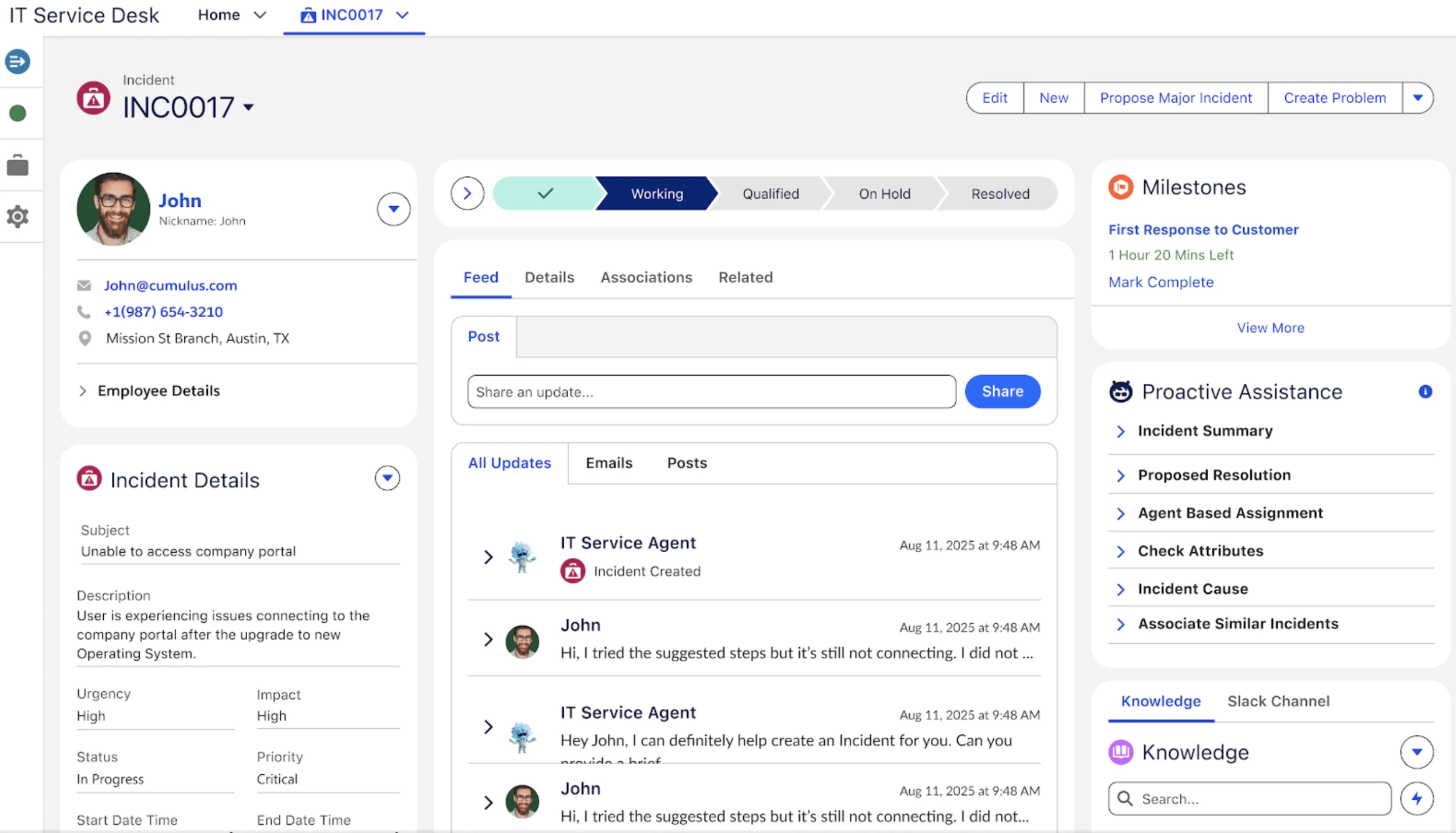
Salesforce’s Agentforce IT Service is an agent-based IT service desk designed to automate incident resolution and service requests across channels such as Slack, Microsoft Teams, employee portals, and web chat. The product aims to reduce reliance on traditional ticket-based ITSM workflows by enabling employees to get instant support through natural-language conversations.
The solution includes an AI-powered IT service desk, multiple specialized AI agents, and an embedded Configuration Management Database (CMDB) with a service graph for mapping infrastructure dependencies. Salesforce claims this unified approach helps break down data silos and improve resolution accuracy by using a single source of truth.
Salesforce also emphasizes integration capabilities, launching with 100+ pre-built connectors and workflows through partners including Google, IBM, Microsoft, Oracle NetSuite, Workday, and Zoom.
Figure 1: IT service desk dashboard example from Salesforce.
Task management use cases
2. Incident management
Leveraging AI in ITSM plays an important role in incident management through enabling automated ticketing, where AI systems automatically create and categorize tickets based on the content of incoming service requests or incidents.
This process reduces the manual workload on IT staff and ensures that service desk tickets are accurately classified, which would lead to quicker resolution times.
Additionally, AI systems utilize machine learning to prioritize incidents based on factors such as severity, impact, and urgency, and ensure that critical issues are addressed promptly. This prioritization helps improve service efficiency and minimize the impact on business operations.
Another application for incident management is AI-powered root cause analysis. By analyzing historical data to identify patterns and predict the root causes of recurring issues, AI in ITSM helps resolve underlying problems more effectively, reducing the frequency of incidents and enhancing system reliability.
Real-life example: SysAid with Grand Traverse County
Grand Traverse County’s 12-person IT team had been managing 3,500 assets with spreadsheets, inconsistent email-based ticketing, limited performance visibility, and software license chaos.
With SysAid, they introduced ITIL-compliant ticketing, automated SLAs, real-time asset and license management, an AI Chatbot, an AI Copilot, and automated workflows.
The result was faster resolution, less manual work, better first-call resolution, improved asset visibility, and more control over software renewals, compliance risks, and IT spending.2
Real-life example: SolarWinds Service Desk
SolarWinds Service Desk provides a system designed to manage incidents that may not require formal submission. While agents often face challenges managing high volumes of low-priority requests, the incident management platform leverages artificial intelligence to integrate with the knowledge base and automatically suggest articles to users during the ticket creation process.
Additionally, the Virtual Agent offers end-users access to knowledge base solutions that address their most common technical issues.
As a consequence, end users benefit from faster access to answers for routine problems, which reduces disruptions in their workflow.
3. Service request management
Service requests are managed through request automation:
AI can automate the handling of routine service requests such as password resets, software installations, and access permissions. By using predefined workflows and intelligent processing, AI systems can manage these requests without human intervention.
For example, when a user submits a request to reset their password, these AI-powered tools can verify the user’s identity through security questions or multi-factor authentication and then proceed to reset the password and notify the user. This reduces the time and effort required by IT staff and provides faster resolution for users.
Automating these routine tasks improves efficiency and also reduces the risk of errors associated with manual processing.
4. Change management
AI brings significant improvements to change management by enhancing the assessment and management of IT changes:
Impact analysis:
Impact analysis with AI evaluates the potential impact of proposed changes on the IT environment. By analyzing historical data and current system configurations, AI can predict potential conflicts and disruptions, helping IT teams to make informed decisions and avoid negative outcomes.
This proactive approach minimizes downtime risk and ensures smoother transitions during changes. By providing a detailed impact assessment, AI enables more effective planning and execution of changes, resulting in a more stable and resilient IT infrastructure.
5. Workflow and process automation
Workflow automation:
Workflow automation involves the use of AI to automate routine, repetitive tasks that are typically time-consuming for IT staff.
Process automation:
Process automation takes workflow automation a step further by automating entire processes, from initiation to completion. This can include processes such as software deployment, user onboarding, and system backups. AI tools can manage these processes end-to-end to ensure that each step is executed accurately.
For instance, during the user onboarding process, AI systems can automatically create user accounts, assign appropriate access permissions, and deploy necessary software applications.
Process automation also includes the ability to monitor and optimize processes continuously by analyzing process performance data, identifying bottlenecks, and recommending improvements.
Real-life example: SysAid with Ross School of Business
The University of Michigan’s Ross School of Business collaborated with SysAid to support the institution with automated workflows and centralized asset management.
This collaboration led to a 54% reduction in ticket submission time, enhanced collaboration through an extensive knowledge base, and better planning and budgeting through centralized insights. Moving forward, Ross IT plans to extend SysAid’s integration to support more event management activities and build comprehensive employee workflows.
Real-life example: SysAid with St. George
St. George, the fastest-growing municipality in the US, faced significant IT service management challenges due to rapid expansion and limited resources.
By implementing SysAid, they automated key processes such as patch management, asset tracking, and ticket management, leading to a 90% improvement in software patch success rates and a 20% reduction in Mean Time to Resolution (MTTR).
SysAid’s AI-powered tools, including Copilot’s Chatbot and Emailbot, empowered end-users to resolve issues independently. This transition enabled the IT team to shift from reactive to proactive management, while enhancing productivity.
Predictive measures and monitoring
6. Predictive analytics
AI models can predict equipment failures before they occur, thereby alerting IT teams to proactive maintenance. Given that machine learning techniques typically outperform and produce superior results compared to traditional hard computing methods, this predictive approach is crucial.
By automating workflows, managing schedules, and sending notifications for due tasks, AI-powered ITSM tools aim to extend the lifespan of equipment and ensure uninterrupted IT service management operations.
Utilizing predictive analytics, organizations can forecast future performance and potential failures using historical and real-time data. This process supports decision-making processes and resource allocation for maintenance activities.
Continuous health monitoring of IT infrastructure through AI detects anomalies and provides early warnings to IT teams by enabling them to address potential issues before they escalate.
Real-life example: BMC Helix AIOps
BMC Helix AIOps analyzes events from multiple IT sources (infrastructure, applications, networks, and third-party monitoring tools) and correlates them into “situations” based on factors such as timing, topology, signatures, and event messages. This helps teams move from isolated alerts to grouped incidents that reflect real service impact.
The platform supports two main situation types: policy-based situations (created from predefined event policies in BMC Helix Operations Management) and ML-based situations (created automatically using AI/ML correlation). 3
Real-life example: ServiceNow Predictive Intelligence
ServiceNow Predictive Intelligence leverages historical data to predict outcomes and recommend actions for managing tasks, such as categorizing, routing, and prioritizing incidents and requests.
Predictive Intelligence can identify patterns, such as recurring issues or potential bottlenecks, and make suggestions to improve service efficiency.
This feature helps organizations reduce manual work, minimize errors, and improve response times by automating repetitive tasks and predicting issues before they escalate.4
7. Performance management
AI-driven performance management focuses on optimizing IT resources and services by:
Capacity planning, where AI analyzes usage patterns and predicts future resource requirements. This helps organizations in effective capacity planning and resource allocation, ensuring that they can meet future demands without over-provisioning.
Performance optimization, where AI tools continuously monitor and optimize the performance of IT services. By analyzing performance metrics in real-time, the AI technology identifies areas for improvement and implements changes to enhance operational efficiency and user satisfaction. This continuous optimization ensures that IT services run smoothly and effectively.
8. Security management
Security management with AI tools focuses on protecting IT systems from threats and ensuring compliance via:
Threat detection:
Threat detection includes detecting and responding to security threats in real-time. By analyzing patterns and anomalies, AI can identify potential breaches and take immediate action to mitigate risks. This proactive approach significantly improves the security posture of an organization.
Compliance monitoring:
It includes monitoring IT environments for adherence to policies and regulations. This approach ensures that organizations remain compliant with industry standards and reduces the risk of legal and regulatory issues.
AI-driven compliance monitoring provides continuous oversight, helping organizations maintain a secure and compliant IT infrastructure.
Real-life example: Freshservice with Databricks
Databricks, a leading AI and data analytics company, needed to enhance its IT service operations to reduce downtime and increase scalability.
They chose Freshservice for its no-code capabilities and AI-powered automation. The implementation resulted in a 23% self-service deflection rate, thereby reducing the workload on IT staff and enhancing efficiency.
Their collaboration with Freshservice led Databricks to expand its use to eight other departments, including HR and legal, creating a unified hub for employee support.
This transition improved employee experience, supported operations, and reduced IT costs.
Self-service and agent performance use cases
9. Virtual assistants and chatbots
Virtual assistants and chatbots support the ITSM experience by providing personalized and efficient support. AI-powered systems can tailor responses and solutions to individual users based on their roles, preferences, and history, and can improve user satisfaction and the effectiveness of IT support.
Sentiment analysis and natural language processing (NLP) help analyze user feedback and identify areas for improvement in IT services and support. This approach helps organizations to understand user needs better and enhance service quality.
AI-powered chatbots provide 24/7 real-time support, answering common queries and resolving routine issues without human intervention, thus ensuring continuous support availability and reducing wait times.
Additionally, virtual assistants can guide users through troubleshooting steps, offering a more interactive and efficient support experience while reducing the time taken to resolve issues and enhancing overall user satisfaction.
Self-service portals:
Self-service portals leverage AI to analyze user profiles, past interactions, and common issues to offer tailored support. When a user logs in and describes their issue, the AI tools can suggest relevant knowledge base articles, FAQs, or automated solutions that have resolved similar issues in the past.
For instance, if a user frequently requests software installations, the self-service portal can remember this preference and provide quick access to installation procedures or direct links to download the necessary software.
Real-life example: Risotto chatbot with Fundrise
Fundrise replaced an underperforming IT chatbot with Risotto to improve employee support and reduce manual ticket work.
By integrating directly into Slack, Risotto helped employees get answers, request access, and complete approvals without leaving their normal workflow. After one month, Risotto automatically resolved 33% of IT tickets and assisted with another 26%, automating nearly 60% of support tasks.
Fundrise also valued Risotto’s ability to learn from everyday team interactions, reduce documentation, and support access provisioning through flexible approval workflows.5
Real-life example: ManageEngine’s Zia AI Virtual Agent
ManageEngine’s Zia AI Virtual Agent supports multi-turn conversations through an LLM interface, enabling users to ask questions and perform tasks without navigating menus manually.
Zia can understand context, instantly provide responses, and summarize insights from internal knowledge bases or connected large language models. It maintains continuity across follow-ups and supports ticket actions, such as updating statuses, adding notes, or closing requests, based on conversational prompts.
Zia also supports multimodal input (text, voice, images) and preserves conversation context for follow-up queries.6
Real-life example: Freshservice Freddy AI
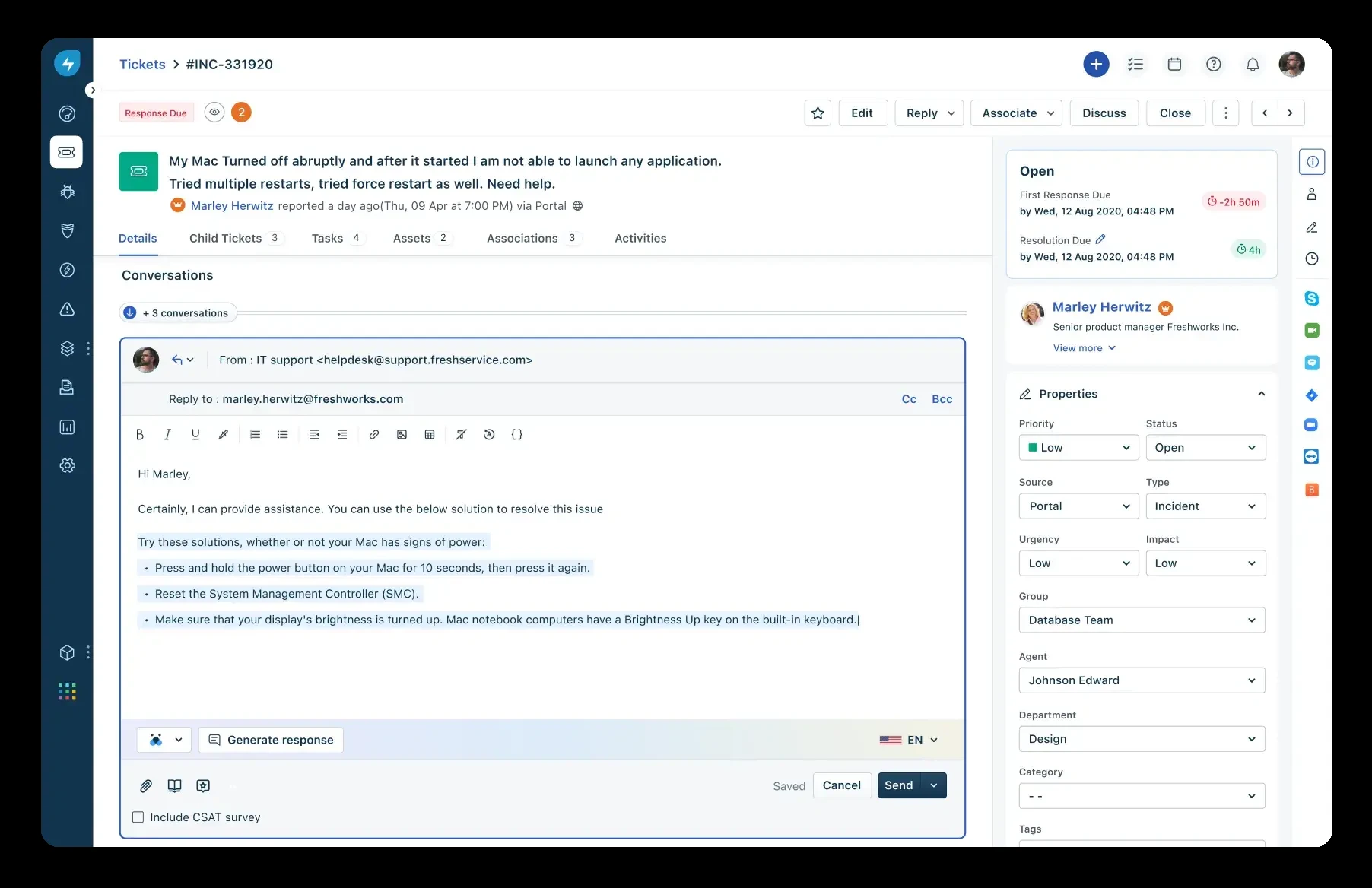
Freddy AI Copilot is an AI add-on for Freshservice (Pro/Enterprise) and Freshservice for Business Teams. It helps IT and business teams reduce repetitive work by automating ticket handling, improving response quality, and speeding up service delivery across departments such as IT, HR, finance, legal, and marketing.
Key capabilities include:
- Ticket summarization and resolution note generation
- Reply suggestions (including multilingual support) and writing assistance
- Similar incident detection and related change recommendations for RCA
- Field autofill and ticket translation
- Knowledge article generation and content recommendations
- Post-incident report generation and test case creation
Freddy Copilot supports multiple languages, including English, German, French, Spanish, Dutch, Swedish, and Portuguese (Brazil), though Similar Incident Suggester is currently English-only.7
Figure 2: Freshservice Freddy AI copilot dashboard.
Real-life example: Jira Service Management Virtual Agent
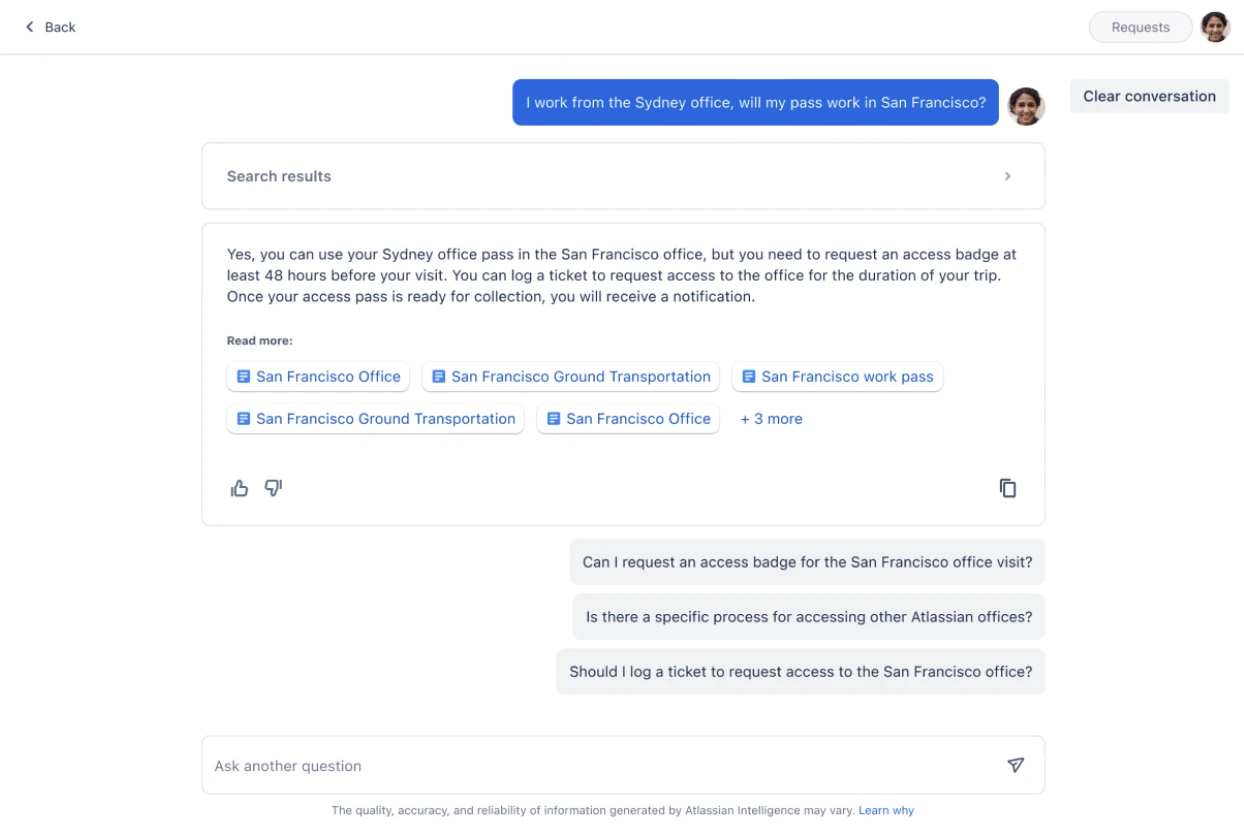
Jira Service Management Virtual Agent enhances IT support by automating routine support tasks. This artificial intelligence-powered virtual agent integrates with platforms, including Slack, to provide conversational support, using NLP to understand and respond to user requests, detecting intent, sentiment, and context to deliver personalized interactions.
The virtual agent can handle common issues, answer frequently asked questions, and manage support requests for human agents to focus on more complex tasks. For more complex problems, the virtual agent can create tickets and transition the conversation to a human agent without losing context.
In addition to automation, Rovo agents (agentic AI teammates) assist IT operations teams by surfacing related incidents, change risks, probable root causes, suggested responders, and recommended playbooks. Rovo agents can also generate draft Post-Incident Reviews (PIRs) and trigger automation workflows during incident response.
Service teams can monitor and optimize AI effectiveness with an AI-powered performance dashboard that provides insights into resolution rates, knowledge gaps, and improvement opportunities, including AI-suggested knowledge article creation.
The platform also supports customizable intent flows using templates, steps such as “Ask for information” and “Web request,” and embedded AI recommendations within agent workflows to accelerate resolution times and improve service delivery efficiency.8
Figure 3: Jira self-service support dashboard.9
10. Knowledge management
Within this domain, AI technologies support the organization and accessibility of information through:
Content curation:
AI systems can curate and recommend relevant knowledge base articles to both IT staff and end-users based on the context of their queries. This ensures that users receive the required information quickly, and their ability to resolve issues independently increases.
Document analysis:
Document analysis involves analyzing and categorizing large volumes of documentation. This process helps users to find and utilize information while improving the overall efficiency of knowledge management processes.
By organizing documents and creating intuitive categories, AI-powered ITSM tools enable easier access to critical information, thereby boosting productivity and reducing the time spent searching for solutions.
Real-life example: Autonomous Knowledge Building with Nebula ITSM
Nebula ITSM automatically gathers data from multiple IT systems, applications, and databases without the need for custom integrations or extensive manual effort.
The system identifies relationships and dependencies within the data to create a cohesive network of information for the knowledge base.
The system does not require manual curation or intervention from IT staff to maintain or build the knowledge graph. This would result in faster deployment, reduced operational overhead, and the ability to continuously learn and adapt as new data is introduced, without the need for human experts to constantly oversee the process.10
11. Asset management
IT asset management with artificial intelligence focuses on automating and optimizing various aspects of asset lifecycle management.
Automated inventory tracking enables accurate and real-time asset records while reducing manual efforts and improving data accuracy.
AI tools can also predict when assets need maintenance or replacement, thereby optimizing the lifecycle of assets. This predictive approach helps in planning and resource allocation, ensuring that assets are well-maintained and operational.
Additionally, AI tools increase asset security by detecting unauthorized access or unusual activity related to assets and provide an added layer of protection.
AI-driven analytics offer insights into asset utilization, helping organizations make informed decisions and achieve cost savings.
Real-life example: Ivanti Neurons Self-Healing with AI
Self-healing refers to the ability of systems to automatically detect, diagnose, and resolve issues within the IT infrastructure without requiring manual intervention.
The self-healing is enabled through:
- Proactive monitoring: Ivanti Neurons continuously monitors IT assets such as endpoints and servers by using AI to detect anomalies in real-time. It identifies potential issues such as performance degradation, security vulnerabilities, or malfunctions before they escalate.
- Automated diagnostics: When a problem is detected, Ivanti’s AI system automatically runs diagnostics to pinpoint the root cause by analyzing logs, configurations, and patterns.
- Automated remediation: After diagnosing the issue, the system initiates automatic fixes such as patching, restarting services, or running scripts. The process is completed without human intervention to ensure quicker resolutions.
- Endpoint management: Ivanti’s self-healing can be particularly effective for endpoints, monitoring devices, and resolving issues such as security vulnerabilities and misconfigurations automatically.11
 Add as preferred source
What are the benefits of leveraging AI in ITSM?
Utilizing AI service management tools offers numerous benefits that can enhance the efficiency, accuracy, and overall effectiveness of IT operations. Here are some key advantages of AI technologies for ITSM:
AI can automate repetitive and time-consuming tasks such as ticket creation, categorization, and routing. This reduces the manual workload on IT staff, allowing them to focus on more complex and strategic tasks.
AI systems can provide consistent responses and actions to minimize human error. This is particularly beneficial in routine tasks such as incident classification, root cause analysis, and solution recommendations.
Chatbots and virtual assistants allow continuous service availability and reduce response times, while improving user satisfaction. These AI tools can scale to handle increasing volumes of requests, which would make them ideal for large and growing organizations
AI systems generate valuable insights from large amounts of data to support IT managers in making informed decisions.
By automating routine tasks and reducing the need for extensive human intervention, artificial intelligence systems can lead to cost savings. These systems optimize resource utilization and reduce the operational costs associated with managing IT services.
Cite this research
Pick the format that matches where you're publishing. Pasting the link version into your CMS preserves the backlink.
@misc{dilmegani2026,
  author = {Dilmegani, Cem and Ermut, Sıla},
  title  = {{Top 11 AI in ITSM Use Cases & Examples}},
  year   = {2026},
  month  = jun,
  howpublished    = {\url{https://aimultiple.com/ai-in-itsm}},
  note   = {AIMultiple. Retrieved June 18, 2026}
}
Changelog
6 updatesAdded real-life examples SysAid with Grand Traverse County and Risotto with Fundrise.
Removed the sections on technical requirements, AI-native versus AI-powered ITSM, conversational intelligence, and practical benefits.
Added a real-life example for BMC Helix AIOps in the Predictive analytics section.
Reference Links
Cem's work at AIMultiple has been cited by leading global publications including Business Insider, Forbes, Morning Brew, and Washington Post, global firms like Deloitte and HPE, NGOs like World Economic Forum, and supranational organizations like European Commission. [1], [2], [3], [4], [5]
Throughout his career, Cem served as a tech consultant, tech buyer and tech entrepreneur. He advised enterprises on their technology decisions at McKinsey & Company and Altman Solon for more than a decade. He also published a McKinsey report on digitalization.
He led technology strategy and procurement of a telco while reporting to the CEO. He has also led commercial growth of deep tech company Hypatos that reached a 7 digit annual recurring revenue and a 9 digit valuation from 0 within 2 years. Cem's work in Hypatos was covered by leading technology publications like TechCrunch and Business Insider.
Cem regularly speaks at international technology conferences. He graduated from Bogazici University as a computer engineer and holds an MBA from Columbia Business School.

She previously worked as a recruiter in project management and consulting firms. Sıla holds a Master of Science degree in Social Psychology and a Bachelor of Arts degree in International Relations.




Be the first to comment
Your email address will not be published. All fields are required. Comments are left in their original language.