


Top 3 Open Source Firewall Audit Tools Compared

Open-source firewall audit tools enable IT teams to assess whether their firewalls are properly configured without incurring high costs. However, mid-market and enterprise companies may explore closed-source firewall audit software for more comprehensive solutions.
Explore the key players in open source firewall audit tools, providing a comprehensive overview of their features, benefits and drawbacks:
Comparison of software
* All analyzed software packages are compatible with Windows
Ranking: The companies are ordered based on the total count of GitHub stars.
1. Firewall Orchestrator
Firewall Orchestrator imports firewall configurations from multiple vendors and produces compliance reports and rule-set documentation. It provides capabilities commonly associated with Network Security Policy Management (NSPM) tools, including rule analysis, reporting, and compliance workflows.
It connects to firewall vendors, including Check Point, Fortinet, Cisco, and Juniper, and stores imported data in a PostgreSQL database. Reports can be exported for compliance reviews.
It is distributed under the Apache-2.0 license. It supports Windows and provides partial Linux support.
2. Firewall Audit
Firewall Audit checks firewall rules against a user-defined policy file. It reads a rule set, compares it to your criteria, and flags anything that doesn’t match. The tool is CLI-based, it runs from the command line rather than a web interface, and is cross-platform.
The Firewall Audit is dual-licensed under Apache-2.0 and MIT. It is compatible with Linux. Setup is minimal: it runs as a single binary with a config file, and an automated software delivery process that runs security checks on every change.
3. Batfish
Batfish analyzes network device configurations, including routers, switches, and firewalls, to verify that the network behaves as intended. It does this without connecting to live devices; it works entirely from configuration files.
The core analysis requires device configuration files. No direct access to network devices is needed. This matters for large or sensitive environments where connecting an audit tool to production gear is not an option.
Its main strength is what-if analysis: you can test a proposed configuration change against your access control lists (ACLs), the rules that control which traffic is allowed, before deploying it. Batfish can confirm whether the change would permit or block any given flow across the network.
It is distributed under the Apache License 2.0. It is compatible with MacOS.
Key features of open-source firewall audit solutions
When it comes to choosing the best firewall audit tool, several key factors warrant consideration to ensure optimal functionality and alignment with organizational needs. Here are essential aspects to evaluate:
1. License
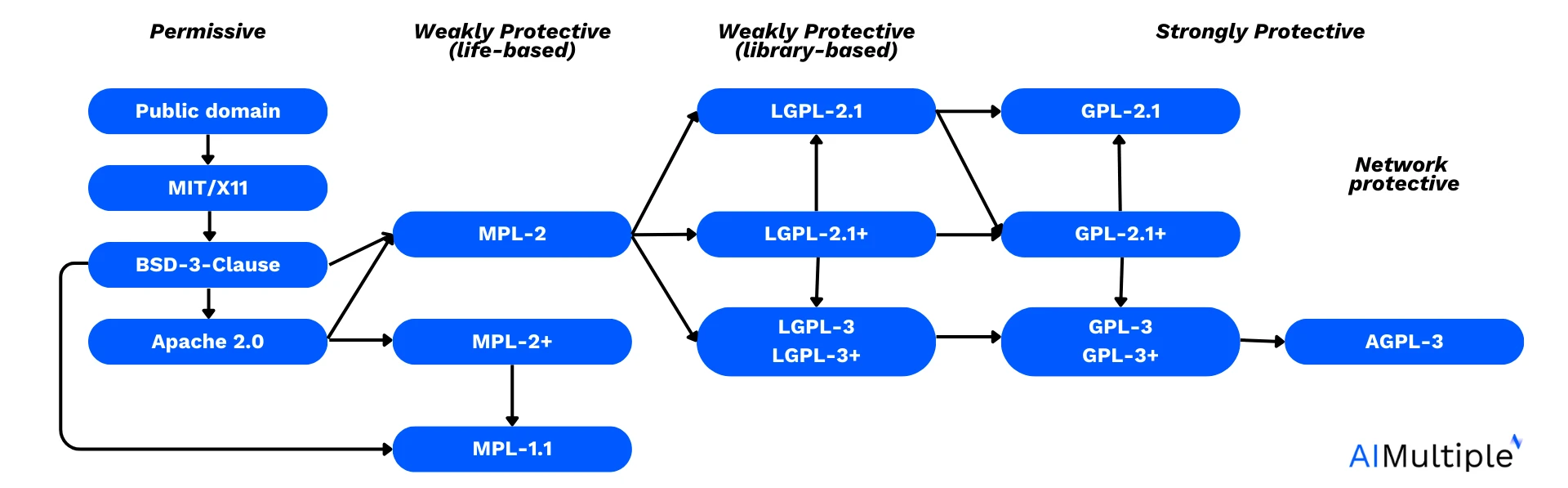
Source: David A. Wheeler (2007)1
The tool’s license determines usage rights, redistribution, and compatibility with your organization’s policies. The software’s license determines its usage rights, redistribution policies, and whether it aligns with organizational requirements and compliance standards.
Apache 2.0 is known for its permissive nature, allowing users to modify and distribute derivative works under certain conditions. GPL-2, GPL-2+, and LGPL-2.1 are licenses that prioritize open-source principles, requiring derivative works to also be open source and adhere to specific distribution terms.
MIT is another permissive license, granting users the freedom to use, modify, and distribute software with minimal restrictions, making it compatible with a wide range of projects and licenses.
2. Platform compatibility
Considering the platform compatibility of the software ensures seamless integration with existing infrastructure, network devices, and cloud service providers. Compatibility with Windows, MacOS, Linux, and other operating systems is crucial for widespread deployment and management convenience.
3. Deployment method
Deployment method determines how quickly a tool can be set up and what infrastructure it requires. Common deployment methods include standalone CLI binaries, which run without additional dependencies, and containerized setups using Docker, which require a container runtime but simplify dependency management. Some tools also require a database to store imported configurations for reporting and querying.
Reasons to use open source firewall audit tools
1. Continuous compliance
Firewall audit tools open source enable regular firewall audits, ensuring adherence to regulatory standards like NIS2, DORA, PCI DSS and GDPR and fostering a secure network environment.
Neither regulation mandates a specific tool. But both require documented evidence of firewall controls at the time of the audit. An open-source audit tool that exports reports can satisfy that requirement at no cost.
2. Finding rule bloat and drift
Firewall rule sets grow. Rules added to a project are rarely removed when the project ends. An audit tool checks for redundant, overly permissive, or contradictory rules, problems that manual review misses at scale.
3. Pre-deployment validation
Tools like Batfish can verify a proposed rule change before it goes live. This catches errors that would otherwise show up in production, either as a blocked service or an unintended open port.
 Add as preferred source
Benefits and drawbacks of working with open source firewall audit tools
Benefits
1. No licensing cost
Open source software is typically free to use, eliminating licensing fees and reducing overall costs associated with firewall audit software procurement. This cost-effectiveness is particularly beneficial for organizations with limited budgets or those seeking cost-efficient solutions without compromising on quality.
2. Customizability and flexibility
One of the key strengths of open source firewall audit tools lies in their customizability. Users have the freedom to modify and adapt the source code according to their specific firewall configurations, network security policies, and compliance requirements. This level of flexibility allows organizations to tailor the tool to their unique security management needs, ensuring a more robust and tailored approach to firewall auditing.
3. Community support and collaboration
Open source projects thrive on community-driven support and collaboration. Users can leverage the collective expertise and contributions of a diverse community of developers, security professionals, and enthusiasts.
This collaborative environment fosters continuous improvement, innovation, and the rapid development of new features and functionalities, enhancing the overall quality and effectiveness of open source firewall audit tools.
4. Auditable code
The transparency of open source firewall audit tools provides organizations with greater visibility into the tool’s codebase, security mechanisms, and data handling practices. This transparency fosters trust and confidence in the tool’s security posture, as users can independently review and audit the source code for vulnerabilities, compliance with security standards, and adherence to best practices.
Additionally, the open nature of the software allows for timely security updates and patches, further bolstering network security and resilience against emerging threats.
5. Integration and compatibility
CLI-based tools run inside CI/CD workflows. A rule-set check can become part of every deployment, the same way a code linter runs on every commit.
Moreover, open source tools often support various industry-standard protocols and formats, facilitating interoperability and data exchange with other security tools and management platforms.
Drawbacks
1. No vendor support
While open source communities can offer valuable assistance and resources, the support may not always be as comprehensive or timely as what closed source firewall vendors provide. This can be a concern for organizations that require immediate assistance with complex firewall configurations, troubleshooting security incidents, or resolving technical issues promptly.
2. Setup requires technical expertise
While customization allows organizations to tailor firewall configurations and security policies according to their specific needs, it can also lead to complexity, especially for users with limited technical expertise.
Firewall Orchestrator needs Docker Compose and a database. Batfish runs as a Docker container with a Python client. Neither is a simple install for a non-technical user.
Configuring and managing open source firewall audit tools effectively may require a deeper understanding of network security principles, firewall policies, and audit processes, which may not be easily accessible to all users.
3. Integration challenges
Compatibility issues with cloud service providers, network infrastructure, or other security tools may require additional development efforts or workaround solutions, adding complexity to the implementation process. Organizations need to carefully evaluate the compatibility of open source firewall audit tools with their existing infrastructure and assess the level of effort required for seamless integration.
FAQs
Open-source firewall audit tools are available for free or at a relatively low cost, as they are community-driven and do not involve licensing fees.
On the other hand, proprietary firewall audit tools may have pricing structures that include one-time licensing fees, subscription models based on monthly or annual payments, or usage-based pricing for cloud-based solutions. It’s essential to research and compare different firewall audit tools to determine the most suitable option based on your organization’s needs and budget.
Firewall audit software can automatically recommend optimizations to firewall rules based on industry best practices. These recommendations are often generated through the analysis of network traffic patterns, security policies, and known vulnerabilities.
By leveraging machine learning algorithms and rule-based engines, open source firewall audit tools can identify redundant or ineffective rules, detect potential security gaps, and propose optimizations to enhance the overall security posture of the network.
These recommendations may include suggestions such as:
Removing redundant or unused firewall rules to reduce complexity and improve performance.
Consolidating overlapping rules to streamline firewall policy management.
Identifying and addressing overly permissive rules that may expose the network to security risks.
Implementing rule optimizations based on specific compliance requirements, such as PCI DSS or HIPAA.
Prioritizing critical rules or traffic for more effective threat prevention and mitigation.
Security software to combine with open source firewall audit tools
Network security audit tools: Identify threats, vulnerabilities, and malicious activity to help companies mitigate cyber attacks and follow compliance with regulations.
DSPM vendors: Provide network visibility into where to find sensitive data, who has access to it, and how it has been used across the cloud.
Network security policy management solutions (NSPM): Protect network infrastructure using firewalls and security policies against all threats.
Cite this research
Pick the format that matches where you're publishing. Pasting the link version into your CMS preserves the backlink.
@misc{hafa2026,
  author = {Hafa, Adil and Arslan, Ezgi},
  title  = {{Top 3 Open Source Firewall Audit Tools Compared}},
  year   = {2026},
  month  = jun,
  howpublished    = {\url{https://aimultiple.com/open-source-firewall-audit-tools}},
  note   = {AIMultiple. Retrieved June 4, 2026}
}Results and timestamps of 43 data points. Download the summary data shown in this article's charts and tables as a ZIP file containing 2 CSV files.
Want the granular data behind it? Join Premium
Changelog
4 updatesAdded a deployment method criterion to the key features section and removed the 4k GitHub stars inclusion criterion.
Replaced the three compared tools with Firewall Orchestrator, Firewall Audit and Batfish, ranked by GitHub stars.





Be the first to comment
Your email address will not be published. All fields are required. Comments are left in their original language.