

Top 12 AI Governance Tools Compared

To map the AI governance landscape, we checked 12 leading platforms for their coverage of 11 core capabilities, and highlighted what each tool does best.
End-to-end: Cover both sides of governance, regulatory compliance on one side and technical model testing on the other.
Compliance: Handle policy, risk, and audit, but leave the technical model testing to other tools.
Observability: Monitor, evaluate, and guardrail models in production, but don’t offer a regulatory compliance layer.
AI governance tools comparison
AI governance is a broad job. It stretches from proving to a regulator that a system is lawful all the way to catching a model misbehaving in production. To make the space easier to navigate, we broke it down into eleven capabilities a governance tool can offer.
Which of these a tool covers is exactly what separates the three types we identified: some are compliance-focused, some are observability-focused, and some are end-to-end platforms that do both.
Governance & compliance
- AI inventory keeps every AI model and agent in the organization in a single list, because you cannot govern what you do not know is running. It answers a basic question: what AI systems do we have, and who owns them?
- Risk assessment rates how much harm each AI could cause, whether to people, their rights, safety, or the business, and sorts systems into low to high risk levels so the riskiest ones get the tightest oversight.
- Compliance mapping tracks whether each AI meets the laws and standards that apply to it, such as GDPR and the EU AI Act, because non-compliance brings fines and reputational damage.
Trust & controls
- Lifecycle & version control versions an AI as it moves from draft to production and ties every release to an approval, so you always know which version is live and who signed off on it. Uncontrolled change is uncontrolled risk.
- Access control (RBAC) uses role-based permissions to control who can build, change, or publish AI, on the principle that not everyone should be able to do everything.
- Audit trail keeps a tamper-proof record of who did what and when, giving auditors and regulators the evidence they need after the fact.
- Bias & explainability check that an AI does not discriminate and that it can explain how it reached a decision, so its outcomes are both fair and understandable.
Operations & evaluation
- Monitoring & observability watches and logs everything an AI does while it runs, so problems can be spotted and stopped in real time instead of being discovered after the damage is done.
- Evaluation & testing systematically tests an AI before release for quality and safety, because “it worked once” is not evidence. You need repeatable proof that it is reliable.
- Guardrails & safety set hard limits on what an AI is not allowed to do, blocking behavior such as leaking personal data, producing toxic output, or being tricked into unsafe actions.
- Cost / FinOps tracks how much each AI spends in tokens, usage, and cost, and attributes it to the right team, so spending stays under control.
Top AI governance tools
Weights & Biases (Weave)
Weights and Biases is a platform for building, tracking, and evaluating machine learning models, covering experiment tracking and model development. Its Weave product extends this to LLM and agent applications, which is where its AI governance capabilities sit.
On the governance side, W&B focuses on evaluation and observability. Bias detection is a built-in capability rather than just a stated principle: the WeaveBiasScorerV1 scorer flags gender, race and origin, and sexual-orientation bias out of the box.
- Evaluation: built-in and custom scorers, LLM-as-judge, and leaderboards
- Built-in bias detection via WeaveBiasScorerV1 (gender, race and origin, sexual orientation)
- Monitoring and tracing of what a model or agent does in production
- Runtime guardrails and safety scorers
- Model and prompt versioning
- Access control with SSO and role-based permissions
- Audit logs
- Token-level cost tracking
CortX (XNode)
CortX, by XNode, is a platform for building, running, and governing AI agents that sit on top of existing business tools.
What the product covers:
- AI agents (ReAct) that connect to tools such as Slack and web search, plus multi-agent teams and workflows
- Bring-your-own-model support, open-source or custom, through Create Model
- Governance controls at both the agent level and the organization level
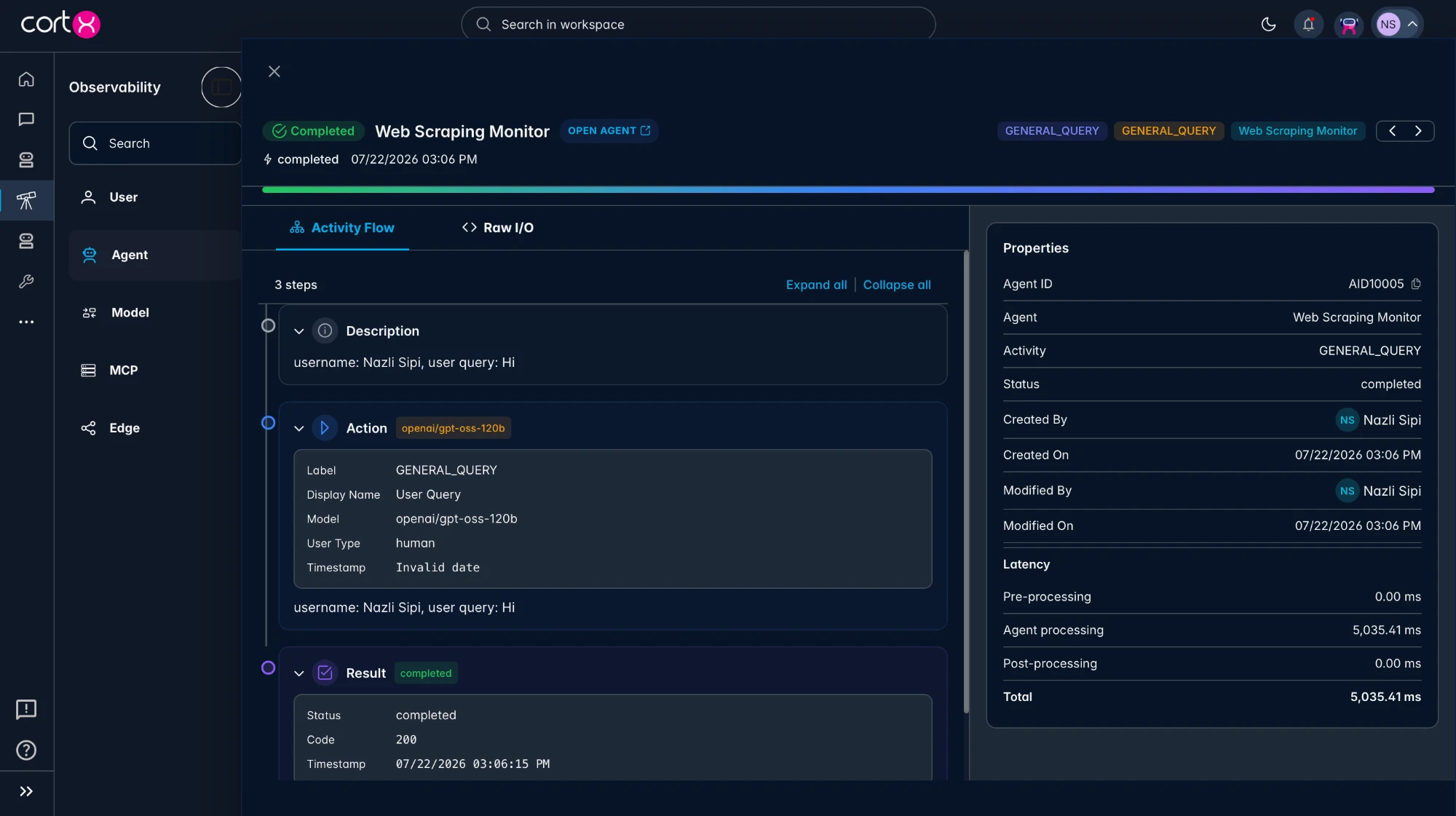
End-to-end audit of a single decision
Any interaction opens a full trace that records the request, the exact model that answered it (openai/gpt-oss-120b), the result and its status code (200), and a latency breakdown, along with created-by and modified-by stamps and a raw input and output view.
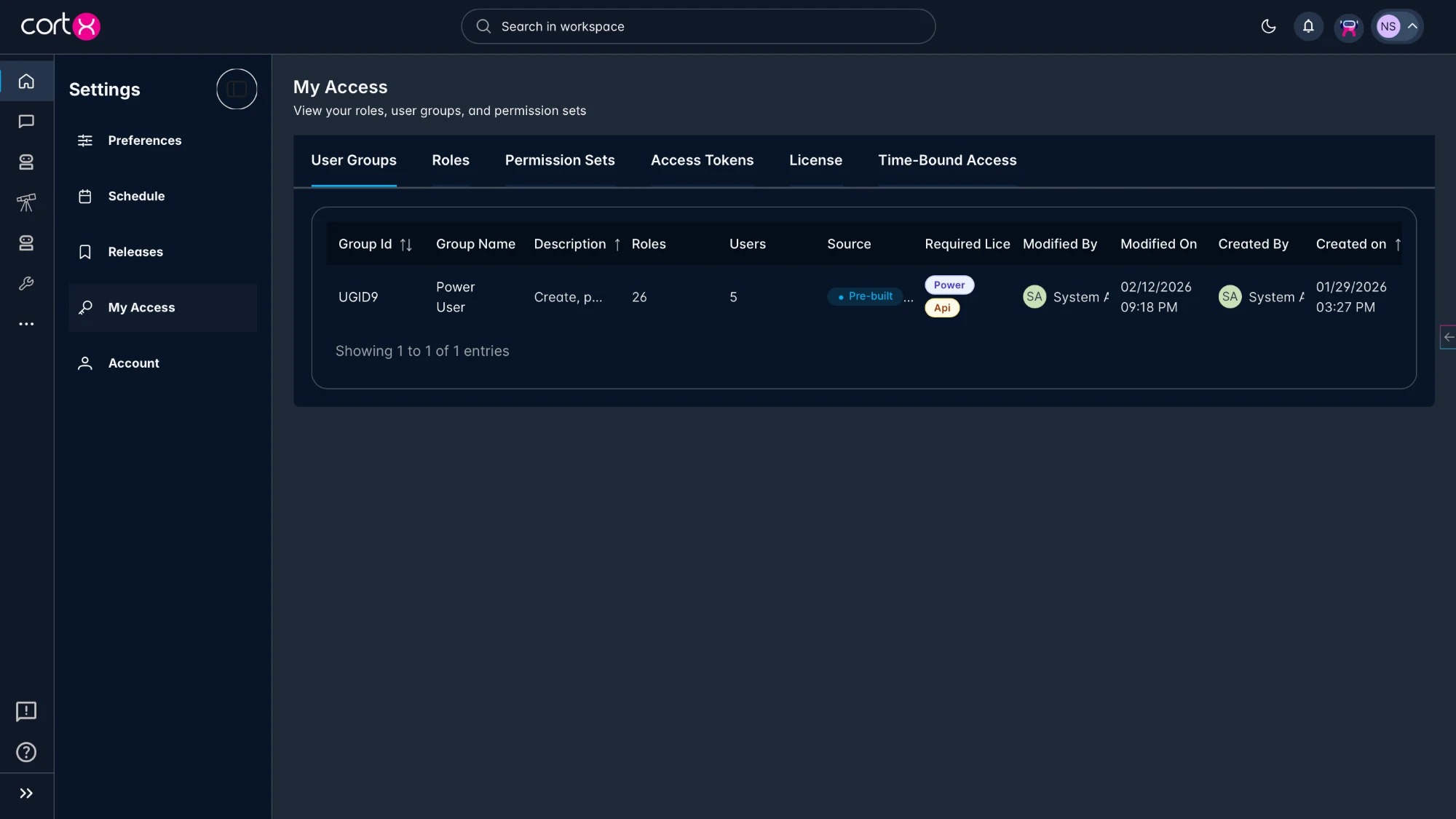
Access control across the organization
At the organization level, access is governed through user groups, roles, permission sets, access tokens, and licensing, plus time-bound access that grants permissions which expire on their own. Even the access records themselves carry created-by and modified-by stamps.
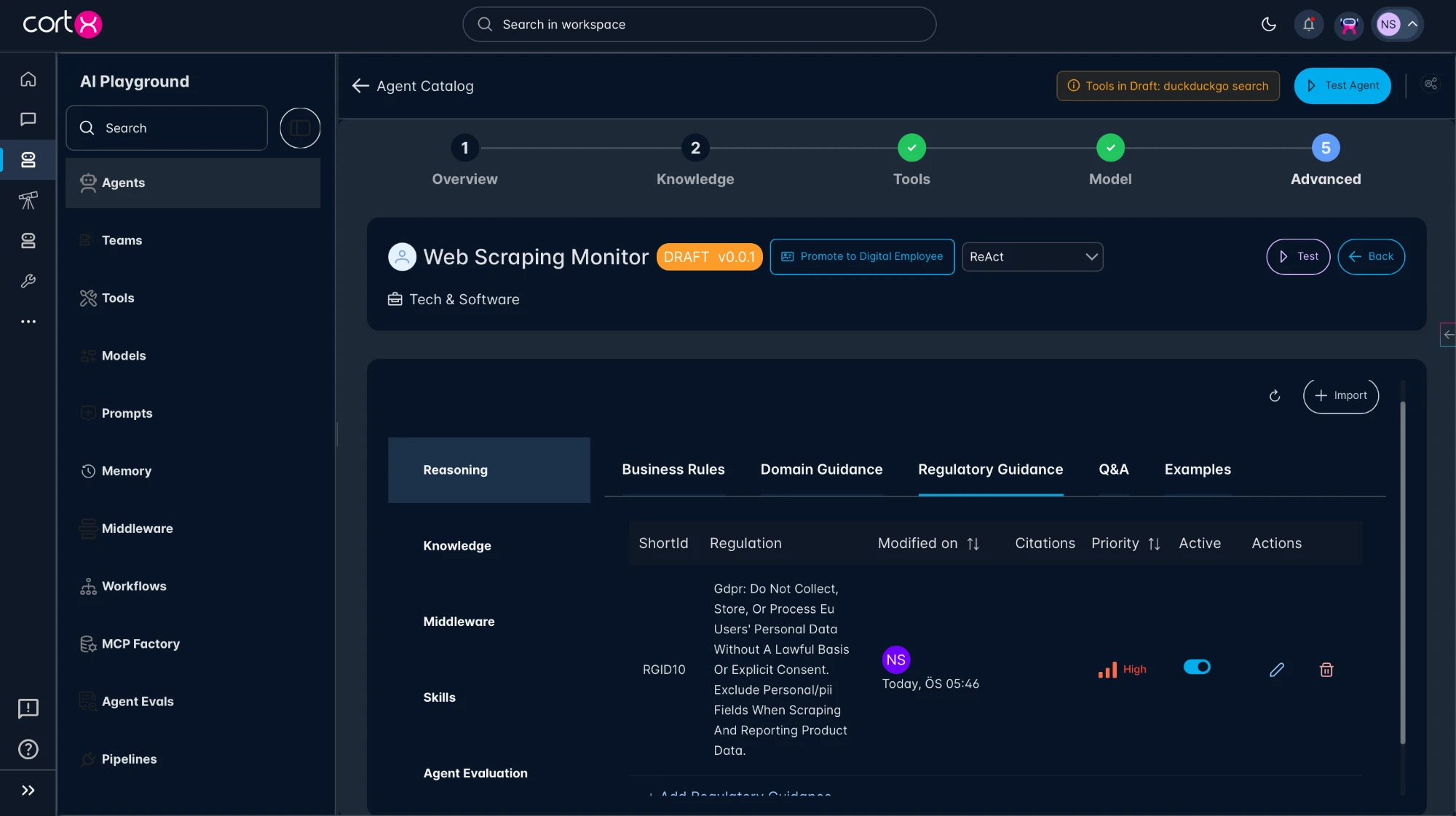
Compliance mapping at the agent level
It handles compliance mapping at the agent level: regulatory rules are bound directly to an agent and tracked with a short ID, priority, active status, and citations. The rule shown here is a GDPR directive to exclude personal data when scraping, saved as a high-priority, active record with its author and timestamp.
Beyond these three, it also provides:
- Business rules with typed categories (compliance, validation, constraint)
- Middleware guardrails that pre- and post-process agent requests and responses
- Agent evaluations covering quality, grounding, safety, and cost
- Prompt and agent versioning through a draft-to-live lifecycle
- Model-level cost and token tracking
Ketch
Ketch is a data privacy and consent platform, and its AI governance product applies that same lens to AI: it governs the data flowing into AI systems rather than the models themselves. Its approach comes down to policy, visibility, and enforcement, with enforcement happening in real time at the point of use.
What the product covers:
- Consent orchestration that controls what data an AI system is allowed to access
- Agent-based discovery that maps how data actually flows across systems
- AI Sentry, a real-time engine that inspects prompts and outputs before and after the model
On the governance side, what it does well:
- Privacy risk assessments: built-in DPIA, TIA, and PIA workflows, plus AI impact assessments.
- Compliance mapping: ties privacy policies to specific systems and contract clauses, with audit-ready output.
- Real-time enforcement: AI Sentry blocks, redacts, or restricts personal data in prompts and responses.
- Data-flow monitoring: continuous visibility into what data moves into and out of AI.
- Audit trail: every blocked prompt and redacted field is logged with full context.
Ketch sits on the data and privacy side of governance. It does not test, evaluate, or inspect the models themselves, so it works best alongside a model-focused tool rather than in place of one.
Datatron
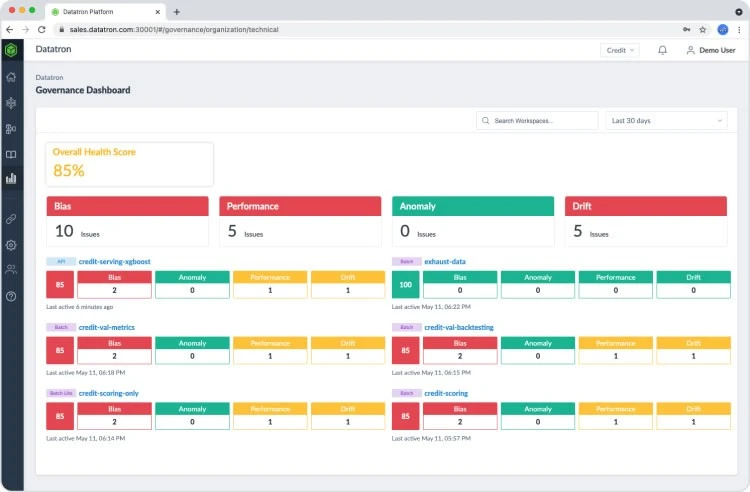
Datatron is a platform for deploying, managing, and monitoring machine learning models in production, with a focus on traditional ML rather than LLM or generative AI. It centers on a central catalog of deployed models, deployment controls such as rollout, rollback, and a publisher/challenger gateway, and continuous production monitoring through dashboards and a model Health Score.
- Model inventory: every deployed model is listed in one place.
- Operational risk monitoring: a Health Score tracks drift, anomalies, and performance degradation as models run.
- Lifecycle control: versioning, rollback, and controlled rollout of new model versions.
- Evaluation: performance metrics such as R², RMSE, and MAE, plus challenger comparisons.
- Guardrails: alerts and an automatic shutdown that stops a model when it crosses set thresholds.
- Bias monitoring and explainability across defined scenarios.
- Access control: role-based access with LDAP authentication.
- Audit trail: a record of past predictions, datasets, model versions, approver, and time.
Among monitoring tools, Datatron leans further toward governance, but its risk view is operational model health rather than regulatory risk, and it has no compliance mapping.
Holistic AI
Holistic AI is a dedicated AI governance platform structured around three stages: identify, protect, and enforce. It aims to cover an AI system’s full path, from discovery through to compliant, controlled operation in production.
- AI inventory: automated discovery of AI across the organization, including shadow AI, kept in a live inventory
- Risk assessment: risk scoring and classification, mapped to compliance frameworks
- Compliance mapping: built-in frameworks for the EU AI Act, NIST AI RMF, ISO 42001, and NYC Local Law 144
- Evaluation and red teaming: automated testing plus adversarial attack simulations covering jailbreak, prompt injection, bias, and robustness
- Monitoring: continuous, real-time monitoring for drift and policy violations
- Guardrails: enforcement that acts rather than only alerts, including a kill switch and autonomous remediation
- Bias testing across protected characteristics
- Access control with SSO and granular permissions
- Audit trail: continuous audit-ready reporting and evidence collection
Holistic AI covers both the compliance and the technical-testing sides of governance in one platform, with the only visible gap being cost tracking.
IBM watsonx.governance
IBM watsonx.governance is IBM’s enterprise AI governance product, built to oversee a large and mixed AI estate, spanning traditional, generative, and agentic AI, at organizational scale.
- AI inventory: a Governance Graph that catalogs the full AI estate and links every asset to its policies, risks, and regulations
- Risk assessment: AI risk assessed alongside IT, operational, third-party, and business-continuity risk, with third-party scoring through integrations such as D&B and Security Scorecard
- Compliance mapping: over 200 regulatory frameworks, mapping obligations directly to AI systems, with automated conformance and audit-ready reports
- Lifecycle control: full lineage of what AI is in use, for what purpose, and under what controls, with model approval and reuse
- Monitoring: real-time monitoring and continuous oversight, extended to agentic monitoring and security
- Evaluation: model evaluation and approval with bias and performance testing
- Guardrails: policies translated into controls and enforced through AI control planes
- Bias and explainability: bias detection and transparency built into the evaluation flow
- Access control: role-based access through IBM Cloud IAM and watsonx roles across projects and deployment spaces
- Audit trail: continuous audit-ready reporting and automated evidence collection
IBM watsonx.governance covers the full governance stack for regulated enterprises, with cost tracking the one capability it does not address.
ModelOp
ModelOp is an enterprise AI governance layer that sits above the tools used to build AI, rather than being one of them. It is vendor-agnostic and designed to govern an organization’s entire AI portfolio, first-party and third-party, from traditional ML to generative and agentic AI, from a single control point.
- AI inventory: a searchable record of every AI asset, first-party and third-party, positioned as an AI system of record
- Risk assessment: automatic risk tiering per use case, based on policy, with risk-based controls
- Compliance mapping: controls mapped to the EU AI Act, NIST AI RMF, ISO 42001, OCC SR 11-7, HIPAA, and GDPR
- Lifecycle control: the full lifecycle from registration to retirement, with deployment tracking and model card generation
- Monitoring: continuous monitoring of all use cases from one place
- Evaluation: automated bias, drift, and performance testing
- Guardrails: policy enforcement with approval workflows and mandatory pre-production gates
- Bias and explainability: bias testing alongside drift and performance
- Access control: role-based workflows with separate permissions for business owners, AI practitioners, and risk partners
- Audit trail: evidence collection and defensible, regulator-grade reporting
- Cost tracking: usage, throughput, and cost measured across the portfolio
Monitaur
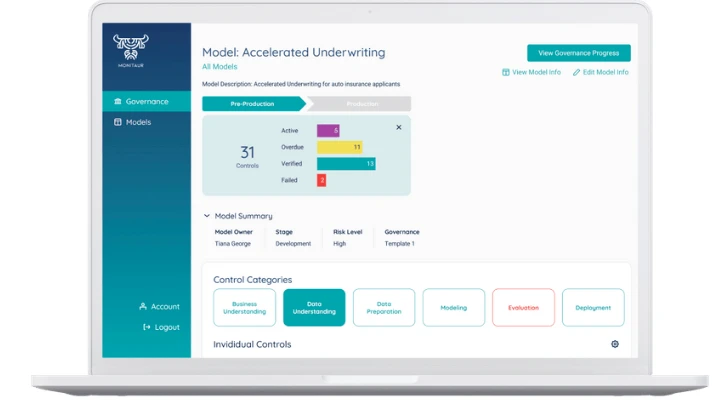
Monitaur is an AI governance and assurance platform aimed at regulated industries such as insurance and financial services, focused on producing defensible evidence that AI is behaving as it should.
Its governance capabilities include:
- AI inventory: a complete inventory of business use cases and models, including third-party AI for vendor governance
- Risk assessment: a dedicated risk-assessment methodology that scores use cases by their risk drivers
- Compliance mapping: a Common Controls Library that maps evidence to NIST AI RMF, ISO 42001, and the EU AI Act, so one control can satisfy many frameworks
- Lifecycle management: repeatable, risk-based governance practices applied across the model lifecycle
- Monitoring: continuous production validation with automatic drift and bias monitoring that flags out-of-range behavior
- Evaluation: independent pre-deployment testing through synthetic simulations, returning a letter grade and remediation guidance
- Bias monitoring: bias validation in production, with proxy-discrimination checks
- Audit trail: a transparent record of every AI decision, producing audit-ready, board-level accountability evidence
Monitaur is built around recording and proving AI behavior rather than blocking it in real time, so it does not offer runtime guardrails, and it does not track cost.
OneTrust AI Governance
OneTrust is a governance, risk, and privacy platform, and its AI governance product extends that same discipline to AI. It is compliance-first, built to operationalize AI risk identification and regulatory obligations across an organization.
- AI inventory: a central inventory of models, datasets, agents, and vendors, with ownership and dependency tracking
- Risk assessment: automatic risk tiering per system or use case, with continuous re-assessment
- Compliance mapping: templates for the EU AI Act, NIST, and ISO 42001, mapping risk and control frameworks with compliance reporting
- Lifecycle management: ownership and lifecycle status, with governance scope that updates as systems change
- Monitoring: continuous monitoring and governing AI at runtime, including post-market monitoring
- Guardrails: enforcement of approved use and policy gates to prevent non-compliant behavior
- Access control: detailed role-based access, user provisioning and de-provisioning, access certifications, and identity governance
- Audit trail: automated evidence and audit outputs generated from governance actions
Saidot
Saidot is an AI governance platform with a European, EU AI Act focus, built around a curated knowledge graph that links regulations, risks, and controls to the AI systems and agents in use.
- AI inventory: a centralized inventory of every AI system, model, agent, and dataset that updates itself as components change
- Risk assessment: a knowledge graph of over 260 risks that are inherited automatically by systems and agents
- Compliance mapping: templates for the EU AI Act, ISO/IEC 42001, and NIST RMF, plus over 110 policies, with curated controls and guided workflows
- Lifecycle management: governance embedded into every step of the AI lifecycle, with automated lifecycle approvals
- Monitoring: observability and runtime monitoring that catches governance-related changes as they happen
- Evaluation: methods to regularly test how models perform and behave for safety and performance
- Guardrails: safety and performance checks with tool-level risk classification for safe, human-led agent deployment
- Audit trail: a complete, traceable, event-driven record of governance, ready for any audit or review
Saidot pairs compliance and a risk knowledge graph with agent oversight. It has no native bias or explainability tooling, does not surface role-based access, and does not track cost.
Arize
Arize is an observability and evaluation platform for machine learning and LLM applications, operating at very large scale.
- Lifecycle and version control: version tracking across experiments, prompts, and datasets
- Monitoring: tracing, production monitoring, and alerting in real time
- Evaluation: online and offline evals, evaluators, Agent-as-a-Judge, and dataset and experiment testing
- Guardrails: real-time guardrails, LLM security, and LLM red teaming
- Access control: SSO and RBAC with custom roles, project restrictions, and an RBAC API
- Audit trail: an audit log, with audit logs available through the SDK
- Cost tracking: cost and token tracking, viewable alongside evaluation results
LangSmith
LangSmith is an observability and evaluation platform for LLM and agent applications. It comes from the makers of LangChain but works with any framework.
- Lifecycle and version control: prompt versioning, deployment management, and experiment versioning
- Monitoring: tracing, dashboards, and alerts for full visibility into agent behavior
- Evaluation: LLM-as-judge, code-based, and multi-turn evaluators, with experiment comparison and human calibration
- Access control: role-based access control plus attribute-based access, organization roles, and access policies
- Audit trail: audit logs, available through an API
- Cost tracking: token and evaluation cost tracking
Why does AI agent governance matter?
The need for dedicated agent governance is increasing due to new risks, including:
- Unintended actions (e.g. deleting data, sending emails, placing orders)
- Tool misuse or privilege escalation
- Hallucinated but executed decisions especially for high-impact autonomous decisions
- Unpredictable behavior in multi-agent interactions.
- Non-compliance with regulations (GDPR, AI Act, HIPAA, etc.)
- No clear accountability (“why did the agent do this?”)
AI agent governance vs. AI governance
AI agent governance shares principles with general AI governance, such as risk assessment, compliance, auditing, and ethical oversight. The differences include:
- Dynamic vs. static systems: Traditional AI governance focuses on static models, while agent governance manages autonomous systems that act and plan in real time.
- Runtime oversight: Agent governance emphasizes real-time monitoring and control rather than development-time checks.
- Emergent behavior management: Multi-agent interactions can produce unpredictable outcomes, which require additional safeguards.
What is AI governance & why is it important?
AI governance refers to establishing rules, policies, and frameworks that guide the development, deployment, and use of artificial intelligence technologies. It aims to ensure ethical behavior, transparency, accountability, and societal benefit while mitigating potential risks and biases associated with AI systems.
Ethical AI has become a priority for enterprises largely because of the EU AI Act, in force since August 2024. Its rules are phasing in: general-purpose AI obligations have applied since August 2025 and transparency duties arrive in August 2026, but the EU’s 2026 Digital Omnibus deal delayed high-risk system obligations to December 2027.
The immediate need is inventory, classification, and transparency; conformity assessment and documentation have more time.
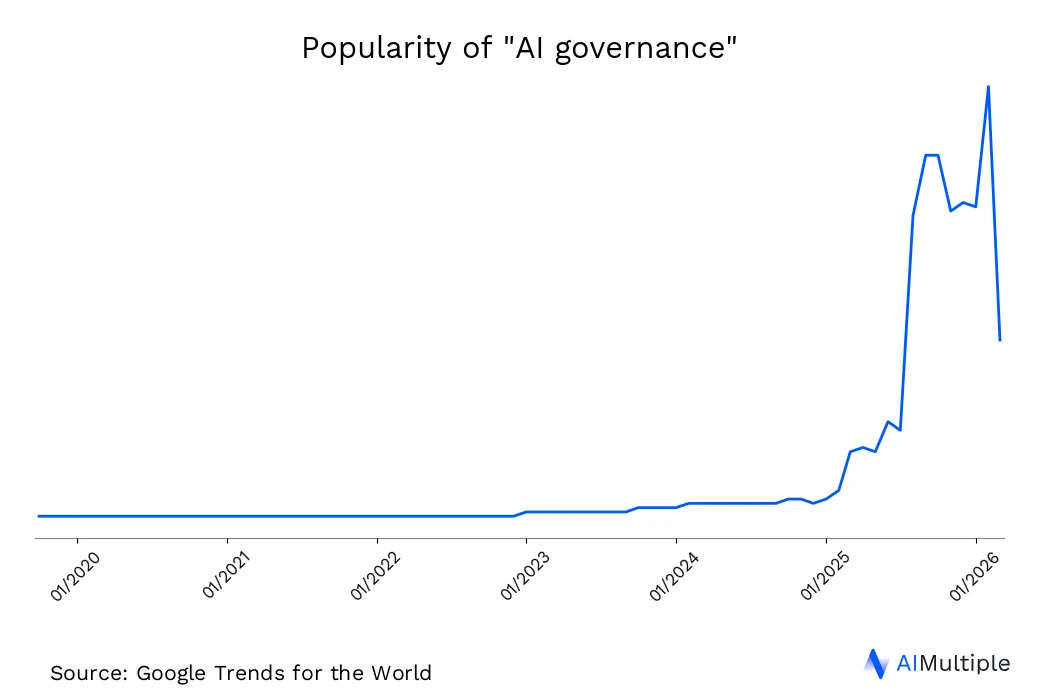
These factors led to an increased interest in AI governance:
Data and algorithm biases can harm an enterprises’ reputation and finances, which can be prevented by adopting AI governance platforms. These tools help companies developing and implementing AI by improving:
- Ethical and responsible AI: Ensures AI systems are designed, trained, and used ethically, preventing biased or harmful outcomes. Learn more on ethical AI and generative AI ethics.
- Transparency and accountability: Promotes transparency in AI algorithms and decisions, making developers and organizations accountable for actions that AI systems take.
- Data privacy and compliance: Helps organizations comply with data privacy regulations like GDPR and HIPAA, ensuring that data is collected and used legally and ethically.
- Risk assessment and mitigation: Identifies and mitigates various risks associated with AI, including legal, financial, and reputational risks, before they lead to negative consequences.
- Fairness and equity: Identifies and addresses AI bias in AI models to promote equal treatment across diverse users and groups.
- Model performance and reliability: Continuously monitors AI models to maintain reliability by detecting model drift and performing model retraining as needed, reducing errors and improving user satisfaction.
- Public trust: Builds public trust in AI technologies by emphasizing ethical behavior and transparency.
- Alignment with organizational values: Allows organizations to align AI practices with their mission and values, demonstrating a commitment to ethics and responsibility.
- Discover more on AI compliance solutions.
- Competitive advantage: Ethical AI and responsible governance can provide a competitive edge by attracting customers, partners, and investors who value ethical AI solutions.
FAQs
AI governance software employs common techniques to streamline building and deploying AI/ML models, such as:
Explainability and interpretability: AI governance software employs visualizations and explanations for AI model outputs to provide insights into how AI models make decisions. These tools allow users to understand and predict complex model behavior.
Transparency and accountability: AI governance provides clear documentation of model training data and processes, which enables monitoring of model decisions for accountability.
Fairness and bias detection: AI governance practices mainly focus on identifying and quantifying biases in AI models and data. For example, AI governance tools can monitor model performance across different demographic groups, allowing to mitigate biases in real-time or during training. Two main ways to detect bias in the model is to ensure compliance with ethics and law:
Ethical AI compliance: AI governance primarily aligns AI behavior with ethics by implementing guidelines and constraints. As a result, a data scientist can customize AI behavior to avoid harmful and offensive outputs of AI systems.
Regulatory compliance: A major AI governance practice is to ensure adherence to legal and regulatory requirements, meet data privacy and security standards and help business users comply with industry-specific regulations.
Model lifecycle management: Once a model is ready, AI governance techniques can manage the deployment of the model in the production environment by monitoring models for drift, degradation, or unexpected behavior. Two features that can facilitate AI deployment include:
Model validation and testing: Some AI governance tools can contain model validator features to test and verify models against benchmark datasets. Deploy these tools before production to detect potential issues.
Model risk management: AI governance techniques provide insights to assess and mitigate risks for AI systems.
Continual monitoring and auditing: Another common practice is tracking the model performance in production and behavior to ensure compliance and reliability in AI systems.
1. Identify your objective and scale: Consider the scale of your AI initiatives and the types of AI models and applications you are developing.
2. Research and evaluate available tools in the market:
– Look for vendors that specialize in the areas most relevant to your needs.
– Create a shortlist of promising tools based on their features, capabilities, and user reviews.
3. Benchmark the shortlisted tools based on the following:
– Each tool’s features: Assess its ability to detect bias, ensure data privacy, provide transparency, and monitor compliance.
– Ease of integration: Assess how well the AI governance tool integrates with your existing AI development and deployment pipeline.
– Compatibility with your organization: Check for compatibility with the programming languages, frameworks, and platforms you use for AI development. Ensure the tool can work seamlessly with your data sources, storage solutions, and cloud providers.
– User-friendly interface: How intuitive the tool is for seamless interaction.
– Customization and flexibility: The extent to which the tool can be customized to match your requirements, allowing you to adjust settings and configurations.
– Scalability: Consider the tool’s scalability to accommodate your organization’s growth in AI initiatives, such as increasing data volumes and workloads as your projects grow.
– Quality of vendor support: Investigate the level of customer support, response time and assistance provided.
– Training and resources: Review how comprehensive is the documentation, tutorials, user guides, online sources and training materials. Remember that adequate resources to help your team learn how to use the tool effectively.
– Cost and budget: Evaluate the cost structure of the AI governance tool, including licensing fees, subscription costs, and implementation expenses. Calculate the long-term costs and benefits of the tool to ensure it provides value based on your financial resources.
– Data security and privacy: Check compliance with data protection regulations, including encryption and access controls. Ensure the security and confidentiality of sensitive information.
3. Seek free trial and proof of concept (if applicable): Conduct a trial or proof of concept (PoC) with the selected AI governance software. You may use real or simulated AI projects to assess how well the tool addresses your governance needs. Involve key stakeholders, data scientists, and AI developers in the PoC to gather feedback on usability and effectiveness.
 Add as preferred source
Disclaimers
This is an emerging domain, and most of these tools are embedded in platforms offering other services like MLOps. Therefore, AIMultiple has not had a chance to examine these tools in detail and relied on public vendor statements in this categorization. AIMultiple will improve our categorization as the market matures.
Products, except the products of sponsors, are sorted alphabetically on this page since AIMultiple doesn’t currently have access to more relevant metrics to rank these companies.
The vendor lists are not comprehensive.
Further reading
Explore more on AIOps, MLOps, ITOPs and LLMOps by checking out our comprehensive articles:
- Comparing 10+ LLMOps Tools: A Comprehensive Vendor Benchmark
- Top IT Process Automation Tools
- MLOps Tools & Platforms Landscape: In-Depth Guide
Cite this research
Pick the format that matches where you're publishing. Pasting the link version into your CMS preserves the backlink.
@misc{sipi2026,
  author = {Şipi, Nazlı},
  title  = {{Top 12 AI Governance Tools Compared}},
  year   = {2026},
  month  = aug,
  howpublished    = {\url{https://aimultiple.com/ai-governance-tools}},
  note   = {AIMultiple. Retrieved August 3, 2026}
}
Reference Links







Be the first to comment
Your email address will not be published. All fields are required. Comments are left in their original language.