


Synthetic data is gaining widespread popularity and applicability across industries, including machine learning, deep learning, and generative AI (GenAI). Synthetic data offers solutions to challenges such as data privacy concerns and limited dataset sizes. It is estimated that synthetic data will be preferred over real data in AI models by 2030.1
We listed the capabilities and most common use cases of synthetic data in different industries and departments/business units.
Industry-agnostic use cases
Data sharing with third parties
Partnerships with third-party organizations such as fintechs, medtechs, or supply chain providers often require access to sensitive information.
Synthetic data enables enterprises to evaluate vendor performance and collaborate without exposing regulated or confidential data. This allows testing, model training, and joint development while maintaining compliance with data protection laws.
Internal data sharing
Within large organizations, privacy regulations and access restrictions can delay internal data sharing for weeks. Synthetic datasets can be shared freely between departments such as marketing, product development, and operations without risking leaks or privacy violations. This speeds up innovation and facilitates more frequent experimentation.
Cloud migration
Cloud services offer a range of innovative products for many sectors. However, moving private data to cloud infrastructures involves security and compliance risks.
In some cases, moving synthetic versions of sensitive data to the cloud can enable organizations to take advantage of the benefits of cloud services. This is not possible for all use cases.
For example, in cloud machine learning pipelines, synthetic data could be used instead of real data. However, it wouldn’t be useful for the sales team to have synthetic data in their CRM; they should see the correct customer information, not modified information.
Data retention compliance
Data protection laws limit how long personal information can be stored. Synthetic data lets companies maintain the statistical patterns of historical datasets for trend analysis, seasonal studies, or anomaly detection without keeping the original identifiable records.
Finance
Fraud identification
Fraud cases are rare, making them difficult to model. Synthetic datasets can simulate a wide variety of fraudulent patterns, enabling fraud detection algorithms to be trained and tested more effectively.
Customer intelligence
Synthetic transaction records preserve the statistical characteristics of real customer behavior, enabling financial institutions to build segmentation models, assess customer lifetime value, or forecast churn while staying compliant with regulations like GDPR and PCI DSS.
Manufacturing
Quality assurance
Real-world defect data is often limited. Synthetic anomaly datasets allow engineers to test inspection systems against a wide range of defect types, improving recall rates and reducing false negatives. This applies to visual inspection, sensor readings, and IoT data streams.
Predictive maintenance
Synthetic sensor data can simulate equipment degradation patterns or fault signals. This helps train predictive maintenance models before sufficient real fault history exists, allowing earlier deployment of monitoring systems.
Supply chain optimization
Synthetic demand and logistics datasets can be used to test supply chain planning models under different market scenarios, seasonal shifts, or disruption events, without exposing actual operational data.
Healthcare
Healthcare analytics
Synthetic data enables healthcare data professionals to allow the internal and external use of record data while still maintaining patient confidentiality. This is similar to the use case on “internal data sharing,” however, it is applicable more widely in healthcare, where most customer data is private. This is also known as healthcare analytics.
Clinical trials
When launching a new trial, researchers often lack sufficient historical data for simulation and baseline analysis. Synthetic datasets can help predict outcomes, plan patient recruitment, and identify potential adverse event patterns before real-world data collection begins.
Automotive and robotics
Autonomous Things (AuT)
Autonomous Things (AuT) refer to technology such as robots, drones, and self-driving car simulations pioneered the use of synthetic data. This is because real-life testing of robotic systems is expensive and slow. Synthetic data enables companies to test their robotics solutions in thousands of simulations, improving their robots and complementing expensive real-life testing.
Autonomous systems testing
Synthetic environments simulate thousands of driving or operational scenarios for self-driving cars, delivery drones, and manufacturing robots. This reduces costs and accelerates safety validation before field deployment.
Additional example: Testing emergency braking algorithms using simulated rare road hazards (e.g., animals crossing, sudden pedestrian movement).
World models for robot and vehicle training
Robots and self-driving cars need training data that follows real-world physics. Collecting it on the road is slow and costly, and rare hazards almost never appear.
A new class of tools fills the gap. A world foundation model is an AI system trained to predict how a scene changes through time. Given a rough 3D layout, it produces photorealistic video under varied weather, lighting, and traffic. NVIDIA’s Cosmos models, for example, generate such clips to train perception and control systems.
The payoff is coverage. A team can produce thousands of edge cases, such as a child stepping into the road at dusk, without staging the event in real life.
Security
Synthetic data can be used to secure organizations’ online & offline properties. Two methods are commonly used:
Training data for video surveillance
To take advantage of image recognition, organizations need to create and train neural network models, but this has two limitations: Acquiring the volumes of data and manually tagging the objects. Synthetic data can help train models at a lower cost compared to acquiring and annotating training data.
Deep fakes
Deepfakes, which are becoming an increasingly important AI cybersecurity topic, can be used to test face recognition systems.
Social Media
Social networks are using synthetic data to improve their various products:
Testing content filtering systems
Social networks are fighting fake news, online harassment, and political propaganda from foreign governments. Testing with synthetic data ensures that the content filters are flexible and can deal with novel attacks.
Algorithm fairness evaluation
Synthetic user profiles and interaction data can help platforms assess whether recommendation or moderation algorithms exhibit bias toward certain demographics, languages, or viewpoints without processing real personal data.
Feature and UI testing
Synthetic behavioral datasets allow social platforms to test new features (e.g., feed ranking, comment sorting) under realistic traffic loads, click patterns, and engagement distributions, without needing to run risky live experiments on real users.
Ad targeting simulation
Synthetic audience data can replicate demographic and behavioral patterns, enabling advertisers and platform operators to test targeting models, budget allocation algorithms, and campaign optimization strategies while maintaining compliance with privacy laws like GDPR and CCPA.
Agile development and DevOps
Test data generation
For software testing and quality assurance, artificially generated data is often the better choice as it eliminates the need to wait for ‘real’ data. Often referred to under this circumstance as ‘test data’. This can ultimately lead to decreased test time and increased flexibility and agility during development
HR
Employee data simulation
Employee datasets of companies contain sensitive information and are often protected by data privacy regulations. In-house data teams and external parties may not have access to these datasets but they can leverage synthetic employee data to conduct analyses. It can help companies to optimize HR processes.
 Add as preferred source
Marketing
Customer behavior simulation
Synthetic data allows marketing units to run detailed, individual-level simulations to improve their marketing spend. Such simulations would not be allowed without user consent due to GDPR. However synthetic data, which follows the properties of real data, can be reliably used in simulation.
Conversational AI
Synthetic data generated with generative AI can support the training of conversational AI systems by creating realistic dialogue examples that reflect domain-specific language, different user intents, and rare edge cases. This approach helps address the limited availability of real conversation transcripts while avoiding privacy concerns.
By expanding training datasets with tailored dialogue scenarios, synthetic data can improve a model’s ability to understand varied requests, respond accurately, and manage complex, multi-turn interactions.
Machine learning
Training data augmentation
Synthetic data expands the available dataset by creating realistic, statistically accurate samples that mirror the distribution of real-world data. This is especially valuable when training AI models that suffer from class imbalance or when collecting real data is too costly, time-consuming, or legally restricted.
By including additional variations in the dataset, such as lighting changes in computer vision or noise variations in audio, models become more resilient to environmental changes and unexpected inputs.
Rare event simulation
Many AI models underperform when predicting events that occur infrequently because these events are poorly represented in real datasets. Synthetic data solves this by generating numerous realistic examples of such rare events, preserving their statistical and contextual properties.
This approach enables models to “experience” and learn from scenarios they might never encounter during traditional training, leading to higher recall and better preparedness for mission-critical situations such as fraud detection, equipment failure prediction, or emergency response planning.
Automated data labeling
Manually labeling data is often one of the most expensive and time-consuming stages of AI development, particularly for tasks like object detection or speech recognition. Synthetic data generation can include automatic label assignment during the creation process.
This eliminates human annotation errors, speeds up model development, and allows teams to create large, precisely labeled datasets tailored to specific business needs, whether for detecting anomalies in manufacturing, recognizing entities in legal documents, or identifying objects in aerial imagery.
Training large language models and AI agents
The supply of fresh human-written text on the web is running low. To keep improving models, AI labs now generate training data instead of scraping more.
Two patterns lead the field in 2026:
- Instruction and dialogue data. A strong model writes worked examples, such as a question with a step-by-step answer. A smaller model learns from these examples.
- Verifiable-reward training. An agent attempts a task, such as a coding or math problem. A checker marks the result right or wrong, and that signal trains the agent. The method is called reinforcement learning with verifiable rewards (RLVR). The reward comes from a fact that can be checked, not a human rating.
Synthetic data fits agent training well. A team can generate thousands of tool-use scenarios with known correct outcomes, so the agent practices safely before it touches real systems.
A limit to watch: model collapse
Synthetic data has a failure mode. A model trained repeatedly on its own output can drift from reality.2 Rare cases fade first, then the output narrows toward a bland average. Researchers call this model collapse (or AI inbreeding).
The cause is simple. Generated data carries less variety than real data. Each new round drops more of the edges, and small errors pile up across generations.
Teams reduce the risk with a few steps:
- Keep real human data in the training mix rather than replacing it.
- Add synthetic data to real data instead of swapping one for the other.
- Track data provenance, so the source of each record stays known.
- Check generated data for drift before training on it.
How synthetic data is made
Three methods cover most synthetic data work in 2026:3
- Rule-based generation. A tool fills fields by set rules, such as a valid postal code or date. The output is fast and predictable, and suits simple test data. Faker and Mockaroo work this way.
- Statistical models. A model learns the patterns and relationships in a real dataset, then produces new records that match those patterns without copying any person. This suits tabular business data.
- Large language models. A model writes data from a plain-language request. This suits text, dialogue, and seed data, though output can drift at large scale.
The future of synthetic data
Synthetic data is becoming more important in many industries. It is artificial data made by computers that looks like real data but does not include real people’s information. This quality makes it useful where privacy, cost, or access to real data is a challenge.
Many companies now use synthetic data to train machine learning models. For example, sectors such as healthcare, finance, autonomous driving, and retail rely on it to test new systems without exposing personal data or facing legal limits.
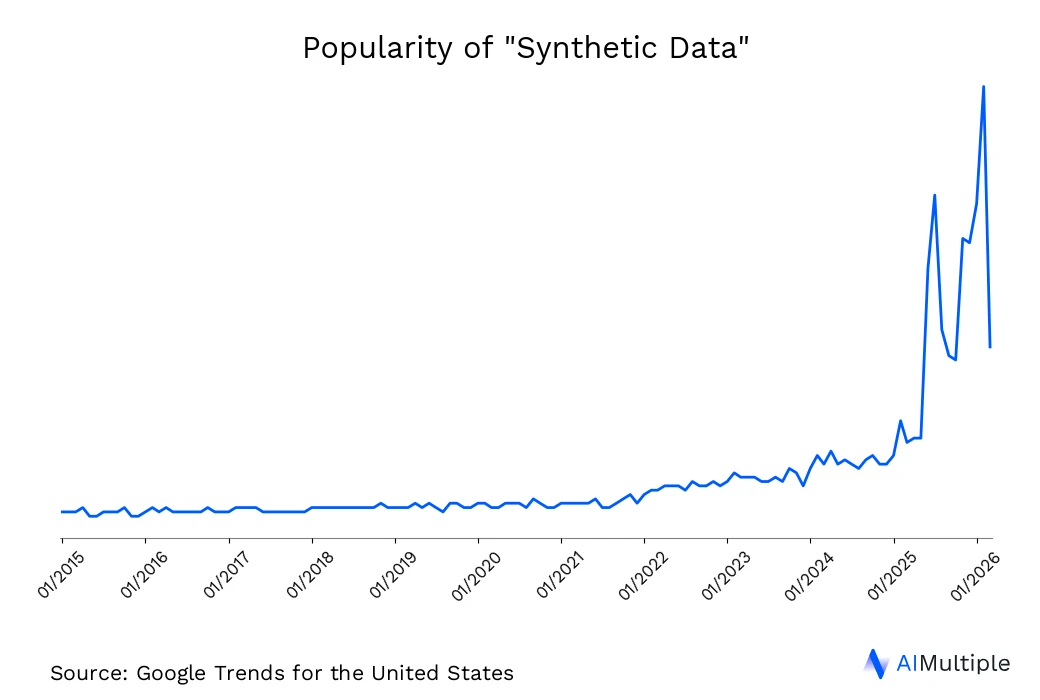
Figure 1: Popularity of Synthetic Data
Reasons the synthetic data is trending includes:
- Privacy and legal risks with real data: New regulations make sharing real data harder. Synthetic data avoids these privacy limits because it contains no actual personal records.
- Data scarcity and cost: Real datasets may be small, incomplete, or expensive to collect and label. Synthetic data can be made on demand, filling gaps and reducing costs.
- Support for AI innovation: Large AI systems need large and varied datasets. Analysts predict a big rise in synthetic data use, with many businesses expected to adopt it by 2026.
By 2026, many organizations generate synthetic customer or training data for AI. One industry report estimates that up to 75% of businesses will use generative AI tools to produce synthetic data.4
Further reading
Cite this research
Pick the format that matches where you're publishing. Pasting the link version into your CMS preserves the backlink.
@misc{dilmegani2026,
  author = {Dilmegani, Cem and Arslan, Ezgi},
  title  = {{Top 25+ Synthetic Data Use Cases}},
  year   = {2026},
  month  = jul,
  howpublished    = {\url{https://aimultiple.com/synthetic-data-use-cases}},
  note   = {AIMultiple. Retrieved July 30, 2026}
}
Changelog
5 updatesAdded a section on training large language models and AI agents.
Added Conversational AI to the list of synthetic data use cases.
Reference Links

Cem's work at AIMultiple has been cited by leading global publications including Business Insider, Forbes, Morning Brew, and Washington Post, global firms like Deloitte and HPE, NGOs like World Economic Forum, and supranational organizations like European Commission. [1], [2], [3], [4], [5]
Throughout his career, Cem served as a tech consultant, tech buyer and tech entrepreneur. He advised enterprises on their technology decisions at McKinsey & Company and Altman Solon for more than a decade. He also published a McKinsey report on digitalization.
He led technology strategy and procurement of a telco while reporting to the CEO. He has also led commercial growth of deep tech company Hypatos that reached a 7 digit annual recurring revenue and a 9 digit valuation from 0 within 2 years. Cem's work in Hypatos was covered by leading technology publications like TechCrunch and Business Insider.
Cem regularly speaks at international technology conferences. He graduated from Bogazici University as a computer engineer and holds an MBA from Columbia Business School.


Be the first to comment
Your email address will not be published. All fields are required. Comments are left in their original language.