


Searching with LLMs has become a major alternative to Google search. We benchmarked the following AI search engines to see which one provides the most correct results:
Benchmark results
Deepseek is the leader of this benchmark, by correctly providing 57% of the data in our ground truth dataset.
You can also read our AI deep research benchmark if you are looking for a solution to more advanced research tasks.
Methodology
Our prompt: List all companies that are currently manufacturing or have announced AI-specific chips/accelerators, including: 1. Their flagship AI chip models 2. Manufacturing process node (e.g., 5nm, 4nm)
We checked if they could correctly find the company, its product, and its process node. We rated them with the amount of information correctly provided, if any information was wrong or missing, we rated them 0.
Top AI Search Engines
DeepSeek Search
Deepseek‘s flagship line moved from R1 to DeepSeek-V4 (V4-Pro and V4-Flash), a 1M-token-context model family that succeeded R1 as the default reasoning and chat model.1 The legacy deepseek-chat and deepseek-reasoner API names, which previously pointed to R1, are being retired in favor of explicit V4 model IDs.2 R1 remains available as an open-weight model under an MIT license and can still be used directly, but it is no longer DeepSeek’s primary offering. Since it is open-source, users can make unlimited searches with it.
Andi
Andi is a free AI answer engine that first finds information from various sources, then, with the user’s approval, prepares a document using those sources. Andi was named PCMag’s “Best Free AI Search Engine” for a third consecutive year in March 2026, and it published results from the independent SearchBench evaluation showing 87% accuracy, ahead of You.com (80%), Google (71%), ChatGPT (62%), and Perplexity (59%).3 Since it remains a free tool, it may be a good choice for users with a limited budget.
ChatGPT Search
OpenAI retired GPT-4o and the entire o-series (o1, o3, o3-mini, o4-mini) from ChatGPT on February 13, 2026.4 ChatGPT Search now runs on the GPT-5.x family: GPT-5.3 Instant is the default model across all tiers, including Free, while GPT-5.4 and GPT-5.5 Thinking/Pro handle deeper reasoning tasks on paid plans. A limited preview of the next generation, GPT-5.6 (Sol, Terra, Luna), began rolling out via the API and Codex in June 2026, but has not yet reached ChatGPT Search itself.
Perplexity
While not an LLM itself, Perplexity uses AI models for web searches and is one of the leading AI search engines.
How do they differ from the traditional search engines?
The main differences are:
- When you search for something on Google, you see some sponsored pages at the top, and some of them are not relevant to your query. Also, the pop-ups on the pages might be time-consuming on traditional search engines.
- You can reach the results faster with AI search engines. They search many pages in seconds and provide you with only the related part of an article or blog, not the whole text.
- AI search engines do not allow users to experience reading a blog post, discovering another interesting topic on the page, and broadening their knowledge that way. Getting faster results may help in some cases, but to learn new concepts, a regular search is a better option.
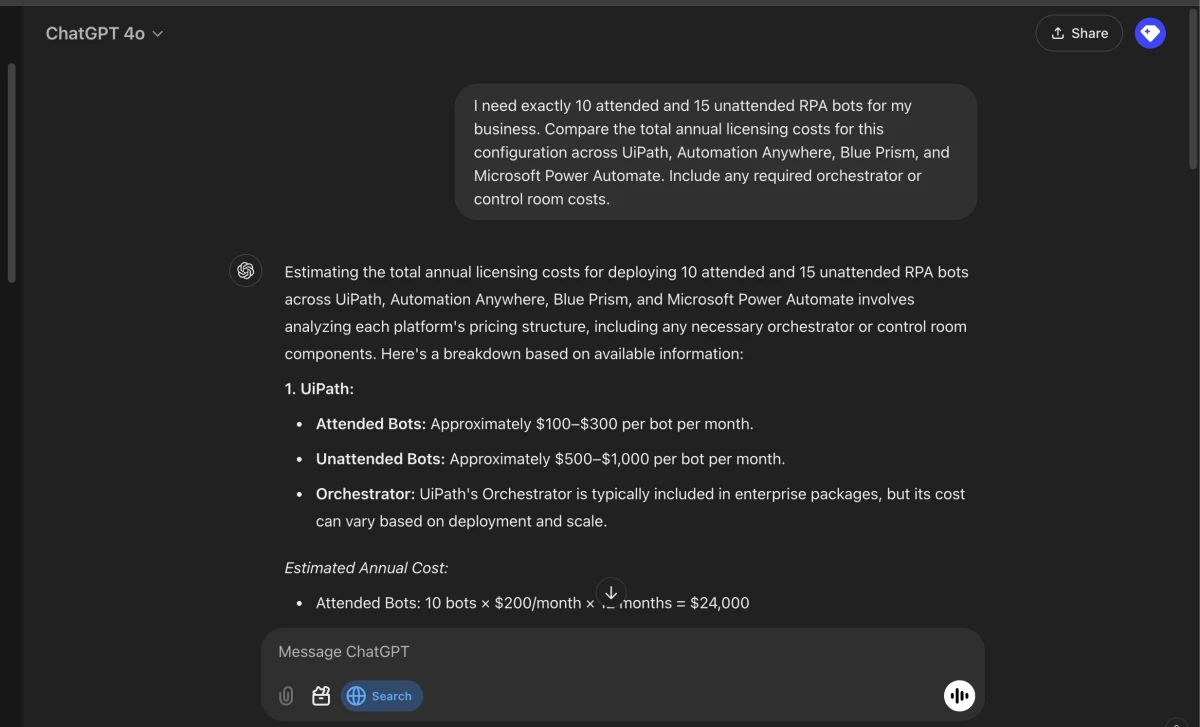
It first gathered information about every tool and its pricing.
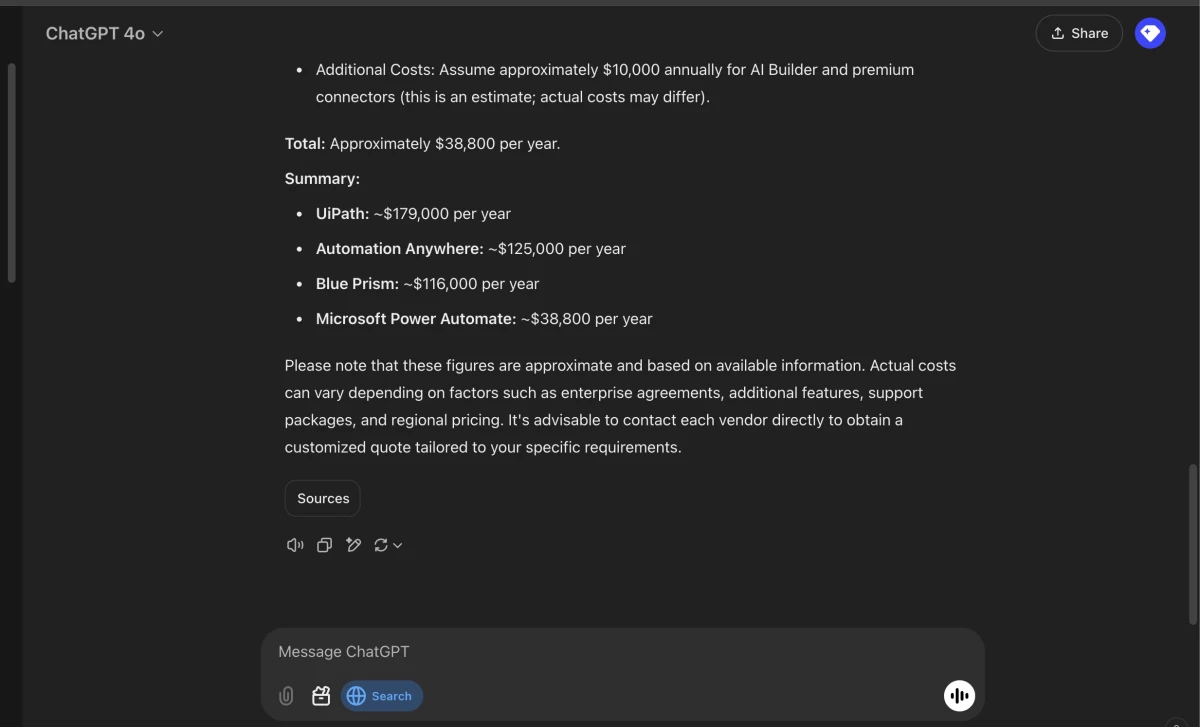
Then, by using this information, it calculated the total costs and compared them with each other.
Using the same prompt on Google Search will not provide direct answers. Instead, you would need to search for ‘RPA pricing,’ ‘UiPath pricing,’ ‘Automation Anywhere pricing,’ etc., and then calculate the pricing yourself.
However, in that search, ChatGPT didn’t use pricing information from the official websites of the RPA vendors. Therefore, you should be careful about trusting the information. For more reliable results, you can refine your prompt by adding phrases like ‘Only use information from official websites. ‘ We recommend always checking the sources before trusting the provided data.
Adoption and traffic context
AI-mediated search has grown into a meaningful share of overall search activity. AI search platforms as a category received more than 27 billion visits in Q1 2026, with ChatGPT accounting for the largest share, and AI search’s proportion of total search traffic rose year over year.5 Within the category, usage is diversifying: Claude and Gemini both posted strong quarter-over-quarter traffic growth in Q1 2026, while ChatGPT and Perplexity each saw declines over the same period, pointing to a less ChatGPT-centric AI search landscape than a year earlier.5
Pricing
DeepSeek and Andi are free to use.
ChatGPT Search is available in the free tier with a daily limit. Perplexity’s usage limits work in the opposite direction from how they’re often assumed: the Free tier is capped at roughly 3-5 Pro Search queries per day, while Perplexity Pro ($20/month) includes unlimited Pro Search.6
 Add as preferred source
Other AI search engines
Google now runs three distinct AI-enhanced search surfaces built on Gemini: classic Search, AI Overviews (summaries embedded directly in regular search results), and AI Mode (a separate, full-page conversational search experience). AI Mode has expanded to more than 200 countries and territories and reached roughly 75 million users by December 2025.7
- Epsilon: Epsilon’s AI-powered search engine is focused on scientific research.
- You.com
FAQs
An AI answer engine uses artificial intelligence (AI) to improve the search experience and provide more accurate results.
AI search engines use natural language processing (NLP) to understand search queries and provide relevant results.
They can also learn from user behavior and adapt to provide more personalized results with their AI features, unlike a traditional browser.
The main issue is that they can provide incorrect information, and users tend to believe it without fact-checking simply because sources are listed. Therefore, finding the best search engine is important to get more accurate results.
Ability to understand natural language and provide relevant results.
Ability to learn from user behavior and adapt to provide more personalized results.
Integration with other AI tools and services to provide a more comprehensive search experience.
Ability to provide up-to-date information and verify the accuracy of search results.
Ability to handle follow-up questions and provide additional information.
To choose the best AI search engine, users should consider whether they can provide data correctly, without hallucinations.
Further reading
- Large Language Models
- Top 7 Generative AI Services & Vendors
- Answer Engine Optimization Tools
- AEO vs SEO: Key Differences, Strategies & Integration Tips
Cite this benchmark
Pick the format that matches where you're publishing. Pasting the link version into your CMS preserves the backlink.
@misc{dilmegani2026,
  author = {Dilmegani, Cem},
  title  = {{Top 4 AI Search Engines Compared}},
  year   = {2026},
  month  = jul,
  howpublished    = {\url{https://aimultiple.com/ai-search-engine}},
  note   = {AIMultiple. Retrieved July 9, 2026}
}Results and timestamps of 0 data points. Download the summary data shown in this article's charts and tables as a ZIP file containing 0 CSV files.
Want the granular data behind it? Join Premium
Changelog
1 updatesAdded an Adoption and traffic context section detailing AI search traffic share by platform.
Reference Links

Cem's work at AIMultiple has been cited by leading global publications including Business Insider, Forbes, Morning Brew, and Washington Post, global firms like Deloitte and HPE, NGOs like World Economic Forum, and supranational organizations like European Commission. [1], [2], [3], [4], [5]
Throughout his career, Cem served as a tech consultant, tech buyer and tech entrepreneur. He advised enterprises on their technology decisions at McKinsey & Company and Altman Solon for more than a decade. He also published a McKinsey report on digitalization.
He led technology strategy and procurement of a telco while reporting to the CEO. He has also led commercial growth of deep tech company Hypatos that reached a 7 digit annual recurring revenue and a 9 digit valuation from 0 within 2 years. Cem's work in Hypatos was covered by leading technology publications like TechCrunch and Business Insider.
Cem regularly speaks at international technology conferences. He graduated from Bogazici University as a computer engineer and holds an MBA from Columbia Business School.






Be the first to comment
Your email address will not be published. All fields are required. Comments are left in their original language.